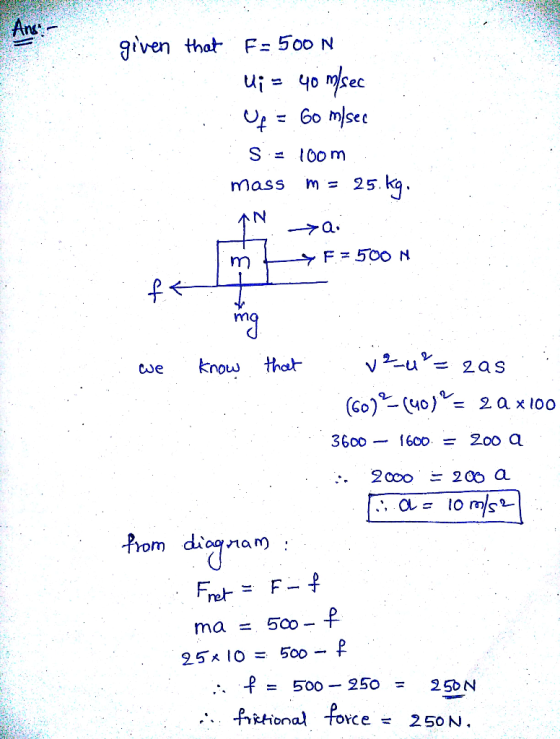
An accelerating force of 500N changes and object from 40 m/sec to 60 m/sec in a...
An accelerating force of 500N changes and object from 40 m/sec to 60 m/sec in a distance of 100 m. The mass is 25 kg. Determine the force of friction acting opposite this force.
Homework Answers
Add Answer to:
An accelerating force of 500N changes and object from 40 m/sec
to 60 m/sec in a...
1. Draw the forces acting on mı and m2 in the diagram below. m2 > m1...
 1. Draw the forces acting on mı and m2 in the diagram below. m2 > m1 Determine the acceleration of the system. Show your work. 2. An accelerating force of 500 N changes an object from 40 m/s to 60 m/s in a distance of 100 m. The mass is 25 kg. Determine the force of friction acting opposite of this force. Draw your free body diagram.
Problem 1: Work done by constant forces. A 500N force is pulling an 100-kg refrigerator across...
Problem 1: Work done by constant forces. A 500N force is pulling an 100-kg refrigerator across a horizontal surface. The force acts at an angle of 36.9 degress above the surface. The coefficient of kinetic friction us 0.200, and the refrigerator moves a distance od 10.00 m. Determine: a.The work done by all the forces acting on the refrigerator. b. The net work acting on the refrigerator. c. The velocity of the refrigerator at the end of the 10 m,...
a. Two forces are acting at a single point on an object. Force A has a...
 a. Two forces are acting at a single point on an object. Force A has a magnitude of 8000 N and is directed due West. Force B has a magnitude of 6000 N and is directed at 400 N of E. Determine the magnitude of Force C which must act at the same point so that the object will be in translational equilibrium. b. 40° 5.0 m A 25 kg mass is suspended from the end of a 5.0 m...
A 736-lb object is launched from the ground with an initial upward velocity of 60 ft/sec....
A 736-lb object is launched from the ground with an initial upward velocity of 60 ft/sec. The atmosphere resists the motion of the object with a force of 3 lb for each ft/sec of speed. Assuming that the only other force acting on the object is gravity, find the time it takes for the object to reach its maximum height:
⦁ A mass of 40 kg is pulled across a floor ( μk = 0.35) with...
⦁ A mass of 40 kg is pulled across a floor ( μk = 0.35) with a force of 200 N directed 30 deg above the floor. What is the magnitude of the friction force acting on the mass? What is the magnitude of the normal force? What is the velocity of the object after 10 sec?
Ng 20uu n object of mass 8 kg is given an initial downward velocity of 30 m/sec and then allowed ...
 ng 20uu n object of mass 8 kg is given an initial downward velocity of 30 m/sec and then allowed to fall under the y. Assume the force in newtons due to air resistance is -8e, where v is the velocity of the o object in m/sec. Assume the obj ect is initially 800m above the ground. JAssume the gravitational force constant, with g-9.8m/sec?, sign of g depends on your setting] (a) Write a DE describing the motion.[Hint: See pages...
1. The velocity of an object traveling along the x-axis changes from 20 m/s to 60...
 1. The velocity of an object traveling along the x-axis changes from 20 m/s to 60 m/s in 10 seconds. What was the displacement that occurred during this time? 2. An object moving along the x-axis initially has a velocity of 60 m/s and is slowing rest? down at the rate of 4 m/s per second. How far (in meters) will it travel before coming to 3. An accelerating object travels 12 meters from rest in a certain time. How...
1.A force vector, F, has components F angle, 0, of the force. 180 lbs and F,...
 1.A force vector, F, has components F angle, 0, of the force. 180 lbs and F, -60 lbs. Calculate the magnitude, F, and the direction 2. Calculate the resultant of the following 3 forces: F,- (100 N, 45 deg), F,- (80 N, 180 deg) and Fy-(140 N deg). In other words, calculate R, Ry, R, and 0R (Hint: Use the vector table to help with the procedure.) Vector Mag Dir х-сотропеnt у-соmponent Fi F3 R A 50 kg object is...
Question 13 1 pts A horizontal force of 5 N accelerates a 4-kg object from rest...
 Question 13 1 pts A horizontal force of 5 N accelerates a 4-kg object from rest at 0.5 m/s2. What friction force acts on the object? +3N -3N O+2N 0-2N Question 14 1 pts An object that is acted upon by a net force of 20 N is moving with an acceleration of 10 m/s2 What is the mass of the object? O2 kg O 20 kg O 0.2 kg 10 kg Question 15 1 pts A person weighing 823...
Force (N) 40 1.00 60 8 0 Position (m) Find the work done by the force...
 Force (N) 40 1.00 60 8 0 Position (m) Find the work done by the force in moving the object from 0.40 m to 1.20 m. Explain your calculation and give units. Answer: 7. Assuming that there is no friction and that the object in Question 6 starts from rest at 0.40 m, what is the object's kinetic energy when it reaches 1.20 m? Show your calculation and give units. Answer: 8 What is the velocity of the object in...
 1. Draw the forces acting on mı and m2 in the diagram below. m2 > m1 Determine the acceleration of the system. Show your work. 2. An accelerating force of 500 N changes an object from 40 m/s to 60 m/s in a distance of 100 m. The mass is 25 kg. Determine the force of friction acting opposite of this force. Draw your free body diagram.
 a. Two forces are acting at a single point on an object. Force A has a magnitude of 8000 N and is directed due West. Force B has a magnitude of 6000 N and is directed at 400 N of E. Determine the magnitude of Force C which must act at the same point so that the object will be in translational equilibrium. b. 40° 5.0 m A 25 kg mass is suspended from the end of a 5.0 m...
 ng 20uu n object of mass 8 kg is given an initial downward velocity of 30 m/sec and then allowed to fall under the y. Assume the force in newtons due to air resistance is -8e, where v is the velocity of the o object in m/sec. Assume the obj ect is initially 800m above the ground. JAssume the gravitational force constant, with g-9.8m/sec?, sign of g depends on your setting] (a) Write a DE describing the motion.[Hint: See pages...
 1. The velocity of an object traveling along the x-axis changes from 20 m/s to 60 m/s in 10 seconds. What was the displacement that occurred during this time? 2. An object moving along the x-axis initially has a velocity of 60 m/s and is slowing rest? down at the rate of 4 m/s per second. How far (in meters) will it travel before coming to 3. An accelerating object travels 12 meters from rest in a certain time. How...
 1.A force vector, F, has components F angle, 0, of the force. 180 lbs and F, -60 lbs. Calculate the magnitude, F, and the direction 2. Calculate the resultant of the following 3 forces: F,- (100 N, 45 deg), F,- (80 N, 180 deg) and Fy-(140 N deg). In other words, calculate R, Ry, R, and 0R (Hint: Use the vector table to help with the procedure.) Vector Mag Dir х-сотропеnt у-соmponent Fi F3 R A 50 kg object is...
 Question 13 1 pts A horizontal force of 5 N accelerates a 4-kg object from rest at 0.5 m/s2. What friction force acts on the object? +3N -3N O+2N 0-2N Question 14 1 pts An object that is acted upon by a net force of 20 N is moving with an acceleration of 10 m/s2 What is the mass of the object? O2 kg O 20 kg O 0.2 kg 10 kg Question 15 1 pts A person weighing 823...
 Force (N) 40 1.00 60 8 0 Position (m) Find the work done by the force in moving the object from 0.40 m to 1.20 m. Explain your calculation and give units. Answer: 7. Assuming that there is no friction and that the object in Question 6 starts from rest at 0.40 m, what is the object's kinetic energy when it reaches 1.20 m? Show your calculation and give units. Answer: 8 What is the velocity of the object in...
Most questions answered within 3 hours.
-
Where is the error in this code sequence?
String s1 = "Hello";
String s2 = "ello";...
asked 10 months ago -
Financial data for Joel de Paris, Inc., for last year
follow:
Joel de Paris, Inc.
Balance...
asked 10 months ago -
Consider this reaction:
Al2(SO4)3 (aq)+ BaCl3
(aq) Al2Cl6 (aq)- +
3BaSO4(s) . What is the...
asked 10 months ago -
Suppose that Savneet is considering increasing her
recent random sample from 20 car rentals to 40...
asked 10 months ago -
Trucks arrive at an unloading terminal at an average rate of 120
per hour.
Trucks arrive...
asked 10 months ago -
Why are methanol and ethanol completely soluble in water while
octanol is not very little soluble....
asked 10 months ago -
A facilities manager at a university reads in a research report
that the mean amount of...
asked 10 months ago -
When the CuSO4 is rehydrated by adding water to the anhydrous
compound, is this an endothermic...
asked 10 months ago -
A ray of sunlight is passing from diamond into crown glass; the
angle of incidence is...
asked 10 months ago -
A block of mass 0.249 kg is placed on top of a light, vertical
spring of...
asked 10 months ago -
how do the kidneys compensate in the presences of acidosis
a) trigger hyperventilate
b) reserve acid...
asked 10 months ago -
Question 501 pts
The rental rate of capital to the firm increases. Which of the
following...
asked 10 months ago