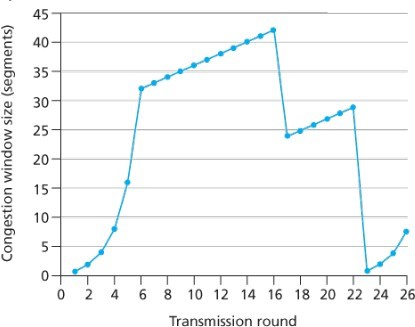
1. Using the figure below:
a. After the 16th transmission round, is segment loss detected by a triple duplicate ACK or by a timeout?
b. After the 22nd transmission round, is segment loss detected by a triple duplicate ACK or by a timeout?
Homework Answers
After the 16th transmission round, packet loss is recognized by a triple duplicate ACK. If there was a timeout, the congestion window size would have dropped to 1.
After the 22nd transmission round, segment loss is detected due to timeout, and hence the congestion
window size is set to 1.
Add Answer to:
1. Using the figure below:
a. After the 16th transmission round, is segment loss detected
by...
mb 8. (10 points) TCP congestion window size (ewnd) is a function of transmission round (n)....
 mb 8. (10 points) TCP congestion window size (ewnd) is a function of transmission round (n). It is following: shown as 39 38 37 36 35 32 34 4 8 16 33 2 cwnd 13 12 11 10 2 3 4 5 6 7 8 1 n 8 4 2 1 25 42 21 22 24 40 41 cwnd 26 25 24 23 22 20 21 15 16 17 18 19 14 (1) During what transmission round is TCP slow...
Problem 1: Consider the following figure. Assuming TCP Reno is the protocol experiencing the beha...
 Networking I need help for g-k
Problem 1: Consider the following figure. Assuming TCP Reno is the protocol experiencing the behavior shown above, answer the following questions. In all cases, you should provide a short discussion justifying your answer Note: this problem is counted for 10 points 45 40 35 2 30 n 25 2 20 c 15 b 10 0 2 468 10 12 14 16 18 20 22 24 26 Transmission round g. What is the value of...
Networking I need help for g-k
Problem 1: Consider the following figure. Assuming TCP Reno is the protocol experiencing the behavior shown above, answer the following questions. In all cases, you should provide a short discussion justifying your answer Note: this problem is counted for 10 points 45 40 35 2 30 n 25 2 20 c 15 b 10 0 2 468 10 12 14 16 18 20 22 24 26 Transmission round g. What is the value of...
6. Figure 1 shows an example variation of congestion window for TCP Reno. Assume that TCP...
 6. Figure 1 shows an example variation of congestion window for TCP Reno. Assume that TCP segment size is 1500 bytes and average RTT is 150 msec. i) What is the average throughput (in bits/sec) during transmission rounds starting from round 6 until round 10 starts. ii) What are the values of ssthresh at the 18th and 24th transmission rounds? iii) Suppose TCP Tahoe is used (instead of TCP Reno), and there is a timeout event at 22nd round. How...
3. Consider the following plot for TCP window size as a function of time. Some of...
 3. Consider the following plot for TCP window size as a function of time. Some of the data points are indicated by the bullets below. Congestion Window Size (Segments) 45 21 35 S1 1.5 110 Transmission Round 2 4 6 8 10 12 14 16 18 20 22 24 26 (a) Identify the loss events that are detected by TCP. Determine when and how each loss is detected by TCP and mention the next phase after each loss. (b) State...
PLEASE HELP 25. The following figure shows the dynamics of a TCP congestion window. (8 points) 45 40 35 s 30 3 25 20 0 2 4 6 8 10 12 14 16 18 20 22 24 26 Transmission round i) What is the initial...
 PLEASE HELP
25. The following figure shows the dynamics of a TCP congestion window. (8 points) 45 40 35 s 30 3 25 20 0 2 4 6 8 10 12 14 16 18 20 22 24 26 Transmission round i) What is the initial threshold? d at the t transmission round that caused the congestion window to change from exponential growh to linear i) What happerned growth? ii) What kind of loss occurred at the 16 transmission round that...
PLEASE HELP
25. The following figure shows the dynamics of a TCP congestion window. (8 points) 45 40 35 s 30 3 25 20 0 2 4 6 8 10 12 14 16 18 20 22 24 26 Transmission round i) What is the initial threshold? d at the t transmission round that caused the congestion window to change from exponential growh to linear i) What happerned growth? ii) What kind of loss occurred at the 16 transmission round that...
TCP Connection Setup consists of a "three-way handshake:" SYN, SYN-ACK, ACK. Which one(s) of these three...
 TCP Connection Setup consists of a "three-way handshake:" SYN,
SYN-ACK, ACK.
Which one(s) of these three
segments specifies an initial sequence number?
Which one(s) of these three
segments is permitted to contain application data?
Congestion Window Size versus Transmission Rounds 140 120 100 80 Congestion Window Size (in segments) 60 40 2. 20 0 1 2 3 4 5 6 7 8 9 10 11 12 13 14 15 16 17 18 19 20 21 22 23 24 25 Transmission...
TCP Connection Setup consists of a "three-way handshake:" SYN,
SYN-ACK, ACK.
Which one(s) of these three
segments specifies an initial sequence number?
Which one(s) of these three
segments is permitted to contain application data?
Congestion Window Size versus Transmission Rounds 140 120 100 80 Congestion Window Size (in segments) 60 40 2. 20 0 1 2 3 4 5 6 7 8 9 10 11 12 13 14 15 16 17 18 19 20 21 22 23 24 25 Transmission...
true or false for (number 1) 1.Selective repeat protocols only retransmits packets that were lost or...
true or false for (number 1) 1.Selective repeat protocols only retransmits packets that were lost or corrupted at the receiver. 2.Consider the acknowledgment for a packet with sequence number n. A __________ acknowledgment indicates that all packets up to and including n have been correctly received. complete comprehensive consistent cumulative 3.The maximum amount of data that can be placed in a segment is limited by the congestion window. maximum segment size. maximum transmission unit. send buffer. 4.Which of the following...
c) Assume that there are two parallel TCP transmissions in the network, one using TCP tahoe...
c) Assume that there are two parallel TCP transmissions in the network, one using TCP tahoe (regular TCP), the other using TCP reno(the one that considers fast recovery). Assume the initial ssthresh for both TCP transmissions is set to 16. Assume that a timeout (without dup Acks) is detected right after the 8th RTT, and another timeout (with 3 dup Acks) is detected right after the 12th RTT. Display the results for the first 15 rounds (20 points). • Indicate...
Consider a simplified actual TCP senderreceiver, described as follows: .Upon a loss (timeout or t...
 Consider a simplified actual TCP senderreceiver, described as follows: .Upon a loss (timeout or triple-duplicate ACKs), the sender o transmits the oldest unACKed packet (whose sequence number Base) o restarts the timer Upon receiving an ACK with a Sequence #y > Base. o it considers all packets with sequence numbers s y as ACKed (cumulative ACK) o Sets Base to the sequence number of the packet immediately after the packet whose sequence number is y o Restarts the timer ....
Explain the solution with every single detail like 888888855555555 why there is 6 8 and 8...
 Explain the solution with every single detail like
888888855555555 why there is 6 8 and 8 5. why did put some numbers
add and some even. also graph it with details
3) (25 points) Consider TCP slow start. Suppose a new TCP connection is just starting up, i.e., sends one maximum size segment (MSS) in the first transmission round. Suppose the Slow Start Threshold is initially 8 MSSs. Suppose the connection has an infinite number of MSSs to send. Further,...
Explain the solution with every single detail like
888888855555555 why there is 6 8 and 8 5. why did put some numbers
add and some even. also graph it with details
3) (25 points) Consider TCP slow start. Suppose a new TCP connection is just starting up, i.e., sends one maximum size segment (MSS) in the first transmission round. Suppose the Slow Start Threshold is initially 8 MSSs. Suppose the connection has an infinite number of MSSs to send. Further,...
 mb 8. (10 points) TCP congestion window size (ewnd) is a function of transmission round (n). It is following: shown as 39 38 37 36 35 32 34 4 8 16 33 2 cwnd 13 12 11 10 2 3 4 5 6 7 8 1 n 8 4 2 1 25 42 21 22 24 40 41 cwnd 26 25 24 23 22 20 21 15 16 17 18 19 14 (1) During what transmission round is TCP slow...
 Networking I need help for g-k
Problem 1: Consider the following figure. Assuming TCP Reno is the protocol experiencing the behavior shown above, answer the following questions. In all cases, you should provide a short discussion justifying your answer Note: this problem is counted for 10 points 45 40 35 2 30 n 25 2 20 c 15 b 10 0 2 468 10 12 14 16 18 20 22 24 26 Transmission round g. What is the value of...
Networking I need help for g-k
Problem 1: Consider the following figure. Assuming TCP Reno is the protocol experiencing the behavior shown above, answer the following questions. In all cases, you should provide a short discussion justifying your answer Note: this problem is counted for 10 points 45 40 35 2 30 n 25 2 20 c 15 b 10 0 2 468 10 12 14 16 18 20 22 24 26 Transmission round g. What is the value of...
 6. Figure 1 shows an example variation of congestion window for TCP Reno. Assume that TCP segment size is 1500 bytes and average RTT is 150 msec. i) What is the average throughput (in bits/sec) during transmission rounds starting from round 6 until round 10 starts. ii) What are the values of ssthresh at the 18th and 24th transmission rounds? iii) Suppose TCP Tahoe is used (instead of TCP Reno), and there is a timeout event at 22nd round. How...
 3. Consider the following plot for TCP window size as a function of time. Some of the data points are indicated by the bullets below. Congestion Window Size (Segments) 45 21 35 S1 1.5 110 Transmission Round 2 4 6 8 10 12 14 16 18 20 22 24 26 (a) Identify the loss events that are detected by TCP. Determine when and how each loss is detected by TCP and mention the next phase after each loss. (b) State...
 PLEASE HELP
25. The following figure shows the dynamics of a TCP congestion window. (8 points) 45 40 35 s 30 3 25 20 0 2 4 6 8 10 12 14 16 18 20 22 24 26 Transmission round i) What is the initial threshold? d at the t transmission round that caused the congestion window to change from exponential growh to linear i) What happerned growth? ii) What kind of loss occurred at the 16 transmission round that...
PLEASE HELP
25. The following figure shows the dynamics of a TCP congestion window. (8 points) 45 40 35 s 30 3 25 20 0 2 4 6 8 10 12 14 16 18 20 22 24 26 Transmission round i) What is the initial threshold? d at the t transmission round that caused the congestion window to change from exponential growh to linear i) What happerned growth? ii) What kind of loss occurred at the 16 transmission round that...
 TCP Connection Setup consists of a "three-way handshake:" SYN,
SYN-ACK, ACK.
Which one(s) of these three
segments specifies an initial sequence number?
Which one(s) of these three
segments is permitted to contain application data?
Congestion Window Size versus Transmission Rounds 140 120 100 80 Congestion Window Size (in segments) 60 40 2. 20 0 1 2 3 4 5 6 7 8 9 10 11 12 13 14 15 16 17 18 19 20 21 22 23 24 25 Transmission...
TCP Connection Setup consists of a "three-way handshake:" SYN,
SYN-ACK, ACK.
Which one(s) of these three
segments specifies an initial sequence number?
Which one(s) of these three
segments is permitted to contain application data?
Congestion Window Size versus Transmission Rounds 140 120 100 80 Congestion Window Size (in segments) 60 40 2. 20 0 1 2 3 4 5 6 7 8 9 10 11 12 13 14 15 16 17 18 19 20 21 22 23 24 25 Transmission...
 Consider a simplified actual TCP senderreceiver, described as follows: .Upon a loss (timeout or triple-duplicate ACKs), the sender o transmits the oldest unACKed packet (whose sequence number Base) o restarts the timer Upon receiving an ACK with a Sequence #y > Base. o it considers all packets with sequence numbers s y as ACKed (cumulative ACK) o Sets Base to the sequence number of the packet immediately after the packet whose sequence number is y o Restarts the timer ....
 Explain the solution with every single detail like
888888855555555 why there is 6 8 and 8 5. why did put some numbers
add and some even. also graph it with details
3) (25 points) Consider TCP slow start. Suppose a new TCP connection is just starting up, i.e., sends one maximum size segment (MSS) in the first transmission round. Suppose the Slow Start Threshold is initially 8 MSSs. Suppose the connection has an infinite number of MSSs to send. Further,...
Explain the solution with every single detail like
888888855555555 why there is 6 8 and 8 5. why did put some numbers
add and some even. also graph it with details
3) (25 points) Consider TCP slow start. Suppose a new TCP connection is just starting up, i.e., sends one maximum size segment (MSS) in the first transmission round. Suppose the Slow Start Threshold is initially 8 MSSs. Suppose the connection has an infinite number of MSSs to send. Further,...
Most questions answered within 3 hours.
-
Where is the error in this code sequence?
String s1 = "Hello";
String s2 = "ello";...
asked 10 months ago -
Financial data for Joel de Paris, Inc., for last year
follow:
Joel de Paris, Inc.
Balance...
asked 10 months ago -
Consider this reaction:
Al2(SO4)3 (aq)+ BaCl3
(aq) Al2Cl6 (aq)- +
3BaSO4(s) . What is the...
asked 10 months ago -
Suppose that Savneet is considering increasing her
recent random sample from 20 car rentals to 40...
asked 10 months ago -
Trucks arrive at an unloading terminal at an average rate of 120
per hour.
Trucks arrive...
asked 10 months ago -
Why are methanol and ethanol completely soluble in water while
octanol is not very little soluble....
asked 10 months ago -
A facilities manager at a university reads in a research report
that the mean amount of...
asked 10 months ago -
When the CuSO4 is rehydrated by adding water to the anhydrous
compound, is this an endothermic...
asked 10 months ago -
A ray of sunlight is passing from diamond into crown glass; the
angle of incidence is...
asked 10 months ago -
A block of mass 0.249 kg is placed on top of a light, vertical
spring of...
asked 10 months ago -
how do the kidneys compensate in the presences of acidosis
a) trigger hyperventilate
b) reserve acid...
asked 10 months ago -
Question 501 pts
The rental rate of capital to the firm increases. Which of the
following...
asked 10 months ago