Four blocks EACH of mass m = 10 kg are arranged as shown in the...
Four blocks EACH of mass m = 10 kg are arranged as shown in the picture, on top of a frictionless table. A hand touching block 1 applies a force of Fh1 = 90 N to the right. The coefficient of friction between the blocks is sufficient to keep the blocks from moving with respect to each other.
What is the total force exerted by block 2 on block 3 ?
F23net =
Homework Answers
The concepts used to solve this problem are newton’s second law, and components of force.
Find the acceleration experienced by the system using the force applied on it.
Find the magnitude of the net force acting on the third block using that force’s horizontal and vertical components calculated.
Newton’s second law states that the acceleration experienced by an object, due to a force that is applied on it, is proportional to the magnitude of that force.
Expression for newton’s second law is,
Here, is the force acting on the object, is the mass of the object, and is the acceleration produced on the object.
The system has four blocks.
Expression for the mass of the system is,
Here, , , , and are the masses of respectively 1, 2, 3,and 4 blocks.
The entire block has same value of mass.
Force is a vector quantity and hence it can be resolved into it the component form which gives the contribution of this force along the two directions of the coordinate system.
The following figure shows the arrangements of four blocks on top of a frictionless table.
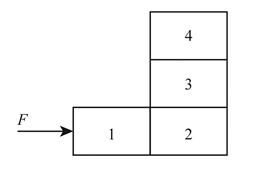
A force applied on the block 1 act directly on it. For all the blocks to hold the same configuration, this force has to be transferred to all the blocks in the system.
The following figure shows the force exerted by the block 2 on block 3.
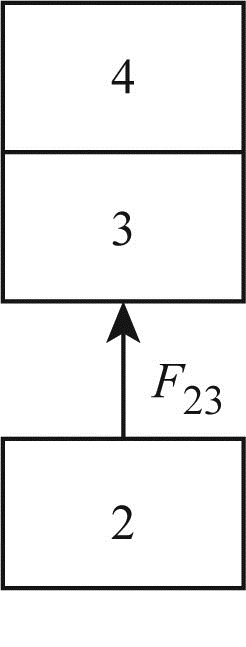
Block 2 exerts a force on the block 3. This force has two components, vertical and horizontal.
The following figure shows the direction of the force exerted by the block 2 on block 3.
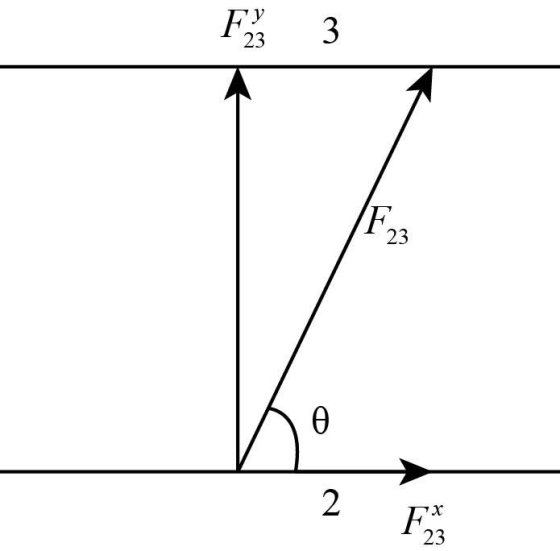
The vertical acceleration of the block 3 depends on the vertical component of the force which is expressed as .
The horizontal acceleration of the block 3 depends on the horizontal component of the force which is expressed as .
Expression for the horizontal component of the force is
Here, is the horizontal component of the force and is the vertical acceleration of the block 3.
Expression for the vertical component of the force is
Here, is the vertical component of the force and is the horizontal acceleration of the block.
The magnitude of the net force is expressed as,
.
Expression for the mass of the system is,
Substitute for , for , for , and for .
Expression for newton’s second law is,
Rearrange the above equation to a,
Substitute for and for .
Therefore, the acceleration of the system is .
Block two exerts a force on the block 3. This force can be divided into its components along vertical and horizontal directions.
Expression for the horizontal component of the force is,
Substitute for and and for .
Expression for the vertical component of the force is,
Substitute for and and for .
The net force exerted by the block 2 on block 3 is
Substitute for and for .
Ans:
The net force exerted by the block 2 on block 3 is .
Pushing Blocks PUSHING BLOCKS BASE Pushing Blocks 4 Four blocks EACH of mass m = 10...
 Pushing Blocks PUSHING BLOCKS BASE Pushing Blocks 4 Four blocks EACH of mass m = 10 kg are arranged as shown in the picture, on top of a frictionless table. A hand touching block 1 applies a force of Fh1 90 N to the right. The coefficient of friction between the blocks is sufficient to keep the blocks from moving with respect to each other. What is the total force exerted by block 2 on block 3? F23net N Submit...
Two blocks, each of mass m = 6.90 kg , are connected by a massless rope...
Two blocks, each of mass m = 6.90 kg , are connected by a massless rope and start sliding down a slope of incline θ = 40.0 ∘ at t=0.000 s. The slope's top portion is a rough surface whose coefficient of kinetic friction is μk = 0.350. At a distance d = 2.90 m from block A's initial position the slope becomes frictionless. What is the velocity of the blocks 4.10 s after the blocks have started moving? Assume...
Three blocks, each of mass 6 kg are on a frictionless table. A hand pushes on...
 Three blocks, each of mass 6 kg are on a frictionless table. A
hand pushes on the left most box (A) such that the three boxes
accelerate in the positive horizontal direction as shown at a rate
of a = 1 m/s2.
1. What is the net horizontal force on block B?
2. What is the horizontal force on block B due to block C?
Three blocks, each of mass 6 kg are on a frictionless table. A hand pushes...
Three blocks, each of mass 6 kg are on a frictionless table. A
hand pushes on the left most box (A) such that the three boxes
accelerate in the positive horizontal direction as shown at a rate
of a = 1 m/s2.
1. What is the net horizontal force on block B?
2. What is the horizontal force on block B due to block C?
Three blocks, each of mass 6 kg are on a frictionless table. A hand pushes...
two blocks are positioned on surfaces, each inclined at the same angle of 49.4 degrees with...
two blocks are positioned on surfaces, each inclined at the same angle of 49.4 degrees with respect to the horizontal. The blocks are connected by a rope which rests on a frictionless pulley at the top of the inclines as shown, so the blocks can slide together. The mass of the black block is 4.61 kg, and the coefficient of kinetic friction for both blocks and inclines is 0.470. Assume static friction has been overcome and that everything can slide....
Please show work: 3. Two stone blocks with mass m = 100 kg are stacked as...
 Please show work:
3. Two stone blocks with mass m = 100 kg are stacked as shown in figure 1 on a stone surface. The top block is held in place by a chain and cannot move to the right. The coefficient of static friction between the blocks, and between the lower block and the surface, is μ8-0.6. stack? What is the minimum force F necessary to begin sliding the lower block out from under the Figure 1: Two stone...
Please show work:
3. Two stone blocks with mass m = 100 kg are stacked as shown in figure 1 on a stone surface. The top block is held in place by a chain and cannot move to the right. The coefficient of static friction between the blocks, and between the lower block and the surface, is μ8-0.6. stack? What is the minimum force F necessary to begin sliding the lower block out from under the Figure 1: Two stone...
The two blocks (m-20 kg and M- 80 kg) in fig. 6-38 are not attached to...
 The two blocks (m-20 kg and M- 80 kg) in fig. 6-38 are not attached to each other. The coefficient of static friction between block is u, = 0.38, but the surface beneath the larger block is frictionless. What is the minimum magnitude of the horizontal force F required to keep the 2. smaller block from slipping down the block? m M Frictionless
A system of two blocks is shown in Figure above. Block # 1 of mass M...
 A system of two blocks is shown in Figure above. Block # 1 of mass M = 10 kg is sitting on the block #2 of mass 3M. There is friction between blocks, the coefficient of friction is mu = 0.4. The second block is sitting on the table, there is no friction between the second block and the table. Force F = 40 N is applied as shown in Figure above. Find accelerations of the blocks.
2. A 3.80-kg hanging block is pulling against a 2.50-kg block on a tabletop, as shown,...
 2. A 3.80-kg hanging block is pulling against a 2.50-kg block on a tabletop, as shown, via a string over a pulley that is massless and frictionless. At the same time, a constant external force F = 5.50 N is pulling the tabletop block to the right, as shown. There is a static friction coefficient is = 0.75, and kinetic friction coefficient dx = 0.15, with the tabletop. (a) The blocks are initially stationary. With a calculation, determine whether the...
Assume the three blocks (m. = 1.0 kg, m = 20 kg and m = 40...
 Assume the three blocks (m. = 1.0 kg, m = 20 kg and m = 40 ko) portrayed in the figure below move on a frictionless surface and a force F: 36w acts as shown on the 4.0 kg block. (a Determine the acceleration given this system (in m/s2 to the right). m/s2 (to the right) b) Determine the tension in the cord connecting the 4.0 kg and the 1.0 kg blocks in N). Determine the force exerted by the...
The two blocks (m-12 kg and M-88 kg) in the figure are not attached to each...
 The two blocks (m-12 kg and M-88 kg) in the figure are not attached to each Other. The oemeient of static friction between the blocks is·s·0.36, but the surface beneath the larger block is frictionless. What is the minimum magnitude of the horizontal force F required to keep the smaller block from slipping down the larger block? ar rictionless Number Units
 Pushing Blocks PUSHING BLOCKS BASE Pushing Blocks 4 Four blocks EACH of mass m = 10 kg are arranged as shown in the picture, on top of a frictionless table. A hand touching block 1 applies a force of Fh1 90 N to the right. The coefficient of friction between the blocks is sufficient to keep the blocks from moving with respect to each other. What is the total force exerted by block 2 on block 3? F23net N Submit...
 Three blocks, each of mass 6 kg are on a frictionless table. A
hand pushes on the left most box (A) such that the three boxes
accelerate in the positive horizontal direction as shown at a rate
of a = 1 m/s2.
1. What is the net horizontal force on block B?
2. What is the horizontal force on block B due to block C?
Three blocks, each of mass 6 kg are on a frictionless table. A hand pushes...
Three blocks, each of mass 6 kg are on a frictionless table. A
hand pushes on the left most box (A) such that the three boxes
accelerate in the positive horizontal direction as shown at a rate
of a = 1 m/s2.
1. What is the net horizontal force on block B?
2. What is the horizontal force on block B due to block C?
Three blocks, each of mass 6 kg are on a frictionless table. A hand pushes...
 Please show work:
3. Two stone blocks with mass m = 100 kg are stacked as shown in figure 1 on a stone surface. The top block is held in place by a chain and cannot move to the right. The coefficient of static friction between the blocks, and between the lower block and the surface, is μ8-0.6. stack? What is the minimum force F necessary to begin sliding the lower block out from under the Figure 1: Two stone...
Please show work:
3. Two stone blocks with mass m = 100 kg are stacked as shown in figure 1 on a stone surface. The top block is held in place by a chain and cannot move to the right. The coefficient of static friction between the blocks, and between the lower block and the surface, is μ8-0.6. stack? What is the minimum force F necessary to begin sliding the lower block out from under the Figure 1: Two stone...
 The two blocks (m-20 kg and M- 80 kg) in fig. 6-38 are not attached to each other. The coefficient of static friction between block is u, = 0.38, but the surface beneath the larger block is frictionless. What is the minimum magnitude of the horizontal force F required to keep the 2. smaller block from slipping down the block? m M Frictionless
 A system of two blocks is shown in Figure above. Block # 1 of mass M = 10 kg is sitting on the block #2 of mass 3M. There is friction between blocks, the coefficient of friction is mu = 0.4. The second block is sitting on the table, there is no friction between the second block and the table. Force F = 40 N is applied as shown in Figure above. Find accelerations of the blocks.
 2. A 3.80-kg hanging block is pulling against a 2.50-kg block on a tabletop, as shown, via a string over a pulley that is massless and frictionless. At the same time, a constant external force F = 5.50 N is pulling the tabletop block to the right, as shown. There is a static friction coefficient is = 0.75, and kinetic friction coefficient dx = 0.15, with the tabletop. (a) The blocks are initially stationary. With a calculation, determine whether the...
 Assume the three blocks (m. = 1.0 kg, m = 20 kg and m = 40 ko) portrayed in the figure below move on a frictionless surface and a force F: 36w acts as shown on the 4.0 kg block. (a Determine the acceleration given this system (in m/s2 to the right). m/s2 (to the right) b) Determine the tension in the cord connecting the 4.0 kg and the 1.0 kg blocks in N). Determine the force exerted by the...
 The two blocks (m-12 kg and M-88 kg) in the figure are not attached to each Other. The oemeient of static friction between the blocks is·s·0.36, but the surface beneath the larger block is frictionless. What is the minimum magnitude of the horizontal force F required to keep the smaller block from slipping down the larger block? ar rictionless Number Units
Most questions answered within 3 hours.
-
Where is the error in this code sequence?
String s1 = "Hello";
String s2 = "ello";...
asked 11 months ago -
Financial data for Joel de Paris, Inc., for last year
follow:
Joel de Paris, Inc.
Balance...
asked 11 months ago -
Consider this reaction:
Al2(SO4)3 (aq)+ BaCl3
(aq) Al2Cl6 (aq)- +
3BaSO4(s) . What is the...
asked 11 months ago -
Suppose that Savneet is considering increasing her
recent random sample from 20 car rentals to 40...
asked 11 months ago -
Trucks arrive at an unloading terminal at an average rate of 120
per hour.
Trucks arrive...
asked 11 months ago -
Why are methanol and ethanol completely soluble in water while
octanol is not very little soluble....
asked 11 months ago -
A facilities manager at a university reads in a research report
that the mean amount of...
asked 11 months ago -
When the CuSO4 is rehydrated by adding water to the anhydrous
compound, is this an endothermic...
asked 11 months ago -
A ray of sunlight is passing from diamond into crown glass; the
angle of incidence is...
asked 11 months ago -
A block of mass 0.249 kg is placed on top of a light, vertical
spring of...
asked 11 months ago -
how do the kidneys compensate in the presences of acidosis
a) trigger hyperventilate
b) reserve acid...
asked 11 months ago -
Question 501 pts
The rental rate of capital to the firm increases. Which of the
following...
asked 11 months ago