Time Series
Let A and B be two independent white-noise processes. What can you say about the time series properties of the process Y = A+B? How will your answer change if the processes A and B are correlated at lag one?
Homework Answers
A stochastic process is a set of random variables with time 1 2 +1 = = as the index. In most applications, the time index is a regularly spaced index that reflects calendar time (e.g., days, months, years, etc.). When modeling time-series data, the ordering enforced by the time index is critical because we often wish to capture any temporal connections between the random variables in the stochastic process. The sequence in which the random variables that make up the sample appear is irrelevant when sampling from a population since they are independent.
A stochastic process employing observations is realised by the sequence of observed data 1 = 1 2 = 2 = = ==1.
1
We'll commonly refer to the stochastic process as a simple = to save on notation.
CONCEPTS OF TIME SERIES IN CHAPTER 1
The goal of time series modeling is to provide a clear picture of the probabilistic behavior of the underlying stochastic process that is considered to have produced the observed data. Furthermore, we want to be able to use the observed sample to estimate critical aspects of a time series model, such as measures of time dependence. To do so, we must make a number of assumptions regarding the combined behavior of the stochastic process' random variables, such that the stochastic process may be compared to a random sample from a given population.
Can you forecast an independent white noise series? At any time white nose is uncorrelated with...
Can you forecast an independent white noise series? At any time white nose is uncorrelated with anything in the past. What happens if the future is uncorrelated with anything in the present or past?
(b) Jan has collected a monthly time series consisting of 167 observations on the differenced log Yen/SAU exchange rate and plotted the sample ACF for the series (see below). Use the QLB(2) statistic...
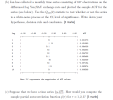 (b) Jan has collected a monthly time series consisting of 167 observations on the differenced log Yen/SAU exchange rate and plotted the sample ACF for the series (see below). Use the QLB(2) statistic to test whether or not the series is a white-noise process at the 5% level of significance. Write down your hypotheses, decision rule and conclusion. [3 marks] Lag-1.00 -0.60-0.20 0.20 0.60 ACF 1.00 I 0.001073 0.121080 1 -0.084039 1 -0.052353 I -0.054732 1 -0.095489 0 . 044049...
Time Series transformation Let an annual series Yt be stationary. However, the series transformed...
Time Series transformation Let an annual series Yt be stationary. However, the series transformed and differentiated Dt = ln(Yt) - ln(Yt-1) is stationary. Moreover, we suppose that it obeys the following theoretical model: Dt = -0.12 + 0.75 Dt-1 + et, in which the error term and is a white noise of variance σ2 = 0.012. How can I transform this model to get the original one before the transformation?
Time series question about independent stationary processes 2:23 Two processes |Z, and (Y are said to...
 Time series question about independent stationary processes
2:23 Two processes |Z, and (Y are said to be independent if for any time points 11 Im and s1.8-2... Sn the random variables [Z, Z,. ..Z, are independent of the random variables [Ys,. Ys, ..., Y). Show that if IZ) and Y are inde- 23 mm pendent stationary proesses, then W-2,+ 7 is stationary.
Time series question about independent stationary processes
2:23 Two processes |Z, and (Y are said to be independent if for any time points 11 Im and s1.8-2... Sn the random variables [Z, Z,. ..Z, are independent of the random variables [Ys,. Ys, ..., Y). Show that if IZ) and Y are inde- 23 mm pendent stationary proesses, then W-2,+ 7 is stationary.
(A). Draw the Autocorrelaogram and Partial Autocorrelogram for a White Noise Time Series Process....
 (A). Draw the Autocorrelaogram and Partial Autocorrelogram for a White Noise Time Series Process. (B). Assume that the optimal h-steps ahead forecast is noted as fth for a MA(1). Lets also assume that the optimal point forecast is a conditional expectation: Where Qt is the information set at time "t" and "h" is the forecast horizon. Now we can write the MA(1) process at time "t+1" as follows; Ü. What is the optimal one period ahead forecast, f,i? (ii). What...
3. Let Zt) be a Gaussian white noise, that is, a sequence of i.i.d. normal r.v.s...
 3. Let Zt) be a Gaussian white noise, that is, a sequence of i.i.d. normal r.v.s each with mean zero and variance 1. Let Y% (a) Using R generate 300 observations of the Gaussian white noise Z. Plot the series and its acf. (b) Using R, plot 300 observations of the series Y -Z. Plot its acf. c) Analyze graphs from (a) and (b). Can you see a difference between the plots of graphs of time series Z and Y?...
Recall that a time series {εt} is called a white noise process if i. E[εt] =...
Recall that a time series {εt} is called a white noise process if i. E[εt] = 0 t ; ii. Cov(εs, εt) = 0 s ≠ t ; iii. Var(εt) = σ2 < ∞ Construct the autocorrelation function f(h), h=0,-+1,-+2,… for the white noise process.
The time series {} is said to be an AR(2) process if , where {} is...
The time series {} is said to be an AR(2) process if , where {} is a white noise process with variance < a) For what values of is the process weakly stationary? b) Select in the range where the process is weakly stationary and plot the autocorrelation function for the chosen We were unable to transcribe this imageWe were unable to transcribe this imageWe were unable to transcribe this imageWe were unable to transcribe this imageWe were unable to...
: Assume Yt is a time series process and Et is a white noise process with...
: Assume Yt is a time series process and Et is a white noise process with mean zero and constant variance. (a). Write an equation for AR(4) process. (b). Write an equation for AR(5) process. (c). Write an equation for MA(3) process. (d). Write down an equation for MA(2) process. (e). Write an equation for ARMA (4,2) process. (f). Do more research and write an equation for ARIMA (4,0,2) proce
Problem 4 Let X(t), a continuous-time white noise process with zero mean and power spectral density equal to 2, be the...
 Problem 4 Let X(t), a continuous-time white noise process with zero mean and power spectral density equal to 2, be the input to an LTI system with impulse response h(t)- 0 otherwise of Y (t). Sketch the autocorrelation function of Y(t)
Problem 4 Let X(t), a continuous-time white noise process with zero mean and power spectral density equal to 2, be the input to an LTI system with impulse response h(t)- 0 otherwise of Y (t). Sketch the autocorrelation function...
Problem 4 Let X(t), a continuous-time white noise process with zero mean and power spectral density equal to 2, be the input to an LTI system with impulse response h(t)- 0 otherwise of Y (t). Sketch the autocorrelation function of Y(t)
Problem 4 Let X(t), a continuous-time white noise process with zero mean and power spectral density equal to 2, be the input to an LTI system with impulse response h(t)- 0 otherwise of Y (t). Sketch the autocorrelation function...
 (b) Jan has collected a monthly time series consisting of 167 observations on the differenced log Yen/SAU exchange rate and plotted the sample ACF for the series (see below). Use the QLB(2) statistic to test whether or not the series is a white-noise process at the 5% level of significance. Write down your hypotheses, decision rule and conclusion. [3 marks] Lag-1.00 -0.60-0.20 0.20 0.60 ACF 1.00 I 0.001073 0.121080 1 -0.084039 1 -0.052353 I -0.054732 1 -0.095489 0 . 044049...
 Time series question about independent stationary processes
2:23 Two processes |Z, and (Y are said to be independent if for any time points 11 Im and s1.8-2... Sn the random variables [Z, Z,. ..Z, are independent of the random variables [Ys,. Ys, ..., Y). Show that if IZ) and Y are inde- 23 mm pendent stationary proesses, then W-2,+ 7 is stationary.
Time series question about independent stationary processes
2:23 Two processes |Z, and (Y are said to be independent if for any time points 11 Im and s1.8-2... Sn the random variables [Z, Z,. ..Z, are independent of the random variables [Ys,. Ys, ..., Y). Show that if IZ) and Y are inde- 23 mm pendent stationary proesses, then W-2,+ 7 is stationary.
 (A). Draw the Autocorrelaogram and Partial Autocorrelogram for a White Noise Time Series Process. (B). Assume that the optimal h-steps ahead forecast is noted as fth for a MA(1). Lets also assume that the optimal point forecast is a conditional expectation: Where Qt is the information set at time "t" and "h" is the forecast horizon. Now we can write the MA(1) process at time "t+1" as follows; Ü. What is the optimal one period ahead forecast, f,i? (ii). What...
 3. Let Zt) be a Gaussian white noise, that is, a sequence of i.i.d. normal r.v.s each with mean zero and variance 1. Let Y% (a) Using R generate 300 observations of the Gaussian white noise Z. Plot the series and its acf. (b) Using R, plot 300 observations of the series Y -Z. Plot its acf. c) Analyze graphs from (a) and (b). Can you see a difference between the plots of graphs of time series Z and Y?...
 Problem 4 Let X(t), a continuous-time white noise process with zero mean and power spectral density equal to 2, be the input to an LTI system with impulse response h(t)- 0 otherwise of Y (t). Sketch the autocorrelation function of Y(t)
Problem 4 Let X(t), a continuous-time white noise process with zero mean and power spectral density equal to 2, be the input to an LTI system with impulse response h(t)- 0 otherwise of Y (t). Sketch the autocorrelation function...
Problem 4 Let X(t), a continuous-time white noise process with zero mean and power spectral density equal to 2, be the input to an LTI system with impulse response h(t)- 0 otherwise of Y (t). Sketch the autocorrelation function of Y(t)
Problem 4 Let X(t), a continuous-time white noise process with zero mean and power spectral density equal to 2, be the input to an LTI system with impulse response h(t)- 0 otherwise of Y (t). Sketch the autocorrelation function...
Most questions answered within 3 hours.
-
Where is the error in this code sequence?
String s1 = "Hello";
String s2 = "ello";...
asked 11 months ago -
Financial data for Joel de Paris, Inc., for last year
follow:
Joel de Paris, Inc.
Balance...
asked 11 months ago -
Consider this reaction:
Al2(SO4)3 (aq)+ BaCl3
(aq) Al2Cl6 (aq)- +
3BaSO4(s) . What is the...
asked 11 months ago -
Suppose that Savneet is considering increasing her
recent random sample from 20 car rentals to 40...
asked 11 months ago -
Trucks arrive at an unloading terminal at an average rate of 120
per hour.
Trucks arrive...
asked 11 months ago -
Why are methanol and ethanol completely soluble in water while
octanol is not very little soluble....
asked 11 months ago -
A facilities manager at a university reads in a research report
that the mean amount of...
asked 11 months ago -
When the CuSO4 is rehydrated by adding water to the anhydrous
compound, is this an endothermic...
asked 11 months ago -
A ray of sunlight is passing from diamond into crown glass; the
angle of incidence is...
asked 11 months ago -
A block of mass 0.249 kg is placed on top of a light, vertical
spring of...
asked 11 months ago -
how do the kidneys compensate in the presences of acidosis
a) trigger hyperventilate
b) reserve acid...
asked 11 months ago -
Question 501 pts
The rental rate of capital to the firm increases. Which of the
following...
asked 11 months ago