
Homework Answers
DATA:
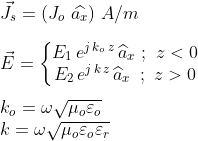
Solution
According to the following equation:

Where:

and

Inserting (2) and (3) into equation (1) we obtain:

Similarly, for the magnetic field we have:

Where;

and

With  and
and  constant values as
follows:
constant values as
follows:

and

Replacing (6) and (7) into equation (5) we have:
![\widehat{a}_{z}\times\left [ \frac{E_{2}}{\eta}e^{jkz}-\left ( -\frac{E_{1}}{\eta_{o}} \right )e^{jk_{o}z} \right ]\widehat{a}_{y}=\vec{J}_{s}\: \: \: \: \: \: \: \: \: \: \: \: \: \: \: \: (10)](http://img.homeworklib.com/questions/30b3bf50-9f28-11ec-bba1-89cd9bfa5b78.png?x-oss-process=image/resize,w_560)
But:

Inserting (11) into (10):
![\widehat{a}_{z}\times\left [ \frac{E_{2}}{\eta}e^{jkz}-\left ( -\frac{E_{1}}{\eta_{o}} \right )e^{jk_{o}z} \right ]\widehat{a}_{y}=J_{o}\,\,\widehat{a}_{x}\: \: \: \: \: \: \: \: \: \: \: \: \: \: \: \: (11)](http://img.homeworklib.com/questions/316a5c40-9f28-11ec-9eb8-2f217e3b0dce.png?x-oss-process=image/resize,w_560)
Solving we obtain:

Inserting (4) into (12) we have:

Isolating  we
obtain:
we
obtain:

Therefore:

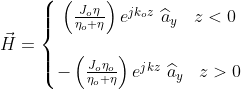
Now, the magnetic field can be written as:
Add Answer to:
b) Figure Q1(b) describes an infinite sheet of electric surface current density (L=a,JoA /m) directed along...
Please show steps B. Magnetostaties: The x-y plane contains an infinite current sheet with surface current...
 Please show steps
B. Magnetostaties: The x-y plane contains an infinite current sheet with surface current density s8Is. Find the magnetic fleld H everywhere in space. Amperian Contour O00o y (a) Use the right-hand rule and make a "Ruestimate" for the magnetic field intensity H both above (z> 0) and below (z<0) this infinite current sheet. (b) Choose an Amperian Contour that encloses the current sheet as shown above and perform the closed path integral of H di around this...
Please show steps
B. Magnetostaties: The x-y plane contains an infinite current sheet with surface current density s8Is. Find the magnetic fleld H everywhere in space. Amperian Contour O00o y (a) Use the right-hand rule and make a "Ruestimate" for the magnetic field intensity H both above (z> 0) and below (z<0) this infinite current sheet. (b) Choose an Amperian Contour that encloses the current sheet as shown above and perform the closed path integral of H di around this...
A current sheet with surface current density K = 94 Am flows in the region-2 m...
 A current sheet with surface current density K = 94 Am flows in the region-2 m < y < 2 m (implies infinite in x axis) the plane atz -0. Calculate magnetic field intensity H at position P = (0, 0, 3) meters. 少
(a) Can the displacement current exist in vacuum? Briefly explain. (2 points) (b) Consider a medi...
 (a) Can the displacement current exist in vacuum? Briefly explain. (2 points) (b) Consider a medium with dielectric permittivity є, magnetic permeability k. The conductivity ơ--O. If the magnetic field in this medium is H = H0 sin (at-kz)as, where-=--, find the electric field . You can assume that at t = 0, E = 0 at z = 0 (4 points) (c) The displacement current causes magnetic field in the same way conduction current does. True or false? Choose...
Part A A nonuniform electric field is directed along the x-axis at all points in space....
 Part A A nonuniform electric field is directed along the x-axis at all points in space. This magnitude of the field varies with x, but not with respect to yor z. The axis of a cylindrical surface, 0.80 m long and 0.20 m in diameter is aligned parallel to the x-axis, as shown in the figure. The electric fields E 1 and E 2 at the ends of the cylindrical surface, have magnitudes of 8000 NIC and 2000 N/C respectively,...
Two parallel long (infinite for our purposes) wires are oriented along the z-axis. The figure below...
 Two parallel long (infinite for our purposes) wires are oriented
along the z-axis. The figure below shows the
(xy)-plane perpendicular to the wires, including
the positions where the wires cross this plane. The wires carry
some unknown electric currents I1 and
I2, which you need to find from a
single measurement of the magnetic field
B=Bxi
+
Byj
at point A, whose position in the plane is also indicated. We will
treat the currents algebraically: the current I
is positive...
Two parallel long (infinite for our purposes) wires are oriented
along the z-axis. The figure below shows the
(xy)-plane perpendicular to the wires, including
the positions where the wires cross this plane. The wires carry
some unknown electric currents I1 and
I2, which you need to find from a
single measurement of the magnetic field
B=Bxi
+
Byj
at point A, whose position in the plane is also indicated. We will
treat the currents algebraically: the current I
is positive...
Problem 6. Electromagnetic plane waves in a lossy medium The electric field of an electromagnetic plane wave traveling in a lossy medium can be written as where z is the distance, t is time, and f...
 Problem 6. Electromagnetic plane waves in a lossy medium The electric field of an electromagnetic plane wave traveling in a lossy medium can be written as where z is the distance, t is time, and fthe frequency. For f 1 GHz, it is found by measurement that the amplitude of the electric field is attenuated by a factor of 3 after the wave travels 100 m (i.e., to 1/3 of the amplitude at z-0 when it arrives at z- 100...
EE303 HW2 01/22/2020, due on 01/29/2020 Q1. Infinite uniform line charges of 5 nC/m lie along...
 EE303 HW2 01/22/2020, due on 01/29/2020 Q1. Infinite uniform line charges of 5 nC/m lie along the (both positive and negative) x and y axes in free space. Find electric field at P (0, 0, 4). Q2. Three infinite uniform sheets of charge are located in the free space as followings: 3 nC/m? at z=-4, 6 nC/m? at z=1, and -8 nC/m² at z=4. Find E at the following points: P1(2, 5, -2), and P2(4, 2, 2). -8x Q3. Find...
A large, flat sheet carries a uniformly distributed electric current with current per unit widthJs. This...
 A large, flat sheet carries a uniformly distributed electric current with current per unit widthJs. This current creates a magnetic field on both sides of the sheet, parallel to the sheet and perpendicular to the current, with magnitude B- 0's. If the current is in the y direction and oscillates in time according to 2 /max (cos ωガーJmax[cos (-wtjj the sheet radiates an electromagnetic wave. The figure below shows such a wave emitted from one point on the sheet chosen...
Two parallel long (infinite for our purposes) wires are oriented along the z- axis. The figure...
 Two parallel long (infinite for our purposes) wires are oriented along the z- axis. The figure below shows the (xy)-plane perpendicular to the wires, including the positions where the wires cross this plane. The wires carry some unknown electric currents 11 and 12, which you need to find from a single measurement of the magnetic field B=By i + By j at point A, whose position in the plane is also indicated. We will treat the currents algebraically: the current...
Two parallel long (infinite for our purposes) wires are oriented along the z-axis. The figure below...
 Two parallel long (infinite for our purposes) wires are oriented along the z-axis. The figure below shows the (xy)-plane perpendicular to the wires, including the positions where the wires cross this plane. The wires carry some unknown electric currents I, and 12, which you need to find from a single measurement of the magnetic field B=BX i + B, j at point A, whose position in the plane is also indicated. We will treat the currents algebraically: the current I...
 Please show steps
B. Magnetostaties: The x-y plane contains an infinite current sheet with surface current density s8Is. Find the magnetic fleld H everywhere in space. Amperian Contour O00o y (a) Use the right-hand rule and make a "Ruestimate" for the magnetic field intensity H both above (z> 0) and below (z<0) this infinite current sheet. (b) Choose an Amperian Contour that encloses the current sheet as shown above and perform the closed path integral of H di around this...
Please show steps
B. Magnetostaties: The x-y plane contains an infinite current sheet with surface current density s8Is. Find the magnetic fleld H everywhere in space. Amperian Contour O00o y (a) Use the right-hand rule and make a "Ruestimate" for the magnetic field intensity H both above (z> 0) and below (z<0) this infinite current sheet. (b) Choose an Amperian Contour that encloses the current sheet as shown above and perform the closed path integral of H di around this...
 A current sheet with surface current density K = 94 Am flows in the region-2 m < y < 2 m (implies infinite in x axis) the plane atz -0. Calculate magnetic field intensity H at position P = (0, 0, 3) meters. 少
 (a) Can the displacement current exist in vacuum? Briefly explain. (2 points) (b) Consider a medium with dielectric permittivity є, magnetic permeability k. The conductivity ơ--O. If the magnetic field in this medium is H = H0 sin (at-kz)as, where-=--, find the electric field . You can assume that at t = 0, E = 0 at z = 0 (4 points) (c) The displacement current causes magnetic field in the same way conduction current does. True or false? Choose...
 Part A A nonuniform electric field is directed along the x-axis at all points in space. This magnitude of the field varies with x, but not with respect to yor z. The axis of a cylindrical surface, 0.80 m long and 0.20 m in diameter is aligned parallel to the x-axis, as shown in the figure. The electric fields E 1 and E 2 at the ends of the cylindrical surface, have magnitudes of 8000 NIC and 2000 N/C respectively,...
 Two parallel long (infinite for our purposes) wires are oriented
along the z-axis. The figure below shows the
(xy)-plane perpendicular to the wires, including
the positions where the wires cross this plane. The wires carry
some unknown electric currents I1 and
I2, which you need to find from a
single measurement of the magnetic field
B=Bxi
+
Byj
at point A, whose position in the plane is also indicated. We will
treat the currents algebraically: the current I
is positive...
Two parallel long (infinite for our purposes) wires are oriented
along the z-axis. The figure below shows the
(xy)-plane perpendicular to the wires, including
the positions where the wires cross this plane. The wires carry
some unknown electric currents I1 and
I2, which you need to find from a
single measurement of the magnetic field
B=Bxi
+
Byj
at point A, whose position in the plane is also indicated. We will
treat the currents algebraically: the current I
is positive...
 Problem 6. Electromagnetic plane waves in a lossy medium The electric field of an electromagnetic plane wave traveling in a lossy medium can be written as where z is the distance, t is time, and fthe frequency. For f 1 GHz, it is found by measurement that the amplitude of the electric field is attenuated by a factor of 3 after the wave travels 100 m (i.e., to 1/3 of the amplitude at z-0 when it arrives at z- 100...
 EE303 HW2 01/22/2020, due on 01/29/2020 Q1. Infinite uniform line charges of 5 nC/m lie along the (both positive and negative) x and y axes in free space. Find electric field at P (0, 0, 4). Q2. Three infinite uniform sheets of charge are located in the free space as followings: 3 nC/m? at z=-4, 6 nC/m? at z=1, and -8 nC/m² at z=4. Find E at the following points: P1(2, 5, -2), and P2(4, 2, 2). -8x Q3. Find...
 A large, flat sheet carries a uniformly distributed electric current with current per unit widthJs. This current creates a magnetic field on both sides of the sheet, parallel to the sheet and perpendicular to the current, with magnitude B- 0's. If the current is in the y direction and oscillates in time according to 2 /max (cos ωガーJmax[cos (-wtjj the sheet radiates an electromagnetic wave. The figure below shows such a wave emitted from one point on the sheet chosen...
 Two parallel long (infinite for our purposes) wires are oriented along the z- axis. The figure below shows the (xy)-plane perpendicular to the wires, including the positions where the wires cross this plane. The wires carry some unknown electric currents 11 and 12, which you need to find from a single measurement of the magnetic field B=By i + By j at point A, whose position in the plane is also indicated. We will treat the currents algebraically: the current...
 Two parallel long (infinite for our purposes) wires are oriented along the z-axis. The figure below shows the (xy)-plane perpendicular to the wires, including the positions where the wires cross this plane. The wires carry some unknown electric currents I, and 12, which you need to find from a single measurement of the magnetic field B=BX i + B, j at point A, whose position in the plane is also indicated. We will treat the currents algebraically: the current I...
Most questions answered within 3 hours.
-
Where is the error in this code sequence?
String s1 = "Hello";
String s2 = "ello";...
asked 11 months ago -
Financial data for Joel de Paris, Inc., for last year
follow:
Joel de Paris, Inc.
Balance...
asked 11 months ago -
Consider this reaction:
Al2(SO4)3 (aq)+ BaCl3
(aq) Al2Cl6 (aq)- +
3BaSO4(s) . What is the...
asked 11 months ago -
Suppose that Savneet is considering increasing her
recent random sample from 20 car rentals to 40...
asked 11 months ago -
Trucks arrive at an unloading terminal at an average rate of 120
per hour.
Trucks arrive...
asked 11 months ago -
Why are methanol and ethanol completely soluble in water while
octanol is not very little soluble....
asked 11 months ago -
A facilities manager at a university reads in a research report
that the mean amount of...
asked 11 months ago -
When the CuSO4 is rehydrated by adding water to the anhydrous
compound, is this an endothermic...
asked 11 months ago -
A ray of sunlight is passing from diamond into crown glass; the
angle of incidence is...
asked 11 months ago -
A block of mass 0.249 kg is placed on top of a light, vertical
spring of...
asked 11 months ago -
how do the kidneys compensate in the presences of acidosis
a) trigger hyperventilate
b) reserve acid...
asked 11 months ago -
Question 501 pts
The rental rate of capital to the firm increases. Which of the
following...
asked 11 months ago