
Homework Answers
Add Answer to:
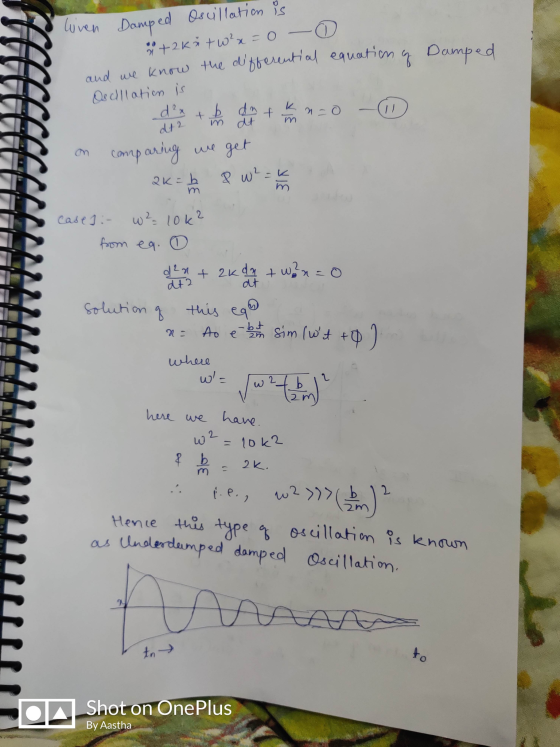
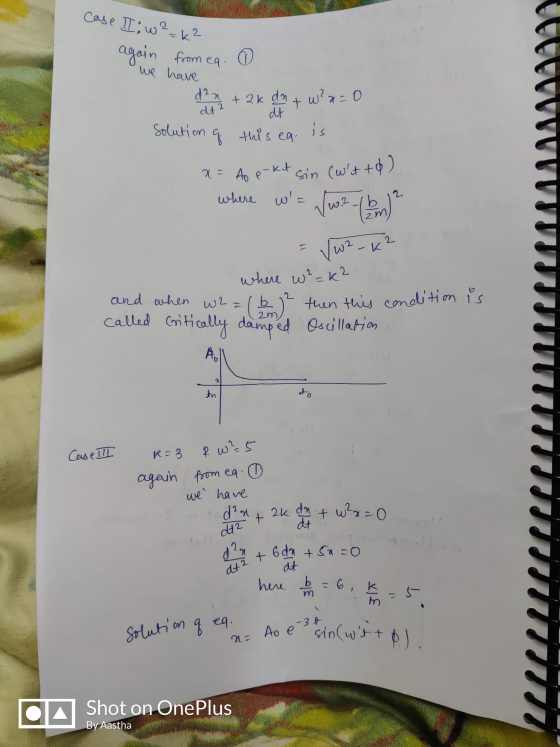
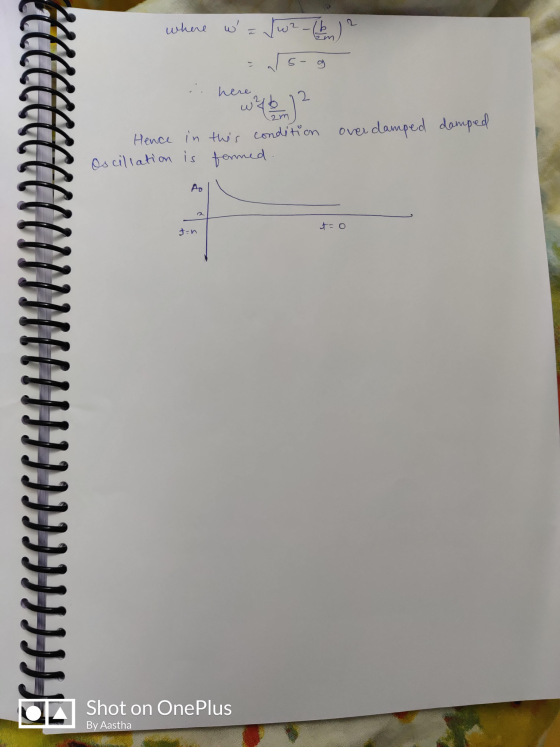
Solve the damped harmonic motion system * + 2ki+w²x = 0 with initial conditions i =...
(1 point) This problem is an example of critically damped harmonic motion. A mass m =...
 (1 point) This problem is an example of critically damped harmonic motion. A mass m = 6 kg is attached to both a spring with spring constant k = 150 N/m and a dash-pot with damping constant c = 60 N· s/m . The ball is started in motion with initial position Xo = 8 m and initial velocity vo = -42 m/s. Determine the position function x(t) in meters. x(t) = Graph the function x(t). Now assume the mass...
Question 4 A viscously damped SDOF system oscillates at a simple harmonic motion given by x(t)-X...
 Question 4 A viscously damped SDOF system oscillates at a simple harmonic motion given by x(t)-X sin(wdt) meters, where the amplitude is 0.2 meters. For the following parameters: Mass 7 kg; Damping constant 6 N-sec/m; Stiffness = 916 N/m. Find The damped frequency
Solve it with matlab 25.16 The motion of a damped spring-mass system (Fig. P25.16) is described...
 Solve it with matlab
25.16 The motion of a damped spring-mass system (Fig. P25.16) is described by the following ordinary differential equation: d’x dx ++ kx = 0 m dr dt where x = displacement from equilibrium position (m), t = time (s), m 20-kg mass, and c = the damping coefficient (N · s/m). The damping coefficient c takes on three values of 5 (under- damped), 40 (critically damped), and 200 (overdamped). The spring constant k = 20 N/m....
Solve it with matlab
25.16 The motion of a damped spring-mass system (Fig. P25.16) is described by the following ordinary differential equation: d’x dx ++ kx = 0 m dr dt where x = displacement from equilibrium position (m), t = time (s), m 20-kg mass, and c = the damping coefficient (N · s/m). The damping coefficient c takes on three values of 5 (under- damped), 40 (critically damped), and 200 (overdamped). The spring constant k = 20 N/m....
5. For each of the following, determine if the system is underdamped, undamped, critically damped or overdamped ad sket...
 5. For each of the following, determine if the system is underdamped, undamped, critically damped or overdamped ad sketch the it step response (a) G (s) = (c) G(s)-t 2+68+ (d) G (s) = 36 6. The equation of motion of a rotational mechanical system is given by where θ° and θί are respectively, output and input angular displace- ments. Assuming that all initial conditions are zero, determine (a) the transfer function model. (b) the natural frequency, w natural frequency,...
Solve the harmonic oscillator motion for initial conditions x(0) = 0, V(0) = V0 in the...
 Solve the harmonic oscillator motion for initial conditions x(0)
= 0, V(0) = V0 in the case of (a) underdamped
(b) overdamped
We were unable to transcribe this imageWe were unable to transcribe this imageWe were unable to transcribe this image
Solve the harmonic oscillator motion for initial conditions x(0)
= 0, V(0) = V0 in the case of (a) underdamped
(b) overdamped
We were unable to transcribe this imageWe were unable to transcribe this imageWe were unable to transcribe this image
5. For each of the following, determine if the system is underdamped, undamped, critically damped or...
 5. For each of the following, determine if the system is underdamped, undamped, critically damped or overdamped ad sketch the it step response (a) G (s) = (c) G(s)-t 2+68+ (d) G (s) = 36 6. The equation of motion of a rotational mechanical system is given by where θ° and θί are respectively, output and input angular displace- ments. Assuming that all initial conditions are zero, determine (a) the transfer function model. (b) the natural frequency, w natural frequency,...
I want matlab code. 585 i1 FIGURE P22.15 22.15 The motion of a damped spring-mass system (Fig. P22.15) is de...
 I want matlab code.
585 i1 FIGURE P22.15 22.15 The motion of a damped spring-mass system (Fig. P22.15) is described by the following ordinary differ- ential equation: dx dx in dt2 dt where x displacement from equilibrium position (m), t time (s), m 20-kg mass, and c the damping coefficient (N s/m). The damping coefficient c takes on three values of 5 (underdamped), 40 (critically damped), and 200 (over- damped). The spring constant k-20 N/m. The initial ve- locity is...
I want matlab code.
585 i1 FIGURE P22.15 22.15 The motion of a damped spring-mass system (Fig. P22.15) is described by the following ordinary differ- ential equation: dx dx in dt2 dt where x displacement from equilibrium position (m), t time (s), m 20-kg mass, and c the damping coefficient (N s/m). The damping coefficient c takes on three values of 5 (underdamped), 40 (critically damped), and 200 (over- damped). The spring constant k-20 N/m. The initial ve- locity is...
(0.49,2.58) (2.60,1.37) (3.65,-1.00) 1.55,-1.88) -3 Engineers often describe damped harmonic motion with the formula x(t) - R e-sn sin(odt) because both ζ and ad can be measured in a straightforward...
 (0.49,2.58) (2.60,1.37) (3.65,-1.00) 1.55,-1.88) -3 Engineers often describe damped harmonic motion with the formula x(t) - R e-sn sin(odt) because both ζ and ad can be measured in a straightforward way There is no phase shift ф because we have chosen an initial time t-0, to be a zero of x(t) If you measure the times and displacements, (ti,xi) and (t2,X2), at two consecutive peaks, then, T-t2 ti is called the quasi-period, and is the damped natural frequency or quasi-frequency...
7. An object attached with a spring undergoes simple harmonic motion, represented by the displacement = (1.0m) Cos...
 7. An object attached with a spring undergoes simple harmonic motion, represented by the displacement = (1.0m) Cos (1.5m t) . Compare with the standard equation for simple harmonic equation: x = A cos (w t). (i) Find the amplitude of oscillation? ute ew m .s (ii) Calculate the displacement x at t 0, 1, 2, 3, 4 and 5 seconds and filled the table below (calculator should be in radian mode for finding x values ) Displacement x (m)...
Problem 17. Consider the standard amplitude-modulation system shown in Figure 3 Figure 3 x) Chann...
 Analysis Linear Systems
Problem 17. Consider the standard amplitude-modulation system shown in Figure 3 Figure 3 x) Channel Filter he(r) cos wor cos ωοι M(w) H(u) (a) Sketch the spectrum of r(t). (b) Sketch the spectrum of y(t) for the following cases: (i) 0S WcWo-m (iii) wc >wowm (c) Sketch the spectrum of z(t) for the following cases: (i) 0 S WcWo-m (iii) wc >wowm d) Sketch the spectrum of v(t) if we wowm and (i) w
Analysis Linear Systems
Problem 17. Consider the standard amplitude-modulation system shown in Figure 3 Figure 3 x) Channel Filter he(r) cos wor cos ωοι M(w) H(u) (a) Sketch the spectrum of r(t). (b) Sketch the spectrum of y(t) for the following cases: (i) 0S WcWo-m (iii) wc >wowm (c) Sketch the spectrum of z(t) for the following cases: (i) 0 S WcWo-m (iii) wc >wowm d) Sketch the spectrum of v(t) if we wowm and (i) w
 (1 point) This problem is an example of critically damped harmonic motion. A mass m = 6 kg is attached to both a spring with spring constant k = 150 N/m and a dash-pot with damping constant c = 60 N· s/m . The ball is started in motion with initial position Xo = 8 m and initial velocity vo = -42 m/s. Determine the position function x(t) in meters. x(t) = Graph the function x(t). Now assume the mass...
 Question 4 A viscously damped SDOF system oscillates at a simple harmonic motion given by x(t)-X sin(wdt) meters, where the amplitude is 0.2 meters. For the following parameters: Mass 7 kg; Damping constant 6 N-sec/m; Stiffness = 916 N/m. Find The damped frequency
 Solve it with matlab
25.16 The motion of a damped spring-mass system (Fig. P25.16) is described by the following ordinary differential equation: d’x dx ++ kx = 0 m dr dt where x = displacement from equilibrium position (m), t = time (s), m 20-kg mass, and c = the damping coefficient (N · s/m). The damping coefficient c takes on three values of 5 (under- damped), 40 (critically damped), and 200 (overdamped). The spring constant k = 20 N/m....
Solve it with matlab
25.16 The motion of a damped spring-mass system (Fig. P25.16) is described by the following ordinary differential equation: d’x dx ++ kx = 0 m dr dt where x = displacement from equilibrium position (m), t = time (s), m 20-kg mass, and c = the damping coefficient (N · s/m). The damping coefficient c takes on three values of 5 (under- damped), 40 (critically damped), and 200 (overdamped). The spring constant k = 20 N/m....
 5. For each of the following, determine if the system is underdamped, undamped, critically damped or overdamped ad sketch the it step response (a) G (s) = (c) G(s)-t 2+68+ (d) G (s) = 36 6. The equation of motion of a rotational mechanical system is given by where θ° and θί are respectively, output and input angular displace- ments. Assuming that all initial conditions are zero, determine (a) the transfer function model. (b) the natural frequency, w natural frequency,...
 Solve the harmonic oscillator motion for initial conditions x(0)
= 0, V(0) = V0 in the case of (a) underdamped
(b) overdamped
We were unable to transcribe this imageWe were unable to transcribe this imageWe were unable to transcribe this image
Solve the harmonic oscillator motion for initial conditions x(0)
= 0, V(0) = V0 in the case of (a) underdamped
(b) overdamped
We were unable to transcribe this imageWe were unable to transcribe this imageWe were unable to transcribe this image
 5. For each of the following, determine if the system is underdamped, undamped, critically damped or overdamped ad sketch the it step response (a) G (s) = (c) G(s)-t 2+68+ (d) G (s) = 36 6. The equation of motion of a rotational mechanical system is given by where θ° and θί are respectively, output and input angular displace- ments. Assuming that all initial conditions are zero, determine (a) the transfer function model. (b) the natural frequency, w natural frequency,...
 I want matlab code.
585 i1 FIGURE P22.15 22.15 The motion of a damped spring-mass system (Fig. P22.15) is described by the following ordinary differ- ential equation: dx dx in dt2 dt where x displacement from equilibrium position (m), t time (s), m 20-kg mass, and c the damping coefficient (N s/m). The damping coefficient c takes on three values of 5 (underdamped), 40 (critically damped), and 200 (over- damped). The spring constant k-20 N/m. The initial ve- locity is...
I want matlab code.
585 i1 FIGURE P22.15 22.15 The motion of a damped spring-mass system (Fig. P22.15) is described by the following ordinary differ- ential equation: dx dx in dt2 dt where x displacement from equilibrium position (m), t time (s), m 20-kg mass, and c the damping coefficient (N s/m). The damping coefficient c takes on three values of 5 (underdamped), 40 (critically damped), and 200 (over- damped). The spring constant k-20 N/m. The initial ve- locity is...
 (0.49,2.58) (2.60,1.37) (3.65,-1.00) 1.55,-1.88) -3 Engineers often describe damped harmonic motion with the formula x(t) - R e-sn sin(odt) because both ζ and ad can be measured in a straightforward way There is no phase shift ф because we have chosen an initial time t-0, to be a zero of x(t) If you measure the times and displacements, (ti,xi) and (t2,X2), at two consecutive peaks, then, T-t2 ti is called the quasi-period, and is the damped natural frequency or quasi-frequency...
 7. An object attached with a spring undergoes simple harmonic motion, represented by the displacement = (1.0m) Cos (1.5m t) . Compare with the standard equation for simple harmonic equation: x = A cos (w t). (i) Find the amplitude of oscillation? ute ew m .s (ii) Calculate the displacement x at t 0, 1, 2, 3, 4 and 5 seconds and filled the table below (calculator should be in radian mode for finding x values ) Displacement x (m)...
 Analysis Linear Systems
Problem 17. Consider the standard amplitude-modulation system shown in Figure 3 Figure 3 x) Channel Filter he(r) cos wor cos ωοι M(w) H(u) (a) Sketch the spectrum of r(t). (b) Sketch the spectrum of y(t) for the following cases: (i) 0S WcWo-m (iii) wc >wowm (c) Sketch the spectrum of z(t) for the following cases: (i) 0 S WcWo-m (iii) wc >wowm d) Sketch the spectrum of v(t) if we wowm and (i) w
Analysis Linear Systems
Problem 17. Consider the standard amplitude-modulation system shown in Figure 3 Figure 3 x) Channel Filter he(r) cos wor cos ωοι M(w) H(u) (a) Sketch the spectrum of r(t). (b) Sketch the spectrum of y(t) for the following cases: (i) 0S WcWo-m (iii) wc >wowm (c) Sketch the spectrum of z(t) for the following cases: (i) 0 S WcWo-m (iii) wc >wowm d) Sketch the spectrum of v(t) if we wowm and (i) w
Most questions answered within 3 hours.
-
Where is the error in this code sequence?
String s1 = "Hello";
String s2 = "ello";...
asked 10 months ago -
Financial data for Joel de Paris, Inc., for last year
follow:
Joel de Paris, Inc.
Balance...
asked 10 months ago -
Consider this reaction:
Al2(SO4)3 (aq)+ BaCl3
(aq) Al2Cl6 (aq)- +
3BaSO4(s) . What is the...
asked 10 months ago -
Suppose that Savneet is considering increasing her
recent random sample from 20 car rentals to 40...
asked 10 months ago -
Trucks arrive at an unloading terminal at an average rate of 120
per hour.
Trucks arrive...
asked 10 months ago -
Why are methanol and ethanol completely soluble in water while
octanol is not very little soluble....
asked 10 months ago -
A facilities manager at a university reads in a research report
that the mean amount of...
asked 10 months ago -
When the CuSO4 is rehydrated by adding water to the anhydrous
compound, is this an endothermic...
asked 10 months ago -
A ray of sunlight is passing from diamond into crown glass; the
angle of incidence is...
asked 10 months ago -
A block of mass 0.249 kg is placed on top of a light, vertical
spring of...
asked 10 months ago -
how do the kidneys compensate in the presences of acidosis
a) trigger hyperventilate
b) reserve acid...
asked 10 months ago -
Question 501 pts
The rental rate of capital to the firm increases. Which of the
following...
asked 10 months ago