
Homework Answers
In the question it is mentioned that at t = 36 sec the train is moving at 8 m/s to the west.
The answer can't be acceleration because the acceleration is change in velocity with time.
Now since the direction is mention it is definitely velocity and not speed.
Also we are given the velocity at a certain point of time ! So this will be instantaneous velocity.
So option 4 ( instantaneous velocity) is correct.
Kindly upvote !!
Add Answer to:
A train leaves a station, starting from rest, at time t=0s. At time t= 36 s,...
A passenger train starts from rest and leaves a station with a constant acceleration. During a...
A passenger train starts from rest and leaves a station with a constant acceleration. During a certain time interval, the displacement of the train increases to three times the value it had at the start of that interval. During that same time interval, determine the increase in the train’s velocity? Let v represent the speed of the train at the end of the time interval and v0 represent the speed at the beginning of the interval. a) v = v0...
2 A train is at rest in a railway station. At time t = 0, the...
 2 A train is at rest in a railway station. At time t = 0, the train starts to move forwards with an increasing speed until it reaches its maximum speed at time t = 48 s. Fig. 1.1 is the speed-time graph for the first 48s of the journey. 40 30- speed m/s 20- 10- 0 20 40 60 80 100 120 time/s Fig. 1.1 (a) (0) State how the graph shows that, during the first 48s of the...
Q.4 A train starts in a train station at time t = 0 s at position...
 Q.4 A train starts in a train station at time t = 0 s at position r = 0 m. For 1 minute, the train has a constant acceleration a = 1 ms? then it has zero acceleration for 5 minutes, then it has a constant acceleration a = -0.25 m s-2 for 4 minutes until it stops with zero velocity at the next train station. The train track is a straight line. Draw a graph of the velocity of...
A train on a straight track starts from rest t station A. It accelerates for 20...
A train on a straight track starts from rest t station A. It accelerates for 20 seconds with an acceleration of 5 m/s^2 and then continues to travel at the velocity reached for two minutes. The train then decelerates at 5 m/s^2 for 20 seconds before coming to a stop at the next station B. What is the distance between the two stations?
A commuter train leaves a station( constant operating speed. a) What is the operating speed of...
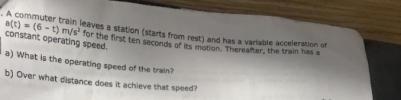 A commuter train leaves a station( constant operating speed. a) What is the operating speed of the train? b) Over what distance does it achieve that speed? starts from rest) and has a variable acceleration of ) m/s* for the first ten seconds of its motion. Thereafter, the train has a
A train has a length of 104 m and starts from rest with a constant acceleration...
A train has a length of 104 m and starts from rest with a constant acceleration at time t = 0 s. At this instant, a car just reaches the end of the train. The car is moving with a constant velocity. At a time t = 8.14 s, the car just reaches the front of the train. Ultimately, however, the train pulls ahead of the car, and at time t = 39.9 s, the car is again at the...
At time, t=0s, car A is at rest at the origin of the coordinate system and...
At time, t=0s, car A is at rest at the origin of the coordinate system and car B is moving due east at a constant velocity of 20.0m/s. When car B is 50.0m west of car A, car A starts to move at a constant acceleration of 2.00m/s2 due east. how far from the origin has car a moved when car B overtakes car A. use graph of position vs time for both cars.
A train has a length of 107 m and starts from rest with a constant acceleration...
A train has a length of 107 m and starts from rest with a constant acceleration at time t = 0 s. At this instant, a car just reaches the end of the train. The car is moving with a constant velocity. At a time t = 11.3 s, the car just reaches the front of the train. Ultimately, however, the train pulls ahead of the car, and at time t = 37.3 s, the car is again at the...
Due date: Thu Jan 31 11:59:59 pm 2019 (EST) (hrw8c2p90) A train started from rest and...
 Due date: Thu Jan 31 11:59:59 pm 2019 (EST) (hrw8c2p90) A train started from rest and moved with con- stant acceleration. At one time it was traveling vo 30.00 m /s, and 170.0 m farther on it was traveling v = 55.00 m/s. Calculate the acceleration. m is Tries 0/8 Calculate the time required to travel the 170.0 m mentioned. Tries 0/8 Calculate the time required to attain the speed of 30.00 m/s. Tries 0/8 Calculate the distance moved from...
A train started from rest and moved with constant acceleration. At one time it was traveling...
A train started from rest and moved with constant acceleration. At one time it was traveling 30 m/s, and 170 m farther on it was traveling 49 m/s. Calculate (a) the acceleration, (b) the time required to travel the 170 m mentioned, (c) the time required to attain the speed of 30 m/s, and (d) the distance moved from rest to the time the train had a speed of 30 m/s.
 2 A train is at rest in a railway station. At time t = 0, the train starts to move forwards with an increasing speed until it reaches its maximum speed at time t = 48 s. Fig. 1.1 is the speed-time graph for the first 48s of the journey. 40 30- speed m/s 20- 10- 0 20 40 60 80 100 120 time/s Fig. 1.1 (a) (0) State how the graph shows that, during the first 48s of the...
 Q.4 A train starts in a train station at time t = 0 s at position r = 0 m. For 1 minute, the train has a constant acceleration a = 1 ms? then it has zero acceleration for 5 minutes, then it has a constant acceleration a = -0.25 m s-2 for 4 minutes until it stops with zero velocity at the next train station. The train track is a straight line. Draw a graph of the velocity of...
 A commuter train leaves a station( constant operating speed. a) What is the operating speed of the train? b) Over what distance does it achieve that speed? starts from rest) and has a variable acceleration of ) m/s* for the first ten seconds of its motion. Thereafter, the train has a
 Due date: Thu Jan 31 11:59:59 pm 2019 (EST) (hrw8c2p90) A train started from rest and moved with con- stant acceleration. At one time it was traveling vo 30.00 m /s, and 170.0 m farther on it was traveling v = 55.00 m/s. Calculate the acceleration. m is Tries 0/8 Calculate the time required to travel the 170.0 m mentioned. Tries 0/8 Calculate the time required to attain the speed of 30.00 m/s. Tries 0/8 Calculate the distance moved from...
Most questions answered within 3 hours.
-
Where is the error in this code sequence?
String s1 = "Hello";
String s2 = "ello";...
asked 10 months ago -
Financial data for Joel de Paris, Inc., for last year
follow:
Joel de Paris, Inc.
Balance...
asked 10 months ago -
Consider this reaction:
Al2(SO4)3 (aq)+ BaCl3
(aq) Al2Cl6 (aq)- +
3BaSO4(s) . What is the...
asked 10 months ago -
Suppose that Savneet is considering increasing her
recent random sample from 20 car rentals to 40...
asked 10 months ago -
Trucks arrive at an unloading terminal at an average rate of 120
per hour.
Trucks arrive...
asked 10 months ago -
Why are methanol and ethanol completely soluble in water while
octanol is not very little soluble....
asked 10 months ago -
A facilities manager at a university reads in a research report
that the mean amount of...
asked 10 months ago -
When the CuSO4 is rehydrated by adding water to the anhydrous
compound, is this an endothermic...
asked 10 months ago -
A ray of sunlight is passing from diamond into crown glass; the
angle of incidence is...
asked 10 months ago -
A block of mass 0.249 kg is placed on top of a light, vertical
spring of...
asked 10 months ago -
how do the kidneys compensate in the presences of acidosis
a) trigger hyperventilate
b) reserve acid...
asked 10 months ago -
Question 501 pts
The rental rate of capital to the firm increases. Which of the
following...
asked 10 months ago