In aqueous basic or acidic solutions, carbonyl compounds are in equilibrium with their enol forms.
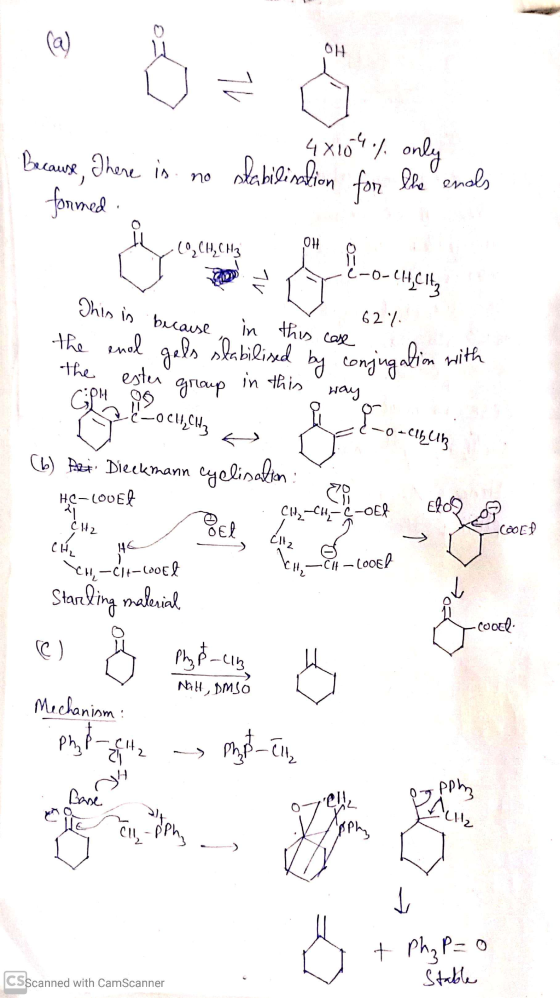
a) The protonation of enol in a neat sample of the two ketones below are shown. Explain why they are so different.
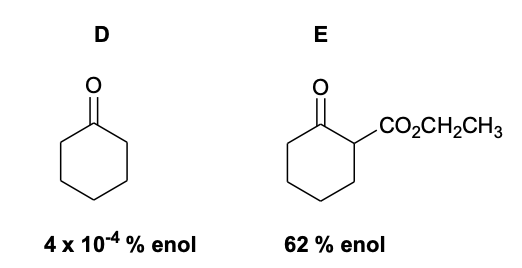
b) Show the starting material, conditions and mechanism for formation of compound E using a Dieckmann condensation reaction.
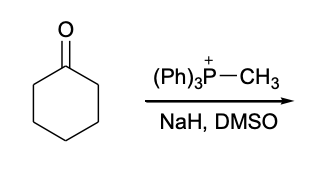
c) Provide a product of the following reaction.
Homework Answers
Add Answer to:
In aqueous basic or acidic solutions, carbonyl compounds are in
equilibrium with their enol forms.
a)...
Predict whether aqueous solutions of the following compounds are acidic, basic, or neutral solution is...? compound aci...
 Predict whether aqueous solutions of the following compounds are acidic, basic, or neutral solution is...? compound acidic K Br basic neutral acidic basic КОН neutral acidic NHNO3 basic neutral ? X
Predict whether aqueous solutions of the following compounds are acidic, basic, or neutral solution is...? compound acidic K Br basic neutral acidic basic КОН neutral acidic NHNO3 basic neutral ? X
Predict whether aqueous solutions of the following compounds are acidic, basic, or neutral solution is...? compound acidic K Br basic neutral acidic basic КОН neutral acidic NHNO3 basic neutral ? X
Please explain each answer Predict whether aqueous solutions of the following compounds are acidic, basic, or...
 Please explain each answer
Predict whether aqueous solutions of the following compounds are acidic, basic, or neutral. compound Cr(NO) solution is...? acidic O basic O neutral NH,CI O acidic basic O neutral acidic Nal basic neutral x 6 ?
Please explain each answer
Predict whether aqueous solutions of the following compounds are acidic, basic, or neutral. compound Cr(NO) solution is...? acidic O basic O neutral NH,CI O acidic basic O neutral acidic Nal basic neutral x 6 ?
Part A:Part B: Predict whether aqueous solutions of the following compounds will be acidic, basic or...
 Part A:Part B:
Predict whether aqueous solutions of the following compounds will be acidic, basic or neutral. If the solution would be acidic or basic, circle the ion that causes the pH to change. a) NH Brb ) FeCl, c) K,CO, d) KCIO e) NaBr f) MgCl, g) NaF h) LiNO Two unknown acid solutions are both labelled 0.50 M. How could you determine which is the strong acid and which is the weak acid? Explain.
Part A:Part B:
Predict whether aqueous solutions of the following compounds will be acidic, basic or neutral. If the solution would be acidic or basic, circle the ion that causes the pH to change. a) NH Brb ) FeCl, c) K,CO, d) KCIO e) NaBr f) MgCl, g) NaF h) LiNO Two unknown acid solutions are both labelled 0.50 M. How could you determine which is the strong acid and which is the weak acid? Explain.
identify which compound is more acidic and explain your choice. or each of the following compounds,...
 identify which compound is more acidic and explain your choice. or each of the following compounds, Make sure you include structures of these which compounds in your answers ounds, 1. F (e) 24-Dimethy-3,5-hepanedione or 4, 4-Dimethy)-3,5-heptanedione (b) 1.2-Cyclopentanedione or 1,3-cyclopentanedione 2. When 2-hepten-4-one is treated with LDA, a proton is removed from one of the gamma (z) positions. identily which gamma position is deprotonated, and explain why the y proton is the most acidie proton in the compound. 3. Rank...
organic chemistry 3. The starting material below forms a six-membered cyclic hemiacetal in an aqueous solution:...
 organic chemistry
3. The starting material below forms a six-membered cyclic hemiacetal in an aqueous solution: (pis) r , " a) Name the starting material b) Draw the mechanism of the reaction above. Note the role of H". c) How many stereoisomers are possible for the starting material? d) How many stereoisomers are possible for the cyclic hemiacetal? 4. Propose a mechanism for the formation of the cyclic acetal by treating acetone with ethylene glycol in the presence of an...
organic chemistry
3. The starting material below forms a six-membered cyclic hemiacetal in an aqueous solution: (pis) r , " a) Name the starting material b) Draw the mechanism of the reaction above. Note the role of H". c) How many stereoisomers are possible for the starting material? d) How many stereoisomers are possible for the cyclic hemiacetal? 4. Propose a mechanism for the formation of the cyclic acetal by treating acetone with ethylene glycol in the presence of an...
Permanganate, MnO4–, can act as an oxidizing agent in both acidic and basic aqueous solutions. Balance each of the following reactions by the half–reaction method, showing all steps in the balancing process.
Permanganate, MnO4–, can act as an oxidizing agent in both acidic and basic aqueous solutions. Balance each of the following reactions by the half–reaction method, showing all steps in the balancing process. i. MnO4– + Al ––> MnO2 + Al(OH)4– in aqueous base ii. MnO4– + CH3COOH ––> Mn+2 + CO2 in aqueous acid
Can you help me identify reagent (i), Compound 8 and Compound 12 in the reaction scheme?...
 Can you help me identify reagent (i), Compound 8 and
Compound 12 in the reaction scheme?
You have laboratory data on all the compounds in the
synthesis, however the amount of data available to you varies. Some
have the entirety of the spectral data, others have as little as
the elemental analysis. Use the laboratory data to help you
discover which reaction has been performed.
The lab data for Compound 8 and 12 is as
follows:
You can use any...
Can you help me identify reagent (i), Compound 8 and
Compound 12 in the reaction scheme?
You have laboratory data on all the compounds in the
synthesis, however the amount of data available to you varies. Some
have the entirety of the spectral data, others have as little as
the elemental analysis. Use the laboratory data to help you
discover which reaction has been performed.
The lab data for Compound 8 and 12 is as
follows:
You can use any...
Please explain what is going on in this lab for STEP 3. what are some important...
 Please explain what is going on in this lab for STEP 3. what
are some important factors?
Multistep Synthesis Preparation of 4,4-Diphenyl-3-buten-2-one! This experiment illustrates se multistep synthesis, in which the the next. This process is very common iment illustrates several important concepts of organic synthesis. It is a synthesis, in which the product of one reaction becomes the starting material of This process is very common in industry and research, and demands careful to vields and techniques. The experiment...
Please explain what is going on in this lab for STEP 3. what
are some important factors?
Multistep Synthesis Preparation of 4,4-Diphenyl-3-buten-2-one! This experiment illustrates se multistep synthesis, in which the the next. This process is very common iment illustrates several important concepts of organic synthesis. It is a synthesis, in which the product of one reaction becomes the starting material of This process is very common in industry and research, and demands careful to vields and techniques. The experiment...
Construct a flow chart describing the seperation of the mixture and the isolation of each compound...
 Construct a flow chart describing the seperation of the
mixture and the isolation of each compound in this experiment. (Lab
steps/procedures includes for reference)
4. Construct a flow chart describing the separation of the mixture and the isolation of each compound in this experiment. A commonly used method of separating a mixture of organic compounds is known as liquid-liquid extraction. Most reactions of organic compounds require extraction at some stage of product purification. In this experiment you will use extraction...
Construct a flow chart describing the seperation of the
mixture and the isolation of each compound in this experiment. (Lab
steps/procedures includes for reference)
4. Construct a flow chart describing the separation of the mixture and the isolation of each compound in this experiment. A commonly used method of separating a mixture of organic compounds is known as liquid-liquid extraction. Most reactions of organic compounds require extraction at some stage of product purification. In this experiment you will use extraction...
please answer the prelab excercise:) I tried doing it but I did not get very far Experiment 7: Grignard Reactio...
 please answer the prelab excercise:) I tried doing it but I did not
get very far
Experiment 7: Grignard Reaction. Introduction Discovered by French chemist Victor Grignard, the reaction that now bears his name is an example of the preparation of an organometallic reagent. In this lab, phenylmagnesium bromide is the Grignard of interest, and it will be added to an aldehyde to produce an alcohol. Lab Objectives 1. To study organometallic reagents in general. benzophenone. 2. To prepare phenylmagnesium...
please answer the prelab excercise:) I tried doing it but I did not
get very far
Experiment 7: Grignard Reaction. Introduction Discovered by French chemist Victor Grignard, the reaction that now bears his name is an example of the preparation of an organometallic reagent. In this lab, phenylmagnesium bromide is the Grignard of interest, and it will be added to an aldehyde to produce an alcohol. Lab Objectives 1. To study organometallic reagents in general. benzophenone. 2. To prepare phenylmagnesium...
 Predict whether aqueous solutions of the following compounds are acidic, basic, or neutral solution is...? compound acidic K Br basic neutral acidic basic КОН neutral acidic NHNO3 basic neutral ? X
Predict whether aqueous solutions of the following compounds are acidic, basic, or neutral solution is...? compound acidic K Br basic neutral acidic basic КОН neutral acidic NHNO3 basic neutral ? X
Predict whether aqueous solutions of the following compounds are acidic, basic, or neutral solution is...? compound acidic K Br basic neutral acidic basic КОН neutral acidic NHNO3 basic neutral ? X
 Please explain each answer
Predict whether aqueous solutions of the following compounds are acidic, basic, or neutral. compound Cr(NO) solution is...? acidic O basic O neutral NH,CI O acidic basic O neutral acidic Nal basic neutral x 6 ?
Please explain each answer
Predict whether aqueous solutions of the following compounds are acidic, basic, or neutral. compound Cr(NO) solution is...? acidic O basic O neutral NH,CI O acidic basic O neutral acidic Nal basic neutral x 6 ?
 Part A:Part B:
Predict whether aqueous solutions of the following compounds will be acidic, basic or neutral. If the solution would be acidic or basic, circle the ion that causes the pH to change. a) NH Brb ) FeCl, c) K,CO, d) KCIO e) NaBr f) MgCl, g) NaF h) LiNO Two unknown acid solutions are both labelled 0.50 M. How could you determine which is the strong acid and which is the weak acid? Explain.
Part A:Part B:
Predict whether aqueous solutions of the following compounds will be acidic, basic or neutral. If the solution would be acidic or basic, circle the ion that causes the pH to change. a) NH Brb ) FeCl, c) K,CO, d) KCIO e) NaBr f) MgCl, g) NaF h) LiNO Two unknown acid solutions are both labelled 0.50 M. How could you determine which is the strong acid and which is the weak acid? Explain.
 identify which compound is more acidic and explain your choice. or each of the following compounds, Make sure you include structures of these which compounds in your answers ounds, 1. F (e) 24-Dimethy-3,5-hepanedione or 4, 4-Dimethy)-3,5-heptanedione (b) 1.2-Cyclopentanedione or 1,3-cyclopentanedione 2. When 2-hepten-4-one is treated with LDA, a proton is removed from one of the gamma (z) positions. identily which gamma position is deprotonated, and explain why the y proton is the most acidie proton in the compound. 3. Rank...
 organic chemistry
3. The starting material below forms a six-membered cyclic hemiacetal in an aqueous solution: (pis) r , " a) Name the starting material b) Draw the mechanism of the reaction above. Note the role of H". c) How many stereoisomers are possible for the starting material? d) How many stereoisomers are possible for the cyclic hemiacetal? 4. Propose a mechanism for the formation of the cyclic acetal by treating acetone with ethylene glycol in the presence of an...
organic chemistry
3. The starting material below forms a six-membered cyclic hemiacetal in an aqueous solution: (pis) r , " a) Name the starting material b) Draw the mechanism of the reaction above. Note the role of H". c) How many stereoisomers are possible for the starting material? d) How many stereoisomers are possible for the cyclic hemiacetal? 4. Propose a mechanism for the formation of the cyclic acetal by treating acetone with ethylene glycol in the presence of an...
 Can you help me identify reagent (i), Compound 8 and
Compound 12 in the reaction scheme?
You have laboratory data on all the compounds in the
synthesis, however the amount of data available to you varies. Some
have the entirety of the spectral data, others have as little as
the elemental analysis. Use the laboratory data to help you
discover which reaction has been performed.
The lab data for Compound 8 and 12 is as
follows:
You can use any...
Can you help me identify reagent (i), Compound 8 and
Compound 12 in the reaction scheme?
You have laboratory data on all the compounds in the
synthesis, however the amount of data available to you varies. Some
have the entirety of the spectral data, others have as little as
the elemental analysis. Use the laboratory data to help you
discover which reaction has been performed.
The lab data for Compound 8 and 12 is as
follows:
You can use any...
 Please explain what is going on in this lab for STEP 3. what
are some important factors?
Multistep Synthesis Preparation of 4,4-Diphenyl-3-buten-2-one! This experiment illustrates se multistep synthesis, in which the the next. This process is very common iment illustrates several important concepts of organic synthesis. It is a synthesis, in which the product of one reaction becomes the starting material of This process is very common in industry and research, and demands careful to vields and techniques. The experiment...
Please explain what is going on in this lab for STEP 3. what
are some important factors?
Multistep Synthesis Preparation of 4,4-Diphenyl-3-buten-2-one! This experiment illustrates se multistep synthesis, in which the the next. This process is very common iment illustrates several important concepts of organic synthesis. It is a synthesis, in which the product of one reaction becomes the starting material of This process is very common in industry and research, and demands careful to vields and techniques. The experiment...
 Construct a flow chart describing the seperation of the
mixture and the isolation of each compound in this experiment. (Lab
steps/procedures includes for reference)
4. Construct a flow chart describing the separation of the mixture and the isolation of each compound in this experiment. A commonly used method of separating a mixture of organic compounds is known as liquid-liquid extraction. Most reactions of organic compounds require extraction at some stage of product purification. In this experiment you will use extraction...
Construct a flow chart describing the seperation of the
mixture and the isolation of each compound in this experiment. (Lab
steps/procedures includes for reference)
4. Construct a flow chart describing the separation of the mixture and the isolation of each compound in this experiment. A commonly used method of separating a mixture of organic compounds is known as liquid-liquid extraction. Most reactions of organic compounds require extraction at some stage of product purification. In this experiment you will use extraction...
 please answer the prelab excercise:) I tried doing it but I did not
get very far
Experiment 7: Grignard Reaction. Introduction Discovered by French chemist Victor Grignard, the reaction that now bears his name is an example of the preparation of an organometallic reagent. In this lab, phenylmagnesium bromide is the Grignard of interest, and it will be added to an aldehyde to produce an alcohol. Lab Objectives 1. To study organometallic reagents in general. benzophenone. 2. To prepare phenylmagnesium...
please answer the prelab excercise:) I tried doing it but I did not
get very far
Experiment 7: Grignard Reaction. Introduction Discovered by French chemist Victor Grignard, the reaction that now bears his name is an example of the preparation of an organometallic reagent. In this lab, phenylmagnesium bromide is the Grignard of interest, and it will be added to an aldehyde to produce an alcohol. Lab Objectives 1. To study organometallic reagents in general. benzophenone. 2. To prepare phenylmagnesium...
Most questions answered within 3 hours.
-
Where is the error in this code sequence?
String s1 = "Hello";
String s2 = "ello";...
asked 10 months ago -
Financial data for Joel de Paris, Inc., for last year
follow:
Joel de Paris, Inc.
Balance...
asked 10 months ago -
Consider this reaction:
Al2(SO4)3 (aq)+ BaCl3
(aq) Al2Cl6 (aq)- +
3BaSO4(s) . What is the...
asked 10 months ago -
Suppose that Savneet is considering increasing her
recent random sample from 20 car rentals to 40...
asked 10 months ago -
Trucks arrive at an unloading terminal at an average rate of 120
per hour.
Trucks arrive...
asked 10 months ago -
Why are methanol and ethanol completely soluble in water while
octanol is not very little soluble....
asked 10 months ago -
A facilities manager at a university reads in a research report
that the mean amount of...
asked 10 months ago -
When the CuSO4 is rehydrated by adding water to the anhydrous
compound, is this an endothermic...
asked 10 months ago -
A ray of sunlight is passing from diamond into crown glass; the
angle of incidence is...
asked 10 months ago -
A block of mass 0.249 kg is placed on top of a light, vertical
spring of...
asked 10 months ago -
how do the kidneys compensate in the presences of acidosis
a) trigger hyperventilate
b) reserve acid...
asked 10 months ago -
Question 501 pts
The rental rate of capital to the firm increases. Which of the
following...
asked 10 months ago