
Homework Answers
Add Answer to:
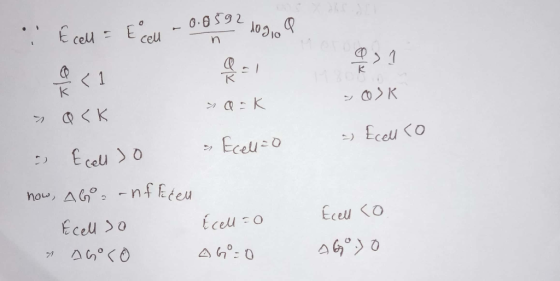
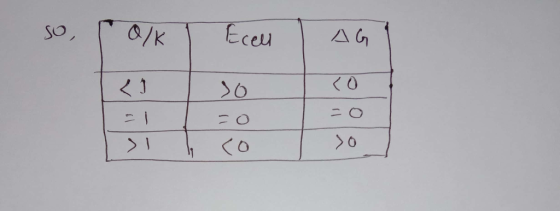
Complete this table relating the values of E_cell and Delta G to the Q/K ratio.
Complete this table relating the values of E_Cell and DeltaG degree to K.
 Complete this table relating the values of E_Cell and DeltaG degree to K.
Complete this table relating the values of AGⓇ and K. AG <0 >1 = 1 <1
 Complete this table relating the values of AGⓇ and K. AG <0 >1 = 1 <1
Complete this table relating the values of cell and AG to K cell AG >00 <0
 Complete this table relating the values of cell and AG to K cell AG >00 <0
8.) From the values of delta H and delta S, calculate delta G then predict whether...
 8.) From the values of delta H and delta S, calculate delta G then predict whether the following reactions would be spontaneous or not at 25 C. a) Reaction A: delta H= 10.5 kJ/mol, and delta S = 30 J/K mol b) Reaction B: delta H=1.8 kJ/mol, and delta S = -113 J/K mol 9.) Calculate the delta G and K, for the following equilibrium reaction at 25 C: 2H2O(Ⓡ) <-> 2H2(g) + O2(8) delta Gran H2O(x) = -228.6 kJ/mol
Using the values of Delta H and Delta S given, calculate Delta G for each of...
 Using the values of Delta H and Delta S given, calculate Delta G for each of the reactions at 25 degree C and indicate whether the reactions are spontaneous or non-spontaneous. Explain. Delta H = 10.5 kJ/mol and Delta S = 30.0 J/K-mol Delta H = -10.5 kJ/mol and Delta S = 105. J/K-mol
Calculate the value of K, at 298 K, for each value of delta G degree. delta...
 Calculate the value of K, at 298 K, for each value of delta G degree. delta G degree = 7.5 kJ/mol delta G degree = -9.0 kJ/mol
Determine H, q, w, and E at 298 K and 1 atm for the complete reaction...
Determine H, q, w, and E at 298 K and 1 atm for the complete reaction of 8.440 g of N2O4. N2O4(g) + 2N2H4(l) 3N2(g) + 4H2O(l). The heat of formation of liquid hydrazine (N2H4) is 50.63 kJ/mol. Use tabulated data for other heats of formation. The tolerance on each question is only 0.03 kJ, so express all answers to 0.01 kJ delta H = ______ q = ____ w = ______ delta E = ______
1a. ) Complete the table with signs and general values for K (ie: K<1 or K>1)...
1a. ) Complete the table with signs and general values for K (ie: K<1 or K>1) Always spontaneous Always nonspontaneous Spontaneous at high temperatures ΔG ΔH ΔS K 2. Calculate the boiling point (in K) for the following: X2 (l) --) X2 (g) ΔH = +35 kJ ΔS = + 215 J/K (HINT: what does ΔG equal when a reaction switches from spontaneous to nonspontaneous?) 1b. ) Trick question (refer to the table in #1): at what temperature does the...
given the values of delta Gf below in kj/mol calculate the value of delta G in...
given the values of delta Gf below in kj/mol calculate the value of delta G in kj for the reaction: NH4Cl (s) --> HCl (g) + NH3 (g) delta Gf (NH4Cl) = -205 delta Gf (HCl (g)) = -93 delta Gf (NH3) = -14
Which of the following statements about the expression Delta G=RTln (Q/K_eq) is not correct? It is...
 Which of the following statements about the expression Delta G=RTln (Q/K_eq) is not correct? It is the same as AG=RTln(Q) - Rti=In(K_eq). Delta G = 0 when Q = Keq. If Q = 1, then Delta G=RTln(Keq). Q can only equal K_eq at equilibrium.
 Complete this table relating the values of E_Cell and DeltaG degree to K.
 Complete this table relating the values of AGⓇ and K. AG <0 >1 = 1 <1
 Complete this table relating the values of cell and AG to K cell AG >00 <0
 8.) From the values of delta H and delta S, calculate delta G then predict whether the following reactions would be spontaneous or not at 25 C. a) Reaction A: delta H= 10.5 kJ/mol, and delta S = 30 J/K mol b) Reaction B: delta H=1.8 kJ/mol, and delta S = -113 J/K mol 9.) Calculate the delta G and K, for the following equilibrium reaction at 25 C: 2H2O(Ⓡ) <-> 2H2(g) + O2(8) delta Gran H2O(x) = -228.6 kJ/mol
 Using the values of Delta H and Delta S given, calculate Delta G for each of the reactions at 25 degree C and indicate whether the reactions are spontaneous or non-spontaneous. Explain. Delta H = 10.5 kJ/mol and Delta S = 30.0 J/K-mol Delta H = -10.5 kJ/mol and Delta S = 105. J/K-mol
 Calculate the value of K, at 298 K, for each value of delta G degree. delta G degree = 7.5 kJ/mol delta G degree = -9.0 kJ/mol
 Which of the following statements about the expression Delta G=RTln (Q/K_eq) is not correct? It is the same as AG=RTln(Q) - Rti=In(K_eq). Delta G = 0 when Q = Keq. If Q = 1, then Delta G=RTln(Keq). Q can only equal K_eq at equilibrium.
Most questions answered within 3 hours.
-
Where is the error in this code sequence?
String s1 = "Hello";
String s2 = "ello";...
asked 10 months ago -
Financial data for Joel de Paris, Inc., for last year
follow:
Joel de Paris, Inc.
Balance...
asked 10 months ago -
Consider this reaction:
Al2(SO4)3 (aq)+ BaCl3
(aq) Al2Cl6 (aq)- +
3BaSO4(s) . What is the...
asked 10 months ago -
Suppose that Savneet is considering increasing her
recent random sample from 20 car rentals to 40...
asked 10 months ago -
Trucks arrive at an unloading terminal at an average rate of 120
per hour.
Trucks arrive...
asked 10 months ago -
Why are methanol and ethanol completely soluble in water while
octanol is not very little soluble....
asked 10 months ago -
A facilities manager at a university reads in a research report
that the mean amount of...
asked 10 months ago -
When the CuSO4 is rehydrated by adding water to the anhydrous
compound, is this an endothermic...
asked 10 months ago -
A ray of sunlight is passing from diamond into crown glass; the
angle of incidence is...
asked 10 months ago -
A block of mass 0.249 kg is placed on top of a light, vertical
spring of...
asked 10 months ago -
how do the kidneys compensate in the presences of acidosis
a) trigger hyperventilate
b) reserve acid...
asked 10 months ago -
Question 501 pts
The rental rate of capital to the firm increases. Which of the
following...
asked 10 months ago