

Homework Answers
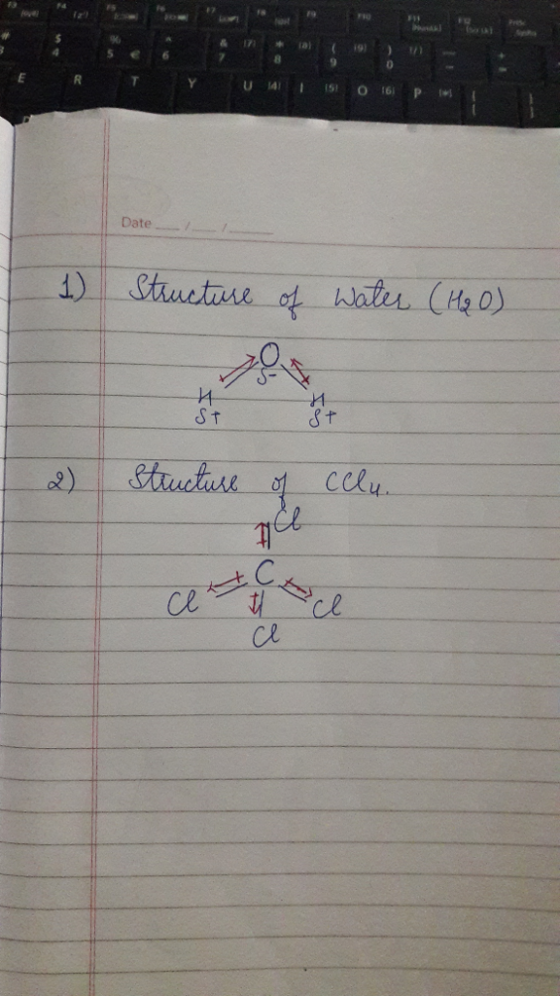
1) water is a polar solvent because of its bent structure as shown in the image. Oxygen is negatively charged and Hydrogen is positively charged.
2) it is non polar as due to the tetrahedral shape the polarity is cancelled.
3) solubility of a substance increases with rise in temperature.Temperature increases the kinetic energy due to which intermolecular attractions between the solute is broken and increases solubility.
4) spectator ions are the ions which remains on both reactant and product side and remain unchanged.They are omitted jn ionic equation because they don't play any role or don't participate in the reaction.
Add Answer to:
structure for water, showing that it is a polar solvent. for CCle carbon tetrachloride. Is this...
Post-Lab Questions Write your answers in pen and include tontits 1. Draw a structure for water, showing that it...
 Post-Lab Questions Write your answers in pen and include tontits 1. Draw a structure for water, showing that it is a polar solvent. 2. Draw a structure for CCL, carbon tetrachloride. Is this a polar or non-polar solvent? 3. Generally, what effect does increasing temperature have on the solubility of a substance? 4. Why are "spectator ions" not included in the net ionic reaction? 5. What did you observe in this experiment that tells us whether wax is polar or...
What is a polar solvent and carbon tetrachloride (CCI_4) is a nonpolar solvent. In which solvent...
 What is a polar solvent and carbon tetrachloride (CCI_4) is a nonpolar solvent. In which solvent is each of the following more likely to be soluble? NaNO_3, ionic in carbon tetrachloride (CCI_4)(a nonpolar solvent) in water (a polar solvent) I_2, nonpolar in carbon tetrachloride (CCI_4)(a nonpolar solvent in water (a polar solvent) sucross (table sugar) polar in water (a polar solvent) in carbon tetrachloride (CCI_4) (a nonpolar solvent) gasoline nonpolar in water (a polar solvent) in carbon tetrachloride (CCI_4)(a nonpolar...
II. Water is a polar solvent; CCI4 (Carbon tetrachloride) is a non-polar solvent. In which solvent...
 II. Water is a polar solvent; CCI4 (Carbon tetrachloride) is a non-polar solvent. In which solvent will the following substances be soluble? Explains briefly. (8 points) a) LINO3 b) gasoline c)C6H6 d) Na2S04
2. "Like Dissolves Like: Polarity and Solubility A. Polar Solvent: Water Salute Iodine Sodium chloride Obseruation...
 2. "Like Dissolves Like: Polarity and Solubility A. Polar Solvent: Water Salute Iodine Sodium chloride Obseruation Chip didn't dissolve some solid on Bottom Solid completely dissolved Chip floated on top of water Floated on top of water Sugar Wax Cooking oil of these solute? 1. What patterns do you observe regarding the polar and non-polar characteristics of these se 2. What effect do you think heating would have on the solubilities of these substances? B. Non-Polar Solvent: Toluene Solute lodine...
question 9.5) can someone please explain to me why CaCO3 is soluble in water and not...
 question 9.5)
can someone please explain to me why CaCO3 is soluble in water
and not carbon tetrachloride (CCl4)? thank you ?!
9.35 9.50 9.379.39 9.67 9.41 9.43 9.459.479.499.55 9.57 9.1 Identify the solute and the solvent in each solution composed of the following: a. 10.0 g of NaCl and 100.0 g of H, O b. 50.0 mL of ethanol, C, H, O, and 10.0 mL of H, O c. 0.20 L of O, and 0.80 L of N2 9.5...
question 9.5)
can someone please explain to me why CaCO3 is soluble in water
and not carbon tetrachloride (CCl4)? thank you ?!
9.35 9.50 9.379.39 9.67 9.41 9.43 9.459.479.499.55 9.57 9.1 Identify the solute and the solvent in each solution composed of the following: a. 10.0 g of NaCl and 100.0 g of H, O b. 50.0 mL of ethanol, C, H, O, and 10.0 mL of H, O c. 0.20 L of O, and 0.80 L of N2 9.5...
2. Identify the strongest type of intermolecular forces in acetone, ethanol, water and hexane. (Structures listed...
 2. Identify the strongest type of intermolecular forces in acetone, ethanol, water and hexane. (Structures listed on page 15.) Experiment 2 Intermolecular Forces There are three general types of intermolecular forces. All substances exhibit London Dispersion Forces (LDF), and they are generally the weakest of the three types. These London forces are due to the attractions between small, temporary dipoles that arise from the constant, random movement of the electrons in a substance. As molar mass increases, the size of...
2. Predict the electron pair geometry, molec following molecules by drawing the Lewis structure and us...
 2. Predict the electron pair geometry, molec following molecules by drawing the Lewis structure and us points). geometry, molecular shape, bond angle, and polarity of the ructure and using VSEPR theory (15 a. Chloramine, NH,CI b. Sulfur trioxide, SO: 3. Complete the following table (18 points): Name Formula Nickel(II) fluoride hexahydrate Potassium hydroxide Boron trihydride Iron(III) oxide ammonia Lead(II) sulfite Sodium bicarbonate Strontium chloride Copper(II) nitrate trihydrate NiF>.6 H.O КОН BH: Fe,O NH: PbSO, NaHCO, SICI: Cu(NO3)3 H20 Ionic, Covalent,...
kar 10-1 12. What sort of titration is the adjacent titration curve? Circle the correct response...
 kar 10-1 12. What sort of titration is the adjacent titration curve? Circle the correct response and explain your choice. SA/SB, SA/WB, SB/WA pH 13. Where is the effective buffer region in this titration curve? Circle this region on the graph. 4) Estimate the Ks of the weak base being titrated in this curve. . 10 20 30 13) Why does the pink color of phenolphthalein fade away? Was the equivalence point for the SA/SB system really where you expected...
need help Insert the missing coefficients to completely balance each chemical equation. equation...
 need help
Insert the missing coefficients to completely balance each chemical equation. equation 1: S+6 HNO, H,SO, + NO, +H,0 equation 2: 3 Cu + 8 HNO, Cu(NO), + NO + H2O We were unable to transcribe this imageBalance the equations by inserting coefficients as needed. equation 1: Sb + Cl, — SbCl, equation 2: Mg, N, + HCI — MgCl, +NH, Select the equation that best describes the reaction. O A+B, AB O 4 A +8 B — 4AB,...
need help
Insert the missing coefficients to completely balance each chemical equation. equation 1: S+6 HNO, H,SO, + NO, +H,0 equation 2: 3 Cu + 8 HNO, Cu(NO), + NO + H2O We were unable to transcribe this imageBalance the equations by inserting coefficients as needed. equation 1: Sb + Cl, — SbCl, equation 2: Mg, N, + HCI — MgCl, +NH, Select the equation that best describes the reaction. O A+B, AB O 4 A +8 B — 4AB,...
help please? this was the only other information given REPORT SHEET Determination of the Solubility-Product Constant...
 help please?
this was the only other information given
REPORT SHEET Determination of the Solubility-Product Constant for a Sparingly Soluble Salt EXPERIMENT 8 A. Preparation of a Calibration Curve Initial (Cro121 0.0024 M Absorbance 5 mL Volume of 0.0024 M K Cro Total volume 1. I mL 100 mL 2. 100ML 3. 10 mL 100ml 4. 15 mL 100 ML Molar extinction coefficient for [CrO2) [Cro,2) 2.4x100M 12x1044 2.4810M 3.6810M 0.04) 2037.37 0.85 1.13 2. 3. Average molar extinction coefficient...
help please?
this was the only other information given
REPORT SHEET Determination of the Solubility-Product Constant for a Sparingly Soluble Salt EXPERIMENT 8 A. Preparation of a Calibration Curve Initial (Cro121 0.0024 M Absorbance 5 mL Volume of 0.0024 M K Cro Total volume 1. I mL 100 mL 2. 100ML 3. 10 mL 100ml 4. 15 mL 100 ML Molar extinction coefficient for [CrO2) [Cro,2) 2.4x100M 12x1044 2.4810M 3.6810M 0.04) 2037.37 0.85 1.13 2. 3. Average molar extinction coefficient...
 Post-Lab Questions Write your answers in pen and include tontits 1. Draw a structure for water, showing that it is a polar solvent. 2. Draw a structure for CCL, carbon tetrachloride. Is this a polar or non-polar solvent? 3. Generally, what effect does increasing temperature have on the solubility of a substance? 4. Why are "spectator ions" not included in the net ionic reaction? 5. What did you observe in this experiment that tells us whether wax is polar or...
 What is a polar solvent and carbon tetrachloride (CCI_4) is a nonpolar solvent. In which solvent is each of the following more likely to be soluble? NaNO_3, ionic in carbon tetrachloride (CCI_4)(a nonpolar solvent) in water (a polar solvent) I_2, nonpolar in carbon tetrachloride (CCI_4)(a nonpolar solvent in water (a polar solvent) sucross (table sugar) polar in water (a polar solvent) in carbon tetrachloride (CCI_4) (a nonpolar solvent) gasoline nonpolar in water (a polar solvent) in carbon tetrachloride (CCI_4)(a nonpolar...
 II. Water is a polar solvent; CCI4 (Carbon tetrachloride) is a non-polar solvent. In which solvent will the following substances be soluble? Explains briefly. (8 points) a) LINO3 b) gasoline c)C6H6 d) Na2S04
 2. "Like Dissolves Like: Polarity and Solubility A. Polar Solvent: Water Salute Iodine Sodium chloride Obseruation Chip didn't dissolve some solid on Bottom Solid completely dissolved Chip floated on top of water Floated on top of water Sugar Wax Cooking oil of these solute? 1. What patterns do you observe regarding the polar and non-polar characteristics of these se 2. What effect do you think heating would have on the solubilities of these substances? B. Non-Polar Solvent: Toluene Solute lodine...
 question 9.5)
can someone please explain to me why CaCO3 is soluble in water
and not carbon tetrachloride (CCl4)? thank you ?!
9.35 9.50 9.379.39 9.67 9.41 9.43 9.459.479.499.55 9.57 9.1 Identify the solute and the solvent in each solution composed of the following: a. 10.0 g of NaCl and 100.0 g of H, O b. 50.0 mL of ethanol, C, H, O, and 10.0 mL of H, O c. 0.20 L of O, and 0.80 L of N2 9.5...
question 9.5)
can someone please explain to me why CaCO3 is soluble in water
and not carbon tetrachloride (CCl4)? thank you ?!
9.35 9.50 9.379.39 9.67 9.41 9.43 9.459.479.499.55 9.57 9.1 Identify the solute and the solvent in each solution composed of the following: a. 10.0 g of NaCl and 100.0 g of H, O b. 50.0 mL of ethanol, C, H, O, and 10.0 mL of H, O c. 0.20 L of O, and 0.80 L of N2 9.5...
 2. Identify the strongest type of intermolecular forces in acetone, ethanol, water and hexane. (Structures listed on page 15.) Experiment 2 Intermolecular Forces There are three general types of intermolecular forces. All substances exhibit London Dispersion Forces (LDF), and they are generally the weakest of the three types. These London forces are due to the attractions between small, temporary dipoles that arise from the constant, random movement of the electrons in a substance. As molar mass increases, the size of...
 2. Predict the electron pair geometry, molec following molecules by drawing the Lewis structure and us points). geometry, molecular shape, bond angle, and polarity of the ructure and using VSEPR theory (15 a. Chloramine, NH,CI b. Sulfur trioxide, SO: 3. Complete the following table (18 points): Name Formula Nickel(II) fluoride hexahydrate Potassium hydroxide Boron trihydride Iron(III) oxide ammonia Lead(II) sulfite Sodium bicarbonate Strontium chloride Copper(II) nitrate trihydrate NiF>.6 H.O КОН BH: Fe,O NH: PbSO, NaHCO, SICI: Cu(NO3)3 H20 Ionic, Covalent,...
 kar 10-1 12. What sort of titration is the adjacent titration curve? Circle the correct response and explain your choice. SA/SB, SA/WB, SB/WA pH 13. Where is the effective buffer region in this titration curve? Circle this region on the graph. 4) Estimate the Ks of the weak base being titrated in this curve. . 10 20 30 13) Why does the pink color of phenolphthalein fade away? Was the equivalence point for the SA/SB system really where you expected...
 need help
Insert the missing coefficients to completely balance each chemical equation. equation 1: S+6 HNO, H,SO, + NO, +H,0 equation 2: 3 Cu + 8 HNO, Cu(NO), + NO + H2O We were unable to transcribe this imageBalance the equations by inserting coefficients as needed. equation 1: Sb + Cl, — SbCl, equation 2: Mg, N, + HCI — MgCl, +NH, Select the equation that best describes the reaction. O A+B, AB O 4 A +8 B — 4AB,...
need help
Insert the missing coefficients to completely balance each chemical equation. equation 1: S+6 HNO, H,SO, + NO, +H,0 equation 2: 3 Cu + 8 HNO, Cu(NO), + NO + H2O We were unable to transcribe this imageBalance the equations by inserting coefficients as needed. equation 1: Sb + Cl, — SbCl, equation 2: Mg, N, + HCI — MgCl, +NH, Select the equation that best describes the reaction. O A+B, AB O 4 A +8 B — 4AB,...
 help please?
this was the only other information given
REPORT SHEET Determination of the Solubility-Product Constant for a Sparingly Soluble Salt EXPERIMENT 8 A. Preparation of a Calibration Curve Initial (Cro121 0.0024 M Absorbance 5 mL Volume of 0.0024 M K Cro Total volume 1. I mL 100 mL 2. 100ML 3. 10 mL 100ml 4. 15 mL 100 ML Molar extinction coefficient for [CrO2) [Cro,2) 2.4x100M 12x1044 2.4810M 3.6810M 0.04) 2037.37 0.85 1.13 2. 3. Average molar extinction coefficient...
help please?
this was the only other information given
REPORT SHEET Determination of the Solubility-Product Constant for a Sparingly Soluble Salt EXPERIMENT 8 A. Preparation of a Calibration Curve Initial (Cro121 0.0024 M Absorbance 5 mL Volume of 0.0024 M K Cro Total volume 1. I mL 100 mL 2. 100ML 3. 10 mL 100ml 4. 15 mL 100 ML Molar extinction coefficient for [CrO2) [Cro,2) 2.4x100M 12x1044 2.4810M 3.6810M 0.04) 2037.37 0.85 1.13 2. 3. Average molar extinction coefficient...
Most questions answered within 3 hours.
-
Where is the error in this code sequence?
String s1 = "Hello";
String s2 = "ello";...
asked 10 months ago -
Financial data for Joel de Paris, Inc., for last year
follow:
Joel de Paris, Inc.
Balance...
asked 10 months ago -
Consider this reaction:
Al2(SO4)3 (aq)+ BaCl3
(aq) Al2Cl6 (aq)- +
3BaSO4(s) . What is the...
asked 10 months ago -
Suppose that Savneet is considering increasing her
recent random sample from 20 car rentals to 40...
asked 10 months ago -
Trucks arrive at an unloading terminal at an average rate of 120
per hour.
Trucks arrive...
asked 10 months ago -
Why are methanol and ethanol completely soluble in water while
octanol is not very little soluble....
asked 10 months ago -
A facilities manager at a university reads in a research report
that the mean amount of...
asked 10 months ago -
When the CuSO4 is rehydrated by adding water to the anhydrous
compound, is this an endothermic...
asked 10 months ago -
A ray of sunlight is passing from diamond into crown glass; the
angle of incidence is...
asked 10 months ago -
A block of mass 0.249 kg is placed on top of a light, vertical
spring of...
asked 10 months ago -
how do the kidneys compensate in the presences of acidosis
a) trigger hyperventilate
b) reserve acid...
asked 10 months ago -
Question 501 pts
The rental rate of capital to the firm increases. Which of the
following...
asked 10 months ago