Malu’s law for the polarization of the light is derived from the fact that an electromagnetic...
Malu’s law for the polarization of the light is derived from the fact that an electromagnetic wave consists of an electric field vector and a magnetic field vector. The intensity of light, I, received at a point by a detector is related to the electric field,E, at that point. How are the intensity and electric field related?
Homework Answers
We know from the definition of Poynting vector which says that the energy crossing per unit time per unit cross-sectional area , perpendicular to the area is given by:

where  is the electric field and
  is the magnetic field, but with the usage of maxwell's equations
we can also write
is the magnetic field, but with the usage of maxwell's equations
we can also write
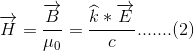
where  represents the direction of motion of the wave. and "c" is the
speed of the wave.
represents the direction of motion of the wave. and "c" is the
speed of the wave.
Using the first and second equation we get:
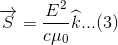
from the definition of the intensity of radiation which states "how much energy is crossing per unit time per unit cross-sectional area", the pointing vector is the same as the intensity of radiation.
In deriving the (3) equation I have used the property of
electromagnetic waves which are transverse in nature and thus
 .
.
The average value of the intensity will be:

which is the required answer.
Add Answer to:
Malu’s law for the polarization of the light is derived
from the fact that an electromagnetic...
To understand polarization of light and how to use Malus's law to calculate the intensity of...
To understand polarization of light and how to use Malus's law to calculate the intensity of a beam of light after passing through one or more polarizing filters. The two transverse waves shown in the figure(Figure 1) both travel in the +z direction. The waves differ in that the top wave oscillates horizontally and the bottom wave oscillates vertically. The direction of oscillation of a wave is called the polarization of the wave. The upper wave is described as polarized...
Light Physics Lab 1.The direction of polarization of an electromagnetic wave is taken by convention to...
Light Physics Lab 1.The direction of polarization of an electromagnetic wave is taken by convention to be: (a) the electric field direction (b) the magnetic field direction (c) the direction of ExB (d) perpendicular to the electric field direction (e) none of the directions is correct 2. If the intensity of radiation from the sun is 1.4 kW/m2 at a distance of 150 x 106 km, at what distance is the intensity 5.6 kW/m2? Show your calculations. 3. An unpolarized...
question 7 and 8 Purpose To examine the properties of polarized light and the mathematical relationship...
 question 7 and 8
Purpose To examine the properties of polarized light and the mathematical relationship describing the intensity of linearly polarized light (Malus'law). In addition, the lab will investigate different ways light can be polarized Overview This lab is the first of three labs exploring the properties of electromagnetic waves. Electromagnetic waves are composed of oscillating electric and magnetic fields. As discussed in the lecture the electric and magnetic field vectors are mutually perpendicular to each other. Light waves...
question 7 and 8
Purpose To examine the properties of polarized light and the mathematical relationship describing the intensity of linearly polarized light (Malus'law). In addition, the lab will investigate different ways light can be polarized Overview This lab is the first of three labs exploring the properties of electromagnetic waves. Electromagnetic waves are composed of oscillating electric and magnetic fields. As discussed in the lecture the electric and magnetic field vectors are mutually perpendicular to each other. Light waves...
Date_ Name Score /30 PRE-LAB FOR POLARIZATION OF LIGHT Which vector from the electromagnetic wave defines...
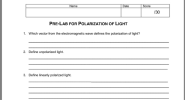 Date_ Name Score /30 PRE-LAB FOR POLARIZATION OF LIGHT Which vector from the electromagnetic wave defines the polarization of light? 1. 2. Define unpolarized light. 3. Define linearly polarized light.
(Ch 35 HW Polarization of Light and Malus's Law Previous Answers Constant, I Penod. Table Correct...
 (Ch 35 HW Polarization of Light and Malus's Law Previous Answers Constant, I Penod. Table Correct Learning Goal: To understand polarization of light and how to use Malus's law to calculate the intensity of a beam of light ater passing through one or mone polarizing iters Part C The two transverse waves shown in the figure(Figure 1) both travel in the -z direction The waves ditfer in thai the top wave oscilates horizontaly and the botom wave oscliabes vertically ?...
4. Which of the following is false about polarization of light? a. It explains the separation...
 4. Which of the following is false about polarization of light? a. It explains the separation of colors in white light by a prism. b. It can arise in reflection or scattering of light. c. The intensity of a light wave by itself does not give any information about the wave's polarization. d. It arises because electric and magnetic fields in waves can have components in two perpendicular directions. 5. Which of the following is false about Maxwell's equations? a....
Light, radiant heat (infrared radiation), X rays, and radio waves are all examples of traveling electromagnetic...
 Light, radiant heat (infrared radiation), X rays, and radio waves are all examples of traveling electromagnetic waves. Electromagnetic waves comprise combinations of electric and magnetic fields that are mutually compatible in the sense that the changes in one generate the other. The simplest form of a traveling electromagnetic wave is a plane wave. For a wave traveling in the x direction whose electric field is in the y direction, the electric and magnetic fields are given by Ē = E,...
Which of the following is false about polarization of light? It explains the separation of colors...
 Which of the following is false about polarization of light?
It explains the separation of colors in white light by a
prism.
It can arise in reflection or scattering of light.
The intensity of a light wave by itself does not give any
information about the wave’s
polarization.
It arises because electric and magnetic fields in waves can have
components in two
perpendicular directions.
Which of the following is false about polarization of light? a. It explains the separation of...
Which of the following is false about polarization of light?
It explains the separation of colors in white light by a
prism.
It can arise in reflection or scattering of light.
The intensity of a light wave by itself does not give any
information about the wave’s
polarization.
It arises because electric and magnetic fields in waves can have
components in two
perpendicular directions.
Which of the following is false about polarization of light? a. It explains the separation of...
8. (30) A plane electromagnetic direction. The electric polarization is parallel to i. The amplitude of...
 8. (30) A plane electromagnetic direction. The electric polarization is parallel to i. The amplitude of the magnetic field is Bo. A rectangular loop of wire lies in the x-z plane, with edges lying at z-a/2, z=al2, -b12, and x -b/2. (a) Find the magnetic flux in the loop wave with wave vectork and frequency o travels in the z as a function of time. (Complex notation is easiest.) (b) Calculate the induced emf E in the loop as a...
Question 2: For an electromagnetic plane wave, the electric field is given by: Ē= E, cos(kz...
 Question 2: For an electromagnetic plane wave, the electric field is given by: Ē= E, cos(kz +wt) ĉ +0 ġ+02 a) Determine the direction of propagation of the electromagnetic wave. b) Find the magnitude and direction of the magnetic field for the given electromagnetic wave B. c) Calculate the Poynting vector associated with this electromagnetic wave. What direction does this vector point? Does this makes sense? d) If the amplitude of the magnetic field was measured to be 2.5 *...
 question 7 and 8
Purpose To examine the properties of polarized light and the mathematical relationship describing the intensity of linearly polarized light (Malus'law). In addition, the lab will investigate different ways light can be polarized Overview This lab is the first of three labs exploring the properties of electromagnetic waves. Electromagnetic waves are composed of oscillating electric and magnetic fields. As discussed in the lecture the electric and magnetic field vectors are mutually perpendicular to each other. Light waves...
question 7 and 8
Purpose To examine the properties of polarized light and the mathematical relationship describing the intensity of linearly polarized light (Malus'law). In addition, the lab will investigate different ways light can be polarized Overview This lab is the first of three labs exploring the properties of electromagnetic waves. Electromagnetic waves are composed of oscillating electric and magnetic fields. As discussed in the lecture the electric and magnetic field vectors are mutually perpendicular to each other. Light waves...
 Date_ Name Score /30 PRE-LAB FOR POLARIZATION OF LIGHT Which vector from the electromagnetic wave defines the polarization of light? 1. 2. Define unpolarized light. 3. Define linearly polarized light.
 (Ch 35 HW Polarization of Light and Malus's Law Previous Answers Constant, I Penod. Table Correct Learning Goal: To understand polarization of light and how to use Malus's law to calculate the intensity of a beam of light ater passing through one or mone polarizing iters Part C The two transverse waves shown in the figure(Figure 1) both travel in the -z direction The waves ditfer in thai the top wave oscilates horizontaly and the botom wave oscliabes vertically ?...
 4. Which of the following is false about polarization of light? a. It explains the separation of colors in white light by a prism. b. It can arise in reflection or scattering of light. c. The intensity of a light wave by itself does not give any information about the wave's polarization. d. It arises because electric and magnetic fields in waves can have components in two perpendicular directions. 5. Which of the following is false about Maxwell's equations? a....
 Light, radiant heat (infrared radiation), X rays, and radio waves are all examples of traveling electromagnetic waves. Electromagnetic waves comprise combinations of electric and magnetic fields that are mutually compatible in the sense that the changes in one generate the other. The simplest form of a traveling electromagnetic wave is a plane wave. For a wave traveling in the x direction whose electric field is in the y direction, the electric and magnetic fields are given by Ē = E,...
 Which of the following is false about polarization of light?
It explains the separation of colors in white light by a
prism.
It can arise in reflection or scattering of light.
The intensity of a light wave by itself does not give any
information about the wave’s
polarization.
It arises because electric and magnetic fields in waves can have
components in two
perpendicular directions.
Which of the following is false about polarization of light? a. It explains the separation of...
Which of the following is false about polarization of light?
It explains the separation of colors in white light by a
prism.
It can arise in reflection or scattering of light.
The intensity of a light wave by itself does not give any
information about the wave’s
polarization.
It arises because electric and magnetic fields in waves can have
components in two
perpendicular directions.
Which of the following is false about polarization of light? a. It explains the separation of...
 8. (30) A plane electromagnetic direction. The electric polarization is parallel to i. The amplitude of the magnetic field is Bo. A rectangular loop of wire lies in the x-z plane, with edges lying at z-a/2, z=al2, -b12, and x -b/2. (a) Find the magnetic flux in the loop wave with wave vectork and frequency o travels in the z as a function of time. (Complex notation is easiest.) (b) Calculate the induced emf E in the loop as a...
 Question 2: For an electromagnetic plane wave, the electric field is given by: Ē= E, cos(kz +wt) ĉ +0 ġ+02 a) Determine the direction of propagation of the electromagnetic wave. b) Find the magnitude and direction of the magnetic field for the given electromagnetic wave B. c) Calculate the Poynting vector associated with this electromagnetic wave. What direction does this vector point? Does this makes sense? d) If the amplitude of the magnetic field was measured to be 2.5 *...
Most questions answered within 3 hours.
-
Where is the error in this code sequence?
String s1 = "Hello";
String s2 = "ello";...
asked 11 months ago -
Financial data for Joel de Paris, Inc., for last year
follow:
Joel de Paris, Inc.
Balance...
asked 11 months ago -
Consider this reaction:
Al2(SO4)3 (aq)+ BaCl3
(aq) Al2Cl6 (aq)- +
3BaSO4(s) . What is the...
asked 11 months ago -
Suppose that Savneet is considering increasing her
recent random sample from 20 car rentals to 40...
asked 11 months ago -
Trucks arrive at an unloading terminal at an average rate of 120
per hour.
Trucks arrive...
asked 11 months ago -
Why are methanol and ethanol completely soluble in water while
octanol is not very little soluble....
asked 11 months ago -
A facilities manager at a university reads in a research report
that the mean amount of...
asked 11 months ago -
When the CuSO4 is rehydrated by adding water to the anhydrous
compound, is this an endothermic...
asked 11 months ago -
A ray of sunlight is passing from diamond into crown glass; the
angle of incidence is...
asked 11 months ago -
A block of mass 0.249 kg is placed on top of a light, vertical
spring of...
asked 11 months ago -
how do the kidneys compensate in the presences of acidosis
a) trigger hyperventilate
b) reserve acid...
asked 11 months ago -
Question 501 pts
The rental rate of capital to the firm increases. Which of the
following...
asked 11 months ago