
Homework Answers
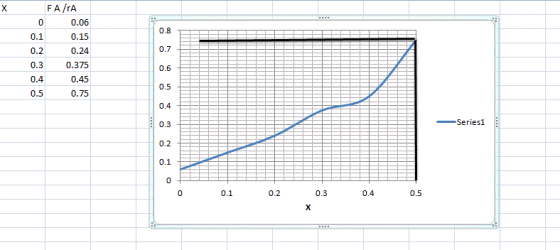
First draw the graph for FA0 / rA vs X
Then from 0 to 0.5 , find the area under the curve which gives the volume of PFR
Area under curve = Scaling x number of boxes = 0.1 x 0.1 x 15 = 0.15 m3
Add Answer to:
The following kinetic data was determined for a specific reactor operating profile (i.e temperature, pressure, initial...
Question 1: Design of isothermal reactors 30 Marks The irreversible, gas-phase reaction A+B D is to be carried out...
 Question 1: Design of isothermal reactors 30 Marks The irreversible, gas-phase reaction A+B D is to be carried out in an isotherma °C) plug-flow reactor (PFR) at 5.0 atm. The mole fractions of the feed streams are A 0 B 0.50, and inerts 0.30. The activation energy for the above reaction is 80 000 cal/mol. the pressure drop due to fluid friction in the reactor is so small that it can be ignored, perform the following tasks: 2T a s...
Kinetic reactions Please make sure you get the same answers as written and solve all the...
 Kinetic reactions
Please make sure you get the same answers as written and
solve all the parts
Thanks in advance
3. The elementary gas-phase reaction A → B + 2C gives a rate constant of 10-4 min-1 at 50°C and has an activation energy of 85 kJ mol1. This reaction is carried out in a flow reactor that is operated isothermally at 127 °C with a negligible pressure drop. The reactor feed is pure A, entering at 127 °C and...
Kinetic reactions
Please make sure you get the same answers as written and
solve all the parts
Thanks in advance
3. The elementary gas-phase reaction A → B + 2C gives a rate constant of 10-4 min-1 at 50°C and has an activation energy of 85 kJ mol1. This reaction is carried out in a flow reactor that is operated isothermally at 127 °C with a negligible pressure drop. The reactor feed is pure A, entering at 127 °C and...
A batch reactor operating at near room temperature, 25°C, is currently taking six hours to reach...
 A batch reactor operating at near room temperature, 25°C, is currently taking six hours to reach ninety percent conversion for an irreversible second-order liquid-phase reaction. Account the time to fill, empty, and clean the reactor, this allows one batch to be handled during an ei hour work shift. ing for ght- There is now pressure to cut the reaction time in half, to three hours, so two batches can be handled during a shift. When the reactor temperature is increased...
Hi everybody,can you help me for problem 4 in the attach . Thank for help! The...
 Hi everybody,can you help me for problem 4 in the attach . Thank
for help!
The elementary reversible reaction A + B 2C occurs in the liquid phase in isothermal CSTR. A stream containing equimolar amounts of A and B in a solvent enters. the reactor, and the conversion of A is measured to be 60%. The equilibrium conversion o A under the same inlet conditions is known to be 80%. The volumetric flowrate into the process is to be...
Hi everybody,can you help me for problem 4 in the attach . Thank
for help!
The elementary reversible reaction A + B 2C occurs in the liquid phase in isothermal CSTR. A stream containing equimolar amounts of A and B in a solvent enters. the reactor, and the conversion of A is measured to be 60%. The equilibrium conversion o A under the same inlet conditions is known to be 80%. The volumetric flowrate into the process is to be...
PLEASE HELP!! Consider an adiabatic constant pressure batch reactor for the following ideal gas phase reaction:...
 PLEASE HELP!!
Consider an adiabatic constant pressure batch reactor for the following ideal gas phase reaction: 2. A—В+С The reactor initial composition is of 50 mol% A and 50 mol% inert material. The initial reactor temperature is 300 K and the pressure is 101.325 kPa. The reaction rate is: -2,500 (-) kCwhere k=exp| Т The enthalpy of reaction can be assumed constant at -5,000 J/mol. The heat capacities are assumed to be constant, with the following values: В: 5 mol...
PLEASE HELP!!
Consider an adiabatic constant pressure batch reactor for the following ideal gas phase reaction: 2. A—В+С The reactor initial composition is of 50 mol% A and 50 mol% inert material. The initial reactor temperature is 300 K and the pressure is 101.325 kPa. The reaction rate is: -2,500 (-) kCwhere k=exp| Т The enthalpy of reaction can be assumed constant at -5,000 J/mol. The heat capacities are assumed to be constant, with the following values: В: 5 mol...
Design a CSTR for the elementary consecutive gas-phase reactions A - B C. Specify the reactor...
 Design a CSTR for the elementary consecutive gas-phase reactions A - B C. Specify the reactor volume and the area of the heating coil inside the reactor for 50% conversion. a. Calculate the desired operating temperature inside the reactor. b. Calculate the volume of the reactor c. Calculate the area of the heating surface. The effluent stream should contain a ratio CB/Cc of 10. The feed is gas-phase and pure A at 400°C and 4 atm, with a molar flow...
. Question 2: The elementary, reversible, organic, liquid-phase reaction is carried out adiabatically in a CSTR...
 .
Question 2: The elementary, reversible, organic, liquid-phase reaction is carried out adiabatically in a CSTR where 65% conversion is achiewd Ated'anonn of A and 50% excess 8, enters the reactor at 27°C with a volumetric flow rate of 2 L/s and a Cos of O.1 mol/L culate the temperature inside the reactor 2. Calculate the equilibrium conversion at the operating temperature. How close (in 3. Calculate the CSTR volume percentage) the conversion is from the equilsbrium conversion? If the...
.
Question 2: The elementary, reversible, organic, liquid-phase reaction is carried out adiabatically in a CSTR where 65% conversion is achiewd Ated'anonn of A and 50% excess 8, enters the reactor at 27°C with a volumetric flow rate of 2 L/s and a Cos of O.1 mol/L culate the temperature inside the reactor 2. Calculate the equilibrium conversion at the operating temperature. How close (in 3. Calculate the CSTR volume percentage) the conversion is from the equilsbrium conversion? If the...
Pressure [Pa] QUESTION 5 Sav Which line represents a process for which PVaconstant? 12 10 A...
 Pressure [Pa] QUESTION 5 Sav Which line represents a process for which PVaconstant? 12 10 A 6 2 0 0 1 2 3 5 Volume [m3] ANSWI hmit to sme and submit. Click Save All Answers to save all ansuers parenthesis. 1. An insulated piston-cylinder device initially contains 10kg of saturated liquid water at 20°C. An electrical resistor embedded in the wall is turned on until the volume of the water triples, but its pressure remains constant. The piston moves...
Please answer all parts 2. A total of 10000 L/h of metaxylene, C&H(CHs)2, is being isomerized...
 Please answer all parts
2. A total of 10000 L/h of metaxylene, C&H(CHs)2, is being isomerized to a mixture of orthoxylene, metaxylene, and paraxylene in a reactor with a volume of 1000 L. The isomerization reaction can be represented as: where A is the metaxylene being fed to the reactor, and B are the different isomers formed. The reaction is being carried out at 400°C and 20 bar. Under these conditions, 35% of the metaxylene fed to the reactor is...
Please answer all parts
2. A total of 10000 L/h of metaxylene, C&H(CHs)2, is being isomerized to a mixture of orthoxylene, metaxylene, and paraxylene in a reactor with a volume of 1000 L. The isomerization reaction can be represented as: where A is the metaxylene being fed to the reactor, and B are the different isomers formed. The reaction is being carried out at 400°C and 20 bar. Under these conditions, 35% of the metaxylene fed to the reactor is...
Describe your solutions in detail, because partial credit will be given based on your work. If...
 Describe your solutions in detail, because partial credit will be given based on your work. If additional information is necessary in solving the problems, DO use your engineering sense and provide reasonable assumptions and explanations. You may use your calculator if necessary. Use a language of your choice. Note: The following information may be used. Gas constant, R-8.314 J(mol K)-8.314 kPa L/(mol K)-0.082 L atm/(mol K)-6.132 lbr ft/(gmol K)=1,987 cal/(mol K). Atomic mass of N-14; Atomic mass of O= 1...
 Question 1: Design of isothermal reactors 30 Marks The irreversible, gas-phase reaction A+B D is to be carried out in an isotherma °C) plug-flow reactor (PFR) at 5.0 atm. The mole fractions of the feed streams are A 0 B 0.50, and inerts 0.30. The activation energy for the above reaction is 80 000 cal/mol. the pressure drop due to fluid friction in the reactor is so small that it can be ignored, perform the following tasks: 2T a s...
 Kinetic reactions
Please make sure you get the same answers as written and
solve all the parts
Thanks in advance
3. The elementary gas-phase reaction A → B + 2C gives a rate constant of 10-4 min-1 at 50°C and has an activation energy of 85 kJ mol1. This reaction is carried out in a flow reactor that is operated isothermally at 127 °C with a negligible pressure drop. The reactor feed is pure A, entering at 127 °C and...
Kinetic reactions
Please make sure you get the same answers as written and
solve all the parts
Thanks in advance
3. The elementary gas-phase reaction A → B + 2C gives a rate constant of 10-4 min-1 at 50°C and has an activation energy of 85 kJ mol1. This reaction is carried out in a flow reactor that is operated isothermally at 127 °C with a negligible pressure drop. The reactor feed is pure A, entering at 127 °C and...
 A batch reactor operating at near room temperature, 25°C, is currently taking six hours to reach ninety percent conversion for an irreversible second-order liquid-phase reaction. Account the time to fill, empty, and clean the reactor, this allows one batch to be handled during an ei hour work shift. ing for ght- There is now pressure to cut the reaction time in half, to three hours, so two batches can be handled during a shift. When the reactor temperature is increased...
 Hi everybody,can you help me for problem 4 in the attach . Thank
for help!
The elementary reversible reaction A + B 2C occurs in the liquid phase in isothermal CSTR. A stream containing equimolar amounts of A and B in a solvent enters. the reactor, and the conversion of A is measured to be 60%. The equilibrium conversion o A under the same inlet conditions is known to be 80%. The volumetric flowrate into the process is to be...
Hi everybody,can you help me for problem 4 in the attach . Thank
for help!
The elementary reversible reaction A + B 2C occurs in the liquid phase in isothermal CSTR. A stream containing equimolar amounts of A and B in a solvent enters. the reactor, and the conversion of A is measured to be 60%. The equilibrium conversion o A under the same inlet conditions is known to be 80%. The volumetric flowrate into the process is to be...
 PLEASE HELP!!
Consider an adiabatic constant pressure batch reactor for the following ideal gas phase reaction: 2. A—В+С The reactor initial composition is of 50 mol% A and 50 mol% inert material. The initial reactor temperature is 300 K and the pressure is 101.325 kPa. The reaction rate is: -2,500 (-) kCwhere k=exp| Т The enthalpy of reaction can be assumed constant at -5,000 J/mol. The heat capacities are assumed to be constant, with the following values: В: 5 mol...
PLEASE HELP!!
Consider an adiabatic constant pressure batch reactor for the following ideal gas phase reaction: 2. A—В+С The reactor initial composition is of 50 mol% A and 50 mol% inert material. The initial reactor temperature is 300 K and the pressure is 101.325 kPa. The reaction rate is: -2,500 (-) kCwhere k=exp| Т The enthalpy of reaction can be assumed constant at -5,000 J/mol. The heat capacities are assumed to be constant, with the following values: В: 5 mol...
 Design a CSTR for the elementary consecutive gas-phase reactions A - B C. Specify the reactor volume and the area of the heating coil inside the reactor for 50% conversion. a. Calculate the desired operating temperature inside the reactor. b. Calculate the volume of the reactor c. Calculate the area of the heating surface. The effluent stream should contain a ratio CB/Cc of 10. The feed is gas-phase and pure A at 400°C and 4 atm, with a molar flow...
 .
Question 2: The elementary, reversible, organic, liquid-phase reaction is carried out adiabatically in a CSTR where 65% conversion is achiewd Ated'anonn of A and 50% excess 8, enters the reactor at 27°C with a volumetric flow rate of 2 L/s and a Cos of O.1 mol/L culate the temperature inside the reactor 2. Calculate the equilibrium conversion at the operating temperature. How close (in 3. Calculate the CSTR volume percentage) the conversion is from the equilsbrium conversion? If the...
.
Question 2: The elementary, reversible, organic, liquid-phase reaction is carried out adiabatically in a CSTR where 65% conversion is achiewd Ated'anonn of A and 50% excess 8, enters the reactor at 27°C with a volumetric flow rate of 2 L/s and a Cos of O.1 mol/L culate the temperature inside the reactor 2. Calculate the equilibrium conversion at the operating temperature. How close (in 3. Calculate the CSTR volume percentage) the conversion is from the equilsbrium conversion? If the...
 Pressure [Pa] QUESTION 5 Sav Which line represents a process for which PVaconstant? 12 10 A 6 2 0 0 1 2 3 5 Volume [m3] ANSWI hmit to sme and submit. Click Save All Answers to save all ansuers parenthesis. 1. An insulated piston-cylinder device initially contains 10kg of saturated liquid water at 20°C. An electrical resistor embedded in the wall is turned on until the volume of the water triples, but its pressure remains constant. The piston moves...
 Please answer all parts
2. A total of 10000 L/h of metaxylene, C&H(CHs)2, is being isomerized to a mixture of orthoxylene, metaxylene, and paraxylene in a reactor with a volume of 1000 L. The isomerization reaction can be represented as: where A is the metaxylene being fed to the reactor, and B are the different isomers formed. The reaction is being carried out at 400°C and 20 bar. Under these conditions, 35% of the metaxylene fed to the reactor is...
Please answer all parts
2. A total of 10000 L/h of metaxylene, C&H(CHs)2, is being isomerized to a mixture of orthoxylene, metaxylene, and paraxylene in a reactor with a volume of 1000 L. The isomerization reaction can be represented as: where A is the metaxylene being fed to the reactor, and B are the different isomers formed. The reaction is being carried out at 400°C and 20 bar. Under these conditions, 35% of the metaxylene fed to the reactor is...
 Describe your solutions in detail, because partial credit will be given based on your work. If additional information is necessary in solving the problems, DO use your engineering sense and provide reasonable assumptions and explanations. You may use your calculator if necessary. Use a language of your choice. Note: The following information may be used. Gas constant, R-8.314 J(mol K)-8.314 kPa L/(mol K)-0.082 L atm/(mol K)-6.132 lbr ft/(gmol K)=1,987 cal/(mol K). Atomic mass of N-14; Atomic mass of O= 1...
Most questions answered within 3 hours.
-
Where is the error in this code sequence?
String s1 = "Hello";
String s2 = "ello";...
asked 10 months ago -
Financial data for Joel de Paris, Inc., for last year
follow:
Joel de Paris, Inc.
Balance...
asked 10 months ago -
Consider this reaction:
Al2(SO4)3 (aq)+ BaCl3
(aq) Al2Cl6 (aq)- +
3BaSO4(s) . What is the...
asked 10 months ago -
Suppose that Savneet is considering increasing her
recent random sample from 20 car rentals to 40...
asked 10 months ago -
Trucks arrive at an unloading terminal at an average rate of 120
per hour.
Trucks arrive...
asked 10 months ago -
Why are methanol and ethanol completely soluble in water while
octanol is not very little soluble....
asked 10 months ago -
A facilities manager at a university reads in a research report
that the mean amount of...
asked 10 months ago -
When the CuSO4 is rehydrated by adding water to the anhydrous
compound, is this an endothermic...
asked 10 months ago -
A ray of sunlight is passing from diamond into crown glass; the
angle of incidence is...
asked 10 months ago -
A block of mass 0.249 kg is placed on top of a light, vertical
spring of...
asked 10 months ago -
how do the kidneys compensate in the presences of acidosis
a) trigger hyperventilate
b) reserve acid...
asked 10 months ago -
Question 501 pts
The rental rate of capital to the firm increases. Which of the
following...
asked 10 months ago