Consider the following hypothetical chemical pathway (A---->D) consisting of three individual reaction steps (A-->B,B-->C,C-->D)
This is the set of questions
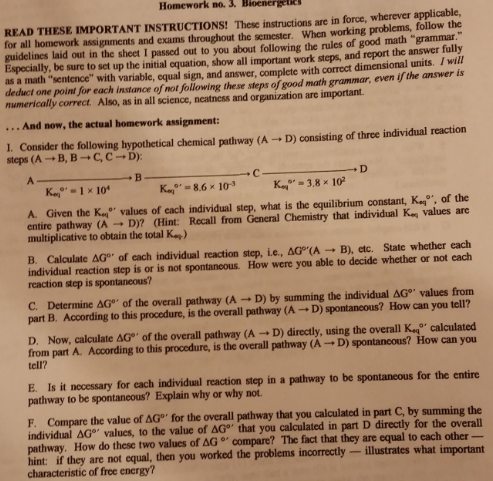
Please use this set of rules/guidlines

Homework Answers
A. K(net) = K1*K2*K3
= 32680
Free energy change = -2.303 * 8.3*298*log(32680) = -25714.439 joules
B. K1= 10^4
change in free energy = -2.303 * 8.3*298*log(10^4) = -22784.9608 joules
Spontaneous. As change is free energy is negative.
K2= 8.6 *10^-3
change in free energy = -2.303 * 8.3*298*log(8.6 *10^-3) = 11853.431joules
Non-Spontaneous. As change is free energy is positive
K3=3.8 *10^2
change in free energy = -2.303 * 8.3*298*log(3.8 *10^2) = -14695.06703 joules
Spontaneous. As change is free energy is negative
C. Net Change in free energy = -22784.9608 +11853.431 -14695.06703 = -25626.59 joules
D.
K(net) = K1*K2*K3
= 32680
Free energy change = -2.303 * 8.3*298*log(32680) = -25714.439joule
Spontaneous. As change is free energy is negative.
E. No. each individual step does not necessarily need to be spontaneous.
the overall change in free energy should be negative. and not the individual steps. all the individual free energies are added up. is the total sum is negative, then spontaneous otherwise non spontaneous.
F. change in free energy by summing up free energy changes = -25.6 kJ
Change free energy by first calculating net equilibrium constant = -25.7 kJ
which are nearly equal
Both will be same as they correspond to same reaction.
A. Keq for the entire pathway(A->D) :-
Keq0'(A->D) = Keq0'(A->B) X Keq0'(B->C) X Keq0'(C->D)
Thus substituting the reapective values as given in the problem we have
Keq0'(A->D) = 1X10^4 X 8.6X10^-3 X 3.8 X 10^2 = 3.2680 X 10^4
B. ATQ we have to calculate the delta G0 for the individual reaction.
delta G0' = - RT0'lnKeq0'
for the step A->B the delta G0' is
delta G0' = -(1.987 X 10^-3 kcal mol-1 K-1) X (298K) X (ln (1X10^4) = -5.453 kcal mol-1
the condition for spontaineity is that standard gibbs free energy i.e delta G0' should be negative . In the reactive delta G0' is negative thus the reaction A-> B is spontaneous.
Next for the step B->C the delta G 0' is
delta G0' = -( 1.987X10^-3 Kcal mol-1 K-1) X (298K) X (ln (8.6X10^-3)) = 2.816 Kcal mol-1
As the change in standard gibbs free energy is positive the reaction is not spontaneous for the step B->C
lastly the delta G0' for the step C->D is
delta G0' = -(1.987 X 10^-3 Kcal mol-1 K-1) X (298K) X (ln(3.8X10^2)) = -3.51 Kcal mol-1
the change in standard gibbs free energy is negative , therefore the step C->D is spontaneous.
C. delta G0' of the overall pathaway is
delta G0' (A->D) = delta G0'(A->B) + delta G0'(B->C) + delta G0'(C->D)
= -6.147 Kcal mol-1
As the net change in standard free energy is negative the reaction is spontaneous for the pathway(A->D)
D. delta G0' using Keq0' calculated in answer A.
delta G0' = - RT0'ln(Keq0')
=-(1.987X10^-3 Kcal mol-1K-1)X(298K)Xln(3.2680X10^4) = -6.15 Kcal mol-1.
The reaction is spontaneous as change in standard free energy is negative.
E. It is not necessary that individual reaction should be spontaneous in order to have the overall reaction to be spontaneous. The spontaneity of the entire reaction is judged on the basis whether overall change in standard gibbs free energy is negative or not. As in the reaction given in the problem, although the reaction step B->C is not spontaneous but the overall reaction is spontaneous as overall change ib standard gibbs free energy is negative.
F. The delta G0' calculated in part C and part D is same and the overall change in standard gibbs free energy is negative which means the reaction is spontaneous.
Add Answer to:
Consider the following hypothetical chemical pathway
(A---->D) consisting of three individual reaction steps
(A-->B,B-->C,C-->D)
This is...
3. Consider a hypothetical chemical reaction: A + B + heat C + D What will...
 3. Consider a hypothetical chemical reaction: A + B + heat C + D What will happen to the position of the equilibrium under the following conditions? (Consider each change separately.) a. The equilibrium mixture is heated. b. More of reactant A is added. C. A reagent is added which causes product D to precipitate from the solution.
A reaction mechanism is defined as the sequence of reaction steps that define the pathway from...
A reaction mechanism is defined as the sequence of reaction steps that define the pathway from reactants to products. Each step in a mechanism is an elementary reaction, which describes a single molecular event of usually one or two molecules interacting. The rate law for an overall reaction is the rate law for the slowest step in the mechanism, which is directly related to the stoichiometric coefficients of the reactants. The exception to this rule occurs when the slowest step...
2. Consider the hypothetical reaction at equilibrium A+B+heat C+D tratinns of A, B
 2. Consider the hypothetical reaction at equilibrium A+B+heat C+D tratinns of A, B
This is a two-part question, please help! PART A: Consider these hypothetical chemical reactions: A⇌B,ΔG= 10.9...
This is a two-part question, please help! PART A: Consider these hypothetical chemical reactions: A⇌B,ΔG= 10.9 kJ/mol B⇌C,ΔG= -29.3 kJ/mol C⇌D,ΔG= 8.40 kJ/mol What is the free energy, ΔG, for the overall reaction, A⇌D? PART B: Firefly luciferase is the enzyme that allows fireflies to illuminate their abdomens. Because this light generation is an ATP-requiring reaction, firefly luciferase can be used to test for the presence of ATP. In this way, luciferase can test for the presence of life. The...
3—Part II: For the following hypothetical mechanism Step (1) slow 2 A+ E + C +...
 3—Part II: For the following hypothetical mechanism Step (1) slow 2 A+ E + C + F Ea = 40 kJ, AH = + 15 kJ Step (2) fast 3 B+F → D+E Ea = 15 kJ, AH = -20 kJ Draw the energy diagram for this 2-step mechanism. Label all parts of the diagram and locate (i.e. indicate) all energy values on your diagram. Calculate the overall enthalpy change for this reaction. Note: must set scale & honour proportionality.
Examining a pathway inside a cell, you determine the following: A+ B --> C + D...
Examining a pathway inside a cell, you determine the following: A+ B --> C + D Which of the follow statements is / are true. (Select all that apply) Possible rate limiting step. Step is in equilibrium. Step does not require energy. Likely point of regulation. Increasing D will decrease C.
Question 1.b of 12 A reaction mechanism has the following proposed elementary steps: Step 1: A...
 Question 1.b of 12 A reaction mechanism has the following proposed elementary steps: Step 1: A B +C Step 2: A+B →D Step 3: 2 A+D → C+E The overall reaction is 4 A 2 C + E. Which species are intermediates in this reaction? A) B and C B) B C) B and D D) D E) C and D
Consider these hypothetical chemical reactions: A⇌B,ΔG= 13.7 kJ/mol B⇌C,ΔG= -27.2 kJ/mol C⇌D,ΔG= 6.20 kJ/mol What is...
Consider these hypothetical chemical reactions: A⇌B,ΔG= 13.7 kJ/mol B⇌C,ΔG= -27.2 kJ/mol C⇌D,ΔG= 6.20 kJ/mol What is the free energy, ΔG, for the overall reaction, A⇌D? Express your answer with the appropriate units. ΔG = Firefly luciferase is the enzyme that allows fireflies to illuminate their abdomens. Because this light generation is an ATP-requiring reaction, firefly luciferase can be used to test for the presence of ATP. In this way, luciferase can test for the presence of life. The coupled reactions...
Answer the following questions for the reaction sequence A + B --> AB --> C -->...
 Answer the following questions for the reaction
sequence A + B --> AB --> C --> P. A table of energy
values for this reaction sequence is found above.
1. Draw a diagram of the reaction profile. Label and
include all enthalpy changes (delta H) and activation energies for
all steps. Draw to scale.
2. Find the activation energy for the overall reaction
A + B --> P. Also find the activation energy for the reverse
reaction P --> A...
Answer the following questions for the reaction
sequence A + B --> AB --> C --> P. A table of energy
values for this reaction sequence is found above.
1. Draw a diagram of the reaction profile. Label and
include all enthalpy changes (delta H) and activation energies for
all steps. Draw to scale.
2. Find the activation energy for the overall reaction
A + B --> P. Also find the activation energy for the reverse
reaction P --> A...
Learning Goal: To understand how to use Hess's law to find the enthalpy of an overall...
 Learning Goal: To understand how to use Hess's law to find the enthalpy of an overall reaction. Correct The change in enthalpy, AH, is the heat absorbed or produced during any reaction at constant pressure. Hess's law states that ? H for an overall reaction is the sum of the values for the individual reactions. For example, if we wanted to know the enthalpy change for the reaction PartB What is the enthalpy for reaction 1 reversed? Express your answer...
 3. Consider a hypothetical chemical reaction: A + B + heat C + D What will happen to the position of the equilibrium under the following conditions? (Consider each change separately.) a. The equilibrium mixture is heated. b. More of reactant A is added. C. A reagent is added which causes product D to precipitate from the solution.
 2. Consider the hypothetical reaction at equilibrium A+B+heat C+D tratinns of A, B
 3—Part II: For the following hypothetical mechanism Step (1) slow 2 A+ E + C + F Ea = 40 kJ, AH = + 15 kJ Step (2) fast 3 B+F → D+E Ea = 15 kJ, AH = -20 kJ Draw the energy diagram for this 2-step mechanism. Label all parts of the diagram and locate (i.e. indicate) all energy values on your diagram. Calculate the overall enthalpy change for this reaction. Note: must set scale & honour proportionality.
 Question 1.b of 12 A reaction mechanism has the following proposed elementary steps: Step 1: A B +C Step 2: A+B →D Step 3: 2 A+D → C+E The overall reaction is 4 A 2 C + E. Which species are intermediates in this reaction? A) B and C B) B C) B and D D) D E) C and D
 Answer the following questions for the reaction
sequence A + B --> AB --> C --> P. A table of energy
values for this reaction sequence is found above.
1. Draw a diagram of the reaction profile. Label and
include all enthalpy changes (delta H) and activation energies for
all steps. Draw to scale.
2. Find the activation energy for the overall reaction
A + B --> P. Also find the activation energy for the reverse
reaction P --> A...
Answer the following questions for the reaction
sequence A + B --> AB --> C --> P. A table of energy
values for this reaction sequence is found above.
1. Draw a diagram of the reaction profile. Label and
include all enthalpy changes (delta H) and activation energies for
all steps. Draw to scale.
2. Find the activation energy for the overall reaction
A + B --> P. Also find the activation energy for the reverse
reaction P --> A...
 Learning Goal: To understand how to use Hess's law to find the enthalpy of an overall reaction. Correct The change in enthalpy, AH, is the heat absorbed or produced during any reaction at constant pressure. Hess's law states that ? H for an overall reaction is the sum of the values for the individual reactions. For example, if we wanted to know the enthalpy change for the reaction PartB What is the enthalpy for reaction 1 reversed? Express your answer...
Most questions answered within 3 hours.
-
Where is the error in this code sequence?
String s1 = "Hello";
String s2 = "ello";...
asked 11 months ago -
Financial data for Joel de Paris, Inc., for last year
follow:
Joel de Paris, Inc.
Balance...
asked 11 months ago -
Consider this reaction:
Al2(SO4)3 (aq)+ BaCl3
(aq) Al2Cl6 (aq)- +
3BaSO4(s) . What is the...
asked 11 months ago -
Suppose that Savneet is considering increasing her
recent random sample from 20 car rentals to 40...
asked 11 months ago -
Trucks arrive at an unloading terminal at an average rate of 120
per hour.
Trucks arrive...
asked 11 months ago -
Why are methanol and ethanol completely soluble in water while
octanol is not very little soluble....
asked 11 months ago -
A facilities manager at a university reads in a research report
that the mean amount of...
asked 11 months ago -
When the CuSO4 is rehydrated by adding water to the anhydrous
compound, is this an endothermic...
asked 11 months ago -
A ray of sunlight is passing from diamond into crown glass; the
angle of incidence is...
asked 11 months ago -
A block of mass 0.249 kg is placed on top of a light, vertical
spring of...
asked 11 months ago -
how do the kidneys compensate in the presences of acidosis
a) trigger hyperventilate
b) reserve acid...
asked 11 months ago -
Question 501 pts
The rental rate of capital to the firm increases. Which of the
following...
asked 11 months ago