
Homework Answers


Add Answer to:
Consider the following composite wall of a building. It is made out of plaster board (Lp...
1. A house has a composite wall of wood, fiberglass insulation, and plaster board, as indicated...
 1. A house has a composite wall of wood, fiberglass insulation, and
plaster board, as indicated below. On a cold winter day the
convection heat transfer coefficients are ho
=
60 W/m2K
and hi
=
30 W/m2K.
The total wall surface area is 350 m2.
(a) Determine the heat transfer rate through the wall in
Watts.
(b) If the wind were blowing violently, raising ho
to 300 W/m2K,
determine the percentage
increase in the heat transfer rate.
(c) What is...
1. A house has a composite wall of wood, fiberglass insulation, and
plaster board, as indicated below. On a cold winter day the
convection heat transfer coefficients are ho
=
60 W/m2K
and hi
=
30 W/m2K.
The total wall surface area is 350 m2.
(a) Determine the heat transfer rate through the wall in
Watts.
(b) If the wind were blowing violently, raising ho
to 300 W/m2K,
determine the percentage
increase in the heat transfer rate.
(c) What is...
A house has a composite wall of wood, fiberglass insulation, and plaster board, as indicated in...
 A house has a composite wall of wood, fiberglass insulation, and
plaster board, as indicated in the sketch. On a cold day, the
temperature and the convection heat transfer coefficients are T∞,i
=20°C, hi =30 W/m2K and T∞,o=−15°C, ho =60 W/m2K. The wall surface
area is 350 m2. Determine the total heat loss through the wall.
Conductivities are given as b k =0.038 W/m.K, s k =0.012 W/m.K, p k
=0.17 W/m.K
Glass fiber blanket (28 kg/m3), kn Plaster board,...
A house has a composite wall of wood, fiberglass insulation, and
plaster board, as indicated in the sketch. On a cold day, the
temperature and the convection heat transfer coefficients are T∞,i
=20°C, hi =30 W/m2K and T∞,o=−15°C, ho =60 W/m2K. The wall surface
area is 350 m2. Determine the total heat loss through the wall.
Conductivities are given as b k =0.038 W/m.K, s k =0.012 W/m.K, p k
=0.17 W/m.K
Glass fiber blanket (28 kg/m3), kn Plaster board,...
Figure 1 A typical section of a building wall is shown in the following figure. This section exte...
 Figure 1 A typical section of a building wall is shown in the following figure. This section extends in depth and repeated in vertical direction. The wall support members (grey parts) are made of steel with thermal conductivity of k.-50W/mK and dimensions ofLs-50mm by t23. The remainder of the inner wall space is filled with insulation. The inner wall is made of gypsum board with thermal conductivity of k-0.5W/ mK and thickness of tı2-10mm The inner wall is made of...
Consider a composite wall that includes an 8-mm-thick hardboard siding, 40-mm by 130-mm hardwood studs on...
 Consider a composite wall that includes an 8-mm-thick hardboard siding, 40-mm by 130-mm hardwood studs on 0.65-m centers with glass fiber insulation (paper faced, 28 kg/m3 ), and a 12-mm layer of gypsum (vermiculite) wall board. What is the thermal resistance associated with a wall that is 2.5 m high by 6.5 m wide (having 10 studs, each 2.5 m high)? Assume surfaces normal to the x-direction are isothermal. Wood siding Stud Insulation Wall board Rtot K/W
For such aircraft application (Figure 3), a wall is made from insulation material (k-0.030 W/m.K) and...
 For such aircraft application (Figure 3), a wall is made from insulation material (k-0.030 W/m.K) and the insulation material is mounted between four layers of carbon steel (2 mm thickness), the carbon layers are separated by a 2 mm air gap (kair-0.025 W/mK). Figure 3, the thermal conductivity of the carbon steel is (k-15.5 W/m.K). The temperature inside the wall is maintained at 6 °C. The environmental temperature is 24°C. The engineer would like to avoid condensation occurring at outer...
A house has a composite wall of wood (exterior) (k = 0.12 W m-1 K -1...
A house has a composite wall of wood (exterior) (k = 0.12 W m-1 K -1 , 20 mm thick), fibreglass insulation (k = 0.045 W m-1 K -1 , 70 mm thick) and plasterboard (interior) (k = 0.25 W m-1 K -1 , 10 mm thick). Determine the total heat loss through the wall when the inside temperature is 20 °C, the outside temperature is -10 °C, the inside heat transfer coefficient is 15 W m-2 K -1, and...
Problem 3.014 Consider a composite wall that includes an 8-mm-thick hardwood siding, 40-mm by 100-mm hardwood...
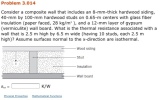 Problem 3.014 Consider a composite wall that includes an 8-mm-thick hardwood siding, 40-mm by 100-mm hardwood studs on 0.65-m centers with glass fiber insulation (paper faced, 28 kg/m), and a 12-mm layer of gypsum (vermiculite) wall board. What is the thermal resistance associated with a wall that is 2.5 m high by 6.5 m wide (having 10 studs, each 2.5 m high)? Assume surfaces normal to the x-direction are isothermal. Wood siding Stud Insulation Wall board Rtot K/W Physical Properties...
Problem : A cryogenic flui d is flowing in a 304 SS pipe. The pipe is...
 Problem
:
A cryogenic flui
d is flowing in a
304 SS
pipe.
The pipe is insulated
on its outside surface
with
6
-
mm thick,
evacuated,
aluminum foil/glass mat insulation.
(“Evacuated” means a partial vacuum is drawn on the
insulation to
remove air that would otherwise fill
pores inside the insulation.)
The pipe
inside diameter
is 127 mm; it’s outside diameter is 138 mm.
The
fluid temperature is
-
173
o
C
.
T
he
air temperature
outside the...
Problem
:
A cryogenic flui
d is flowing in a
304 SS
pipe.
The pipe is insulated
on its outside surface
with
6
-
mm thick,
evacuated,
aluminum foil/glass mat insulation.
(“Evacuated” means a partial vacuum is drawn on the
insulation to
remove air that would otherwise fill
pores inside the insulation.)
The pipe
inside diameter
is 127 mm; it’s outside diameter is 138 mm.
The
fluid temperature is
-
173
o
C
.
T
he
air temperature
outside the...
1) A wall consists of i inch of gypsum plaster on cork- board insulation 1 inch...
 1) A wall consists of i inch of gypsum plaster on cork- board insulation 1 inch thick on studding, the outside being wood siding, building paper, and sheathing about 1 inches thick Find the value of U for the wall A common bricle u11 12 nhes s
QUESTION 1 Quarter of the area of a 5m x 3m outside wall of a house...
 QUESTION 1 Quarter of the area of a 5m x 3m outside wall of a house is made of glass windows. The wall is 15 cm thick and has an average thermal conductivity of 0.8 W/m K. The window glass is 8 mm thick and has an average thermal conductivity of 0.15 W/m K. On a winter day the inside temperature of the wall and the glass is 20°C, and the outside air temperature is -10°C. The outside convection heat...
 1. A house has a composite wall of wood, fiberglass insulation, and
plaster board, as indicated below. On a cold winter day the
convection heat transfer coefficients are ho
=
60 W/m2K
and hi
=
30 W/m2K.
The total wall surface area is 350 m2.
(a) Determine the heat transfer rate through the wall in
Watts.
(b) If the wind were blowing violently, raising ho
to 300 W/m2K,
determine the percentage
increase in the heat transfer rate.
(c) What is...
1. A house has a composite wall of wood, fiberglass insulation, and
plaster board, as indicated below. On a cold winter day the
convection heat transfer coefficients are ho
=
60 W/m2K
and hi
=
30 W/m2K.
The total wall surface area is 350 m2.
(a) Determine the heat transfer rate through the wall in
Watts.
(b) If the wind were blowing violently, raising ho
to 300 W/m2K,
determine the percentage
increase in the heat transfer rate.
(c) What is...
 A house has a composite wall of wood, fiberglass insulation, and
plaster board, as indicated in the sketch. On a cold day, the
temperature and the convection heat transfer coefficients are T∞,i
=20°C, hi =30 W/m2K and T∞,o=−15°C, ho =60 W/m2K. The wall surface
area is 350 m2. Determine the total heat loss through the wall.
Conductivities are given as b k =0.038 W/m.K, s k =0.012 W/m.K, p k
=0.17 W/m.K
Glass fiber blanket (28 kg/m3), kn Plaster board,...
A house has a composite wall of wood, fiberglass insulation, and
plaster board, as indicated in the sketch. On a cold day, the
temperature and the convection heat transfer coefficients are T∞,i
=20°C, hi =30 W/m2K and T∞,o=−15°C, ho =60 W/m2K. The wall surface
area is 350 m2. Determine the total heat loss through the wall.
Conductivities are given as b k =0.038 W/m.K, s k =0.012 W/m.K, p k
=0.17 W/m.K
Glass fiber blanket (28 kg/m3), kn Plaster board,...
 Figure 1 A typical section of a building wall is shown in the following figure. This section extends in depth and repeated in vertical direction. The wall support members (grey parts) are made of steel with thermal conductivity of k.-50W/mK and dimensions ofLs-50mm by t23. The remainder of the inner wall space is filled with insulation. The inner wall is made of gypsum board with thermal conductivity of k-0.5W/ mK and thickness of tı2-10mm The inner wall is made of...
 Consider a composite wall that includes an 8-mm-thick hardboard siding, 40-mm by 130-mm hardwood studs on 0.65-m centers with glass fiber insulation (paper faced, 28 kg/m3 ), and a 12-mm layer of gypsum (vermiculite) wall board. What is the thermal resistance associated with a wall that is 2.5 m high by 6.5 m wide (having 10 studs, each 2.5 m high)? Assume surfaces normal to the x-direction are isothermal. Wood siding Stud Insulation Wall board Rtot K/W
 For such aircraft application (Figure 3), a wall is made from insulation material (k-0.030 W/m.K) and the insulation material is mounted between four layers of carbon steel (2 mm thickness), the carbon layers are separated by a 2 mm air gap (kair-0.025 W/mK). Figure 3, the thermal conductivity of the carbon steel is (k-15.5 W/m.K). The temperature inside the wall is maintained at 6 °C. The environmental temperature is 24°C. The engineer would like to avoid condensation occurring at outer...
 Problem 3.014 Consider a composite wall that includes an 8-mm-thick hardwood siding, 40-mm by 100-mm hardwood studs on 0.65-m centers with glass fiber insulation (paper faced, 28 kg/m), and a 12-mm layer of gypsum (vermiculite) wall board. What is the thermal resistance associated with a wall that is 2.5 m high by 6.5 m wide (having 10 studs, each 2.5 m high)? Assume surfaces normal to the x-direction are isothermal. Wood siding Stud Insulation Wall board Rtot K/W Physical Properties...
 Problem
:
A cryogenic flui
d is flowing in a
304 SS
pipe.
The pipe is insulated
on its outside surface
with
6
-
mm thick,
evacuated,
aluminum foil/glass mat insulation.
(“Evacuated” means a partial vacuum is drawn on the
insulation to
remove air that would otherwise fill
pores inside the insulation.)
The pipe
inside diameter
is 127 mm; it’s outside diameter is 138 mm.
The
fluid temperature is
-
173
o
C
.
T
he
air temperature
outside the...
Problem
:
A cryogenic flui
d is flowing in a
304 SS
pipe.
The pipe is insulated
on its outside surface
with
6
-
mm thick,
evacuated,
aluminum foil/glass mat insulation.
(“Evacuated” means a partial vacuum is drawn on the
insulation to
remove air that would otherwise fill
pores inside the insulation.)
The pipe
inside diameter
is 127 mm; it’s outside diameter is 138 mm.
The
fluid temperature is
-
173
o
C
.
T
he
air temperature
outside the...
 1) A wall consists of i inch of gypsum plaster on cork- board insulation 1 inch thick on studding, the outside being wood siding, building paper, and sheathing about 1 inches thick Find the value of U for the wall A common bricle u11 12 nhes s
 QUESTION 1 Quarter of the area of a 5m x 3m outside wall of a house is made of glass windows. The wall is 15 cm thick and has an average thermal conductivity of 0.8 W/m K. The window glass is 8 mm thick and has an average thermal conductivity of 0.15 W/m K. On a winter day the inside temperature of the wall and the glass is 20°C, and the outside air temperature is -10°C. The outside convection heat...
Most questions answered within 3 hours.
-
Where is the error in this code sequence?
String s1 = "Hello";
String s2 = "ello";...
asked 11 months ago -
Financial data for Joel de Paris, Inc., for last year
follow:
Joel de Paris, Inc.
Balance...
asked 11 months ago -
Consider this reaction:
Al2(SO4)3 (aq)+ BaCl3
(aq) Al2Cl6 (aq)- +
3BaSO4(s) . What is the...
asked 11 months ago -
Suppose that Savneet is considering increasing her
recent random sample from 20 car rentals to 40...
asked 11 months ago -
Trucks arrive at an unloading terminal at an average rate of 120
per hour.
Trucks arrive...
asked 11 months ago -
Why are methanol and ethanol completely soluble in water while
octanol is not very little soluble....
asked 11 months ago -
A facilities manager at a university reads in a research report
that the mean amount of...
asked 11 months ago -
When the CuSO4 is rehydrated by adding water to the anhydrous
compound, is this an endothermic...
asked 11 months ago -
A ray of sunlight is passing from diamond into crown glass; the
angle of incidence is...
asked 11 months ago -
A block of mass 0.249 kg is placed on top of a light, vertical
spring of...
asked 11 months ago -
how do the kidneys compensate in the presences of acidosis
a) trigger hyperventilate
b) reserve acid...
asked 11 months ago -
Question 501 pts
The rental rate of capital to the firm increases. Which of the
following...
asked 11 months ago