The thigh has a mass of 4kg and a location of (20,18). The shank has a...
The thigh has a mass of 4kg and a location of (20,18). The shank has a mass of 2.5kg and a location of (24,15). The foot has a mass of 0.8 kg and a location of (30,10).
What is the Center of Mass for the leg?
Question 9 options:
|
|||
|
|||
|
|||
|
Homework Answers
 ***********************************************************************************************
Check the answer and let me know whether it's
correct.....
SOLUTION :
Let centre of mass for the leg be at point (x, y)
Total mass = 4 + 2.5 + 0.8 = 7.3 kg
So,
7.3 * x = 4*20 + 2.5*24 + 0.8* 30 = 164
=> x = 164/7.3 = 22.47
7.3 * y = 4*18 + 2.5*15 + 0.8*10 = 117.5
=> y = 117.5/7.3 = 16.10
Hence,
Center of mass for the leg is at point (22.47, 16.10) : Option D (ANSWER).
Add Answer to:
The thigh has a mass of 4kg and a location of (20,18). The shank
has a...
Short answer questions. Please show your work with detailed steps and circle your final answers. (30...
 Short answer questions. Please show your work with detailed steps and circle your final answers. (30 points) 1. A model is used to divide the right lower extremities into three segments: the right thigh, right shank, and right foot. Table I below shows the coordinates of the proximal and distal joints to define these segments. Table II shows relative segment center of mass locations and relative segment mass as a percent of total body mass. The total body mass is...
.30 kg mass has location x as graphed. label max acceleration, calculate curvature , energy in...
 .30 kg mass has location x as
graphed. label max acceleration, calculate curvature , energy in
oscillator
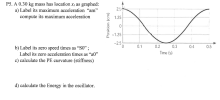
P5. A 0.30 kg mass has location Xı as graphed: a) Label its maximum acceleration “am” compute its maximum acceleration Position (cm) 400 0.1 0.2 0.3 Time (s) 0.4 b) Label its zero speed times as “SO”; Label its zero acceleration times as "a0” c) calculate the PE curvature (stiffness) 0.5 d) calculate the Energy in the oscillator.
.30 kg mass has location x as
graphed. label max acceleration, calculate curvature , energy in
oscillator
P5. A 0.30 kg mass has location Xı as graphed: a) Label its maximum acceleration “am” compute its maximum acceleration Position (cm) 400 0.1 0.2 0.3 Time (s) 0.4 b) Label its zero speed times as “SO”; Label its zero acceleration times as "a0” c) calculate the PE curvature (stiffness) 0.5 d) calculate the Energy in the oscillator.
The 25-kg bar has a center of mass at G. It is supported by a smooth...
 The 25-kg bar has a center of mass at G. It is supported by a smooth peg at C, a roller at A, and cord AB (Figure 1) Draw the free-body dagram of the bar Draw the vectors starting at the black dots. The location and orientation of the vectors will be graded Figure 1 of 1 0.3m 02m 0.2 m s m os m
In the figure above, block A has mass mA = 25 kg and block B has...
 In the figure above, block A has mass mA = 25 kg and block B has mass mB = 10 kg. Both blocks move with constant acceleration a = 2 m/s2 to the right, and the coefficient of static friction between the two blocks is = 0.8. The static frictional force acting between the blocks is (A) 20 N (B) 50 N (C) 78 N (D) 196 N E) 274 N
The weight is used to turn the gear system shown below. Gear A has a mass...
 The weight is used to turn the gear system shown below. Gear A has a mass of 15 kg and a radius of gyration of 100 mm about its center of mass. Gear B and Drum C have a combined mass of 25 kg and a radius of gyration about their mass center of 165 mm. If the system starts from rest, determine the speed of the 55-kg weight after it has been lowered 3 m, the angular velocity of...
The weight is used to turn the gear system shown below. Gear A has a mass...
 The weight is used to turn the gear system shown below. Gear A has a mass of 15 kg and a radius of gyration of 100 mm about its center of mass. Gear B and Drum C have a combined mass of 25 kg and a radius of gyration about their mass center of 165 mm. If the system starts from rest, determine the speed of the 55-kg weight after it has been lowered 3 m, the angular velocity of...
The weight is used to turn the gear system shown below. Gear A has a mass...
 The weight is used to turn the gear system shown below. Gear A has a mass of 15 kg and a radius of gyration of 100 mm about its center of mass. Gear B and Drum C have a combined mass of 25 kg and a radius of gyration about their mass center of 165 mm. If the system starts from rest, determine the speed of the 55-kg weight after it has been lowered 3 m, the angular velocity of...
The weight is used to turn the gear system shown below. Gear A has a mass...
 The weight is used to turn the gear system shown below. Gear A has a mass of 15 kg and a radius of gyration of 100 mm about its center of mass. Gear B and Drum C have a combined mass of 25 kg and a radius of gyration about their mass center of 165 mm. If the system starts from rest, determine the speed of the 55-kg weight after it has been lowered 3 m, the angular velocity of...
The weight is used to turn the gear system shown below. Gear A has a mass...
 The weight is used to turn the gear system shown below. Gear A has a mass of 15 kg and a radius of gyration of 100 mm about its center of mass. Gear B and Drum C have a combined mass of 25 kg and a radius of gyration about their mass center of 165 mm. If the system starts from rest, determine the speed of the 55-kg weight after it has been lowered 3 m, the angular velocity of...
Please show the work Question 1 of 14 6 Points A ball of mass 0.056 kg...
 Please show the work
Question 1 of 14 6 Points A ball of mass 0.056 kg and radius 1.6 cm is attached to a string of length 17 cm. It collides with a stationary can of beans which has a mass of 0.21 kg. The can of beans is assumed to be a solid cylinder with a radius of 3 cm. The collision is elastic and the can leaves the collision with a speed 3.9 cm/s. The collision is also...
Please show the work
Question 1 of 14 6 Points A ball of mass 0.056 kg and radius 1.6 cm is attached to a string of length 17 cm. It collides with a stationary can of beans which has a mass of 0.21 kg. The can of beans is assumed to be a solid cylinder with a radius of 3 cm. The collision is elastic and the can leaves the collision with a speed 3.9 cm/s. The collision is also...
 Short answer questions. Please show your work with detailed steps and circle your final answers. (30 points) 1. A model is used to divide the right lower extremities into three segments: the right thigh, right shank, and right foot. Table I below shows the coordinates of the proximal and distal joints to define these segments. Table II shows relative segment center of mass locations and relative segment mass as a percent of total body mass. The total body mass is...
 .30 kg mass has location x as
graphed. label max acceleration, calculate curvature , energy in
oscillator
P5. A 0.30 kg mass has location Xı as graphed: a) Label its maximum acceleration “am” compute its maximum acceleration Position (cm) 400 0.1 0.2 0.3 Time (s) 0.4 b) Label its zero speed times as “SO”; Label its zero acceleration times as "a0” c) calculate the PE curvature (stiffness) 0.5 d) calculate the Energy in the oscillator.
.30 kg mass has location x as
graphed. label max acceleration, calculate curvature , energy in
oscillator
P5. A 0.30 kg mass has location Xı as graphed: a) Label its maximum acceleration “am” compute its maximum acceleration Position (cm) 400 0.1 0.2 0.3 Time (s) 0.4 b) Label its zero speed times as “SO”; Label its zero acceleration times as "a0” c) calculate the PE curvature (stiffness) 0.5 d) calculate the Energy in the oscillator.
 The 25-kg bar has a center of mass at G. It is supported by a smooth peg at C, a roller at A, and cord AB (Figure 1) Draw the free-body dagram of the bar Draw the vectors starting at the black dots. The location and orientation of the vectors will be graded Figure 1 of 1 0.3m 02m 0.2 m s m os m
 In the figure above, block A has mass mA = 25 kg and block B has mass mB = 10 kg. Both blocks move with constant acceleration a = 2 m/s2 to the right, and the coefficient of static friction between the two blocks is = 0.8. The static frictional force acting between the blocks is (A) 20 N (B) 50 N (C) 78 N (D) 196 N E) 274 N
 The weight is used to turn the gear system shown below. Gear A has a mass of 15 kg and a radius of gyration of 100 mm about its center of mass. Gear B and Drum C have a combined mass of 25 kg and a radius of gyration about their mass center of 165 mm. If the system starts from rest, determine the speed of the 55-kg weight after it has been lowered 3 m, the angular velocity of...
 The weight is used to turn the gear system shown below. Gear A has a mass of 15 kg and a radius of gyration of 100 mm about its center of mass. Gear B and Drum C have a combined mass of 25 kg and a radius of gyration about their mass center of 165 mm. If the system starts from rest, determine the speed of the 55-kg weight after it has been lowered 3 m, the angular velocity of...
 The weight is used to turn the gear system shown below. Gear A has a mass of 15 kg and a radius of gyration of 100 mm about its center of mass. Gear B and Drum C have a combined mass of 25 kg and a radius of gyration about their mass center of 165 mm. If the system starts from rest, determine the speed of the 55-kg weight after it has been lowered 3 m, the angular velocity of...
 The weight is used to turn the gear system shown below. Gear A has a mass of 15 kg and a radius of gyration of 100 mm about its center of mass. Gear B and Drum C have a combined mass of 25 kg and a radius of gyration about their mass center of 165 mm. If the system starts from rest, determine the speed of the 55-kg weight after it has been lowered 3 m, the angular velocity of...
 The weight is used to turn the gear system shown below. Gear A has a mass of 15 kg and a radius of gyration of 100 mm about its center of mass. Gear B and Drum C have a combined mass of 25 kg and a radius of gyration about their mass center of 165 mm. If the system starts from rest, determine the speed of the 55-kg weight after it has been lowered 3 m, the angular velocity of...
 Please show the work
Question 1 of 14 6 Points A ball of mass 0.056 kg and radius 1.6 cm is attached to a string of length 17 cm. It collides with a stationary can of beans which has a mass of 0.21 kg. The can of beans is assumed to be a solid cylinder with a radius of 3 cm. The collision is elastic and the can leaves the collision with a speed 3.9 cm/s. The collision is also...
Please show the work
Question 1 of 14 6 Points A ball of mass 0.056 kg and radius 1.6 cm is attached to a string of length 17 cm. It collides with a stationary can of beans which has a mass of 0.21 kg. The can of beans is assumed to be a solid cylinder with a radius of 3 cm. The collision is elastic and the can leaves the collision with a speed 3.9 cm/s. The collision is also...
Most questions answered within 3 hours.
-
Where is the error in this code sequence?
String s1 = "Hello";
String s2 = "ello";...
asked 11 months ago -
Financial data for Joel de Paris, Inc., for last year
follow:
Joel de Paris, Inc.
Balance...
asked 11 months ago -
Consider this reaction:
Al2(SO4)3 (aq)+ BaCl3
(aq) Al2Cl6 (aq)- +
3BaSO4(s) . What is the...
asked 11 months ago -
Suppose that Savneet is considering increasing her
recent random sample from 20 car rentals to 40...
asked 11 months ago -
Trucks arrive at an unloading terminal at an average rate of 120
per hour.
Trucks arrive...
asked 11 months ago -
Why are methanol and ethanol completely soluble in water while
octanol is not very little soluble....
asked 11 months ago -
A facilities manager at a university reads in a research report
that the mean amount of...
asked 11 months ago -
When the CuSO4 is rehydrated by adding water to the anhydrous
compound, is this an endothermic...
asked 11 months ago -
A ray of sunlight is passing from diamond into crown glass; the
angle of incidence is...
asked 11 months ago -
A block of mass 0.249 kg is placed on top of a light, vertical
spring of...
asked 11 months ago -
how do the kidneys compensate in the presences of acidosis
a) trigger hyperventilate
b) reserve acid...
asked 11 months ago -
Question 501 pts
The rental rate of capital to the firm increases. Which of the
following...
asked 11 months ago