Apply mergesort algorithm to sort S, O, R, T, I, N, G in alphabetical order.
Apply mergesort algorithm to sort S, O, R, T, I, N, G in alphabetical order.
Homework Answers
Note: For any doubts please put a comment before giving a thumbs down.
Code:
#include<stdio.h>
#include<stdlib.h>
#include<string.h> //To use the string functions like strcmp and strcpy
#define MAX 10
// This is the default size of every string
void Merge(char* arr[],int low,int mid,int high) //Merging the Array Function
{
int nL= mid-low+1;
int nR= high-mid;
char** L=malloc(sizeof(char *)*nL);
char** R=malloc(sizeof(char *)*nR);
int i;
for(i=0;i<nL;i++)
{
L[i]=malloc(sizeof(arr[low+i]));
strcpy(L[i],arr[low+i]);
}
for(i=0;i<nR;i++)
{
R[i]=malloc(sizeof(arr[mid+i+1]));
strcpy(R[i],arr[mid+i+1]);
}
int j=0,k;
i=0;
k=low;
while(i<nL&&j<nR)
{
if(strcmp(L[i],R[j])<0)strcpy(arr[k++],L[i++]);
else strcpy(arr[k++],R[j++]);
}
while(i<nL)strcpy(arr[k++],L[i++]);
while(j<nR)strcpy(arr[k++],R[j++]);
}
void MergeSort(char* arr[],int low,int high) //Main MergeSort function
{
if(low<high)
{
int mid=(low+high)/2;
MergeSort(arr,low,mid);
MergeSort(arr,mid+1,high);
Merge(arr,low,mid,high);
}
}
int main()
{
printf("\nEnter the size of the array desired: ");
int size; //This is the String array size
scanf("%d",&size);
char** arr= malloc(sizeof(char *)* size); //Creating required string array
printf("\nEnter the strings of the array: ");
*arr = "SORTING";
int i;
MergeSort(arr,0,size-1);
printf("\nThe Sorted Array is: ");
for(i=0;i<size;i++)printf("%s ->",arr[i]);
return 0;
}
Add Answer to:
Apply mergesort algorithm to sort S, O, R, T, I, N, G in
alphabetical order.
Show that the time complexity for the number of assignments of records for the Mergesort algorithm...
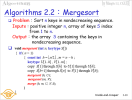 Show that the time complexity for the
number of assignments of records for the Mergesort algorithm
(Algorithms 2.2 and 2.4) is approximated by T (n)
= 2nlgn.
by Mingfu LI, CGUEE Algorithms Algorithms 2.2 : Mergesort O Problem Sort n keys in nondecreasing sequence. Inputs positive integer n, array of keys S index from 1 to n Output the array 5 containing the keys in nondecreasing sequence. void mergesort (int n, keytype S[]) (1 <u)и } keytype UI..h), ИI.m); copy...
Show that the time complexity for the
number of assignments of records for the Mergesort algorithm
(Algorithms 2.2 and 2.4) is approximated by T (n)
= 2nlgn.
by Mingfu LI, CGUEE Algorithms Algorithms 2.2 : Mergesort O Problem Sort n keys in nondecreasing sequence. Inputs positive integer n, array of keys S index from 1 to n Output the array 5 containing the keys in nondecreasing sequence. void mergesort (int n, keytype S[]) (1 <u)и } keytype UI..h), ИI.m); copy...
Show that the time complexity for the number of assignments of records for the Mergesort algorithm...
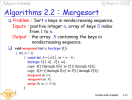 Show that the time complexity for the
number of assignments of records for the Mergesort algorithm
(Algorithms 2.2 and 2.4) is approximated by T (n)
= 2nlgn.
by Mingfu LI, CGUEE Algorithms Algorithms 2.2 : Mergesort O Problem Sort n keys in nondecreasing sequence. Inputs positive integer n, array of keys S index from 1 to n Output the array 5 containing the keys in nondecreasing sequence. void mergesort (int n, keytype S[]) (1 <u)и } keytype UI..h), ИI.m); copy...
Show that the time complexity for the
number of assignments of records for the Mergesort algorithm
(Algorithms 2.2 and 2.4) is approximated by T (n)
= 2nlgn.
by Mingfu LI, CGUEE Algorithms Algorithms 2.2 : Mergesort O Problem Sort n keys in nondecreasing sequence. Inputs positive integer n, array of keys S index from 1 to n Output the array 5 containing the keys in nondecreasing sequence. void mergesort (int n, keytype S[]) (1 <u)и } keytype UI..h), ИI.m); copy...
1. Show the steps in order to sort {11,5,6,3,8,1,9,2} using Mergesort algorithm. 2. Show the element...
1. Show the steps in order to sort {11,5,6,3,8,1,9,2} using Mergesort algorithm. 2. Show the element sequences of running Shellsort on the input {15,2,8,1,10,7,4,3,9,11,12,6} at the increments {7, 3, 1}, respectively. 3. Show the steps in details of sorting {15, 2, 8, 1, 10, 7, 4, 3, 9, 11, 12, 6} using quicksort with median-of-three partitioning and a cutoff 3 (if the elements are less than 3, using insertion sort).
In C++: 1. What is the difference between a deterministic algorithm and a randomized algorithm? 2....
 In C++:
1. What is the difference between a deterministic algorithm and a randomized algorithm? 2. What is the difference between a Las Vegas algorithm (pattern) and a Monte Carlo algorithm? 3. Solve the following recurrences, giving the answer in terms of Big-Oh O() F (n) = 4F ( 1 ) +no F (n) = 2 F (*) +2 4. Given the string "DECEMBER", execute the mergesort algorithm by hand to sort it. Show your work to make it clear...
In C++:
1. What is the difference between a deterministic algorithm and a randomized algorithm? 2. What is the difference between a Las Vegas algorithm (pattern) and a Monte Carlo algorithm? 3. Solve the following recurrences, giving the answer in terms of Big-Oh O() F (n) = 4F ( 1 ) +no F (n) = 2 F (*) +2 4. Given the string "DECEMBER", execute the mergesort algorithm by hand to sort it. Show your work to make it clear...
No program needed. Sort the sequence M, I, D, T, E, R, M, E, X, A,...
No program needed. Sort the sequence M, I, D, T, E, R, M, E, X, A, M using the following sort methods. Show the trace after each iteration of the outer loop. a. Insertion sort b. Top-Down Mergesort
Problem 5: Recurrence relations and detailed analysis of recursive algorithm efficiency g(n: non-negative integer)  
Problem 5: Recurrence relations and detailed analysis of recursive algorithm efficiency g(n: non-negative integer) 1. if n ≤ 1 then return n 2. else return (5 * g(n─1) ─ 6 * g(n─2)) MergeSort divides the array to be sorted into two equal halves, calls itself recursively on each half to sort that subarray, and then calls the Merge algorithm to merge the two sorted halves in linear time. This leads to its two recurrence relations T(n)=2T(n/2)+cn, n>1;...
In Java, Bucket sort is a sorting algorithm that has O(n) performance on average. I want...
In Java, Bucket sort is a sorting algorithm that has O(n) performance on average. I want you to write a function to perform bucket sort on a list of strings. I also want you to test your function to see if it really work in linear time on average. This code will need to be tested. Finally, I want you to compare the performance of your function with Javasort method for lists.
19.5 (Enhanced Bubble Sort) Explain why bubble sort is an O(n^2) algorithm.
19.5 (Enhanced Bubble Sort) Explain why bubble sort is an O(n^2) algorithm.
Q3) Apply Quick sort algorithm to sort the following Array (Show complete steps, and show the...
Q3) Apply Quick sort algorithm to sort the following Array (Show complete steps, and show the values of p,r and q) 7 13 5 2 4 10 15 6 3 6
Algorithm Analysis: Study the following sorting algorithm. SORT( A[1...n]) bound <- Length(A) -1 for i...
Algorithm Analysis: Study the following sorting algorithm. SORT( A[1...n]) bound <- Length(A) -1 for i <- 1 to Length(A) newbound <- 0 for j <- 0 to bound if A[j] > A[j + 1] swap( A[j], A[j + 1] ) newbound = j -1 bound <- newbound (a) Use the longer approach described in lecture 3 week 1 that we used in analyzing Insertion-Sort to compute the running time T(n) of the above SORT algorithm. You may...
 Show that the time complexity for the
number of assignments of records for the Mergesort algorithm
(Algorithms 2.2 and 2.4) is approximated by T (n)
= 2nlgn.
by Mingfu LI, CGUEE Algorithms Algorithms 2.2 : Mergesort O Problem Sort n keys in nondecreasing sequence. Inputs positive integer n, array of keys S index from 1 to n Output the array 5 containing the keys in nondecreasing sequence. void mergesort (int n, keytype S[]) (1 <u)и } keytype UI..h), ИI.m); copy...
Show that the time complexity for the
number of assignments of records for the Mergesort algorithm
(Algorithms 2.2 and 2.4) is approximated by T (n)
= 2nlgn.
by Mingfu LI, CGUEE Algorithms Algorithms 2.2 : Mergesort O Problem Sort n keys in nondecreasing sequence. Inputs positive integer n, array of keys S index from 1 to n Output the array 5 containing the keys in nondecreasing sequence. void mergesort (int n, keytype S[]) (1 <u)и } keytype UI..h), ИI.m); copy...
 Show that the time complexity for the
number of assignments of records for the Mergesort algorithm
(Algorithms 2.2 and 2.4) is approximated by T (n)
= 2nlgn.
by Mingfu LI, CGUEE Algorithms Algorithms 2.2 : Mergesort O Problem Sort n keys in nondecreasing sequence. Inputs positive integer n, array of keys S index from 1 to n Output the array 5 containing the keys in nondecreasing sequence. void mergesort (int n, keytype S[]) (1 <u)и } keytype UI..h), ИI.m); copy...
Show that the time complexity for the
number of assignments of records for the Mergesort algorithm
(Algorithms 2.2 and 2.4) is approximated by T (n)
= 2nlgn.
by Mingfu LI, CGUEE Algorithms Algorithms 2.2 : Mergesort O Problem Sort n keys in nondecreasing sequence. Inputs positive integer n, array of keys S index from 1 to n Output the array 5 containing the keys in nondecreasing sequence. void mergesort (int n, keytype S[]) (1 <u)и } keytype UI..h), ИI.m); copy...
 In C++:
1. What is the difference between a deterministic algorithm and a randomized algorithm? 2. What is the difference between a Las Vegas algorithm (pattern) and a Monte Carlo algorithm? 3. Solve the following recurrences, giving the answer in terms of Big-Oh O() F (n) = 4F ( 1 ) +no F (n) = 2 F (*) +2 4. Given the string "DECEMBER", execute the mergesort algorithm by hand to sort it. Show your work to make it clear...
In C++:
1. What is the difference between a deterministic algorithm and a randomized algorithm? 2. What is the difference between a Las Vegas algorithm (pattern) and a Monte Carlo algorithm? 3. Solve the following recurrences, giving the answer in terms of Big-Oh O() F (n) = 4F ( 1 ) +no F (n) = 2 F (*) +2 4. Given the string "DECEMBER", execute the mergesort algorithm by hand to sort it. Show your work to make it clear...
Most questions answered within 3 hours.
-
Where is the error in this code sequence?
String s1 = "Hello";
String s2 = "ello";...
asked 10 months ago -
Financial data for Joel de Paris, Inc., for last year
follow:
Joel de Paris, Inc.
Balance...
asked 10 months ago -
Consider this reaction:
Al2(SO4)3 (aq)+ BaCl3
(aq) Al2Cl6 (aq)- +
3BaSO4(s) . What is the...
asked 10 months ago -
Suppose that Savneet is considering increasing her
recent random sample from 20 car rentals to 40...
asked 10 months ago -
Trucks arrive at an unloading terminal at an average rate of 120
per hour.
Trucks arrive...
asked 10 months ago -
Why are methanol and ethanol completely soluble in water while
octanol is not very little soluble....
asked 10 months ago -
A facilities manager at a university reads in a research report
that the mean amount of...
asked 10 months ago -
When the CuSO4 is rehydrated by adding water to the anhydrous
compound, is this an endothermic...
asked 10 months ago -
A ray of sunlight is passing from diamond into crown glass; the
angle of incidence is...
asked 10 months ago -
A block of mass 0.249 kg is placed on top of a light, vertical
spring of...
asked 10 months ago -
how do the kidneys compensate in the presences of acidosis
a) trigger hyperventilate
b) reserve acid...
asked 10 months ago -
Question 501 pts
The rental rate of capital to the firm increases. Which of the
following...
asked 10 months ago