Any excess charge on a conductor tends to remain on the _____ of the conductor. a....
Any excess charge on a conductor tends to remain on the _____ of the conductor.
|
a. |
inside volume |
|
b. |
half –value layer |
|
c. |
autotransformer |
|
d. |
outside surface |
Homework Answers
Any conductor in electrostatic equilibrium tend to distribute entire excess charge on its outer surface.
Answer (d) outside surface
Add Answer to:
Any excess charge on a conductor tends to remain on the _____ of
the conductor.
a....
10. [10pt] An isolated spherical conductor has an excess charge of -17.2 uC placed on its...
 10. [10pt] An isolated spherical conductor has an excess charge of -17.2 uC placed on its surface. Inside the conductor is a cavity, within which is a point charge of 9.80 uC. How many excess electrons are on the exterior surface of the conductor ? 11. /10pt/ An additional 7.8 μC is then placed on the exterior of the sphere in the above proien Vhat is the total electric flux through a cubical gaussian surface drawn outside the sphere?.
Please provide diagrams and explain very clearly. E14M.2 Consider a conductor with excess charge on its...
 Please provide diagrams and explain very clearly.
E14M.2 Consider a conductor with excess charge on its surface, and consider a patch of that conductor's surface that is small enough so that we can approximate it as being flat (a) Argue using the results of chapter E3 the conductor's surface must be perpendicular to that surface Use Gauss's law in integral form to prove that l E-σ eo Just outside the conductor, where σ is the local charge per unit area....
Please provide diagrams and explain very clearly.
E14M.2 Consider a conductor with excess charge on its surface, and consider a patch of that conductor's surface that is small enough so that we can approximate it as being flat (a) Argue using the results of chapter E3 the conductor's surface must be perpendicular to that surface Use Gauss's law in integral form to prove that l E-σ eo Just outside the conductor, where σ is the local charge per unit area....
14: Explain why any excess charge must lie on the surface of a conductor.
 14: Explain why any excess charge must lie on the surface of a conductor.
(i) An isolated cubical conductor has an excess charge of 5.30 μC placed on its surface....
(i) An isolated cubical conductor has an excess charge of 5.30 μC placed on its surface. Inside the conductor is a cavity, within which is a point charge of 4.10 μC. How many excess electrons are on the wall of the cavity? (ii) Calculate the total electric flux that would pass through an irregularly shaped Gaussian surface drawn around the conductor in the previous problem.
Refer to the figure below. The charge lowered into the center of the hollow conductor has...
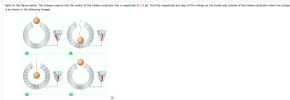 Refer to the figure below. The charge lowered into the center of the hollow conductor has a magnitude of 2.8 UC. Find the magnitude and sign of the charge on the inside and outside of the hollow conductor when the charge is as shown in the following images. a (a) Figure (a) Inside: Outside: (b) Figure (b) Inside: Outside: (c) Figure (c) Inside: Outside: (d) Figure (d) Inside: Outside:
A charge is placed inside a hollow conductor. If the conductor initially had no net charge,...
A charge is placed inside a hollow conductor. If the conductor initially had no net charge, which of these is true? a. There is no charge on the conductor b. The inner surface and outer surface is charged c. Only the inner surface is charged d. Only the outer surface is charged Can anyone tell me the answer and why, please?
Refer to the figure below. The charge lowered into the center ofthe hollow conductor has a magnitude of 5 µC. Find the m...
 Refer to the figure below. The charge lowered into the center ofthe
hollow conductor has a magnitude of 5 µC. Find the magnitude and
sign of thecharge on the inside and outside of the hollow conductor
when thecharge is as shown in the following images:
(a) Figure (a)
Inside:
1
Your response differs from the correct answerby orders of
magnitude. µC
Outside:
2
Your response differs from the correct answerby orders of
magnitude. µC
(b) Figure (b)
Inside:
3 µC...
Refer to the figure below. The charge lowered into the center ofthe
hollow conductor has a magnitude of 5 µC. Find the magnitude and
sign of thecharge on the inside and outside of the hollow conductor
when thecharge is as shown in the following images:
(a) Figure (a)
Inside:
1
Your response differs from the correct answerby orders of
magnitude. µC
Outside:
2
Your response differs from the correct answerby orders of
magnitude. µC
(b) Figure (b)
Inside:
3 µC...
© 12 of 20 > Part A An uncharged conductor has a hollow cavity inside of...
 © 12 of 20 > Part A An uncharged conductor has a hollow cavity inside of it. Within this cavity there is a charge of +10°C that does not touch the conductor. There are no other charges in the vicinity. Which statement about this conductor is true? (There may be more than one correct choice.) The inner and outer surfaces of the conductor each contain charges of -5ục. The net electric field within the material of the conductor points away...
A conductor in the shape of a cube has a net charge of +1.3 ✕ 10−5...
A conductor in the shape of a cube has a net charge of +1.3 ✕ 10−5 C. Inside the conductor is an oval-shaped hollow region, which is not at the center of the cube; inside the hollow region is a point charge of charge q = +3.1 ✕ 10−6 C. (a) What is the net charge on the wall of the hollow region? C (b) What is the net charge on the outer surface of the cube-shaped conductor? C
For a conductor in electrostatic equilibrium, which of the following properties are true? Choose all that...
 For a conductor in electrostatic equilibrium, which of the following properties are true? Choose all that apply. Any excess charge is uniformly spread throughout the volume of the conductor. The electric field inside is zero. The entire conductor is at the same potential.
 10. [10pt] An isolated spherical conductor has an excess charge of -17.2 uC placed on its surface. Inside the conductor is a cavity, within which is a point charge of 9.80 uC. How many excess electrons are on the exterior surface of the conductor ? 11. /10pt/ An additional 7.8 μC is then placed on the exterior of the sphere in the above proien Vhat is the total electric flux through a cubical gaussian surface drawn outside the sphere?.
 Please provide diagrams and explain very clearly.
E14M.2 Consider a conductor with excess charge on its surface, and consider a patch of that conductor's surface that is small enough so that we can approximate it as being flat (a) Argue using the results of chapter E3 the conductor's surface must be perpendicular to that surface Use Gauss's law in integral form to prove that l E-σ eo Just outside the conductor, where σ is the local charge per unit area....
Please provide diagrams and explain very clearly.
E14M.2 Consider a conductor with excess charge on its surface, and consider a patch of that conductor's surface that is small enough so that we can approximate it as being flat (a) Argue using the results of chapter E3 the conductor's surface must be perpendicular to that surface Use Gauss's law in integral form to prove that l E-σ eo Just outside the conductor, where σ is the local charge per unit area....
 14: Explain why any excess charge must lie on the surface of a conductor.
 Refer to the figure below. The charge lowered into the center of the hollow conductor has a magnitude of 2.8 UC. Find the magnitude and sign of the charge on the inside and outside of the hollow conductor when the charge is as shown in the following images. a (a) Figure (a) Inside: Outside: (b) Figure (b) Inside: Outside: (c) Figure (c) Inside: Outside: (d) Figure (d) Inside: Outside:
 Refer to the figure below. The charge lowered into the center ofthe
hollow conductor has a magnitude of 5 µC. Find the magnitude and
sign of thecharge on the inside and outside of the hollow conductor
when thecharge is as shown in the following images:
(a) Figure (a)
Inside:
1
Your response differs from the correct answerby orders of
magnitude. µC
Outside:
2
Your response differs from the correct answerby orders of
magnitude. µC
(b) Figure (b)
Inside:
3 µC...
Refer to the figure below. The charge lowered into the center ofthe
hollow conductor has a magnitude of 5 µC. Find the magnitude and
sign of thecharge on the inside and outside of the hollow conductor
when thecharge is as shown in the following images:
(a) Figure (a)
Inside:
1
Your response differs from the correct answerby orders of
magnitude. µC
Outside:
2
Your response differs from the correct answerby orders of
magnitude. µC
(b) Figure (b)
Inside:
3 µC...
 © 12 of 20 > Part A An uncharged conductor has a hollow cavity inside of it. Within this cavity there is a charge of +10°C that does not touch the conductor. There are no other charges in the vicinity. Which statement about this conductor is true? (There may be more than one correct choice.) The inner and outer surfaces of the conductor each contain charges of -5ục. The net electric field within the material of the conductor points away...
 For a conductor in electrostatic equilibrium, which of the following properties are true? Choose all that apply. Any excess charge is uniformly spread throughout the volume of the conductor. The electric field inside is zero. The entire conductor is at the same potential.
Most questions answered within 3 hours.
-
Where is the error in this code sequence?
String s1 = "Hello";
String s2 = "ello";...
asked 10 months ago -
Financial data for Joel de Paris, Inc., for last year
follow:
Joel de Paris, Inc.
Balance...
asked 10 months ago -
Consider this reaction:
Al2(SO4)3 (aq)+ BaCl3
(aq) Al2Cl6 (aq)- +
3BaSO4(s) . What is the...
asked 10 months ago -
Suppose that Savneet is considering increasing her
recent random sample from 20 car rentals to 40...
asked 10 months ago -
Trucks arrive at an unloading terminal at an average rate of 120
per hour.
Trucks arrive...
asked 10 months ago -
Why are methanol and ethanol completely soluble in water while
octanol is not very little soluble....
asked 10 months ago -
A facilities manager at a university reads in a research report
that the mean amount of...
asked 10 months ago -
When the CuSO4 is rehydrated by adding water to the anhydrous
compound, is this an endothermic...
asked 10 months ago -
A ray of sunlight is passing from diamond into crown glass; the
angle of incidence is...
asked 10 months ago -
A block of mass 0.249 kg is placed on top of a light, vertical
spring of...
asked 10 months ago -
how do the kidneys compensate in the presences of acidosis
a) trigger hyperventilate
b) reserve acid...
asked 10 months ago -
Question 501 pts
The rental rate of capital to the firm increases. Which of the
following...
asked 10 months ago