In the figure below, two identical springs of spring constant 7500 N/m are attached to a...
In the figure below, two identical springs of spring constant
7500 N/m are attached to a block of mass 0.300 kg. What is the
frequency of oscillation on the frictionless floor? Give your
answer in Hz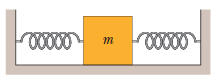
Homework Answers
In this case spring are in parelellel with respect to block
hence Keffective = 2k
f = 1/2π (√(2k/m)
= 1/2π(√(2×7500/0.300)
= 35.59 Hz
Add Answer to:
In the figure below, two identical springs of spring constant
7500 N/m are attached to a...
In the figure, two identical springs of spring constant 180 N/m are attached to a block...
In the figure, two identical springs of spring constant 180 N/m are attached to a block of mass 22 kg. The block is set oscillating on the frictionless floor. What is the frequency of oscillation?
A mass of 500 grams is attached to two springs whose spring constants are k1=2 N/m...
A mass of 500 grams is attached to two springs whose spring constants are k1=2 N/m and k2 = 5 N/m, which are in turn attached to a wall. The system is on a horizontal frictionless surface. The system is displaced to the right and released. (a) What is the effective spring constant of the two springs in ”series”? Hint use Hooke’s law and the fact that the force required to displace the system is the same acting on each...
a 0.675 kg mass is attached to a spring of spring constant 42.4 n/m, pulled, and...
 a 0.675 kg mass is attached to a spring of spring constant
42.4 n/m, pulled, and released. what is the frequency of the
resulting oscillation
A 0.675 kg mass is attached to a spring of spring constant 42.4 N/m, pulled, and released. What is the frequency of the resulting oscillation? (Unit = Hz) Enter 2000 Acelas Corporation. All Rights Reserved ONHOQE
a 0.675 kg mass is attached to a spring of spring constant
42.4 n/m, pulled, and released. what is the frequency of the
resulting oscillation
A 0.675 kg mass is attached to a spring of spring constant 42.4 N/m, pulled, and released. What is the frequency of the resulting oscillation? (Unit = Hz) Enter 2000 Acelas Corporation. All Rights Reserved ONHOQE
A block of mass m = 6.04 kg is attached to a spring with spring constant...
 A block of mass m = 6.04 kg is attached to a spring with spring constant k = 1572 N/m and rests on a frictionless surface. The block is pulled, stretching the spring a distance of 0.170 m, and is held still. The block is then released and moves in simple harmonic motion about the equilibrium position. (Assume that the block is stretched in the positive direction.) (a) What is the frequency of this oscillation? 2.57 Hz (b) Where is...
2. A system consists ofa block attached to two horizontally-mounted springs, as shown in the figure...
 2. A system consists ofa block attached to two horizontally-mounted springs, as shown in the figure is to the right. The horizontal sur- face across which the block slides is frictionless. What is the angular frequency of the oscillations of this system? Express your answer in terms of the mass of the block (m) and the spring constant of the spring (k).
A block with mass m = 5.8 kg is attached to two springs with spring constants kleft = 37 N/m and Kright = 55 N/m. T...
 A block with mass m = 5.8 kg is attached to two springs with spring constants kleft = 37 N/m and Kright = 55 N/m. The block is pulled a distance x = 0.24 m to the left of its equilibrium position and released from rest. 1) What is the magnitude of the net force on the block (the moment it is released)? 2) What is the effective spring constant of the two springs? 3) What is the period of oscillation of the...
A block with mass m = 5.7 kg is attached to two springs with spring constants...
 A block with mass m = 5.7 kg is attached to two
springs with spring constants kleft = 36 N/m and
kright = 53 N/m. The block is pulled a distance x =
0.23 m to the left of its equilibrium position and released from
rest.
1)
What is the magnitude of the net force on the block
(the moment it is released)?
2)
What is the effective spring constant of the two
springs?
3)
What is the period of oscillation of...
A block with mass m = 5.7 kg is attached to two
springs with spring constants kleft = 36 N/m and
kright = 53 N/m. The block is pulled a distance x =
0.23 m to the left of its equilibrium position and released from
rest.
1)
What is the magnitude of the net force on the block
(the moment it is released)?
2)
What is the effective spring constant of the two
springs?
3)
What is the period of oscillation of...
A block with mass m = 5.5 kg is attached to two springs with spring constants...
A block with mass m = 5.5 kg is attached to two springs with spring constants kleft = 34 N/m and kright = 51 N/m. The block is pulled a distance x = 0.29 m to the left of its equilibrium position and released from rest. A)What is the magnitude of the net force on the block (the moment it is released)? B)What is the effective spring constant of the two springs? C)What is the period of oscillation of the...
A block mass of 3 kg attached with a spring of spring constant 2000 N/m as shown in the Figure below
 Part A: 10 points each (Questions 1-4) 1. A block mass of 3 kg attached with a spring of spring constant 2000 N/m as shown in the Figure below. The amplitude or maximum displacement Xmax is 5m. Calculatea) Maximum Potential energy stored in the spring b) Maximum kinetic energy of the block c) the total energy-spring block system 2. A small mass moves in simple harmonic motion according to the equation x = 2 Cos(45t), where "x" displacement from equilibrium point in meters and "t"...
A spring of spring constant k=261 N/m is attached to a block of mass 1.38 kg...
A spring of spring constant k=261 N/m is attached to a block of mass 1.38 kg and stretched horizontally to a position 15.0 cm from the springs equilibrium position. The spring and mass are released and oscillate in simple harmonic motion across a frictionless horizontal surface. What is the maximum speed obtained by the mass? m/s
 a 0.675 kg mass is attached to a spring of spring constant
42.4 n/m, pulled, and released. what is the frequency of the
resulting oscillation
A 0.675 kg mass is attached to a spring of spring constant 42.4 N/m, pulled, and released. What is the frequency of the resulting oscillation? (Unit = Hz) Enter 2000 Acelas Corporation. All Rights Reserved ONHOQE
a 0.675 kg mass is attached to a spring of spring constant
42.4 n/m, pulled, and released. what is the frequency of the
resulting oscillation
A 0.675 kg mass is attached to a spring of spring constant 42.4 N/m, pulled, and released. What is the frequency of the resulting oscillation? (Unit = Hz) Enter 2000 Acelas Corporation. All Rights Reserved ONHOQE
 A block of mass m = 6.04 kg is attached to a spring with spring constant k = 1572 N/m and rests on a frictionless surface. The block is pulled, stretching the spring a distance of 0.170 m, and is held still. The block is then released and moves in simple harmonic motion about the equilibrium position. (Assume that the block is stretched in the positive direction.) (a) What is the frequency of this oscillation? 2.57 Hz (b) Where is...
 2. A system consists ofa block attached to two horizontally-mounted springs, as shown in the figure is to the right. The horizontal sur- face across which the block slides is frictionless. What is the angular frequency of the oscillations of this system? Express your answer in terms of the mass of the block (m) and the spring constant of the spring (k).
 A block with mass m = 5.7 kg is attached to two
springs with spring constants kleft = 36 N/m and
kright = 53 N/m. The block is pulled a distance x =
0.23 m to the left of its equilibrium position and released from
rest.
1)
What is the magnitude of the net force on the block
(the moment it is released)?
2)
What is the effective spring constant of the two
springs?
3)
What is the period of oscillation of...
A block with mass m = 5.7 kg is attached to two
springs with spring constants kleft = 36 N/m and
kright = 53 N/m. The block is pulled a distance x =
0.23 m to the left of its equilibrium position and released from
rest.
1)
What is the magnitude of the net force on the block
(the moment it is released)?
2)
What is the effective spring constant of the two
springs?
3)
What is the period of oscillation of...
Most questions answered within 3 hours.
-
Where is the error in this code sequence?
String s1 = "Hello";
String s2 = "ello";...
asked 10 months ago -
Financial data for Joel de Paris, Inc., for last year
follow:
Joel de Paris, Inc.
Balance...
asked 10 months ago -
Consider this reaction:
Al2(SO4)3 (aq)+ BaCl3
(aq) Al2Cl6 (aq)- +
3BaSO4(s) . What is the...
asked 10 months ago -
Suppose that Savneet is considering increasing her
recent random sample from 20 car rentals to 40...
asked 10 months ago -
Trucks arrive at an unloading terminal at an average rate of 120
per hour.
Trucks arrive...
asked 10 months ago -
Why are methanol and ethanol completely soluble in water while
octanol is not very little soluble....
asked 10 months ago -
A facilities manager at a university reads in a research report
that the mean amount of...
asked 10 months ago -
When the CuSO4 is rehydrated by adding water to the anhydrous
compound, is this an endothermic...
asked 10 months ago -
A ray of sunlight is passing from diamond into crown glass; the
angle of incidence is...
asked 10 months ago -
A block of mass 0.249 kg is placed on top of a light, vertical
spring of...
asked 10 months ago -
how do the kidneys compensate in the presences of acidosis
a) trigger hyperventilate
b) reserve acid...
asked 10 months ago -
Question 501 pts
The rental rate of capital to the firm increases. Which of the
following...
asked 10 months ago