Write an efficient java private int countodds (node t) method that returns the number of odd...
Write an efficient java private int countodds (node t) method that returns the number of odd integers in a singly linked list headed by node t. (
Assume class node is defined as: private class node {int data; node rlink;}
Homework Answers

private int countodds(node t) {
    int count = 0;
    while (t != null) {
        if (t.data % 2 == 1)
            ++count;
        t = t.rlink;
    }
    return count;
}
Add Answer to:
Write an efficient java private int countodds (node t)
method that returns the number of odd...
In Java The following Java implementation of a class Node is given: private class Node<Object> {...
In Java The following Java implementation of a class Node is given: private class Node<Object> { Node() { this(null, null); } Node(Object d) { this(d, null); } Node(Object d, Node n) { data = d; next = n; } Object data; Node next; } Assume that a singly linked list is implemented with a header node, but no tail node, and that it maintains only a reference to the header node. Using the class Node described above, write a MySingleLinkedList...
Language: Java Topic: Doubly Linked Lists Write a method that removes and returns the last copy...
Language: Java Topic: Doubly Linked Lists Write a method that removes and returns the last copy of the given data from the list. Do not return the same data that was passed in. Return the data that was stored in the list. Must be O(1) if data is in the tail and O(n) for all other cases. * @param data the data to be removed from the list * @return the data that was removed * @throws java.lang.IllegalArgumentException if...
JAVA~ 1. Write a static method named countOdd(my_array) that returns the number of odd integers in...
JAVA~ 1. Write a static method named countOdd(my_array) that returns the number of odd integers in a given array. If there are no odd numbers in the array, the method should return 0. If the array is empty, the method should also return 0. For example: Test Result System.out.println(countOdd(new int[]{2, 3, 5, 6})); 2 System.out.println(countOdd(new int[]{2})); 0 System.out.println(countOdd(new int[]{})); 0 System.out.println(countOdd(new int[]{-7, 2, 3, 8, 6, 6, 75, 38, 3, 2})); 4 public static int ----------------------------------------------------------------------------------------------------------- 2. Write a static...
You are given a Node class and a List class: Write a java method insertNodeBefore() which...
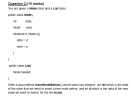 You are given a Node class and a List class: Write a java method insertNodeBefore() which takes two integers (int ref which is the data of the node that we need to insert a new node before, and int d which is the data of the new node we want to insert), for the list mylist.
Java Write the function void insertAtTail (int v). Don’t add any class variables to the List...
 Java
Write the function void insertAtTail (int v). Don’t add any
class variables to the List class.
Here are the class definitions of Node and List that implement a linked list. class Node {private Node next; private int key; Node (Node nxt, int keyValue);//constructor Node getNext(); int getKey(); void putNext(Node nxt);} class List {//assume the class does not use a dummy Node private Node head; List ();//constructor boolean exists (int ky);//returns true if v is in the list void insertAtHead(int...
Java
Write the function void insertAtTail (int v). Don’t add any
class variables to the List class.
Here are the class definitions of Node and List that implement a linked list. class Node {private Node next; private int key; Node (Node nxt, int keyValue);//constructor Node getNext(); int getKey(); void putNext(Node nxt);} class List {//assume the class does not use a dummy Node private Node head; List ();//constructor boolean exists (int ky);//returns true if v is in the list void insertAtHead(int...
Using Java You are given a Node class and a List class: public class Node {...
 Using Java
You are given a
Node class and a
List class:
public class
Node
{
int data;
Node
next;
}
public class
List
{
Node
first;
}
You are also given a Stack class.
The following functions are available for use:
public class Stack
{
public boolean
isEmpty(){};
public void push(int
n){};
public int
pop(){};}
Write a Java method
snglyRevToStck that pushes the data found
in a linked list t in reverse order into the stack...
Using Java
You are given a
Node class and a
List class:
public class
Node
{
int data;
Node
next;
}
public class
List
{
Node
first;
}
You are also given a Stack class.
The following functions are available for use:
public class Stack
{
public boolean
isEmpty(){};
public void push(int
n){};
public int
pop(){};}
Write a Java method
snglyRevToStck that pushes the data found
in a linked list t in reverse order into the stack...
Given the following linked list structure called node: struct node { int val; struct node *...
Given the following linked list structure called node: struct node { int val; struct node * ptrNext; }; Assume we have a single list created from this structure with a head pointer called ptrFirst which is declared in the global scope. a. Write a complete C function called CountEven to count all the even values in this singly linked list of arbitrary number of nodes using an iterative (non-recursive) approach. The function takes as parameter the pointer to the starting...
Linked List in Java The data node should be modeled somewhat like this: class node{ int...
Linked List in Java The data node should be modeled somewhat like this: class node{ int node iNum; node next; } Write a program that creates a linked list and loads it with the numbers 0 to 9. Start with an empty list and then use a "for loop" to fill it. Create a linked list class, a node class, etc. Routines like makeNode and findTail should be methods in the linked list class. Create a showList function to display...
Write a method max() that takes a reference to the first node in a linked list...
Write a method max() that takes a reference to the first node in a linked list as argument and returns the value of the maximum key in the list. Assume that all keys are positive integers, and return 0 if the list is empty. In java
Write a java code : Student ID at University is composed of year of admission and...
Write a java code : Student ID at University is composed of year of admission and students number. we aim to implement a structure that improves operations of inserting and searching for a student. To enhance these operations, we will build a tree of linked lists (TreeOfLists) to combine advantages of both structures. Each node in this tree contains a linked list of all students who were admitted in that year. Each node in the linked list represents a student(id,...
 You are given a Node class and a List class: Write a java method insertNodeBefore() which takes two integers (int ref which is the data of the node that we need to insert a new node before, and int d which is the data of the new node we want to insert), for the list mylist.
 Java
Write the function void insertAtTail (int v). Don’t add any
class variables to the List class.
Here are the class definitions of Node and List that implement a linked list. class Node {private Node next; private int key; Node (Node nxt, int keyValue);//constructor Node getNext(); int getKey(); void putNext(Node nxt);} class List {//assume the class does not use a dummy Node private Node head; List ();//constructor boolean exists (int ky);//returns true if v is in the list void insertAtHead(int...
Java
Write the function void insertAtTail (int v). Don’t add any
class variables to the List class.
Here are the class definitions of Node and List that implement a linked list. class Node {private Node next; private int key; Node (Node nxt, int keyValue);//constructor Node getNext(); int getKey(); void putNext(Node nxt);} class List {//assume the class does not use a dummy Node private Node head; List ();//constructor boolean exists (int ky);//returns true if v is in the list void insertAtHead(int...
 Using Java
You are given a
Node class and a
List class:
public class
Node
{
int data;
Node
next;
}
public class
List
{
Node
first;
}
You are also given a Stack class.
The following functions are available for use:
public class Stack
{
public boolean
isEmpty(){};
public void push(int
n){};
public int
pop(){};}
Write a Java method
snglyRevToStck that pushes the data found
in a linked list t in reverse order into the stack...
Using Java
You are given a
Node class and a
List class:
public class
Node
{
int data;
Node
next;
}
public class
List
{
Node
first;
}
You are also given a Stack class.
The following functions are available for use:
public class Stack
{
public boolean
isEmpty(){};
public void push(int
n){};
public int
pop(){};}
Write a Java method
snglyRevToStck that pushes the data found
in a linked list t in reverse order into the stack...
Most questions answered within 3 hours.
-
Where is the error in this code sequence?
String s1 = "Hello";
String s2 = "ello";...
asked 11 months ago -
Financial data for Joel de Paris, Inc., for last year
follow:
Joel de Paris, Inc.
Balance...
asked 11 months ago -
Consider this reaction:
Al2(SO4)3 (aq)+ BaCl3
(aq) Al2Cl6 (aq)- +
3BaSO4(s) . What is the...
asked 11 months ago -
Suppose that Savneet is considering increasing her
recent random sample from 20 car rentals to 40...
asked 11 months ago -
Trucks arrive at an unloading terminal at an average rate of 120
per hour.
Trucks arrive...
asked 11 months ago -
Why are methanol and ethanol completely soluble in water while
octanol is not very little soluble....
asked 11 months ago -
A facilities manager at a university reads in a research report
that the mean amount of...
asked 11 months ago -
When the CuSO4 is rehydrated by adding water to the anhydrous
compound, is this an endothermic...
asked 11 months ago -
A ray of sunlight is passing from diamond into crown glass; the
angle of incidence is...
asked 11 months ago -
A block of mass 0.249 kg is placed on top of a light, vertical
spring of...
asked 11 months ago -
how do the kidneys compensate in the presences of acidosis
a) trigger hyperventilate
b) reserve acid...
asked 11 months ago -
Question 501 pts
The rental rate of capital to the firm increases. Which of the
following...
asked 11 months ago