
Homework Answers
Note if there is any understanding problem regarding this please feel free to ask via comment box
thank you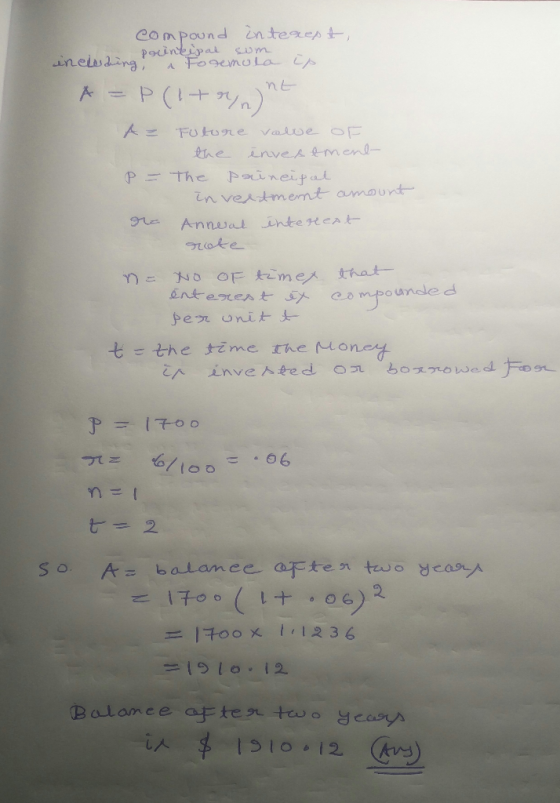
Add Answer to:
Use an online savings calculator or another computational device to assist you in answering this question...
Question 1) You have $30,000 that you want to invest in an online account for the...
Question 1) You have $30,000 that you want to invest in an online account for the next 10 years. You are offered an investment plan that will pay you 3% for the first 5 years and then 6% for the remaining 5 years. What will be the balance in your online account at the end of the 10 years? Assume that the interest rate is compounded semi-annually.
Show the excel formulas used Ex. 1 You have $5,000 in your savings account that pays...
 Show the excel formulas used
Ex. 1 You have $5,000 in your savings account that pays 4% interest. How much will you have in your account after 20 years, a) if your bank pays annually compounded interest? b) if your bank pays monthly compounded interest? c) if your bank pays daily compounded interest? Current balance Interest Years Compounding Annually Monthly Daily a) FV b) FV c) FV Ex. 2 If you need $10,000 in 7 years and you can earn...
Show the excel formulas used
Ex. 1 You have $5,000 in your savings account that pays 4% interest. How much will you have in your account after 20 years, a) if your bank pays annually compounded interest? b) if your bank pays monthly compounded interest? c) if your bank pays daily compounded interest? Current balance Interest Years Compounding Annually Monthly Daily a) FV b) FV c) FV Ex. 2 If you need $10,000 in 7 years and you can earn...
4. You would like to invest 58,500 in a savings account that pays interest of 1.35%,...
 4. You would like to invest 58,500 in a savings account that pays interest of 1.35%, compounded continuously. The formula for computing the future amount. After years is ven by A = 8,500e 0.0133. Te 2.718281828 1828 or use the key on your calculator (a). Calculate the amount you have in the account after 3 years (b). Calculate the amount you have in the account after 10 years.
12. Compound interest. You invest $1000 in an account that pays 5% compounded annually. What is...
 12. Compound interest. You invest $1000 in an account that pays 5% compounded annually. What is the balance after two years? 13. Compounding using different periods. You invest $2000 in an account that pays an APR of 6%. a. What is the value of the investment after three years if interest is compounded yearly? Round your
You would like to deposit $1000 in a savings account. The bank gives you two options:...
You would like to deposit $1000 in a savings account. The bank gives you two options: Account A pays interest at a rate of 8% (annually compounded) each year. Account B pays a simple interest rate of 8% per year (but never compounds), and gives you a $50 bonus at the end of 5 years. What is the difference in the account balances in 5 years? (Your answer should be the solution to Balance of Account A minus Balance of...
Future Value 13. You invest $10,000 today in a retirement account that pays 6 percent interest...
 Future Value 13. You invest $10,000 today in a retirement account that pays 6 percent interest compounded annually. What is the total balance in the account 10 years from today? a. $17,908 14. You invest $10,000 today in a retirement account that pays 6 percent interest compounded annually. What is the total balance in the account 20 years from today? a. $32,071
You deposit $3,000 at the end of the year (k = 0) into an account that pays interest at a rate of 7% compounded annually. A year after your deposit, the savings account interest rate changes to 1 2%...
 You deposit $3,000 at the end of the year (k = 0) into an account that pays interest at a rate of 7% compounded annually. A year after your deposit, the savings account interest rate changes to 1 2% nominal interest compounded month y Five years after ur de o the savings account aga changes it interest rate this time e interest rate becomes 8% nominal interest compounded quarterly. Eight years after your deposit, the saving account changes its rate...
Show the excel formulas used and answer all questions Ex. 1 You have $5,000 in your...
 Show the excel formulas used and answer all questions
Ex. 1 You have $5,000 in your savings account that pays 4% interest. How much will you have in your account after 20 years, a) if your bank pays annually compounded interest? b) if your bank pays monthly compounded interest? c) if your bank pays daily compounded interest? Current balance Interest Years Compounding Annually Monthly Daily a) FV b) FV c) FV Ex. 2 If you need $10,000 in 7 years...
Show the excel formulas used and answer all questions
Ex. 1 You have $5,000 in your savings account that pays 4% interest. How much will you have in your account after 20 years, a) if your bank pays annually compounded interest? b) if your bank pays monthly compounded interest? c) if your bank pays daily compounded interest? Current balance Interest Years Compounding Annually Monthly Daily a) FV b) FV c) FV Ex. 2 If you need $10,000 in 7 years...
at the beginning of the year you deposit $1,500 in a savings account. How much will...
at the beginning of the year you deposit $1,500 in a savings account. How much will accumulate in four years if you earn 6% compounded annually? Use Excel or a financial calculator for computation. Round answer to the nearest dollar.
M C CUNICU NU Tulure Value or savings account If you put $4,000 in a savings...
 M C CUNICU NU Tulure Value or savings account If you put $4,000 in a savings account that pays Interest at the rate of 7 percent, compounded annually. a. how much will you have in three years? Round the answer to the nearest cent. Round PV-factor to three decimal places or use the Appendix A. (Hint: Use the future value formula.) b. how much interest will you earn during the three years? Round the answer to the nearest cent. c....
 Show the excel formulas used
Ex. 1 You have $5,000 in your savings account that pays 4% interest. How much will you have in your account after 20 years, a) if your bank pays annually compounded interest? b) if your bank pays monthly compounded interest? c) if your bank pays daily compounded interest? Current balance Interest Years Compounding Annually Monthly Daily a) FV b) FV c) FV Ex. 2 If you need $10,000 in 7 years and you can earn...
Show the excel formulas used
Ex. 1 You have $5,000 in your savings account that pays 4% interest. How much will you have in your account after 20 years, a) if your bank pays annually compounded interest? b) if your bank pays monthly compounded interest? c) if your bank pays daily compounded interest? Current balance Interest Years Compounding Annually Monthly Daily a) FV b) FV c) FV Ex. 2 If you need $10,000 in 7 years and you can earn...
 4. You would like to invest 58,500 in a savings account that pays interest of 1.35%, compounded continuously. The formula for computing the future amount. After years is ven by A = 8,500e 0.0133. Te 2.718281828 1828 or use the key on your calculator (a). Calculate the amount you have in the account after 3 years (b). Calculate the amount you have in the account after 10 years.
 12. Compound interest. You invest $1000 in an account that pays 5% compounded annually. What is the balance after two years? 13. Compounding using different periods. You invest $2000 in an account that pays an APR of 6%. a. What is the value of the investment after three years if interest is compounded yearly? Round your
 Future Value 13. You invest $10,000 today in a retirement account that pays 6 percent interest compounded annually. What is the total balance in the account 10 years from today? a. $17,908 14. You invest $10,000 today in a retirement account that pays 6 percent interest compounded annually. What is the total balance in the account 20 years from today? a. $32,071
 You deposit $3,000 at the end of the year (k = 0) into an account that pays interest at a rate of 7% compounded annually. A year after your deposit, the savings account interest rate changes to 1 2% nominal interest compounded month y Five years after ur de o the savings account aga changes it interest rate this time e interest rate becomes 8% nominal interest compounded quarterly. Eight years after your deposit, the saving account changes its rate...
 Show the excel formulas used and answer all questions
Ex. 1 You have $5,000 in your savings account that pays 4% interest. How much will you have in your account after 20 years, a) if your bank pays annually compounded interest? b) if your bank pays monthly compounded interest? c) if your bank pays daily compounded interest? Current balance Interest Years Compounding Annually Monthly Daily a) FV b) FV c) FV Ex. 2 If you need $10,000 in 7 years...
Show the excel formulas used and answer all questions
Ex. 1 You have $5,000 in your savings account that pays 4% interest. How much will you have in your account after 20 years, a) if your bank pays annually compounded interest? b) if your bank pays monthly compounded interest? c) if your bank pays daily compounded interest? Current balance Interest Years Compounding Annually Monthly Daily a) FV b) FV c) FV Ex. 2 If you need $10,000 in 7 years...
 M C CUNICU NU Tulure Value or savings account If you put $4,000 in a savings account that pays Interest at the rate of 7 percent, compounded annually. a. how much will you have in three years? Round the answer to the nearest cent. Round PV-factor to three decimal places or use the Appendix A. (Hint: Use the future value formula.) b. how much interest will you earn during the three years? Round the answer to the nearest cent. c....
Most questions answered within 3 hours.
-
Where is the error in this code sequence?
String s1 = "Hello";
String s2 = "ello";...
asked 11 months ago -
Financial data for Joel de Paris, Inc., for last year
follow:
Joel de Paris, Inc.
Balance...
asked 11 months ago -
Consider this reaction:
Al2(SO4)3 (aq)+ BaCl3
(aq) Al2Cl6 (aq)- +
3BaSO4(s) . What is the...
asked 11 months ago -
Suppose that Savneet is considering increasing her
recent random sample from 20 car rentals to 40...
asked 11 months ago -
Trucks arrive at an unloading terminal at an average rate of 120
per hour.
Trucks arrive...
asked 11 months ago -
Why are methanol and ethanol completely soluble in water while
octanol is not very little soluble....
asked 11 months ago -
A facilities manager at a university reads in a research report
that the mean amount of...
asked 11 months ago -
When the CuSO4 is rehydrated by adding water to the anhydrous
compound, is this an endothermic...
asked 11 months ago -
A ray of sunlight is passing from diamond into crown glass; the
angle of incidence is...
asked 11 months ago -
A block of mass 0.249 kg is placed on top of a light, vertical
spring of...
asked 11 months ago -
how do the kidneys compensate in the presences of acidosis
a) trigger hyperventilate
b) reserve acid...
asked 11 months ago -
Question 501 pts
The rental rate of capital to the firm increases. Which of the
following...
asked 11 months ago