The mixture of Xe and Kr above, with gas constant R=483.6 ft∙lbf/(slug∙R), is at a temperature...
The mixture of Xe and Kr above, with gas constant R=483.6 ft∙lbf/(slug∙R), is at a temperature of T=60oF and an absolute pressure P=15atm. Assume that the ideal gas law may be applied in your analysis. What is the mass density in slug/ft3? Ans. 0.00842 slug/ft3.
Homework Answers

Add Answer to:
The mixture of Xe and Kr above, with gas constant R=483.6
ft∙lbf/(slug∙R), is at a temperature...
Consider a mixture of neon (Ne, MW = 20.18 g/mol) and krypton (Kr, MW = 83.80...
Consider a mixture of neon (Ne, MW = 20.18 g/mol) and krypton (Kr, MW = 83.80 g/mol) at a temperature T = 309.15 Kelvin. The total pressure of the gas mixture is p = 811.4 torr, and the density of the gas mixture is 2.556 g/L. Find the following. a) The volume occupied by 1.000 moles of the gas mixture. b) p(Ne), the partial pressure of neon gas in the gas mixture. For the conditions in the problem you may...
Air within a piston–cylinder assembly, initially at 15 lbf/ in.2, 510°R, and a volume of 6...
Air within a piston–cylinder assembly, initially at 15 lbf/ in.2, 510°R, and a volume of 6 ft3, is compressed isentropically to a final volume of 3 ft3. Assuming the ideal gas model with k = 1.4 for the air, determine the: (a) mass, in lb. (b) final pressure, in lbf/in.2 (c) final temperature, in °R. (d) work, in Btu.
7. Air [R=1715 ft·lb/(slug R), cp = 6003 ft-lb/(slug-R)] flows steadily, as shown in the figure,...
 7. Air [R=1715 ft·lb/(slug R), cp = 6003 ft-lb/(slug-R)] flows steadily, as shown in the figure, through a turbine which produces 700 hp. For the inlet and exit conditions shown, estimate (a) the exit velocity V2 and (b) the heat transferred in Btu per hour. Hint: The specific enthalpy of an ideal gas is h = CAT. w,700 hp Turbomachine D = 6 in P = 150 lb/in? Ti - 300°F V = 100 ft/s D -6 in P2 -...
Example 1 What is the weight (in lbf) of one gallon of air at 1 atm...
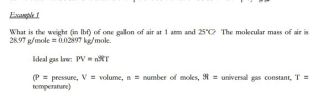 Example 1 What is the weight (in lbf) of one gallon of air at 1 atm and 25°C? The molecular mass of air is 28.97 g/mole = 0.02897 kg/mole. Ideal gas law: PV = nRT (P = pressure, V = volume, n = number of moles, R = universal gas constant, T = temperature)
Problem 2.3. An ideal ramjet is to fly at 20,000 ft with a Mach number of...
Problem 2.3. An ideal ramjet is to fly at 20,000 ft with a Mach number of 3.5. The burner exit total temperature is to be 3200 °?? and the engine will use 145 lbm/s of air. The heating value of the fuel is 18,500 Btu/lbm. What is the diameter of the rounded exit, thrust, dimensionless thrust, and TSFC at this condition? (Assume that the temperature is 447.38°??, the static pressure is 6.747161 psia, and the specific heat ratio is 1.4...
The Ideal Gas Law 4 of 8 Review | Constants I Periodic Table The ideal gas law describes thee relationship among...
 The Ideal Gas Law 4 of 8 Review | Constants I Periodic Table The ideal gas law describes thee relationship among the pressure P. volume V. number of moles n and absolute temperature T'of an ideal gas Here is the relationship expressed mathematicaly Part A PV-nRT How many air molecules are in a 14.0 x 12.0 x 10.0 ft room (28.2 L 200 C and ideal behavior 1 ft? Assume atmospheric pressure of 1.00 atm a room temperature of where...
1a) According to the ideal gas law, _______________. a. a gas has infinite volume at absolute...
1a) According to the ideal gas law, _______________. a. a gas has infinite volume at absolute zero b. temperature and volume are directly proportional c. pressure and volume are directly proportional d. temperature and pressure are inversely proportional e. the gas constant increases as temperature decreases 1b) In a plot of the volume (V) of a gas versus its temperature (T), the slope represents _______________. a. pressure (P) b. RP/n c. the gas constant (R) d. number of moles (n)...
Please help! Problem 4. A process gas flowing at a rate of Q ft/hr at the...
 Please help!
Problem 4. A process gas flowing at a rate of Q ft/hr at the total pressure of p atm absolute and the temperature of T oF contains H25 with a partial pressure of pa psia. The process gas passes to a scrubber in which RM 96 of the H2S is removed from the process gas. a. Find the mass flow rate of H2S in Ibm/hr before the scrubber. b. Find the mass flow rate of H2S in Ibm/hr...
Please help!
Problem 4. A process gas flowing at a rate of Q ft/hr at the total pressure of p atm absolute and the temperature of T oF contains H25 with a partial pressure of pa psia. The process gas passes to a scrubber in which RM 96 of the H2S is removed from the process gas. a. Find the mass flow rate of H2S in Ibm/hr before the scrubber. b. Find the mass flow rate of H2S in Ibm/hr...
Problem 1: Ideal Gas Law Problem 1. The ideal gas law states PV nRT where P,...
 Problem 1: Ideal Gas Law
Problem 1. The ideal gas law states PV nRT where P, V, and T are the pressure, volume and absolute temperature; n is the number of moles of gas; and R is the the ideal gas constant. Consider a 1-gallon canister of gas at a pressure of 1 atm. Answer the following questions: 1. How much energy would be needed to increase the pressure of the closed canister to 50 psi without changing its volume?...
Problem 1: Ideal Gas Law
Problem 1. The ideal gas law states PV nRT where P, V, and T are the pressure, volume and absolute temperature; n is the number of moles of gas; and R is the the ideal gas constant. Consider a 1-gallon canister of gas at a pressure of 1 atm. Answer the following questions: 1. How much energy would be needed to increase the pressure of the closed canister to 50 psi without changing its volume?...
If a 30 cu. ft. volume of gas at 10 psig is compressed to a volume of 15 cu. ft. at a constant temperature, what will be the new pressure of the gas in psig? ( Remember to convert to absolute pressure and then back to psig)
If a 30 cu. ft. volume of gas at 10 psig is compressed to a volume of 15 cu. ft. at a constant temperature, what will be the new pressure of the gas in psig? ( Remember to convert to absolute pressure and then back to psig)
 7. Air [R=1715 ft·lb/(slug R), cp = 6003 ft-lb/(slug-R)] flows steadily, as shown in the figure, through a turbine which produces 700 hp. For the inlet and exit conditions shown, estimate (a) the exit velocity V2 and (b) the heat transferred in Btu per hour. Hint: The specific enthalpy of an ideal gas is h = CAT. w,700 hp Turbomachine D = 6 in P = 150 lb/in? Ti - 300°F V = 100 ft/s D -6 in P2 -...
 Example 1 What is the weight (in lbf) of one gallon of air at 1 atm and 25°C? The molecular mass of air is 28.97 g/mole = 0.02897 kg/mole. Ideal gas law: PV = nRT (P = pressure, V = volume, n = number of moles, R = universal gas constant, T = temperature)
 The Ideal Gas Law 4 of 8 Review | Constants I Periodic Table The ideal gas law describes thee relationship among the pressure P. volume V. number of moles n and absolute temperature T'of an ideal gas Here is the relationship expressed mathematicaly Part A PV-nRT How many air molecules are in a 14.0 x 12.0 x 10.0 ft room (28.2 L 200 C and ideal behavior 1 ft? Assume atmospheric pressure of 1.00 atm a room temperature of where...
 Please help!
Problem 4. A process gas flowing at a rate of Q ft/hr at the total pressure of p atm absolute and the temperature of T oF contains H25 with a partial pressure of pa psia. The process gas passes to a scrubber in which RM 96 of the H2S is removed from the process gas. a. Find the mass flow rate of H2S in Ibm/hr before the scrubber. b. Find the mass flow rate of H2S in Ibm/hr...
Please help!
Problem 4. A process gas flowing at a rate of Q ft/hr at the total pressure of p atm absolute and the temperature of T oF contains H25 with a partial pressure of pa psia. The process gas passes to a scrubber in which RM 96 of the H2S is removed from the process gas. a. Find the mass flow rate of H2S in Ibm/hr before the scrubber. b. Find the mass flow rate of H2S in Ibm/hr...
 Problem 1: Ideal Gas Law
Problem 1. The ideal gas law states PV nRT where P, V, and T are the pressure, volume and absolute temperature; n is the number of moles of gas; and R is the the ideal gas constant. Consider a 1-gallon canister of gas at a pressure of 1 atm. Answer the following questions: 1. How much energy would be needed to increase the pressure of the closed canister to 50 psi without changing its volume?...
Problem 1: Ideal Gas Law
Problem 1. The ideal gas law states PV nRT where P, V, and T are the pressure, volume and absolute temperature; n is the number of moles of gas; and R is the the ideal gas constant. Consider a 1-gallon canister of gas at a pressure of 1 atm. Answer the following questions: 1. How much energy would be needed to increase the pressure of the closed canister to 50 psi without changing its volume?...
Most questions answered within 3 hours.
-
Where is the error in this code sequence?
String s1 = "Hello";
String s2 = "ello";...
asked 11 months ago -
Financial data for Joel de Paris, Inc., for last year
follow:
Joel de Paris, Inc.
Balance...
asked 11 months ago -
Consider this reaction:
Al2(SO4)3 (aq)+ BaCl3
(aq) Al2Cl6 (aq)- +
3BaSO4(s) . What is the...
asked 11 months ago -
Suppose that Savneet is considering increasing her
recent random sample from 20 car rentals to 40...
asked 11 months ago -
Trucks arrive at an unloading terminal at an average rate of 120
per hour.
Trucks arrive...
asked 11 months ago -
Why are methanol and ethanol completely soluble in water while
octanol is not very little soluble....
asked 11 months ago -
A facilities manager at a university reads in a research report
that the mean amount of...
asked 11 months ago -
When the CuSO4 is rehydrated by adding water to the anhydrous
compound, is this an endothermic...
asked 11 months ago -
A ray of sunlight is passing from diamond into crown glass; the
angle of incidence is...
asked 11 months ago -
A block of mass 0.249 kg is placed on top of a light, vertical
spring of...
asked 11 months ago -
how do the kidneys compensate in the presences of acidosis
a) trigger hyperventilate
b) reserve acid...
asked 11 months ago -
Question 501 pts
The rental rate of capital to the firm increases. Which of the
following...
asked 11 months ago