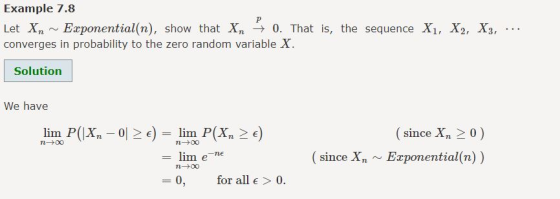
Where does epsilon come from in the lim e^n part? is it acting as
  for the exponential distribution?
Homework Answers

Add Answer to:
Where does epsilon come from in the lim e^n
part? is it acting as
for the...
16. lim n-> inf 24. Find the limit of the sequence 25. lim n-> inf ....
 16. lim n-> inf
24. Find the limit of the sequence
25. lim n-> inf
. limit=
We were unable to transcribe this imageWe were unable to transcribe this imageWe were unable to transcribe this image
16. lim n-> inf
24. Find the limit of the sequence
25. lim n-> inf
. limit=
We were unable to transcribe this imageWe were unable to transcribe this imageWe were unable to transcribe this image
Let X1, X2,.......Xn be a random sample of size n from a continuous distribution symmetric about...
 Let X1, X2,.......Xn be a
random sample of size n from a continuous distribution symmetric
about .
For testing H0: =
10 vs H1: <
10, consider the statistic T- =
Ri+ (1-i),
where i
=1 if Xi>10 , 0 otherwise; and
Ri+ is the rank of (Xi - 10) among
|X1 -10|, |X2-10|......|Xn
-10|.
1. Find the null mean and variance of T- .
2. Find the exact null distribution of T- for
n=5.
We were unable to transcribe this imageWe were...
Let X1, X2,.......Xn be a
random sample of size n from a continuous distribution symmetric
about .
For testing H0: =
10 vs H1: <
10, consider the statistic T- =
Ri+ (1-i),
where i
=1 if Xi>10 , 0 otherwise; and
Ri+ is the rank of (Xi - 10) among
|X1 -10|, |X2-10|......|Xn
-10|.
1. Find the null mean and variance of T- .
2. Find the exact null distribution of T- for
n=5.
We were unable to transcribe this imageWe were...
Suppose n independent, identically distributed observations are drawn from an exponential () distribution, with pdf given...
 Suppose n independent, identically distributed observations are
drawn from an exponential ()
distribution, with pdf given by f(x,)=,
0 < x <
.
The data are x1, x2, .. , xn
Construct a likelihood ratio hypothesis test of Ho :
vs H1:
(where
and
are known constants, with
), where the critical value is taken to be a constant c
We were unable to transcribe this imageWe were unable to transcribe this imageWe were unable to transcribe this imageWe were...
Suppose n independent, identically distributed observations are
drawn from an exponential ()
distribution, with pdf given by f(x,)=,
0 < x <
.
The data are x1, x2, .. , xn
Construct a likelihood ratio hypothesis test of Ho :
vs H1:
(where
and
are known constants, with
), where the critical value is taken to be a constant c
We were unable to transcribe this imageWe were unable to transcribe this imageWe were unable to transcribe this imageWe were...
Test for convergence or divergence of the series and identify the test used. In(n) n n...
 Test for convergence or divergence of the series and identify the test used. In(n) n n = 2 O diverges by the Direct Comparison Test O converges by the Direct Comparison Test O converges by the p-Series Test O diverges by the p-Series Test Determine the convergence or divergence of the series. (If you need to use co or -, enter INFINITY or -INFINITY, respectively.) 00 į (-1)"(4n – 1) 3n + 1 n = 1 4n - 1 lim...
Prove the ratio test . What does this tell you if exists? (Ratio test) If for all...
 Prove the ratio test . What does this tell you if
exists?
(Ratio test) If
for all sufficiently large n and some
r < 1, then
converges absolutely; while if
for
all sufficiently large n, then
diverges.
lim |.1n+1/01 700 In+1/xn < We were unable to transcribe this image2x+1/2 > 1 We were unable to transcribe this image
Prove the ratio test . What does this tell you if
exists?
(Ratio test) If
for all sufficiently large n and some
r < 1, then
converges absolutely; while if
for
all sufficiently large n, then
diverges.
lim |.1n+1/01 700 In+1/xn < We were unable to transcribe this image2x+1/2 > 1 We were unable to transcribe this image
Derive the moment generating function of y= a x1+b x2, where y~ N( a 1 +...
Derive the moment generating function of y= a x1+b x2, where y~ N( a 1 + b2 , a2 12 +b222 + 2ab cov(x1, x2) ), not both a and b equal to zero. We were unable to transcribe this imageWe were unable to transcribe this imageWe were unable to transcribe this imageWe were unable to transcribe this image
Let X1, X2, ..., Xn be a random sample of size n from the distribution with...
 Let X1, X2, ..., Xn be a random sample of size n from the
distribution with probability density function
To answer this question, enter you answer as a formula. In
addition to the usual guidelines, two more instructions for this
problem only : write
as single variable p and
as m. and these can be used as inputs of functions as usual
variables e.g log(p), m^2, exp(m) etc. Remember p represents the
product of
s only, but will not work...
Let X1, X2, ..., Xn be a random sample of size n from the
distribution with probability density function
To answer this question, enter you answer as a formula. In
addition to the usual guidelines, two more instructions for this
problem only : write
as single variable p and
as m. and these can be used as inputs of functions as usual
variables e.g log(p), m^2, exp(m) etc. Remember p represents the
product of
s only, but will not work...
Independent random samples X1, X2, . . . , Xn are from exponential distribution with pdfs...
 Independent random samples X1, X2, . . . , Xn are from
exponential distribution with pdfs
, xi > 0, where λ is fixed but unknown. Let
. Here we have a relative large sample size n = 100.
(ii) Notice that the population mean here is µ = E(X1) = 1/λ ,
population variance σ^2 = Var(X1) = 1/λ^2 is unknown. Assume the
sample standard deviation s = 10, sample average
= 5, construct a 95% large-sample approximate confidence...
Independent random samples X1, X2, . . . , Xn are from
exponential distribution with pdfs
, xi > 0, where λ is fixed but unknown. Let
. Here we have a relative large sample size n = 100.
(ii) Notice that the population mean here is µ = E(X1) = 1/λ ,
population variance σ^2 = Var(X1) = 1/λ^2 is unknown. Assume the
sample standard deviation s = 10, sample average
= 5, construct a 95% large-sample approximate confidence...
(6) The sequence of random variable are independent of each other and they follow the normal...
 (6) The sequence of random variable
are independent of each other and they follow the normal
distribution
.
However, the actual value of were not
observed, instead we only observed if each is either
greater than or
equal to 0, or less than 0.
And you can use the fact that there is the inverse function
that is continuous.
Answer the following questions.
Find
the maximum likelihood estimator
of .
When
, show
, where
represents conversion of probability....
(6) The sequence of random variable
are independent of each other and they follow the normal
distribution
.
However, the actual value of were not
observed, instead we only observed if each is either
greater than or
equal to 0, or less than 0.
And you can use the fact that there is the inverse function
that is continuous.
Answer the following questions.
Find
the maximum likelihood estimator
of .
When
, show
, where
represents conversion of probability....
Let be a sequence of random variables, and let Y be a random variable on the...
 Let
be a sequence of random variables, and let Y be a random
variable on the same sample space. Let An(ϵ) be the
event that |Yn − Y | > ϵ. It can be shown that a
sufficient condition for Yn to converge to Y w.p.1 as
n → ∞ is that for every ϵ > 0,
(a) Let
be independent uniformly distributed random variables on [0, 1],
and let Yn = min(X1, . . . , Xn).
In class,...
Let
be a sequence of random variables, and let Y be a random
variable on the same sample space. Let An(ϵ) be the
event that |Yn − Y | > ϵ. It can be shown that a
sufficient condition for Yn to converge to Y w.p.1 as
n → ∞ is that for every ϵ > 0,
(a) Let
be independent uniformly distributed random variables on [0, 1],
and let Yn = min(X1, . . . , Xn).
In class,...
 16. lim n-> inf
24. Find the limit of the sequence
25. lim n-> inf
. limit=
We were unable to transcribe this imageWe were unable to transcribe this imageWe were unable to transcribe this image
16. lim n-> inf
24. Find the limit of the sequence
25. lim n-> inf
. limit=
We were unable to transcribe this imageWe were unable to transcribe this imageWe were unable to transcribe this image
 Let X1, X2,.......Xn be a
random sample of size n from a continuous distribution symmetric
about .
For testing H0: =
10 vs H1: <
10, consider the statistic T- =
Ri+ (1-i),
where i
=1 if Xi>10 , 0 otherwise; and
Ri+ is the rank of (Xi - 10) among
|X1 -10|, |X2-10|......|Xn
-10|.
1. Find the null mean and variance of T- .
2. Find the exact null distribution of T- for
n=5.
We were unable to transcribe this imageWe were...
Let X1, X2,.......Xn be a
random sample of size n from a continuous distribution symmetric
about .
For testing H0: =
10 vs H1: <
10, consider the statistic T- =
Ri+ (1-i),
where i
=1 if Xi>10 , 0 otherwise; and
Ri+ is the rank of (Xi - 10) among
|X1 -10|, |X2-10|......|Xn
-10|.
1. Find the null mean and variance of T- .
2. Find the exact null distribution of T- for
n=5.
We were unable to transcribe this imageWe were...
 Suppose n independent, identically distributed observations are
drawn from an exponential ()
distribution, with pdf given by f(x,)=,
0 < x <
.
The data are x1, x2, .. , xn
Construct a likelihood ratio hypothesis test of Ho :
vs H1:
(where
and
are known constants, with
), where the critical value is taken to be a constant c
We were unable to transcribe this imageWe were unable to transcribe this imageWe were unable to transcribe this imageWe were...
Suppose n independent, identically distributed observations are
drawn from an exponential ()
distribution, with pdf given by f(x,)=,
0 < x <
.
The data are x1, x2, .. , xn
Construct a likelihood ratio hypothesis test of Ho :
vs H1:
(where
and
are known constants, with
), where the critical value is taken to be a constant c
We were unable to transcribe this imageWe were unable to transcribe this imageWe were unable to transcribe this imageWe were...
 Test for convergence or divergence of the series and identify the test used. In(n) n n = 2 O diverges by the Direct Comparison Test O converges by the Direct Comparison Test O converges by the p-Series Test O diverges by the p-Series Test Determine the convergence or divergence of the series. (If you need to use co or -, enter INFINITY or -INFINITY, respectively.) 00 į (-1)"(4n – 1) 3n + 1 n = 1 4n - 1 lim...
 Prove the ratio test . What does this tell you if
exists?
(Ratio test) If
for all sufficiently large n and some
r < 1, then
converges absolutely; while if
for
all sufficiently large n, then
diverges.
lim |.1n+1/01 700 In+1/xn < We were unable to transcribe this image2x+1/2 > 1 We were unable to transcribe this image
Prove the ratio test . What does this tell you if
exists?
(Ratio test) If
for all sufficiently large n and some
r < 1, then
converges absolutely; while if
for
all sufficiently large n, then
diverges.
lim |.1n+1/01 700 In+1/xn < We were unable to transcribe this image2x+1/2 > 1 We were unable to transcribe this image
 Let X1, X2, ..., Xn be a random sample of size n from the
distribution with probability density function
To answer this question, enter you answer as a formula. In
addition to the usual guidelines, two more instructions for this
problem only : write
as single variable p and
as m. and these can be used as inputs of functions as usual
variables e.g log(p), m^2, exp(m) etc. Remember p represents the
product of
s only, but will not work...
Let X1, X2, ..., Xn be a random sample of size n from the
distribution with probability density function
To answer this question, enter you answer as a formula. In
addition to the usual guidelines, two more instructions for this
problem only : write
as single variable p and
as m. and these can be used as inputs of functions as usual
variables e.g log(p), m^2, exp(m) etc. Remember p represents the
product of
s only, but will not work...
 Independent random samples X1, X2, . . . , Xn are from
exponential distribution with pdfs
, xi > 0, where λ is fixed but unknown. Let
. Here we have a relative large sample size n = 100.
(ii) Notice that the population mean here is µ = E(X1) = 1/λ ,
population variance σ^2 = Var(X1) = 1/λ^2 is unknown. Assume the
sample standard deviation s = 10, sample average
= 5, construct a 95% large-sample approximate confidence...
Independent random samples X1, X2, . . . , Xn are from
exponential distribution with pdfs
, xi > 0, where λ is fixed but unknown. Let
. Here we have a relative large sample size n = 100.
(ii) Notice that the population mean here is µ = E(X1) = 1/λ ,
population variance σ^2 = Var(X1) = 1/λ^2 is unknown. Assume the
sample standard deviation s = 10, sample average
= 5, construct a 95% large-sample approximate confidence...
 (6) The sequence of random variable
are independent of each other and they follow the normal
distribution
.
However, the actual value of were not
observed, instead we only observed if each is either
greater than or
equal to 0, or less than 0.
And you can use the fact that there is the inverse function
that is continuous.
Answer the following questions.
Find
the maximum likelihood estimator
of .
When
, show
, where
represents conversion of probability....
(6) The sequence of random variable
are independent of each other and they follow the normal
distribution
.
However, the actual value of were not
observed, instead we only observed if each is either
greater than or
equal to 0, or less than 0.
And you can use the fact that there is the inverse function
that is continuous.
Answer the following questions.
Find
the maximum likelihood estimator
of .
When
, show
, where
represents conversion of probability....
 Let
be a sequence of random variables, and let Y be a random
variable on the same sample space. Let An(ϵ) be the
event that |Yn − Y | > ϵ. It can be shown that a
sufficient condition for Yn to converge to Y w.p.1 as
n → ∞ is that for every ϵ > 0,
(a) Let
be independent uniformly distributed random variables on [0, 1],
and let Yn = min(X1, . . . , Xn).
In class,...
Let
be a sequence of random variables, and let Y be a random
variable on the same sample space. Let An(ϵ) be the
event that |Yn − Y | > ϵ. It can be shown that a
sufficient condition for Yn to converge to Y w.p.1 as
n → ∞ is that for every ϵ > 0,
(a) Let
be independent uniformly distributed random variables on [0, 1],
and let Yn = min(X1, . . . , Xn).
In class,...
Most questions answered within 3 hours.
-
Where is the error in this code sequence?
String s1 = "Hello";
String s2 = "ello";...
asked 10 months ago -
Financial data for Joel de Paris, Inc., for last year
follow:
Joel de Paris, Inc.
Balance...
asked 10 months ago -
Consider this reaction:
Al2(SO4)3 (aq)+ BaCl3
(aq) Al2Cl6 (aq)- +
3BaSO4(s) . What is the...
asked 10 months ago -
Suppose that Savneet is considering increasing her
recent random sample from 20 car rentals to 40...
asked 10 months ago -
Trucks arrive at an unloading terminal at an average rate of 120
per hour.
Trucks arrive...
asked 10 months ago -
Why are methanol and ethanol completely soluble in water while
octanol is not very little soluble....
asked 10 months ago -
A facilities manager at a university reads in a research report
that the mean amount of...
asked 10 months ago -
When the CuSO4 is rehydrated by adding water to the anhydrous
compound, is this an endothermic...
asked 10 months ago -
A ray of sunlight is passing from diamond into crown glass; the
angle of incidence is...
asked 10 months ago -
A block of mass 0.249 kg is placed on top of a light, vertical
spring of...
asked 10 months ago -
how do the kidneys compensate in the presences of acidosis
a) trigger hyperventilate
b) reserve acid...
asked 10 months ago -
Question 501 pts
The rental rate of capital to the firm increases. Which of the
following...
asked 10 months ago