 please write them in parts and not the whole code
Homework Answers
/* here in this program as per the question variable back is taken as rear named variable */
/* enqueue member function */
template <class X>
void ArrQueue <X>::enqueue(X item)
{
if(front==-1)
{
front = 0;
}
rear=(rear+1)%sz;
items[rear]=item;
cout<<endl<<"Inserted :
"<<item<<endl;
}
/* dequeue member function */
template <class X>
X ArrQueue <X>::dequeue()
{
X element;
element=items[front];
if(front==rear){
front=-1;
rear=-1;
}
else
{
front=(front+1)%sz;
}
return(element);
}
/* peek Front memeber function */
template <class X>
X ArrQueue <X>::peekFront()
{
if(front>=0)
cout<<"peek front element is :"<<
items[front];
else
cout<<"No peek element in queue";
}
/* isEmpty member function */
template <class X>
void ArrQueue <X>::isEmpty()
{
if(front==-1)
{
cout<<"Circular Queue is
empty";
}
else
{
cout<<"Circular Queue is not empty";
}
}
/* ArrQueue class with template */
template <class X>
class ArrQueue
{
X *items; // dynamically allocated array
//
int capacity;
int front;
int rear;
int count;
public:
ArrQueue (int size=sz); // constructor
//
X dequeue(); // delete element//
void enqueue(X x); // insert element //
X peekFront(); // front element //
int size(); // count elements //
void isEmpty(); // check empty or not //
void display(); // display queue //
};
/* full program */
/* here for better under standing the full program is given, which will help to co relate the above functions and other functions with rest of the program */
/* here in this program as per the question variable back is taken as rear named variable */
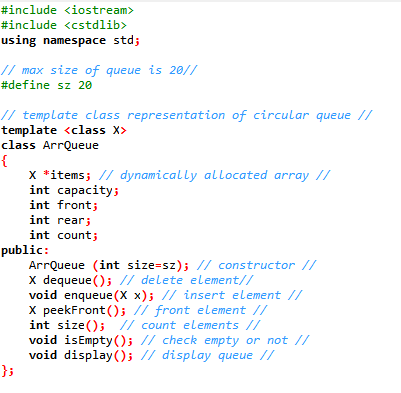
#include <iostream>
#include <cstdlib>
using namespace std;
// max size of queue is 20//
#define sz 20
// template class representation of circular queue //
template <class X>
class ArrQueue
{
X *items; // dynamically allocated array
//
int capacity;
int front;
int rear; // as per the question back named variable
//
int count;
public:
ArrQueue (int size=sz); // constructor
//
X dequeue(); // delete element//
void enqueue(X x); // insert element //
X peekFront(); // front element //
int size(); // count elements //
void isEmpty(); // check empty or not //
void display(); // display queue //
};
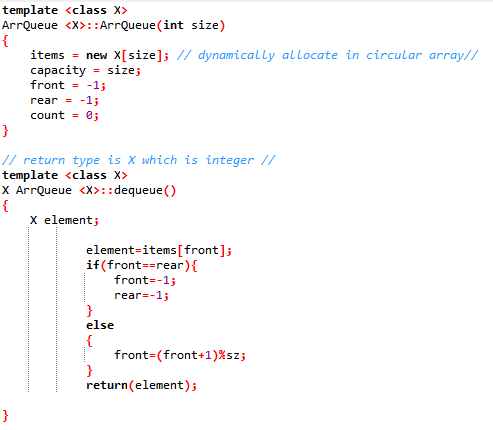
template <class X>
ArrQueue <X>::ArrQueue(int size)
{
items = new X[size]; // dynamically allocate in
circular array//
capacity = size;
front = -1;
rear = -1;
count = 0;
}
// return type is X which is integer //
template <class X>
X ArrQueue <X>::dequeue()
{
X element;
element=items[front];
if(front==rear){
front=-1;
rear=-1;
}
else
{
front=(front+1)%sz;
}
return(element);
}
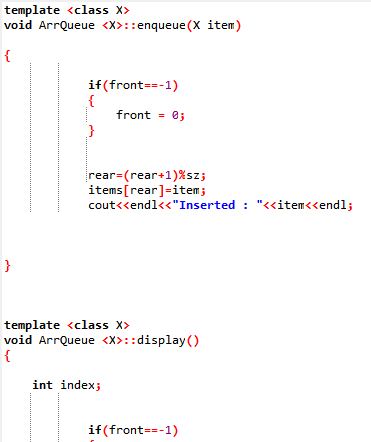
template <class X>
void ArrQueue <X>::enqueue(X item)
{
if(front==-1)
{
front = 0;
}
rear=(rear+1)%sz;
items[rear]=item;
cout<<endl<<"Inserted :
"<<item<<endl;
}
template <class X>
void ArrQueue <X>::display()
{
int index;
if(front==-1)
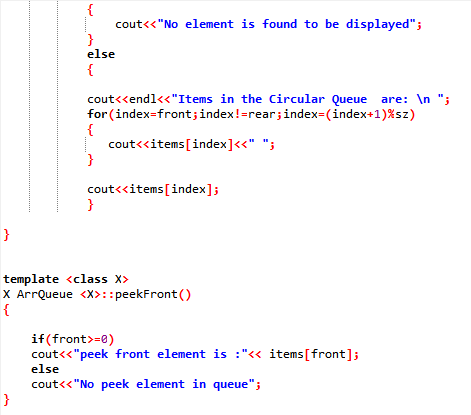
{
cout<<"No element is found to be
displayed";
}
else
{
cout<<endl<<"Items in the Circular Queue are: \n
";
for(index=front;index!=rear;index=(index+1)%sz)
{
cout<<items[index]<<"
";
}
cout<<items[index];
}
}
template <class X>
X ArrQueue <X>::peekFront()
{
if(front>=0)
cout<<"peek front element is :"<<
items[front];
else
cout<<"No peek element in queue";
}
template <class X>
int ArrQueue <X>::size()
{
return count;
}
template <class X>
void ArrQueue <X>::isEmpty()
{
if(front==-1)
{
cout<<"Circular Queue is
empty";
}
else
{
cout<<"Circular Queue is not empty";
}
}
int main()
{
// here template X is int //
ArrQueue <int> q;
int ch,val,p;
char ch1;
do
{
cout<<"1.Enque"<<endl;
cout<<"2.Deque"<<endl;
cout<<"3.isEmpty"<<endl;
cout<<"4.Peek
Front"<<endl;
cout<<"5.Display"<<endl;
cout<<"Enter the choice:";
cin>>ch;
switch(ch)
{
case 1:
cout<<"Enter the item
:";
cin>>val;
q.enqueue(val);
break;
case 2:
p=q.dequeue();
cout<<"Removed element
is:"<<p;
break;
case 3:
q.isEmpty();
break;
case 4:
q.peekFront();
break;
case 5:
q.display();
break;
default:
cout<<endl<<"Wrong option[ Enter from
1,2,3,4,5]"<<endl;
}
cout<<endl<<"Want to
continue[Y/y]:";
cin>>ch1;
} while(ch1=='Y' || ch1=='y');
}
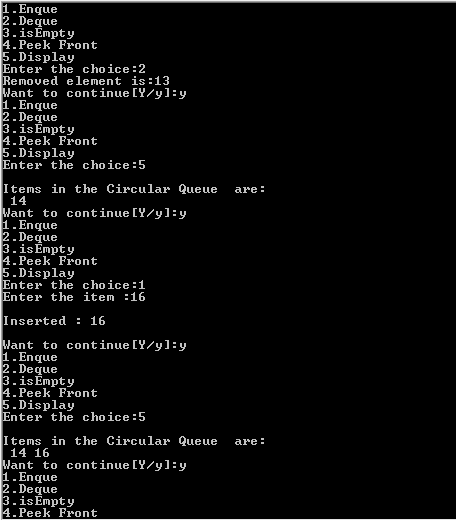
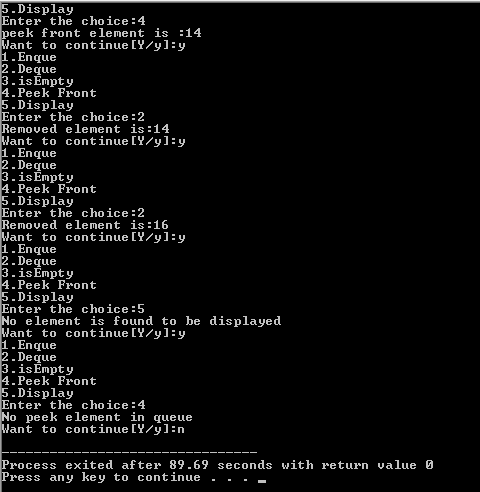
SCREEN SHOT
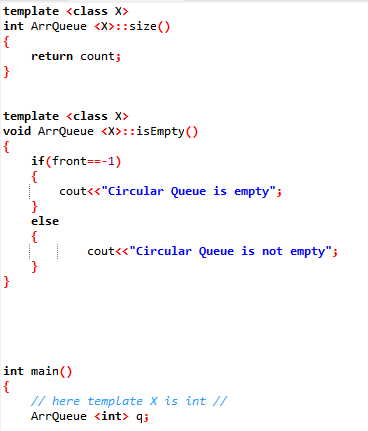
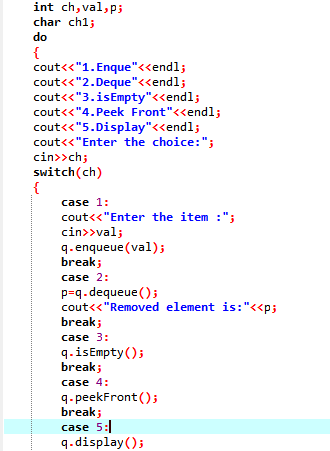
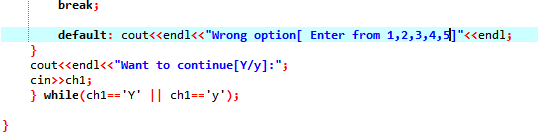
OUTPUT
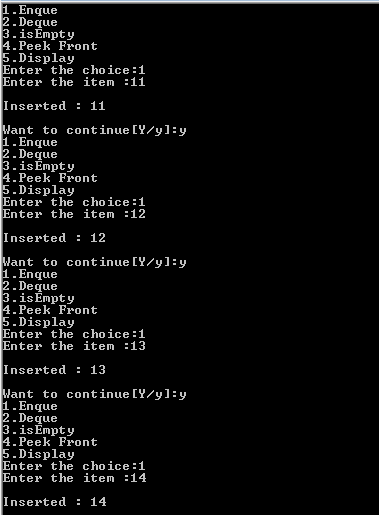
Add Answer to:
please write them in parts and not the whole code
Page 3 of 5 based queue...
Suppose we have an array-based queue (circular buffer) of size 6: int data[6]; int front =...
Suppose we have an array-based queue (circular buffer) of size 6: int data[6]; int front = 0, back = 0; void enqueue(int x) { data[back] = x; back = (back + 1) % 6; } void dequeue() { front = (front + 1) % 6; } and we perform the following series of queue operations: enqueue(1); dequeue(); enqueue(2); dequeue(); enqueue(7); enqueue(3); enqueue(5); dequeue(); dequeue(); enqueue(4); enqueue(6); Write the state of the queue array after each operation, and at the end,...
Array-based Queue Lecture 6 Two Class Exercises | Class Exercise #1 - Create an array-based queue that holds value...
 Array-based Queue Lecture 6 Two Class Exercises | Class Exercise #1 - Create an array-based queue that holds values of double data type. 1.) Create a program that produces the following output OUTPUT: Q Quit Enter your choice: e Enter an item: 1.1 E Enqueue D Dequeue s-show queue ← showMenuO function called in main) OQuit // screen clears-.. continue enqueuing.screen clearing with each iteration Enter your choice: e Queue is full. E Enqueue D Dequeue s Show queue 0...
QUESTION 1: Queue Class: Write a Queue class using doubly-linked structure and implement the following functionalities....
QUESTION 1: Queue Class: Write a Queue class using doubly-linked structure and implement the following functionalities. enqueue (inserts element to the end) dequeue (removes the front element and provides content) isEmpty (checks whether the Queue is empty or not) makeEmpty () peek (provides the element sitting at the top/front, but does not remove) print (prints all the elements from front to the end) reversePrint(prints all the elements from end to the front with the help of back pointers inside your...
(C++) (VISUAL STUDIO) Circular Queue is a linear data structure in which the operations are performed...
(C++) (VISUAL STUDIO) Circular Queue is a linear data structure in which the operations are performed based on FIFO (First In First Out) principle and the last position is connected back to the first position to make a circle. In a normal Queue, we can insert elements until queue becomes full. But once queue becomes full, we cannot insert the next element even if there is a space in front of queue. Efficiently implement a queue class using a circular...
Write a C++ program to implement Queue ADT using singly linked structure. The program includes the...
Write a C++ program to implement Queue ADT using singly linked structure. The program includes the following: Define the Queue class template in the header file QueueLinked.h. // QueueLinked.h #ifndef QUEUE_H #define QUEUE_H #include <iostream> using namespace std; template <typename T> class Queue { public: // Constructor Queue(); //Desctructor ~Queue(); // Makes the queue to the empty state. void make_empty(); // Checks if the queue is empty. bool empty() const; // Inserts item at the end of the queue. void...
e. public class Queue { // Uses the correct Stack class from ME2 Ex 19 private Stack mStack; public Queue() { setStack(new Stack()); } public Queue enqueue(E pData) { getStack().push(pData); return t...
 e. public class Queue { // Uses the correct Stack class from ME2
Ex 19 private Stack mStack; public Queue() { setStack(new Stack());
} public Queue enqueue(E pData) { getStack().push(pData); return
this; } public E dequeue() { return getStack().pop(); } public E
peek() { return getStack.peek(); } private Stack getStack() {
return mStack; } private void setStack(Stack pStack) { mStack =
pStack; } }
f. public class Queue extends Stack { // Uses the correct Stack
class from ME2 Ex...
e. public class Queue { // Uses the correct Stack class from ME2
Ex 19 private Stack mStack; public Queue() { setStack(new Stack());
} public Queue enqueue(E pData) { getStack().push(pData); return
this; } public E dequeue() { return getStack().pop(); } public E
peek() { return getStack.peek(); } private Stack getStack() {
return mStack; } private void setStack(Stack pStack) { mStack =
pStack; } }
f. public class Queue extends Stack { // Uses the correct Stack
class from ME2 Ex...
Study the "Queue as linked list simple example" posted in this module. Rewrite the code to...
Study the "Queue as linked list simple example" posted in this module. Rewrite the code to use array instead of linked lists. Please do not change anything besides the data structure. Instead of linked list use an array. The functionality should remain exactly the same. LListQueue.cpp ///--------------------------------------------------------------- /// File: LListQueue.cpp /// Purpose: Implementation file for a demonstration of a queue /// implemented as an array. Data type: Character /// Programming Language: C++ ///--------------------------------------------------------------- #include "LListQueue.h" ///-------------------------------------------- /// Function: LListQueue() ///...
You need to implement a queue based on the doubly linked list. (In C++) **PLEASE follow...
You need to implement a queue based on the doubly linked list. (In C++) **PLEASE follow the format** **Don't worry about the readme.txt** THANK YOU SO SO MUCH! You have to implement the doubly linked list in DList.h and DList.cpp and the queue in the LinkedQueue.h and LinkedQueue.cpp; all as template classes. You have to provide the main.cpp file as we discussed in class to allow the user to interact with your queue using enqueue, dequeue, front, back, size, empty,...
Write a function that takes a string parameter and determines whether the string contains matching grouping...
Write a function that takes a string parameter and determines whether the string contains matching grouping symbols. Grouping symbols are parenthesis ( ) , brackets [] and curly braces { }. For example, the string {a(b+ac)d[xy]g} and kab*cd contain matching grouping symbols. However, the strings ac)cd(e(k, xy{za(dx)k, and {a(b+ac}d) do not contain matching grouping symbols. (Note: open and closed grouping symbols have to match both in number and in the order they occur in the string). Your function must use...
PART A - STACKS To complete this assignment: Please study the code posted below. Please rewrite...
PART A - STACKS To complete this assignment: Please study the code posted below. Please rewrite the code implementing a template class using a linked list instead of an array. Note: The functionality should remain the same *************************************************************************************************************** /** * Stack implementation using array in C/procedural language. */ #include <iostream> #include <cstdio> #include <cstdlib> //#include <climits> // For INT_MIN #define SIZE 100 using namespace std; /// Create a stack with capacity of 100 elements int stack[SIZE]; /// Initially stack is...
 Array-based Queue Lecture 6 Two Class Exercises | Class Exercise #1 - Create an array-based queue that holds values of double data type. 1.) Create a program that produces the following output OUTPUT: Q Quit Enter your choice: e Enter an item: 1.1 E Enqueue D Dequeue s-show queue ← showMenuO function called in main) OQuit // screen clears-.. continue enqueuing.screen clearing with each iteration Enter your choice: e Queue is full. E Enqueue D Dequeue s Show queue 0...
 e. public class Queue { // Uses the correct Stack class from ME2
Ex 19 private Stack mStack; public Queue() { setStack(new Stack());
} public Queue enqueue(E pData) { getStack().push(pData); return
this; } public E dequeue() { return getStack().pop(); } public E
peek() { return getStack.peek(); } private Stack getStack() {
return mStack; } private void setStack(Stack pStack) { mStack =
pStack; } }
f. public class Queue extends Stack { // Uses the correct Stack
class from ME2 Ex...
e. public class Queue { // Uses the correct Stack class from ME2
Ex 19 private Stack mStack; public Queue() { setStack(new Stack());
} public Queue enqueue(E pData) { getStack().push(pData); return
this; } public E dequeue() { return getStack().pop(); } public E
peek() { return getStack.peek(); } private Stack getStack() {
return mStack; } private void setStack(Stack pStack) { mStack =
pStack; } }
f. public class Queue extends Stack { // Uses the correct Stack
class from ME2 Ex...
Most questions answered within 3 hours.
-
Where is the error in this code sequence?
String s1 = "Hello";
String s2 = "ello";...
asked 10 months ago -
Financial data for Joel de Paris, Inc., for last year
follow:
Joel de Paris, Inc.
Balance...
asked 10 months ago -
Consider this reaction:
Al2(SO4)3 (aq)+ BaCl3
(aq) Al2Cl6 (aq)- +
3BaSO4(s) . What is the...
asked 10 months ago -
Suppose that Savneet is considering increasing her
recent random sample from 20 car rentals to 40...
asked 10 months ago -
Trucks arrive at an unloading terminal at an average rate of 120
per hour.
Trucks arrive...
asked 10 months ago -
Why are methanol and ethanol completely soluble in water while
octanol is not very little soluble....
asked 10 months ago -
A facilities manager at a university reads in a research report
that the mean amount of...
asked 10 months ago -
When the CuSO4 is rehydrated by adding water to the anhydrous
compound, is this an endothermic...
asked 10 months ago -
A ray of sunlight is passing from diamond into crown glass; the
angle of incidence is...
asked 10 months ago -
A block of mass 0.249 kg is placed on top of a light, vertical
spring of...
asked 10 months ago -
how do the kidneys compensate in the presences of acidosis
a) trigger hyperventilate
b) reserve acid...
asked 10 months ago -
Question 501 pts
The rental rate of capital to the firm increases. Which of the
following...
asked 10 months ago