
Homework Answers


Add Answer to:
9.1) A composite shape made of different materials, A and B, is given in Figure 9.1....
Q.4) For the following diagram, parts A and B are made from 2 different metals. Determine...
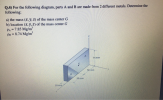 Q.4) For the following diagram, parts A and B are made from 2 different metals. Determine the following: a) the mass (x,y,z) of the mass center G b) location (x,y,z) of the mass center G PA = 7.85 Mg/m PB - 8.74 Mg/m 50 mm 10 mm
1. A composite beam is made of wood and reinforced with a steel strap located on...
 1. A composite beam is made of wood and reinforced with a steel strap located on its bottom side. It has the cross-sectional area shown in the given Figure. Given the beam is subjected to a bending moment of M 2 kN m and the material properties wood and steel are, E Esteel 200 GPa, respectively, determine the of wood 12 GPa and 150 mm normal stress at points B and C (20 points) 20 mm
1. A wall of an industrial oven consists of two different materials, as depicted in Figure....
 1. A wall of an industrial oven consists of two different materials, as depicted in Figure. The first layer is composed of 5 cm of insulating cement with a clay binder that has a thermal conductivity of 0.08 W/m K. The second layer is made from 15 cm of 6-ply asbestos board with a thermal conductivity of 0.074 W/mK (W/m °C). The inside oven air is 400°C with a convection coefficient of 100 W/m² K (W/m² °C) and the outside...
1. A wall of an industrial oven consists of two different materials, as depicted in Figure....
 1. A wall of an industrial oven consists of two different materials, as depicted in Figure. The first layer is composed of 5 cm of insulating cement with a clay binder that has a thermal conductivity of 0.08 W/m K. The second layer is made from 15 cm of 6-ply asbestos board with a thermal conductivity of 0.074 W/ mK (W/m °C). The inside oven air is 400°C with a convection coefficient of 100 W/m² K (W/m2 °C) and the...
1. A wall of an industrial oven consists of two different materials, as depicted in Figure....
 1. A wall of an industrial oven consists of two different materials, as depicted in Figure. The first layer is composed of 5 cm of insulating cement with a clay binder that has a thermal conductivity of 0.08 W/m K. The second layer is made from 15 cm of 6-ply asbestos board with a thermal conductivity of 0.074 W/mK (W/m °C). The inside oven air is 400°C with a convection coefficient of 100 W/m²K(W/m² °C) and the outside air is...
• A wall of an industrial oven consists of three different materials, as depicted in Figure....
 • A wall of an industrial oven consists of three different materials, as depicted in Figure. • The first layer is composed of 5 cm of insulating cement with a clay binder that has a thermal conductivity of 0.08 W/m.K. • The second layer is made from 15 cm of 6-ply asbestos board with a thermal conductivity of 0.074 W/mK (W/m.°C). • The exterior consists of 10-cm common brick with a thermal conductivity of 0.72 W/mK (W/m °C). • The...
Consider the 1D plan composite wall shown in the figure made of three regions.Only in region...
 Consider the 1D plan composite wall shown in the figure made of
three regions.Only in region B, there is a uniform thermal energy
generation qB. The left side of wall A is insulated, and the right
side of wall B is exposed to convection. There is thermal
resistance between region B and region C. The numerical values are
given below.
Problem 1. Consider the 1D plan composite wall shown in the figure made of three regions. Only in region B,...
Consider the 1D plan composite wall shown in the figure made of
three regions.Only in region B, there is a uniform thermal energy
generation qB. The left side of wall A is insulated, and the right
side of wall B is exposed to convection. There is thermal
resistance between region B and region C. The numerical values are
given below.
Problem 1. Consider the 1D plan composite wall shown in the figure made of three regions. Only in region B,...
11-4. The assembly shown below is comprised of a steel hemisphere and an aluminum cylinder with...
 11-4. The assembly shown below is comprised of a steel hemisphere and an aluminum cylinder with densities, Pst = 7.50 Mg/m and pal = 2.5 Mg/m3, respectively. If h 220 mm, (a) Determine the location of the center of mass of the assembly (b) Determine the location of the center of mass of the same assembly (same dimensions) if it was made entirely out of steel. (c) How does the location of the center of mass from part (b) change...
Q3:- The old building (A) is to be removed and replaced by a new building (B),...
 Q3:- The old building (A) is to be removed and replaced by a new building (B), as shown in Figure (03). The vertical pressure at the center of the clay layer from the building (A) and building (B) is equal to 13.64 kN/m² and 23.3 kN/m” respectively, Find:- 1. O.C.R after removing building (A). 2. The void ratio (e) of the clay layer: a. Immediately after removing building (A). b. After a very long time from removing building (A). 3....
Two spheres are rolling without slipping on a horizontal floor. They are made of different materials,...
Two spheres are rolling without slipping on a horizontal floor. They are made of different materials, but each has mass 5.00 kg and radius 0.120 m. For each the translational speed of the center of mass is 4.00 m/s. Sphere A is a uniform solid sphere and sphere B is a thin-walled, hollow sphere. For which sphere is a greater magnitude of work required? (The spheres continue to roll without slipping as they slow down.) For which sphere is a...
 Q.4) For the following diagram, parts A and B are made from 2 different metals. Determine the following: a) the mass (x,y,z) of the mass center G b) location (x,y,z) of the mass center G PA = 7.85 Mg/m PB - 8.74 Mg/m 50 mm 10 mm
 1. A composite beam is made of wood and reinforced with a steel strap located on its bottom side. It has the cross-sectional area shown in the given Figure. Given the beam is subjected to a bending moment of M 2 kN m and the material properties wood and steel are, E Esteel 200 GPa, respectively, determine the of wood 12 GPa and 150 mm normal stress at points B and C (20 points) 20 mm
 1. A wall of an industrial oven consists of two different materials, as depicted in Figure. The first layer is composed of 5 cm of insulating cement with a clay binder that has a thermal conductivity of 0.08 W/m K. The second layer is made from 15 cm of 6-ply asbestos board with a thermal conductivity of 0.074 W/mK (W/m °C). The inside oven air is 400°C with a convection coefficient of 100 W/m² K (W/m² °C) and the outside...
 1. A wall of an industrial oven consists of two different materials, as depicted in Figure. The first layer is composed of 5 cm of insulating cement with a clay binder that has a thermal conductivity of 0.08 W/m K. The second layer is made from 15 cm of 6-ply asbestos board with a thermal conductivity of 0.074 W/ mK (W/m °C). The inside oven air is 400°C with a convection coefficient of 100 W/m² K (W/m2 °C) and the...
 1. A wall of an industrial oven consists of two different materials, as depicted in Figure. The first layer is composed of 5 cm of insulating cement with a clay binder that has a thermal conductivity of 0.08 W/m K. The second layer is made from 15 cm of 6-ply asbestos board with a thermal conductivity of 0.074 W/mK (W/m °C). The inside oven air is 400°C with a convection coefficient of 100 W/m²K(W/m² °C) and the outside air is...
 • A wall of an industrial oven consists of three different materials, as depicted in Figure. • The first layer is composed of 5 cm of insulating cement with a clay binder that has a thermal conductivity of 0.08 W/m.K. • The second layer is made from 15 cm of 6-ply asbestos board with a thermal conductivity of 0.074 W/mK (W/m.°C). • The exterior consists of 10-cm common brick with a thermal conductivity of 0.72 W/mK (W/m °C). • The...
 Consider the 1D plan composite wall shown in the figure made of
three regions.Only in region B, there is a uniform thermal energy
generation qB. The left side of wall A is insulated, and the right
side of wall B is exposed to convection. There is thermal
resistance between region B and region C. The numerical values are
given below.
Problem 1. Consider the 1D plan composite wall shown in the figure made of three regions. Only in region B,...
Consider the 1D plan composite wall shown in the figure made of
three regions.Only in region B, there is a uniform thermal energy
generation qB. The left side of wall A is insulated, and the right
side of wall B is exposed to convection. There is thermal
resistance between region B and region C. The numerical values are
given below.
Problem 1. Consider the 1D plan composite wall shown in the figure made of three regions. Only in region B,...
 11-4. The assembly shown below is comprised of a steel hemisphere and an aluminum cylinder with densities, Pst = 7.50 Mg/m and pal = 2.5 Mg/m3, respectively. If h 220 mm, (a) Determine the location of the center of mass of the assembly (b) Determine the location of the center of mass of the same assembly (same dimensions) if it was made entirely out of steel. (c) How does the location of the center of mass from part (b) change...
 Q3:- The old building (A) is to be removed and replaced by a new building (B), as shown in Figure (03). The vertical pressure at the center of the clay layer from the building (A) and building (B) is equal to 13.64 kN/m² and 23.3 kN/m” respectively, Find:- 1. O.C.R after removing building (A). 2. The void ratio (e) of the clay layer: a. Immediately after removing building (A). b. After a very long time from removing building (A). 3....
Most questions answered within 3 hours.
-
Where is the error in this code sequence?
String s1 = "Hello";
String s2 = "ello";...
asked 10 months ago -
Financial data for Joel de Paris, Inc., for last year
follow:
Joel de Paris, Inc.
Balance...
asked 10 months ago -
Consider this reaction:
Al2(SO4)3 (aq)+ BaCl3
(aq) Al2Cl6 (aq)- +
3BaSO4(s) . What is the...
asked 10 months ago -
Suppose that Savneet is considering increasing her
recent random sample from 20 car rentals to 40...
asked 10 months ago -
Trucks arrive at an unloading terminal at an average rate of 120
per hour.
Trucks arrive...
asked 10 months ago -
Why are methanol and ethanol completely soluble in water while
octanol is not very little soluble....
asked 10 months ago -
A facilities manager at a university reads in a research report
that the mean amount of...
asked 10 months ago -
When the CuSO4 is rehydrated by adding water to the anhydrous
compound, is this an endothermic...
asked 10 months ago -
A ray of sunlight is passing from diamond into crown glass; the
angle of incidence is...
asked 10 months ago -
A block of mass 0.249 kg is placed on top of a light, vertical
spring of...
asked 10 months ago -
how do the kidneys compensate in the presences of acidosis
a) trigger hyperventilate
b) reserve acid...
asked 10 months ago -
Question 501 pts
The rental rate of capital to the firm increases. Which of the
following...
asked 10 months ago