
Homework Answers

Add Answer to:
Evaluate the following fraction. (6.41 times 10^3)/(5.64 times 10^8) (4.01 times 10^4) = _______
Evaluate the following integral. X2 + 16x-4 S*** dx x2 - 4x Find the partial fraction...
 Evaluate the following integral. X2 + 16x-4 S*** dx x2 - 4x Find the partial fraction decomposition of the integrand. 1 * +18 x2 + 16x-4 dx = x² - 4x JOdx Evaluate the indefinite integral. *x? + 16x-4 dx = 3 х - 4x
1. Use a partial fraction decomposition to evaluate each of the following. (b) 2.0 + 3...
 1. Use a partial fraction decomposition to evaluate each of the following. (b) 2.0 + 3 23 – 3.x2 + 4.x - 12 | 5x4 + 32x - 32, 75 – 4.4 + 4.23 | 4.24 - 8.23 - 21.22 4.x2 - 1 (3.84 +4.73 + 6.x2 + 3 (:22 + 1) +3 di
Evaluate 20 % 8 - (2, 4, 6, or 8)? valuate 10 % 2 ...
Evaluate 20 % 8 - (2, 4, 6, or 8)? valuate 10 % 2 - (0, 2, 4, 5)? Given the line of code: x = 5 + 5 / 5; what value will be stored in x? - (2, 5, 6, or 10)? Given the following code: int a,b=10,c=3; a = b/c; what value will be stored in the variable a? - (0, 3, 3.333333, or 4)? Given the following code: Float a, b...
Evaluate the following integral 8x +x+33 + 1)(x +4 dx Can partial fraction decomposition be used...
 Evaluate the following integral 8x +x+33 + 1)(x +4 dx Can partial fraction decomposition be used to evaluate the given integral? Select the correct choice below and, if necessary, fill in the answer box to complete your choice ОА Yes, partial fraction decomposition can be used. The given integral can be rewritten as ( dx, which is more readily evaluated OB. No, partial fraction decomposition cannot be used Evaluate the indefinite integral &x?+x+39 s dx = 0
Q3: Expand the following functions by partial fraction expansion. Do not evaluate coefficients or invert expressions....
 Q3: Expand the following functions by partial fraction expansion. Do not evaluate coefficients or invert expressions. 2 (a) x(s) = (5 + 1)(²+1) (s +3) (6) X() – F76+ 16 + 24 g Dos (b) x(s) = 31 sºls + 1) (s + 2)(s + 3) (c) X(s) = 1 (s + 1)(s + 2)(8 + 3)(s + 4)
Evaluate the following integral using the partial fraction method Jee - А) Зах — 1 dx...
 Evaluate the following integral using the partial fraction
method
Jee - А) Зах — 1 dx х (х2 — 4).
Evaluate the following integral using the partial fraction
method
Jee - А) Зах — 1 dx х (х2 — 4).
Problem 9 (8 points): Q1 (4 points): Write down the bit pattern in the fraction of value 1/3 assu...
 Problem 9 (8 points): Q1 (4 points): Write down the bit pattern in the fraction of value 1/3 assuming a floating point format that uses binary numbers in the fraction. Assume there are 24 bits, and you do not need to normalize. Is this representation exact? 02 (4 points): Write down the bit pattern in the fraction of value 1/3 assuming a floating point format that uses Binary Coded Decimal (base 10) numbers in the fraction instead of base 2....
1. Evaluate the following determinants: 8 7 3 4 0 2 (a) 4 0 1 (c)...
 1. Evaluate the following determinants: 8 7 3 4 0 2 (a) 4 0 1 (c) 6 0 3 6 03 8 2 3 ab (e) b c с a b 1 1 1 2 3 (b) 4 7 5 3 6 9 4 -2 (d) 8 11 4 х (f) 3 9 5 0 y 2 -18 7
REVIEW QUESTIONS 1. Explain the difference in calculating military and civilian times. 2. In the fraction...
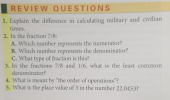 REVIEW QUESTIONS 1. Explain the difference in calculating military and civilian times. 2. In the fraction 7/8: A. Which number represents the numerator? B. Which number represents the denominator? C. What type of fraction is this? 3. In the fractions 7/8 and 1/6, what is the least common denominator? 4. What is meant by "the order of operations"? 5. What is the place value of 3 in the number 22.0453? 6. What is the value of 5? 7. Complete the...
1. Evaluate the following determinant. -3 -8 11 7 -2 4 5 6 91
 1. Evaluate the following determinant. -3 -8 11 7 -2 4 5 6 91
 Evaluate the following integral. X2 + 16x-4 S*** dx x2 - 4x Find the partial fraction decomposition of the integrand. 1 * +18 x2 + 16x-4 dx = x² - 4x JOdx Evaluate the indefinite integral. *x? + 16x-4 dx = 3 х - 4x
 1. Use a partial fraction decomposition to evaluate each of the following. (b) 2.0 + 3 23 – 3.x2 + 4.x - 12 | 5x4 + 32x - 32, 75 – 4.4 + 4.23 | 4.24 - 8.23 - 21.22 4.x2 - 1 (3.84 +4.73 + 6.x2 + 3 (:22 + 1) +3 di
 Evaluate the following integral 8x +x+33 + 1)(x +4 dx Can partial fraction decomposition be used to evaluate the given integral? Select the correct choice below and, if necessary, fill in the answer box to complete your choice ОА Yes, partial fraction decomposition can be used. The given integral can be rewritten as ( dx, which is more readily evaluated OB. No, partial fraction decomposition cannot be used Evaluate the indefinite integral &x?+x+39 s dx = 0
 Q3: Expand the following functions by partial fraction expansion. Do not evaluate coefficients or invert expressions. 2 (a) x(s) = (5 + 1)(²+1) (s +3) (6) X() – F76+ 16 + 24 g Dos (b) x(s) = 31 sºls + 1) (s + 2)(s + 3) (c) X(s) = 1 (s + 1)(s + 2)(8 + 3)(s + 4)
 Evaluate the following integral using the partial fraction
method
Jee - А) Зах — 1 dx х (х2 — 4).
Evaluate the following integral using the partial fraction
method
Jee - А) Зах — 1 dx х (х2 — 4).
 Problem 9 (8 points): Q1 (4 points): Write down the bit pattern in the fraction of value 1/3 assuming a floating point format that uses binary numbers in the fraction. Assume there are 24 bits, and you do not need to normalize. Is this representation exact? 02 (4 points): Write down the bit pattern in the fraction of value 1/3 assuming a floating point format that uses Binary Coded Decimal (base 10) numbers in the fraction instead of base 2....
 1. Evaluate the following determinants: 8 7 3 4 0 2 (a) 4 0 1 (c) 6 0 3 6 03 8 2 3 ab (e) b c с a b 1 1 1 2 3 (b) 4 7 5 3 6 9 4 -2 (d) 8 11 4 х (f) 3 9 5 0 y 2 -18 7
 REVIEW QUESTIONS 1. Explain the difference in calculating military and civilian times. 2. In the fraction 7/8: A. Which number represents the numerator? B. Which number represents the denominator? C. What type of fraction is this? 3. In the fractions 7/8 and 1/6, what is the least common denominator? 4. What is meant by "the order of operations"? 5. What is the place value of 3 in the number 22.0453? 6. What is the value of 5? 7. Complete the...
 1. Evaluate the following determinant. -3 -8 11 7 -2 4 5 6 91
Most questions answered within 3 hours.
-
Where is the error in this code sequence?
String s1 = "Hello";
String s2 = "ello";...
asked 10 months ago -
Financial data for Joel de Paris, Inc., for last year
follow:
Joel de Paris, Inc.
Balance...
asked 10 months ago -
Consider this reaction:
Al2(SO4)3 (aq)+ BaCl3
(aq) Al2Cl6 (aq)- +
3BaSO4(s) . What is the...
asked 10 months ago -
Suppose that Savneet is considering increasing her
recent random sample from 20 car rentals to 40...
asked 10 months ago -
Trucks arrive at an unloading terminal at an average rate of 120
per hour.
Trucks arrive...
asked 10 months ago -
Why are methanol and ethanol completely soluble in water while
octanol is not very little soluble....
asked 10 months ago -
A facilities manager at a university reads in a research report
that the mean amount of...
asked 10 months ago -
When the CuSO4 is rehydrated by adding water to the anhydrous
compound, is this an endothermic...
asked 10 months ago -
A ray of sunlight is passing from diamond into crown glass; the
angle of incidence is...
asked 10 months ago -
A block of mass 0.249 kg is placed on top of a light, vertical
spring of...
asked 10 months ago -
how do the kidneys compensate in the presences of acidosis
a) trigger hyperventilate
b) reserve acid...
asked 10 months ago -
Question 501 pts
The rental rate of capital to the firm increases. Which of the
following...
asked 10 months ago