communication systems
What can you infer about the time domain representation of this signal ? Would you expect it to be real or complex? Why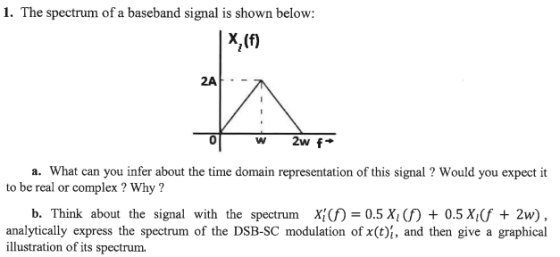
Homework Answers
Request Answer!
We need at least 10 more requests to produce the answer.
0 / 10 have requested this problem solution
The more requests, the faster the answer.
Prelab Consider the circuits (systems) in Figure 1 2000 1k2 Vo Vi 10pF 2H (b) 2002...
 Prelab Consider the circuits (systems) in Figure 1 2000 1k2 Vo Vi 10pF 2H (b) 2002 Figure We want to understand what these systems do, and how they are expected to behave. Because they are "physical systems" they are causal. For each of the circuits: 1. Use the integration-in-time-domain properties of the Laplace transfom to derive the impedance of the capacitors and inductors. Since both capacitors and inductors are causal systems, what are the regions of convergence of their Laplace...
10 in Cartesian coordinates. (a) Write the complex number (b) Write the complex number (c) What...
 10 in Cartesian coordinates. (a) Write the complex number (b) Write the complex number (c) What is the phasor representation of the signal 4. (2 + j4)(3-J)in Polar coordinates i = 4 sin(10t + 10%) ǐn polar coordinates? (d) What is the time domain sinusoidal represenation of the phasor if the frequency of the signal is o- 20 rad/s? I=j(5-j12) if (e) What is the time domain sinusoidal represenation of the phasor the frequency of the signal is ω-10 rad/s?...
Please answer FAST ASAP I will rate you thumbs up ?? (1) What are the reasons...
 Please answer FAST ASAP I will rate you thumbs up
??
(1) What are the reasons behind the need of modulation for radio transmission, i.e., why not directly transmit the original signal? Q2) A carrier signal with frequency f. Hz is double-sideband suppressed carrier (DSB-SC) amplitude modulated by a triangular shaped message signal, m(t), plotted below (Fig. Q2). The DSB-SC amplitude modulated signal is then passed from a band-pass filter with center frequency fc-Im and bandwidth 2fm where fm =...
Please answer FAST ASAP I will rate you thumbs up
??
(1) What are the reasons behind the need of modulation for radio transmission, i.e., why not directly transmit the original signal? Q2) A carrier signal with frequency f. Hz is double-sideband suppressed carrier (DSB-SC) amplitude modulated by a triangular shaped message signal, m(t), plotted below (Fig. Q2). The DSB-SC amplitude modulated signal is then passed from a band-pass filter with center frequency fc-Im and bandwidth 2fm where fm =...
1. (10 points) A binary communication system transmits a signal X that is either a +2...
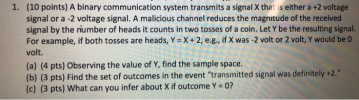 1. (10 points) A binary communication system transmits a signal X that is either a +2 voltage signal or a -2 voltage signal. A malicious channel reduces the magnitude of the received signal by the number of heads it counts in two tosses of a coin. Let Y be the resulting signal For example, if both tosses are heads, Y X+ 2, e.g., if X was -2 volt or 2 volt, Y would be 0 volt (a) (4 pts) Observing...
Part 1 (Calculation): The Z-transform (ZT) converts a discrete time-domain signal, which is a sequence of...
Part 1 (Calculation): The Z-transform (ZT) converts a discrete time-domain signal, which is a sequence of real or complex numbers, into a complex frequency-domain representation. It is the equivalent of the Laplace transform for discrete systems. The one-sided ZT, used for causal signals and systems, is defined as follows: Consider the digital system (filter) described by the input/output difference equation and z-domain transfer function Hz: yn-0.88 yn-1=0.52 xn-0.4 xn-1 Hzz=Y(z)X(z)=0.52-0.4 z-11-0.88 z-1=0.52 z-0.4z-0.88 Assuming a unit step function input, i.e.,...
Given the in-phase/quadrature representation of a real bandpass signal s(t)- 2 cos π6,000t-sin π6,000, determine its eq...
 Given the in-phase/quadrature representation of a real bandpass signal s(t)- 2 cos π6,000t-sin π6,000, determine its equivalent (i) complex baseband representation and (ii) envelop and phase representation.
Given the in-phase/quadrature representation of a real bandpass signal s(t)- 2 cos π6,000t-sin π6,000, determine its equivalent (i) complex baseband representation and (ii) envelop and phase representation.
Given the in-phase/quadrature representation of a real bandpass signal s(t)- 2 cos π6,000t-sin π6,000, determine its equivalent (i) complex baseband representation and (ii) envelop and phase representation.
communication systems
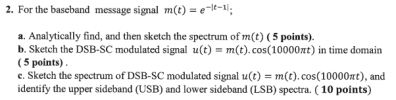 Can i have an answer with the fouirer transform e^-(t-1). And i would like to graph the M(f) in frequency domain.
a) Derive the frequency domain representation X() of a band-limited signal r(t) that has been uniformly sampled in time to become r(n). b) Derive the expression of the reconstructed signal r(t) from...
 a) Derive the frequency domain representation X() of a band-limited signal r(t) that has been uniformly sampled in time to become r(n). b) Derive the expression of the reconstructed signal r(t) from the discrete time signal (n). Show all steps in detail: the sampling/reconstruction functions and processes both in the time and the frequency domain
a) Derive the frequency domain representation X() of a band-limited signal r(t) that has been uniformly sampled in time to become r(n). b) Derive the...
a) Derive the frequency domain representation X() of a band-limited signal r(t) that has been uniformly sampled in time to become r(n). b) Derive the expression of the reconstructed signal r(t) from the discrete time signal (n). Show all steps in detail: the sampling/reconstruction functions and processes both in the time and the frequency domain
a) Derive the frequency domain representation X() of a band-limited signal r(t) that has been uniformly sampled in time to become r(n). b) Derive the...
Using QAM we wish to transmit the following baseband message signals Bcos (w t a) Show the time and frequency domain expression for the transmitted signal. Also, plot the magnitude of the frequency d...
 Using QAM we wish to transmit the following baseband message signals Bcos (w t a) Show the time and frequency domain expression for the transmitted signal. Also, plot the magnitude of the frequency domain representation of the signal. b) On the receiver end, we demodulate the received signal by multiplying with 2cos(Wet +Au). Derive the expression of the demodulated signal in the time domain, before low-pass filtering. c) Derive the Fourier Transform of the demodulated signal.
Using QAM we wish...
Using QAM we wish to transmit the following baseband message signals Bcos (w t a) Show the time and frequency domain expression for the transmitted signal. Also, plot the magnitude of the frequency domain representation of the signal. b) On the receiver end, we demodulate the received signal by multiplying with 2cos(Wet +Au). Derive the expression of the demodulated signal in the time domain, before low-pass filtering. c) Derive the Fourier Transform of the demodulated signal.
Using QAM we wish...
QUESTION 3 What statement best describes the following magnitude spectrum: X,(2) max max S max O A spectrum of a train of complex triangular pulses O A spectrum of a complex continuous-time non-bandl...
 QUESTION 3 What statement best describes the following magnitude spectrum: X,(2) max max S max O A spectrum of a train of complex triangular pulses O A spectrum of a complex continuous-time non-bandlimited signal O A spectrum of a real discrete-time signal uniformly sampled with the rate above Nyquist O A spectrum of a complex continuous-time bandlimited sig O A spectrum of a train of real rectangular pulses O A spectrum of a complex discrete-time signal uniformly sampled with the...
 Prelab Consider the circuits (systems) in Figure 1 2000 1k2 Vo Vi 10pF 2H (b) 2002 Figure We want to understand what these systems do, and how they are expected to behave. Because they are "physical systems" they are causal. For each of the circuits: 1. Use the integration-in-time-domain properties of the Laplace transfom to derive the impedance of the capacitors and inductors. Since both capacitors and inductors are causal systems, what are the regions of convergence of their Laplace...
 10 in Cartesian coordinates. (a) Write the complex number (b) Write the complex number (c) What is the phasor representation of the signal 4. (2 + j4)(3-J)in Polar coordinates i = 4 sin(10t + 10%) ǐn polar coordinates? (d) What is the time domain sinusoidal represenation of the phasor if the frequency of the signal is o- 20 rad/s? I=j(5-j12) if (e) What is the time domain sinusoidal represenation of the phasor the frequency of the signal is ω-10 rad/s?...
 Please answer FAST ASAP I will rate you thumbs up
??
(1) What are the reasons behind the need of modulation for radio transmission, i.e., why not directly transmit the original signal? Q2) A carrier signal with frequency f. Hz is double-sideband suppressed carrier (DSB-SC) amplitude modulated by a triangular shaped message signal, m(t), plotted below (Fig. Q2). The DSB-SC amplitude modulated signal is then passed from a band-pass filter with center frequency fc-Im and bandwidth 2fm where fm =...
Please answer FAST ASAP I will rate you thumbs up
??
(1) What are the reasons behind the need of modulation for radio transmission, i.e., why not directly transmit the original signal? Q2) A carrier signal with frequency f. Hz is double-sideband suppressed carrier (DSB-SC) amplitude modulated by a triangular shaped message signal, m(t), plotted below (Fig. Q2). The DSB-SC amplitude modulated signal is then passed from a band-pass filter with center frequency fc-Im and bandwidth 2fm where fm =...
 1. (10 points) A binary communication system transmits a signal X that is either a +2 voltage signal or a -2 voltage signal. A malicious channel reduces the magnitude of the received signal by the number of heads it counts in two tosses of a coin. Let Y be the resulting signal For example, if both tosses are heads, Y X+ 2, e.g., if X was -2 volt or 2 volt, Y would be 0 volt (a) (4 pts) Observing...
 Given the in-phase/quadrature representation of a real bandpass signal s(t)- 2 cos π6,000t-sin π6,000, determine its equivalent (i) complex baseband representation and (ii) envelop and phase representation.
Given the in-phase/quadrature representation of a real bandpass signal s(t)- 2 cos π6,000t-sin π6,000, determine its equivalent (i) complex baseband representation and (ii) envelop and phase representation.
Given the in-phase/quadrature representation of a real bandpass signal s(t)- 2 cos π6,000t-sin π6,000, determine its equivalent (i) complex baseband representation and (ii) envelop and phase representation.
 a) Derive the frequency domain representation X() of a band-limited signal r(t) that has been uniformly sampled in time to become r(n). b) Derive the expression of the reconstructed signal r(t) from the discrete time signal (n). Show all steps in detail: the sampling/reconstruction functions and processes both in the time and the frequency domain
a) Derive the frequency domain representation X() of a band-limited signal r(t) that has been uniformly sampled in time to become r(n). b) Derive the...
a) Derive the frequency domain representation X() of a band-limited signal r(t) that has been uniformly sampled in time to become r(n). b) Derive the expression of the reconstructed signal r(t) from the discrete time signal (n). Show all steps in detail: the sampling/reconstruction functions and processes both in the time and the frequency domain
a) Derive the frequency domain representation X() of a band-limited signal r(t) that has been uniformly sampled in time to become r(n). b) Derive the...
 Using QAM we wish to transmit the following baseband message signals Bcos (w t a) Show the time and frequency domain expression for the transmitted signal. Also, plot the magnitude of the frequency domain representation of the signal. b) On the receiver end, we demodulate the received signal by multiplying with 2cos(Wet +Au). Derive the expression of the demodulated signal in the time domain, before low-pass filtering. c) Derive the Fourier Transform of the demodulated signal.
Using QAM we wish...
Using QAM we wish to transmit the following baseband message signals Bcos (w t a) Show the time and frequency domain expression for the transmitted signal. Also, plot the magnitude of the frequency domain representation of the signal. b) On the receiver end, we demodulate the received signal by multiplying with 2cos(Wet +Au). Derive the expression of the demodulated signal in the time domain, before low-pass filtering. c) Derive the Fourier Transform of the demodulated signal.
Using QAM we wish...
 QUESTION 3 What statement best describes the following magnitude spectrum: X,(2) max max S max O A spectrum of a train of complex triangular pulses O A spectrum of a complex continuous-time non-bandlimited signal O A spectrum of a real discrete-time signal uniformly sampled with the rate above Nyquist O A spectrum of a complex continuous-time bandlimited sig O A spectrum of a train of real rectangular pulses O A spectrum of a complex discrete-time signal uniformly sampled with the...
Most questions answered within 3 hours.
-
Where is the error in this code sequence?
String s1 = "Hello";
String s2 = "ello";...
asked 10 months ago -
Financial data for Joel de Paris, Inc., for last year
follow:
Joel de Paris, Inc.
Balance...
asked 10 months ago -
Consider this reaction:
Al2(SO4)3 (aq)+ BaCl3
(aq) Al2Cl6 (aq)- +
3BaSO4(s) . What is the...
asked 10 months ago -
Suppose that Savneet is considering increasing her
recent random sample from 20 car rentals to 40...
asked 10 months ago -
Trucks arrive at an unloading terminal at an average rate of 120
per hour.
Trucks arrive...
asked 10 months ago -
Why are methanol and ethanol completely soluble in water while
octanol is not very little soluble....
asked 10 months ago -
A facilities manager at a university reads in a research report
that the mean amount of...
asked 10 months ago -
When the CuSO4 is rehydrated by adding water to the anhydrous
compound, is this an endothermic...
asked 10 months ago -
A ray of sunlight is passing from diamond into crown glass; the
angle of incidence is...
asked 10 months ago -
A block of mass 0.249 kg is placed on top of a light, vertical
spring of...
asked 10 months ago -
how do the kidneys compensate in the presences of acidosis
a) trigger hyperventilate
b) reserve acid...
asked 10 months ago -
Question 501 pts
The rental rate of capital to the firm increases. Which of the
following...
asked 10 months ago