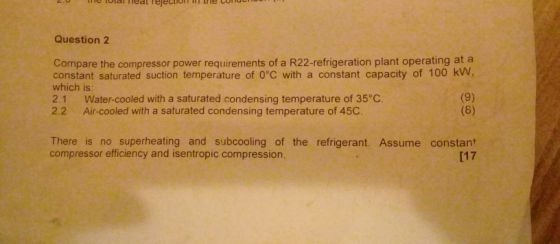
compare the compressor power requirements of a R22
refridgeration of 0°c with a constant capacity of 100kw which is
.
2.1 water-cooled with saturated condensing temperature of
35°C.
2.2 air cooled with sarurated condensing temperature of 45°C.
Homework Answers


Add Answer to:
compare the compressor power requirements of a R22
refridgeration of 0°c with a constant capacity of...
Find (a) the compressor power, in kW, (b) the refrigeration capacity, in tons, and (c) the...
Find (a) the compressor power, in kW, (b) the refrigeration capacity, in tons, and (c) the coefficient of performance (COP) for a real vapor-compression refrigeration cycle using refrigerant 134a. The refrigerant enters the compressor at a rate of 0.15 kg/s as a saturated vapor at −40 °C and leaves the condenser as a saturated liquid at 16 °C. The isentropic efficiency of the compressor is 80%.
Q3/Sixteen cylinders' compressor using R-407C running at 1500 RPM, produce refrigeration capacity of 75 TR. The...
 Q3/Sixteen cylinders' compressor using R-407C running at 1500 RPM, produce refrigeration capacity of 75 TR. The saturated suction temperature is 5 °C and condensing temperature of 50 °C, the condenser sub-cooled by 5 °C. The cylinder bore is 67 mm and the piston is 67 mm. Find the clearance volumetric efficiency if the clearance volume is 4.8 percentage, actual volumetric efficiency, and the actual work of the compressor Note: (compression efficiency 74.68%). The student should attach the P-h diagram with...
In an aircraft cooling system, air enters the compressor at 1 bar and 4°C and is...
 In an aircraft cooling system, air enters the compressor at 1 bar and 4°C and is compressed to 3 bar with an isentropic efficiency of 72%. The compressed air is cooled in a heat exchanger at constant pressure to 55°C and expands in an expander to 1 bar with an isentropic efficiency of 78%. The low temperature air absorbs heat load of 3 tonnes of refrigeration at constant pressure before re- entering the compressor. The compressor is driven by the...
The refrigerant gas which is air, enters the compressor of a Brayton refrigeration cycle at 101...
The refrigerant gas which is air, enters the compressor of a Brayton refrigeration cycle at 101 kPa, 280 K. If the compressor pressure ratio is 5 and the turbine inlet temperature is 330 K. The compressor has an isentropic efficiency of 70% and the turbine has an isentropic efficiency of 80%. Using air table rather than constant-specific-heat theory, determine (a) the net work input per unit mass of air flow, (b) the refrigeration capacity, in kJ/kg, (c) the coefficient of...
available ur tank V=0.2 m reversible, adiabatic compressor R22 Thank = -20°C Vii = 0.05 m...
 available ur tank V=0.2 m reversible, adiabatic compressor R22 Thank = -20°C Vii = 0.05 m I Wc Tomo = -10°C m=0.1 kg/s for t = 10 min Pcout = 18 bar Problem sketch A tank with volume V = 0.2 m2 contains refrigerant R22 at Ttank = -20°C, as shown in the problem sketch. Initially the tank contains V1,1 = 0.05 m2 of liquid R22 and the rest of the tank contains vapor R22. A reversible, adiabatic compressor operating...
Condenser Compressor An ideal vapor-compression refrigeration cycle is modified to include a counter-flow heat exchanger as...
 Condenser Compressor An ideal vapor-compression refrigeration cycle is modified to include a counter-flow heat exchanger as shown. Refrigerant 134a leaves the evaporator as saturated vapor at 0.10 MPa and is heated at constant pressure to 20°C before entering the compressor. Following isentropic compression to 1.4 MPa, the refrigerant passes through the condenser and exits at 45°C and 1.4 MPa. The liquid then passes through the heat exchanger and enters the expansion valve at 1.4 MPa. The mass flow rate of...
An air refrigeration plant of 70.26 kW, capacity comprises a centrifugal compressor, a cooler hea...
An air refrigeration plant of 70.26 kW, capacity comprises a centrifugal compressor, a cooler heat exchanger and an air turbine. The compressor is coupled directly to the air turbine. The compressor also receives power from another prime mover. The processes in the compressor and the turbine are adiabatic but not isentropic. Air at temperature 294 K and 85 kPa enters the compressor. It leaves the compressor at 363 K. the same air enters the turbine at 311 K and 150...
Question 4 A refrigeration system operating on R22, experiences liquid knock during start-up. You suspect that...
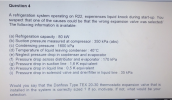 Question 4 A refrigeration system operating on R22, experiences liquid knock during start-up. You suspect that one of the causes could be that the wrong expansion valve was selected/ The following information is available (a) Refrigeration capacity: 80 kVw (b) Suction pressure measured at compressor: 350 kPa (abs) (c) Condensing pressure : 1600 kPa (d) Temperature of liquid leaving condenser : 40°C (e) Neglect pressure drop in condenser and evaporator (f) Pressure drop across distributor and evaporator 170 kPa (g)...
1) A commercial refrigerator with refrigerant-134a as the working fluid is used to keep the refrigerated...
 1) A commercial refrigerator with refrigerant-134a as the working fluid is used to keep the refrigerated space at -30°C by rejecting its waste heat to cooling water that enters the condenser at 16 °C at a rate of 0.25 kg/s and leaves at 26°C. The refrigerant enters the condenser at 1.2 MPa and 65°C and leaves at 42°C. The inlet state of the compressor is 60 kPa and -34°C and the compressor is estimated to gain a net heat of...
1. An air conditioning plant using refrigerant R 134a has evaporating and condensing temperatures of 0°C...
 1. An air conditioning plant using refrigerant R 134a has evaporating and condensing temperatures of 0°C and 35°C, respectively. a) Calculate the refrigerating effect for the plant. If the duty is 352 kW of refrigeration, determine the mass flow rate of refrigerant. b) c) What is the volumetric flow rate under suction conditions? d) Calculate the work done in the compression and the corresponding compressor power e) Evaluate the heat rejected and the rate of heat rejection. f) Calculate the...
 Q3/Sixteen cylinders' compressor using R-407C running at 1500 RPM, produce refrigeration capacity of 75 TR. The saturated suction temperature is 5 °C and condensing temperature of 50 °C, the condenser sub-cooled by 5 °C. The cylinder bore is 67 mm and the piston is 67 mm. Find the clearance volumetric efficiency if the clearance volume is 4.8 percentage, actual volumetric efficiency, and the actual work of the compressor Note: (compression efficiency 74.68%). The student should attach the P-h diagram with...
 In an aircraft cooling system, air enters the compressor at 1 bar and 4°C and is compressed to 3 bar with an isentropic efficiency of 72%. The compressed air is cooled in a heat exchanger at constant pressure to 55°C and expands in an expander to 1 bar with an isentropic efficiency of 78%. The low temperature air absorbs heat load of 3 tonnes of refrigeration at constant pressure before re- entering the compressor. The compressor is driven by the...
 available ur tank V=0.2 m reversible, adiabatic compressor R22 Thank = -20°C Vii = 0.05 m I Wc Tomo = -10°C m=0.1 kg/s for t = 10 min Pcout = 18 bar Problem sketch A tank with volume V = 0.2 m2 contains refrigerant R22 at Ttank = -20°C, as shown in the problem sketch. Initially the tank contains V1,1 = 0.05 m2 of liquid R22 and the rest of the tank contains vapor R22. A reversible, adiabatic compressor operating...
 Condenser Compressor An ideal vapor-compression refrigeration cycle is modified to include a counter-flow heat exchanger as shown. Refrigerant 134a leaves the evaporator as saturated vapor at 0.10 MPa and is heated at constant pressure to 20°C before entering the compressor. Following isentropic compression to 1.4 MPa, the refrigerant passes through the condenser and exits at 45°C and 1.4 MPa. The liquid then passes through the heat exchanger and enters the expansion valve at 1.4 MPa. The mass flow rate of...
 Question 4 A refrigeration system operating on R22, experiences liquid knock during start-up. You suspect that one of the causes could be that the wrong expansion valve was selected/ The following information is available (a) Refrigeration capacity: 80 kVw (b) Suction pressure measured at compressor: 350 kPa (abs) (c) Condensing pressure : 1600 kPa (d) Temperature of liquid leaving condenser : 40°C (e) Neglect pressure drop in condenser and evaporator (f) Pressure drop across distributor and evaporator 170 kPa (g)...
 1) A commercial refrigerator with refrigerant-134a as the working fluid is used to keep the refrigerated space at -30°C by rejecting its waste heat to cooling water that enters the condenser at 16 °C at a rate of 0.25 kg/s and leaves at 26°C. The refrigerant enters the condenser at 1.2 MPa and 65°C and leaves at 42°C. The inlet state of the compressor is 60 kPa and -34°C and the compressor is estimated to gain a net heat of...
 1. An air conditioning plant using refrigerant R 134a has evaporating and condensing temperatures of 0°C and 35°C, respectively. a) Calculate the refrigerating effect for the plant. If the duty is 352 kW of refrigeration, determine the mass flow rate of refrigerant. b) c) What is the volumetric flow rate under suction conditions? d) Calculate the work done in the compression and the corresponding compressor power e) Evaluate the heat rejected and the rate of heat rejection. f) Calculate the...
Most questions answered within 3 hours.
-
Where is the error in this code sequence?
String s1 = "Hello";
String s2 = "ello";...
asked 10 months ago -
Financial data for Joel de Paris, Inc., for last year
follow:
Joel de Paris, Inc.
Balance...
asked 10 months ago -
Consider this reaction:
Al2(SO4)3 (aq)+ BaCl3
(aq) Al2Cl6 (aq)- +
3BaSO4(s) . What is the...
asked 10 months ago -
Suppose that Savneet is considering increasing her
recent random sample from 20 car rentals to 40...
asked 10 months ago -
Trucks arrive at an unloading terminal at an average rate of 120
per hour.
Trucks arrive...
asked 10 months ago -
Why are methanol and ethanol completely soluble in water while
octanol is not very little soluble....
asked 10 months ago -
A facilities manager at a university reads in a research report
that the mean amount of...
asked 10 months ago -
When the CuSO4 is rehydrated by adding water to the anhydrous
compound, is this an endothermic...
asked 10 months ago -
A ray of sunlight is passing from diamond into crown glass; the
angle of incidence is...
asked 10 months ago -
A block of mass 0.249 kg is placed on top of a light, vertical
spring of...
asked 10 months ago -
how do the kidneys compensate in the presences of acidosis
a) trigger hyperventilate
b) reserve acid...
asked 10 months ago -
Question 501 pts
The rental rate of capital to the firm increases. Which of the
following...
asked 10 months ago