
Homework Answers
Problem in this then comment below.. i will help you..
.
please thumbs up for this solution..thanks..
.
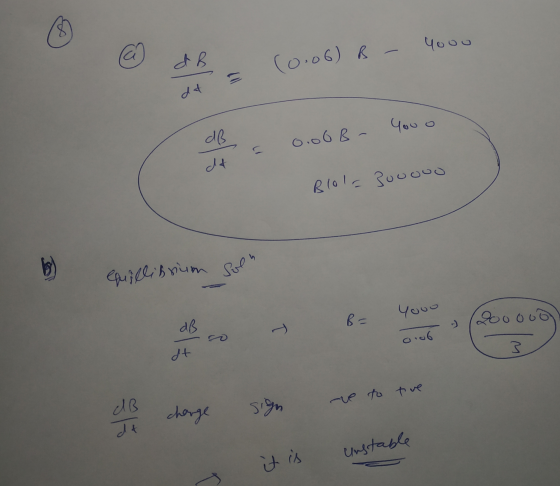
Add Answer to:
8) You invest in a bank account which pays 6 percent compounded continuously. You withdraw money...
You have $520 in an account which pays 4.3% compounded annually. If you invest your money...
You have $520 in an account which pays 4.3% compounded annually. If you invest your money for 10 years, then how many dollars of interest will you earn by the end of the term?
a. You deposit $4000 in an account which pays 4% compounded continuously. How much...
a. You deposit $4000 in an account which pays 4% compounded continuously. How much will you have at the end of 20 years? Round to the nearest penny. b. Find the doubling time for 3% compounded continuously. Do not use the Rule of 72.
Question 5 1 pts You invest a sum of money in an account that pays 7.37%...
 Question 5 1 pts You invest a sum of money in an account that pays 7.37% compounded continuously. How many weeks must you leave this sum invested to double your money? Express your answer in weeks to the nearest whole number of weeks.
Bank A pays 8% interest, compounded quarterly, on its money market account. The managers of bank...
Bank A pays 8% interest, compounded quarterly, on its money market account. The managers of bank B want its money market account’s effective annual rate to equal that of Bank A, but Bank B will compound interest on a monthly basis. What nominal, or quoted, rate must bank B set?
1. Suppose you have A, dollars to invest in a savings account eaming an annual interest...
 1. Suppose you have A, dollars to invest in a savings account eaming an annual interest rate of r percent compounded continuously. Furthermore, suppose that you make annual deposits of d dollars to the account. The differential equation governing this situation is dA =rA+d, AO) = Ao (a) Find an equation for the future value Ac) of the account by solving the aforementioned initial value problem. Be sure your solution is correct as this will be used for the remaining...
"You have three choices in placing your $18,000 in a bank account today for 8 years....
"You have three choices in placing your $18,000 in a bank account today for 8 years. Bank A pays 5.3% compounded annually. Bank B pays 4.62% compounded quatarly. Bank C pays 5.05% compounded continuously. Enter the amount of money that the best option would return after 8 years. There is no inflation."
You have $200,000 to invest for a year and have two choices. Bank A pays 8%...
You have $200,000 to invest for a year and have two choices. Bank A pays 8% annually, compounded annually. Bank B pays 8% annually, compounded quarterly. Which bank should you choose and why? A. Bank A since its effective annual rate is greater than that of Bank B. B. Bank B since its effective annual rate is greater than that of Bank A. C. It does not matter since their effective annual rate is the same 8%. D. Bank B...
The Simple Bank offers a 8 percent simple interest on deposited money. The Not-So-Simple Bank pays...
The Simple Bank offers a 8 percent simple interest on deposited money. The Not-So-Simple Bank pays 8 percent interest on deposited money, compounded annually. You can deposit your money in either one of these two banks. If your deposit equals $65,000, by how much more will your money grow if you deposit it into The Not-So-Simple Bank, rather than The Simple Bank, for a total of 8 years? (Do not round intermediate calculations and round your answer to 2...
Problem 1- Saving Money You want to deposit money into a bank account that pays 1.5%...
 Problem 1- Saving Money You want to deposit money into a bank account that pays 1.5% compounded monthly. Answer the following questions: f depositing $4000, how much is avaiable in the account at the end of S years? .How much do you have to deposit now in order to have $5000 available at the end of 5 years? Instead of depositing one sum of money at the beginning of the 5-year period, suppose you wish to make monthly payments. How...
First City Bank pays 8 percent simple interest on its savings account balances, whereas Second City...
First City Bank pays 8 percent simple interest on its savings account balances, whereas Second City Bank pays 8 percent interest compounded annually. If you made a $65,000 deposit in each bank, how much more money would you earn from your Second City Bank account at the end of 8 years? (Do not round intermediate calculations and round your answer to 2 decimal places, e.g., 32.16.) Your coin collection contains 45 1952 silver dollars. If your grandparents purchased them...
 Question 5 1 pts You invest a sum of money in an account that pays 7.37% compounded continuously. How many weeks must you leave this sum invested to double your money? Express your answer in weeks to the nearest whole number of weeks.
 1. Suppose you have A, dollars to invest in a savings account eaming an annual interest rate of r percent compounded continuously. Furthermore, suppose that you make annual deposits of d dollars to the account. The differential equation governing this situation is dA =rA+d, AO) = Ao (a) Find an equation for the future value Ac) of the account by solving the aforementioned initial value problem. Be sure your solution is correct as this will be used for the remaining...
 Problem 1- Saving Money You want to deposit money into a bank account that pays 1.5% compounded monthly. Answer the following questions: f depositing $4000, how much is avaiable in the account at the end of S years? .How much do you have to deposit now in order to have $5000 available at the end of 5 years? Instead of depositing one sum of money at the beginning of the 5-year period, suppose you wish to make monthly payments. How...
Most questions answered within 3 hours.
-
Where is the error in this code sequence?
String s1 = "Hello";
String s2 = "ello";...
asked 11 months ago -
Financial data for Joel de Paris, Inc., for last year
follow:
Joel de Paris, Inc.
Balance...
asked 11 months ago -
Consider this reaction:
Al2(SO4)3 (aq)+ BaCl3
(aq) Al2Cl6 (aq)- +
3BaSO4(s) . What is the...
asked 11 months ago -
Suppose that Savneet is considering increasing her
recent random sample from 20 car rentals to 40...
asked 11 months ago -
Trucks arrive at an unloading terminal at an average rate of 120
per hour.
Trucks arrive...
asked 11 months ago -
Why are methanol and ethanol completely soluble in water while
octanol is not very little soluble....
asked 11 months ago -
A facilities manager at a university reads in a research report
that the mean amount of...
asked 11 months ago -
When the CuSO4 is rehydrated by adding water to the anhydrous
compound, is this an endothermic...
asked 11 months ago -
A ray of sunlight is passing from diamond into crown glass; the
angle of incidence is...
asked 11 months ago -
A block of mass 0.249 kg is placed on top of a light, vertical
spring of...
asked 11 months ago -
how do the kidneys compensate in the presences of acidosis
a) trigger hyperventilate
b) reserve acid...
asked 11 months ago -
Question 501 pts
The rental rate of capital to the firm increases. Which of the
following...
asked 11 months ago