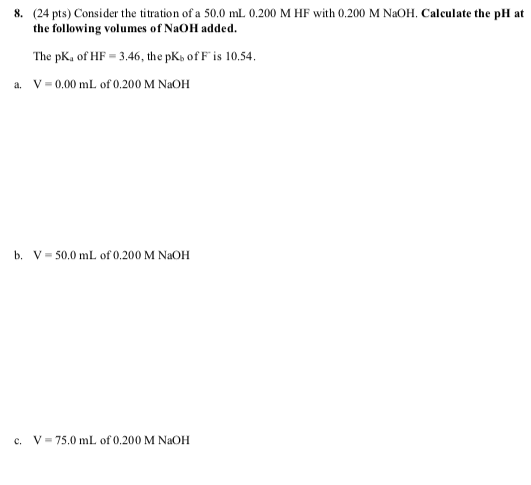
I would like the problem to be done with an ICE table so I could know how to do a titration problem without Henderson Hasselbach when x is small approx. can't be done.
Homework Answers
Request Answer!
We need at least 10 more requests to produce the answer.
0 / 10 have requested this problem solution
The more requests, the faster the answer.
Add Answer to:
I would like the problem to be done with an ICE table so I could
know...
this was a quiz i took and id like to know how i should have done...
 this was a quiz i took and id like to know how i should have
done it.
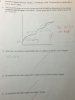
Yellow, and A2 is Blue. er the dipotic acid, H,A with pk, 2.40 and pk, 6.60. The species HaA is colorless, HA is a) When 0.100 M solution of this acid is titrated with 0.100 M NaOH, the following curve was obtained. Completely label all aspects of the diagram. You may assume that the sample volume of acid is 25.0 mL, if necessary...
this was a quiz i took and id like to know how i should have
done it.
Yellow, and A2 is Blue. er the dipotic acid, H,A with pk, 2.40 and pk, 6.60. The species HaA is colorless, HA is a) When 0.100 M solution of this acid is titrated with 0.100 M NaOH, the following curve was obtained. Completely label all aspects of the diagram. You may assume that the sample volume of acid is 25.0 mL, if necessary...
1. Short Answer: Consider the titration of 50.0 mL of 20 M HNO. (K. - 4.0x10'...
 1. Short Answer: Consider the titration of 50.0 mL of 20 M HNO. (K. - 4.0x10' with 1.0 MNOH. Fill in pH values in this table for each amount of strong base added to weak acid (25 points) 1.0 M NaOH O mL Moles of NaOH added Calculated pll (2 sig fig) 25 ml 50 ml. 100 ml 150 ml Before filling in above table construct an ICE chart for each titration step: construct your own on following blank page,...
Calculate the pH for each of the following cases in the titration of 25.0 mL of 0.230 M pyridine, C5H5N(aq) with 0.230 M HBr(aq) Number 9.3 (a) before addition of any HBr Number 5.23 (b) after additi...
 Calculate the pH for each of the following cases in the titration of 25.0 mL of 0.230 M pyridine, C5H5N(aq) with 0.230 M HBr(aq) Number 9.3 (a) before addition of any HBr Number 5.23 (b) after addition of 12.5 mL of HBr With equal concentrations of monoprotic titrant and added volumes are equal (25.0 mL of HBr added) So at point (c), we are 24.0/50.0 = 96.0% of the way to umber analyte, the equivalence point would occur when the...
**Problem 7C should have KOH listed as the solution, not NaOH Please circle the correct answer...
 **Problem 7C should have
KOH listed as the solution, not NaOH
Please circle the correct answer and show all work for 7c.
Thanks
7. In a different titration, 50.0 mL of 0.150 M HF (pKa = 3.10) was titrated with a solution of 0.250 M KOH. A. (3 pts) The following figure represents solutions at various stages of the titration. (The K ions and water molecules have been omitted for clarity.) Which drawing corresponds to the region of the titration...
**Problem 7C should have
KOH listed as the solution, not NaOH
Please circle the correct answer and show all work for 7c.
Thanks
7. In a different titration, 50.0 mL of 0.150 M HF (pKa = 3.10) was titrated with a solution of 0.250 M KOH. A. (3 pts) The following figure represents solutions at various stages of the titration. (The K ions and water molecules have been omitted for clarity.) Which drawing corresponds to the region of the titration...
Why is my professor using an ice table to solvs this titration problem? I seem to be confused with titrations and wh...
 Why is my professor using an ice table to solvs this
titration problem? I seem to be confused with titrations and when
to use an ice table with these kinds of problems. Iv seen similar
problems being done without an ice table. Please break it down step
by step explaing when and why we use ice tables to solve a
titration question.
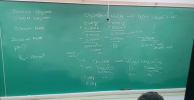
Sooo ml Chacool 0.300 M CH₂COOH Hot Chicoo + Moto 0.300M oh 20.00ml Nach CH₂COOH + NaOH →...
Why is my professor using an ice table to solvs this
titration problem? I seem to be confused with titrations and when
to use an ice table with these kinds of problems. Iv seen similar
problems being done without an ice table. Please break it down step
by step explaing when and why we use ice tables to solve a
titration question.
Sooo ml Chacool 0.300 M CH₂COOH Hot Chicoo + Moto 0.300M oh 20.00ml Nach CH₂COOH + NaOH →...
Not sure about my answers. So I would like to see Half equivilance point, pKa, Ka...
 Not sure about my answers. So I would like to see Half
equivilance point, pKa, Ka and molarity of acid values worked out
from these graphs. Impotant data: titration of 25.00 +/- 0.01 mL of
unknown acid by 0.1069 M NaOh. Two runs were done, but data
calculations for ony one is needed now (they sets are nearly
identical)..
12 10 pH Titration Curves (pH vs. mL NaoH) eequiv. Rint 25 NaOH (mL) inch 9 inch Trial 1 CT.) e...
Not sure about my answers. So I would like to see Half
equivilance point, pKa, Ka and molarity of acid values worked out
from these graphs. Impotant data: titration of 25.00 +/- 0.01 mL of
unknown acid by 0.1069 M NaOh. Two runs were done, but data
calculations for ony one is needed now (they sets are nearly
identical)..
12 10 pH Titration Curves (pH vs. mL NaoH) eequiv. Rint 25 NaOH (mL) inch 9 inch Trial 1 CT.) e...
I know that the answers are: 1)ph=10.88, 2a) 10.71, 5.08, 0.79 but I'm having problems with...
 I know that the answers are: 1)ph=10.88, 2a) 10.71, 5.08, 0.79
but I'm having problems with figuring out the work for question
two
Thank you
A buffer solution is prepared by taking 72.3 g CH3NH3Cl and 315 mL of 5.85 MCH3NH2 and diluting to a final volume of 500.0 mL. Determine the pH of the buffer solution. zeexagPH1O .88 2) 50.0 ml of the buffer prepared in problem 1 above is titrated with 3.86 M HCI. a) Determine the pH...
I know that the answers are: 1)ph=10.88, 2a) 10.71, 5.08, 0.79
but I'm having problems with figuring out the work for question
two
Thank you
A buffer solution is prepared by taking 72.3 g CH3NH3Cl and 315 mL of 5.85 MCH3NH2 and diluting to a final volume of 500.0 mL. Determine the pH of the buffer solution. zeexagPH1O .88 2) 50.0 ml of the buffer prepared in problem 1 above is titrated with 3.86 M HCI. a) Determine the pH...
Please answer #2 php/ 20 %20Extra%20Credit%20-%20Spring%2020 18.pdf CHEM 108- Extra Credit-Spring 2018 IMPORTANT: Show ALL your...
 Please answer #2
php/ 20 %20Extra%20Credit%20-%20Spring%2020 18.pdf CHEM 108- Extra Credit-Spring 2018 IMPORTANT: Show ALL your work. Don't forget the significant figures and units!! Would the following mixtures result in buffer solutions? (Justify your answers) 1. a 100.0 ml, of 0.10 M NH, 100.0 mL of0.15 M NHaCl b. 50.0 mL of 0.10 M HCIO4, 35.0 mL if 0.15 M NaCIO c. 125.0 ml, of 0.15 CH?NH2. 120.0 mL of 0.25 M CHNE ICI d. 165.0 mL of 0.10 M...
Please answer #2
php/ 20 %20Extra%20Credit%20-%20Spring%2020 18.pdf CHEM 108- Extra Credit-Spring 2018 IMPORTANT: Show ALL your work. Don't forget the significant figures and units!! Would the following mixtures result in buffer solutions? (Justify your answers) 1. a 100.0 ml, of 0.10 M NH, 100.0 mL of0.15 M NHaCl b. 50.0 mL of 0.10 M HCIO4, 35.0 mL if 0.15 M NaCIO c. 125.0 ml, of 0.15 CH?NH2. 120.0 mL of 0.25 M CHNE ICI d. 165.0 mL of 0.10 M...
I am looking for help with just trial one. I am not sure what equations to use or how to go about even answering these questions. I figure if I can get help with trial 1 I should be able to do trial 2...
 I am looking for help with just trial one. I am not sure what
equations to use or how to go about even answering these questions.
I figure if I can get help with trial 1 I should be able to do
trial 2 on my own.
( This week has been really bad, I lost my grandfather, so if you
could "dumb" down the steps as much as possible I would appreciate
it, my brain is just not working...
I am looking for help with just trial one. I am not sure what
equations to use or how to go about even answering these questions.
I figure if I can get help with trial 1 I should be able to do
trial 2 on my own.
( This week has been really bad, I lost my grandfather, so if you
could "dumb" down the steps as much as possible I would appreciate
it, my brain is just not working...
Can someone please help me with this? I already asked this and nobody answered. 1. A...
 Can someone please help me with this? I already asked this and
nobody answered.
1. A buffer called "Tris" is widely used in biochemistry. The (neutral) compound "Tris" itself is a weak base, so we'll notate it as "B." The pk, of its conjugate acid (HB) is 8.07. The overall goal of this problem is to calculate the pH change of a Tris buffer upon addition of some strong base. (a) Assume that you have a pH 8.40 Tris buffer...
Can someone please help me with this? I already asked this and
nobody answered.
1. A buffer called "Tris" is widely used in biochemistry. The (neutral) compound "Tris" itself is a weak base, so we'll notate it as "B." The pk, of its conjugate acid (HB) is 8.07. The overall goal of this problem is to calculate the pH change of a Tris buffer upon addition of some strong base. (a) Assume that you have a pH 8.40 Tris buffer...
 this was a quiz i took and id like to know how i should have
done it.
Yellow, and A2 is Blue. er the dipotic acid, H,A with pk, 2.40 and pk, 6.60. The species HaA is colorless, HA is a) When 0.100 M solution of this acid is titrated with 0.100 M NaOH, the following curve was obtained. Completely label all aspects of the diagram. You may assume that the sample volume of acid is 25.0 mL, if necessary...
this was a quiz i took and id like to know how i should have
done it.
Yellow, and A2 is Blue. er the dipotic acid, H,A with pk, 2.40 and pk, 6.60. The species HaA is colorless, HA is a) When 0.100 M solution of this acid is titrated with 0.100 M NaOH, the following curve was obtained. Completely label all aspects of the diagram. You may assume that the sample volume of acid is 25.0 mL, if necessary...
 1. Short Answer: Consider the titration of 50.0 mL of 20 M HNO. (K. - 4.0x10' with 1.0 MNOH. Fill in pH values in this table for each amount of strong base added to weak acid (25 points) 1.0 M NaOH O mL Moles of NaOH added Calculated pll (2 sig fig) 25 ml 50 ml. 100 ml 150 ml Before filling in above table construct an ICE chart for each titration step: construct your own on following blank page,...
 Calculate the pH for each of the following cases in the titration of 25.0 mL of 0.230 M pyridine, C5H5N(aq) with 0.230 M HBr(aq) Number 9.3 (a) before addition of any HBr Number 5.23 (b) after addition of 12.5 mL of HBr With equal concentrations of monoprotic titrant and added volumes are equal (25.0 mL of HBr added) So at point (c), we are 24.0/50.0 = 96.0% of the way to umber analyte, the equivalence point would occur when the...
 **Problem 7C should have
KOH listed as the solution, not NaOH
Please circle the correct answer and show all work for 7c.
Thanks
7. In a different titration, 50.0 mL of 0.150 M HF (pKa = 3.10) was titrated with a solution of 0.250 M KOH. A. (3 pts) The following figure represents solutions at various stages of the titration. (The K ions and water molecules have been omitted for clarity.) Which drawing corresponds to the region of the titration...
**Problem 7C should have
KOH listed as the solution, not NaOH
Please circle the correct answer and show all work for 7c.
Thanks
7. In a different titration, 50.0 mL of 0.150 M HF (pKa = 3.10) was titrated with a solution of 0.250 M KOH. A. (3 pts) The following figure represents solutions at various stages of the titration. (The K ions and water molecules have been omitted for clarity.) Which drawing corresponds to the region of the titration...
 Why is my professor using an ice table to solvs this
titration problem? I seem to be confused with titrations and when
to use an ice table with these kinds of problems. Iv seen similar
problems being done without an ice table. Please break it down step
by step explaing when and why we use ice tables to solve a
titration question.
Sooo ml Chacool 0.300 M CH₂COOH Hot Chicoo + Moto 0.300M oh 20.00ml Nach CH₂COOH + NaOH →...
Why is my professor using an ice table to solvs this
titration problem? I seem to be confused with titrations and when
to use an ice table with these kinds of problems. Iv seen similar
problems being done without an ice table. Please break it down step
by step explaing when and why we use ice tables to solve a
titration question.
Sooo ml Chacool 0.300 M CH₂COOH Hot Chicoo + Moto 0.300M oh 20.00ml Nach CH₂COOH + NaOH →...
 Not sure about my answers. So I would like to see Half
equivilance point, pKa, Ka and molarity of acid values worked out
from these graphs. Impotant data: titration of 25.00 +/- 0.01 mL of
unknown acid by 0.1069 M NaOh. Two runs were done, but data
calculations for ony one is needed now (they sets are nearly
identical)..
12 10 pH Titration Curves (pH vs. mL NaoH) eequiv. Rint 25 NaOH (mL) inch 9 inch Trial 1 CT.) e...
Not sure about my answers. So I would like to see Half
equivilance point, pKa, Ka and molarity of acid values worked out
from these graphs. Impotant data: titration of 25.00 +/- 0.01 mL of
unknown acid by 0.1069 M NaOh. Two runs were done, but data
calculations for ony one is needed now (they sets are nearly
identical)..
12 10 pH Titration Curves (pH vs. mL NaoH) eequiv. Rint 25 NaOH (mL) inch 9 inch Trial 1 CT.) e...
 I know that the answers are: 1)ph=10.88, 2a) 10.71, 5.08, 0.79
but I'm having problems with figuring out the work for question
two
Thank you
A buffer solution is prepared by taking 72.3 g CH3NH3Cl and 315 mL of 5.85 MCH3NH2 and diluting to a final volume of 500.0 mL. Determine the pH of the buffer solution. zeexagPH1O .88 2) 50.0 ml of the buffer prepared in problem 1 above is titrated with 3.86 M HCI. a) Determine the pH...
I know that the answers are: 1)ph=10.88, 2a) 10.71, 5.08, 0.79
but I'm having problems with figuring out the work for question
two
Thank you
A buffer solution is prepared by taking 72.3 g CH3NH3Cl and 315 mL of 5.85 MCH3NH2 and diluting to a final volume of 500.0 mL. Determine the pH of the buffer solution. zeexagPH1O .88 2) 50.0 ml of the buffer prepared in problem 1 above is titrated with 3.86 M HCI. a) Determine the pH...
 Please answer #2
php/ 20 %20Extra%20Credit%20-%20Spring%2020 18.pdf CHEM 108- Extra Credit-Spring 2018 IMPORTANT: Show ALL your work. Don't forget the significant figures and units!! Would the following mixtures result in buffer solutions? (Justify your answers) 1. a 100.0 ml, of 0.10 M NH, 100.0 mL of0.15 M NHaCl b. 50.0 mL of 0.10 M HCIO4, 35.0 mL if 0.15 M NaCIO c. 125.0 ml, of 0.15 CH?NH2. 120.0 mL of 0.25 M CHNE ICI d. 165.0 mL of 0.10 M...
Please answer #2
php/ 20 %20Extra%20Credit%20-%20Spring%2020 18.pdf CHEM 108- Extra Credit-Spring 2018 IMPORTANT: Show ALL your work. Don't forget the significant figures and units!! Would the following mixtures result in buffer solutions? (Justify your answers) 1. a 100.0 ml, of 0.10 M NH, 100.0 mL of0.15 M NHaCl b. 50.0 mL of 0.10 M HCIO4, 35.0 mL if 0.15 M NaCIO c. 125.0 ml, of 0.15 CH?NH2. 120.0 mL of 0.25 M CHNE ICI d. 165.0 mL of 0.10 M...
 I am looking for help with just trial one. I am not sure what
equations to use or how to go about even answering these questions.
I figure if I can get help with trial 1 I should be able to do
trial 2 on my own.
( This week has been really bad, I lost my grandfather, so if you
could "dumb" down the steps as much as possible I would appreciate
it, my brain is just not working...
I am looking for help with just trial one. I am not sure what
equations to use or how to go about even answering these questions.
I figure if I can get help with trial 1 I should be able to do
trial 2 on my own.
( This week has been really bad, I lost my grandfather, so if you
could "dumb" down the steps as much as possible I would appreciate
it, my brain is just not working...
 Can someone please help me with this? I already asked this and
nobody answered.
1. A buffer called "Tris" is widely used in biochemistry. The (neutral) compound "Tris" itself is a weak base, so we'll notate it as "B." The pk, of its conjugate acid (HB) is 8.07. The overall goal of this problem is to calculate the pH change of a Tris buffer upon addition of some strong base. (a) Assume that you have a pH 8.40 Tris buffer...
Can someone please help me with this? I already asked this and
nobody answered.
1. A buffer called "Tris" is widely used in biochemistry. The (neutral) compound "Tris" itself is a weak base, so we'll notate it as "B." The pk, of its conjugate acid (HB) is 8.07. The overall goal of this problem is to calculate the pH change of a Tris buffer upon addition of some strong base. (a) Assume that you have a pH 8.40 Tris buffer...
Most questions answered within 3 hours.
-
Where is the error in this code sequence?
String s1 = "Hello";
String s2 = "ello";...
asked 10 months ago -
Financial data for Joel de Paris, Inc., for last year
follow:
Joel de Paris, Inc.
Balance...
asked 10 months ago -
Consider this reaction:
Al2(SO4)3 (aq)+ BaCl3
(aq) Al2Cl6 (aq)- +
3BaSO4(s) . What is the...
asked 10 months ago -
Suppose that Savneet is considering increasing her
recent random sample from 20 car rentals to 40...
asked 10 months ago -
Trucks arrive at an unloading terminal at an average rate of 120
per hour.
Trucks arrive...
asked 10 months ago -
Why are methanol and ethanol completely soluble in water while
octanol is not very little soluble....
asked 10 months ago -
A facilities manager at a university reads in a research report
that the mean amount of...
asked 10 months ago -
When the CuSO4 is rehydrated by adding water to the anhydrous
compound, is this an endothermic...
asked 10 months ago -
A ray of sunlight is passing from diamond into crown glass; the
angle of incidence is...
asked 10 months ago -
A block of mass 0.249 kg is placed on top of a light, vertical
spring of...
asked 10 months ago -
how do the kidneys compensate in the presences of acidosis
a) trigger hyperventilate
b) reserve acid...
asked 10 months ago -
Question 501 pts
The rental rate of capital to the firm increases. Which of the
following...
asked 10 months ago