3. In a semiconductor device, electrons are accelerated through a potential of 5V attempt to tunnel...
3. In a semiconductor device, electrons are accelerated through
a potential of 5V attempt to
tunnel through a rectangular barrier of width 0.6nm and height 10V.
What fraction of the
electrons are able to tunnel through the barrier if the potential
outside is zero?
Homework Answers

Add Answer to:
3. In a semiconductor device, electrons are accelerated through
a potential of 5V attempt to
tunnel...
2a. The electrons in the lab are accelerated through a potential difference that you can control....
2a. The electrons in the lab are accelerated through a potential difference that you can control. What is the speed of an electron that is released from rest and accelerated through a potential difference of 100 volts? (hint: consider conservation of energy) 2b. A larger potential difference corresponds to a higher speed. By what factor should you multiply the potential difference to double the speed of the electrons?
Electrons are accelerated through potential difference of 12 V and are bombarding the hydrogen atoms. To...
Electrons are accelerated through potential difference of 12 V and are bombarding the hydrogen atoms. To calculate the energy of the electrons use U = eV, where e = 1.6x10⁻¹⁹ C. What wavelength will the atoms emit?
What is the minimum wavelength of x-rays produced by electrons accelerated through a potential difference of...
What is the minimum wavelength of x-rays produced by electrons accelerated through a potential difference of 20 000 V?
Problem 2 The diffusion of electrons and holes across a potential barrier in an electronic device...
 Problem 2 The diffusion of electrons and holes across a potential barrier in an electronic device is modeled as follows: There are m black balls (electrons) in urn A and m white balls (holes) in urn B. We perform independent trials, in each of which a ball is selected at random from each urn and the selected ball from urn A is placed in urn B, while that from urn B is placed in A. Consider the Markov chain representing...
In a laboratory experiment, a beam of electrons is accelerated from rest through a 148-V potential...
 In a laboratory experiment, a beam of electrons is accelerated from rest through a 148-V potential difference. The beam then enters a uniform magnetic field and follows a circular path of radius r = 19.1 cm in the field region. (a) What is the angle between the magnetic field and the electrons' velocity? (b) What is the magnitude of the magnetic field? Submit Answer
A beam of electrons is accelerated through a potential difference of 10 kV before entering a...
A beam of electrons is accelerated through a potential difference of 10 kV before entering a region having uniform electric and magnetic fields that are perpendicular to each other and perpendicular to the direction in which the electron is moving. If the magnetic field in this region has a value of 0.010 T, what magnitude of the electric field is required if the particles are to be undeflected as they pass through the region?
A beam of electrons is accelerated through a potential difference of 11.0 kV before entering a...
A beam of electrons is accelerated through a potential difference of 11.0 kV before entering a velocity selector. If the B-field of the velocity selector is perpendicular to the velocity and has a value of 0.02 T, what value of the E-field is required (in the magnetic field region) if the particles are to be undeflected? answer in V/m
A beam of electrons is accelerated through a potential difference of 12.0 kV before entering a...
A beam of electrons is accelerated through a potential difference of 12.0 kV before entering a velocity selector. If the B-field of the velocity selector is perpendicular to the velocity and has a value of 0.02 T, what value of the E-field is required (in the magnetic field region) if the particles are to be undeflected? It's not 1.949*10^6.
A proton accelerated through a potential of 12.0 kV enters a device which has both an...
 A proton accelerated through a potential of 12.0 kV enters a
device which has both an electric and a magnetic field, that are
perpendicular to each other as shown in the figure. This device is
known as a "velocity filter", because only protons with a given
velocity are not deflected and continue their trajectory along the
y-axis through the aperture shown in the figure.
Indicate the directions of both the electric force and the
magnetic force.
+x -x +y -y...
A proton accelerated through a potential of 12.0 kV enters a
device which has both an electric and a magnetic field, that are
perpendicular to each other as shown in the figure. This device is
known as a "velocity filter", because only protons with a given
velocity are not deflected and continue their trajectory along the
y-axis through the aperture shown in the figure.
Indicate the directions of both the electric force and the
magnetic force.
+x -x +y -y...
4. A beam of electrons is accelerated through a potential difference of 10.0 kV before entering...
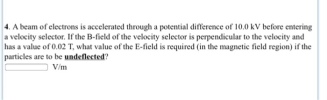 4. A beam of electrons is accelerated through a potential difference of 10.0 kV before entering a velocity selector. If the B-field of the velocity selector is perpendicular to the velocity and has a value of 0.02 T, what value of the E-field is required (in the magnetic field region) if the particles are to be undeflected? V/m
 Problem 2 The diffusion of electrons and holes across a potential barrier in an electronic device is modeled as follows: There are m black balls (electrons) in urn A and m white balls (holes) in urn B. We perform independent trials, in each of which a ball is selected at random from each urn and the selected ball from urn A is placed in urn B, while that from urn B is placed in A. Consider the Markov chain representing...
 In a laboratory experiment, a beam of electrons is accelerated from rest through a 148-V potential difference. The beam then enters a uniform magnetic field and follows a circular path of radius r = 19.1 cm in the field region. (a) What is the angle between the magnetic field and the electrons' velocity? (b) What is the magnitude of the magnetic field? Submit Answer
 A proton accelerated through a potential of 12.0 kV enters a
device which has both an electric and a magnetic field, that are
perpendicular to each other as shown in the figure. This device is
known as a "velocity filter", because only protons with a given
velocity are not deflected and continue their trajectory along the
y-axis through the aperture shown in the figure.
Indicate the directions of both the electric force and the
magnetic force.
+x -x +y -y...
A proton accelerated through a potential of 12.0 kV enters a
device which has both an electric and a magnetic field, that are
perpendicular to each other as shown in the figure. This device is
known as a "velocity filter", because only protons with a given
velocity are not deflected and continue their trajectory along the
y-axis through the aperture shown in the figure.
Indicate the directions of both the electric force and the
magnetic force.
+x -x +y -y...
 4. A beam of electrons is accelerated through a potential difference of 10.0 kV before entering a velocity selector. If the B-field of the velocity selector is perpendicular to the velocity and has a value of 0.02 T, what value of the E-field is required (in the magnetic field region) if the particles are to be undeflected? V/m
Most questions answered within 3 hours.
-
Where is the error in this code sequence?
String s1 = "Hello";
String s2 = "ello";...
asked 10 months ago -
Financial data for Joel de Paris, Inc., for last year
follow:
Joel de Paris, Inc.
Balance...
asked 10 months ago -
Consider this reaction:
Al2(SO4)3 (aq)+ BaCl3
(aq) Al2Cl6 (aq)- +
3BaSO4(s) . What is the...
asked 10 months ago -
Suppose that Savneet is considering increasing her
recent random sample from 20 car rentals to 40...
asked 10 months ago -
Trucks arrive at an unloading terminal at an average rate of 120
per hour.
Trucks arrive...
asked 10 months ago -
Why are methanol and ethanol completely soluble in water while
octanol is not very little soluble....
asked 10 months ago -
A facilities manager at a university reads in a research report
that the mean amount of...
asked 10 months ago -
When the CuSO4 is rehydrated by adding water to the anhydrous
compound, is this an endothermic...
asked 10 months ago -
A ray of sunlight is passing from diamond into crown glass; the
angle of incidence is...
asked 10 months ago -
A block of mass 0.249 kg is placed on top of a light, vertical
spring of...
asked 10 months ago -
how do the kidneys compensate in the presences of acidosis
a) trigger hyperventilate
b) reserve acid...
asked 10 months ago -
Question 501 pts
The rental rate of capital to the firm increases. Which of the
following...
asked 10 months ago