


Homework Answers
Request Answer!
We need at least 10 more requests to produce the answer.
0 / 10 have requested this problem solution
The more requests, the faster the answer.
Add Answer to:
Mech HW-14 Acceleration in one dimension 3. Describe the motion of an object: a. for which...
A cart on a table (cart A) collides with another cart that is initially at rest...
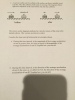 A cart on a table (cart A) collides with another cart that is initially at rest (cart B). After the collision, both carts are moving. The diagrams below represent snapshots of the carts before and after the collision. The arrows on the diagrams indicate the velocity vectors of the carts at the instants shown. (The vectors are drawn to scale.) Consider the time interval between the two instants shown. During this time interval, is the magnitude of the average acceleration...
Conservation of moment in two dimensions Mech HW-62 2. Two objects collide on a level, frictionless...
 Conservation of moment in two dimensions Mech HW-62 2. Two objects collide on a level, frictionless table. The mass of object A is 50 kg: the mass of object B is 3.0 kg. The objects stick together after the collision. The initial velocity of object A and the final velocity of both objects are shown. After collision Before collision BA (One side of a square represents 0.1 m/s) a. In the space provided, draw separate arrows for object A and...
Highest point (same instant on uphill and downhill figures) Uphill Downhill Acceleration in one dimension ech...
 Highest point (same instant on uphill and downhill figures) Uphill Downhill Acceleration in one dimension ech -14 3. Describe the motion of an object: for which the direction of the acceleration is the same as the direction of motion of the o a. b. for which the direction of the acceleration is opposite to the direction of motion of th for which the direction of the c. for which the change in velocity is zero. d. for which the initial...
with reason please. Velocity and Acceleration Vectors An object is moving with an initial velocity along...
 with reason please.
Velocity and Acceleration Vectors An object is moving with an initial velocity along the x-axis and a constant acceleration in the second quadrant of the x-y plane as shown. Which one of the following statements about the subsequent motion of the object is true? (a) The velocity of the object never changes magnitude. (b) The velocity of the object never changes direction. (c) The direction of the velocity of the object is never the same as that...
with reason please.
Velocity and Acceleration Vectors An object is moving with an initial velocity along the x-axis and a constant acceleration in the second quadrant of the x-y plane as shown. Which one of the following statements about the subsequent motion of the object is true? (a) The velocity of the object never changes magnitude. (b) The velocity of the object never changes direction. (c) The direction of the velocity of the object is never the same as that...
Impulse and Momentum Name: Date: TA's Name: Learning Objectives: 1. Understanding force ys time curves for...
 Impulse and Momentum Name: Date: TA's Name: Learning Objectives: 1. Understanding force ys time curves for a collision. 2. Calculating impulse using force vs. time curves. 3. Understanding the relationship between impulse and momentum. 4. Applying conservation of momentum for inelastic collisions. Apparatus: Aluminum track, track legs, two smart carts, two cart stops, and small black rectangular cart masses. Part A: Collision of a moving cart with a fixed cart cart 1 Cart stop stationary cart cart stop Consider the...
need help on numbers 4-6 1. Make a drawing of the path of an object in...
need help on numbers 4-6 1. Make a drawing of the path of an object in circular motion at constant speed. On that path, use a dot to represent the object’s position at time t 1 . Label this point as O, and draw a vector at O to represent the magnitude and direction of the object’s velocity at time t 1 . Draw another dot to represent the object’s position at a later time t 2 , shortly after...
Below is a motion diagram for an object that moves along alinear path. The dots...
Below is a motion diagram for an object that moves along a linear path. The dots represent the position of the object at three subsequent instants, t1, t2, and t3. The vectors v⃗ 21 and v⃗ 32 show the average velocity of the object for the initial time interval, Δt21=t2−t1, and the final time interval, Δt32=t3−t2, respectively. Draw the vector −v→21 and the acceleration vector a⃗ representing the change in average velocity of the object during the total time interval...
Review Correct Learning Goal: To practice Tactics Box 4.1 Finding the Acceleration Vector. Suppose an object...
 Review Correct Learning Goal: To practice Tactics Box 4.1 Finding the Acceleration Vector. Suppose an object has an initial velocity ū at time ty and later, at time tp, has velocity of. The fact that the velocity changes tells us that the object undergoes an acceleration during the time interval At = tp-t. From the definition of acceleration, Part B a = of --e1 = Au tf- At? Below is another motion diagram for an object that moves along a...
Below is a motion diagram for an object that moves along a curved path.
 Learning Goal: To practice Tactics Box 4.1 Finding the Acceleration Vector.Part A Below is a motion diagram for an object that moves along a curved path. The dots represent the position of the object at three subsequent instants, t1, t2 and t3. The vectors 1 and t show the average velocity of the object for the initial time interval. Δt1=t2-t1, and the final time interval, Δt=t3-t2. Figure 1 of 1 average velocity of the object during the total time interval Δt=t3-t1 Draw the...
Exercise 1: Basics of Motion For the motion diagram below, find the requested vectors in component...
 Exercise 1: Basics of Motion For the motion diagram below, find the requested vectors in component form. Assume the dots are separated by 200 ms (milliseconds) and the axes are measured in meters. Give velocity vectors in meters/second and acceleration in meters/secondA2. The acceleration vector @z is the change in velocity before and after point 2. So you can calculate the acceleration vector as a 2 = V2 to 3-nt02, Fill in the following Based on the velocity vectors you...
 A cart on a table (cart A) collides with another cart that is initially at rest (cart B). After the collision, both carts are moving. The diagrams below represent snapshots of the carts before and after the collision. The arrows on the diagrams indicate the velocity vectors of the carts at the instants shown. (The vectors are drawn to scale.) Consider the time interval between the two instants shown. During this time interval, is the magnitude of the average acceleration...
 Conservation of moment in two dimensions Mech HW-62 2. Two objects collide on a level, frictionless table. The mass of object A is 50 kg: the mass of object B is 3.0 kg. The objects stick together after the collision. The initial velocity of object A and the final velocity of both objects are shown. After collision Before collision BA (One side of a square represents 0.1 m/s) a. In the space provided, draw separate arrows for object A and...
 Highest point (same instant on uphill and downhill figures) Uphill Downhill Acceleration in one dimension ech -14 3. Describe the motion of an object: for which the direction of the acceleration is the same as the direction of motion of the o a. b. for which the direction of the acceleration is opposite to the direction of motion of th for which the direction of the c. for which the change in velocity is zero. d. for which the initial...
 with reason please.
Velocity and Acceleration Vectors An object is moving with an initial velocity along the x-axis and a constant acceleration in the second quadrant of the x-y plane as shown. Which one of the following statements about the subsequent motion of the object is true? (a) The velocity of the object never changes magnitude. (b) The velocity of the object never changes direction. (c) The direction of the velocity of the object is never the same as that...
with reason please.
Velocity and Acceleration Vectors An object is moving with an initial velocity along the x-axis and a constant acceleration in the second quadrant of the x-y plane as shown. Which one of the following statements about the subsequent motion of the object is true? (a) The velocity of the object never changes magnitude. (b) The velocity of the object never changes direction. (c) The direction of the velocity of the object is never the same as that...
 Impulse and Momentum Name: Date: TA's Name: Learning Objectives: 1. Understanding force ys time curves for a collision. 2. Calculating impulse using force vs. time curves. 3. Understanding the relationship between impulse and momentum. 4. Applying conservation of momentum for inelastic collisions. Apparatus: Aluminum track, track legs, two smart carts, two cart stops, and small black rectangular cart masses. Part A: Collision of a moving cart with a fixed cart cart 1 Cart stop stationary cart cart stop Consider the...
 Review Correct Learning Goal: To practice Tactics Box 4.1 Finding the Acceleration Vector. Suppose an object has an initial velocity ū at time ty and later, at time tp, has velocity of. The fact that the velocity changes tells us that the object undergoes an acceleration during the time interval At = tp-t. From the definition of acceleration, Part B a = of --e1 = Au tf- At? Below is another motion diagram for an object that moves along a...
 Exercise 1: Basics of Motion For the motion diagram below, find the requested vectors in component form. Assume the dots are separated by 200 ms (milliseconds) and the axes are measured in meters. Give velocity vectors in meters/second and acceleration in meters/secondA2. The acceleration vector @z is the change in velocity before and after point 2. So you can calculate the acceleration vector as a 2 = V2 to 3-nt02, Fill in the following Based on the velocity vectors you...
Most questions answered within 3 hours.
-
Where is the error in this code sequence?
String s1 = "Hello";
String s2 = "ello";...
asked 10 months ago -
Financial data for Joel de Paris, Inc., for last year
follow:
Joel de Paris, Inc.
Balance...
asked 10 months ago -
Consider this reaction:
Al2(SO4)3 (aq)+ BaCl3
(aq) Al2Cl6 (aq)- +
3BaSO4(s) . What is the...
asked 10 months ago -
Suppose that Savneet is considering increasing her
recent random sample from 20 car rentals to 40...
asked 10 months ago -
Trucks arrive at an unloading terminal at an average rate of 120
per hour.
Trucks arrive...
asked 10 months ago -
Why are methanol and ethanol completely soluble in water while
octanol is not very little soluble....
asked 10 months ago -
A facilities manager at a university reads in a research report
that the mean amount of...
asked 10 months ago -
When the CuSO4 is rehydrated by adding water to the anhydrous
compound, is this an endothermic...
asked 10 months ago -
A ray of sunlight is passing from diamond into crown glass; the
angle of incidence is...
asked 10 months ago -
A block of mass 0.249 kg is placed on top of a light, vertical
spring of...
asked 10 months ago -
how do the kidneys compensate in the presences of acidosis
a) trigger hyperventilate
b) reserve acid...
asked 10 months ago -
Question 501 pts
The rental rate of capital to the firm increases. Which of the
following...
asked 10 months ago