class Leibniz: def __init__(self): self.total=0 def calculate_pi(self,n): ...
class Leibniz:
def __init__(self):
self.total=0
def calculate_pi(self,n):
try:
self.total, sign
= 0, 1
for i in
range(n):
term = 1 / (2 * i + 1)
self.total += term * sign
sign *= -1
self.total *= 4
return
self.total
except Exception as e:
print("Exception
occurred..")
return 0
class Main_Calc():
choice = "yes"
while(choice!="no"):
try:
n =
int(input("How many terms: "))
Object_pi=Leibniz()
print(Object_pi.calculate_pi(n))
choice =
input("Want to run it again (yes/no)? ")
except:
print("Enter the
Integer")
if __name__=="__main__":
Call_class=Main_Calc()
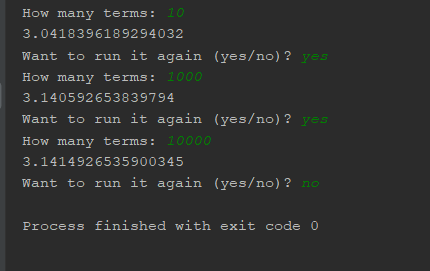
- Add methods which do calculations based on the pi attribute to the class which you wrote above.
- Modify your program module so that it demonstrates those new class methods. Be sure to correct any issues found with Homework 3
Homework Answers
class Leibniz:
    def __init__(self):
        self.total = 0

    def calculate_pi(self, n):
        self.total, sign = 0, 1
        for i in range(n):
            term = 1 / (2 * i + 1)
            self.total += term * sign
            sign *= -1
        self.total *= 4
        return self.total


class Main_Calc:
    choice = "yes"
    while choice != "no":
        try:
            n = int(input("How many terms: "))
            Object_pi = Leibniz()
            print(Object_pi.calculate_pi(n))
            choice = input("Want to run it again (yes/no)? ")
        except:
            print("Enter the Integer")


if __name__ == "__main__":
    Call_class = Main_Calc()
Add Answer to:
class Leibniz:
def __init__(self):
self.total=0
def calculate_pi(self,n):
...
Code Example 14-3 class Multiplier: def __init__(self): self.num1 = 0 self.num2 = 0 def...
Code Example 14-3 class Multiplier: def __init__(self): self.num1 = 0 self.num2 = 0 def getProduct(self): return self.num1 * self.num2 def main(): m = Multiplier() m.num1 = 7 m.num2 = 3 print(m.num1, "X", m.num2, "=", m.getProduct()) if __name__ == "__main__": main() Refer to Code Example 14-3: When this code is executed, what does it print to the console? a. 7 X 3 = 0 b. 3 X 7 = 0 c. 7 X 3...
Code Example 14-2 class Die: def __init__(self): self.__value = 1 def getValue(self): return self.__value def...
Code Example 14-2 class Die: def __init__(self): self.__value = 1 def getValue(self): return self.__value def roll(self): self.__value = random.randrange(1, 7) Refer to Code Example 14-2: Given a Die object named die, which of the following will print the value of the __value attribute to the console? a. print(die.getValue()) b. print(die.roll()) c. print(die.value) d. print(die.__value) To prevent another programmer from directly accessing the attributes of an object, you use a. instantiation b. composition ...
Take the class Person. class Person: """Person class""" def __init__(self, lname, fname, addy=''): self._last_name = lname...
Take the class Person. class Person: """Person class""" def __init__(self, lname, fname, addy=''): self._last_name = lname self._first_name = fname self._address = addy def display(self): return self._last_name + ", " + self._first_name + ":" + self._address Implement derived class Student In the constructor Add attribute major, default value 'Computer Science' Add attribute gpa, default value '0.0' Add attribute student_id, not optional Consider all private Override method display() Test your code with the following driver: # Driver my_student = Student(900111111, 'Song', 'River')...
Write a class called TemperatureFile. • The class has one data attribute: __filename • Write get...
Write a class called TemperatureFile. • The class has one data attribute: __filename • Write getter and setter for the data attribute. • Write a “calculateAverage” function (signature below) to calculate and return average temperature of all temperatures in the file. def calculateAverage(self): • Handle possible exceptions Write a main function: • Create a file ('Temperatures.txt’) and then use “write” method to write temperature values on each line. • Create an object of the TemperaureFile with the filename (‘Temperatures.txt’) just...
PYTHON -------------------------------------------------------- class LinkedList: def __init__(self): self.__head = None self.__tail = None
 PYTHON
--------------------------------------------------------
class LinkedList:
def __init__(self):
self.__head = None
self.__tail = None
self.__size = 0
# Return the head element in the list
def getFirst(self):
if self.__size ==
0:
return
None
else:
return
self.__head.element
# Return the last element in the list
def getLast(self):
if self.__size ==
0:
return
None
else:
return
self.__tail.element
# Add an element to the beginning of the
list
def addFirst(self, e):
newNode = Node(e) #
Create a new node
newNode.next =
self.__head # link...
PYTHON
--------------------------------------------------------
class LinkedList:
def __init__(self):
self.__head = None
self.__tail = None
self.__size = 0
# Return the head element in the list
def getFirst(self):
if self.__size ==
0:
return
None
else:
return
self.__head.element
# Return the last element in the list
def getLast(self):
if self.__size ==
0:
return
None
else:
return
self.__tail.element
# Add an element to the beginning of the
list
def addFirst(self, e):
newNode = Node(e) #
Create a new node
newNode.next =
self.__head # link...
in python and according to this #Creating class for stack class My_Stack: def __init__(self): self.items = [] def isEmpty(self): return self.items == [] def Push(self, d): self.items.append(d) def Po...
 in
python and according to this
#Creating class for stack
class My_Stack:
def __init__(self):
self.items = []
def isEmpty(self):
return self.items == []
def Push(self, d):
self.items.append(d)
def Pop(self):
return self.items.pop()
def Display(self):
for i in reversed(self.items):
print(i,end="")
print()
s = My_Stack()
#taking input from user
str = input('Enter your string for palindrome checking:
')
n= len(str)
#Pushing half of the string into stack
for i in range(int(n/2)):
s.Push(str[i])
print("S",end="")
s.Display()
s.Display()
#for the next half checking the upcoming string...
in
python and according to this
#Creating class for stack
class My_Stack:
def __init__(self):
self.items = []
def isEmpty(self):
return self.items == []
def Push(self, d):
self.items.append(d)
def Pop(self):
return self.items.pop()
def Display(self):
for i in reversed(self.items):
print(i,end="")
print()
s = My_Stack()
#taking input from user
str = input('Enter your string for palindrome checking:
')
n= len(str)
#Pushing half of the string into stack
for i in range(int(n/2)):
s.Push(str[i])
print("S",end="")
s.Display()
s.Display()
#for the next half checking the upcoming string...
In python class Customer: def __init__(self, customer_id, last_name, first_name, phone_number, address): self._customer_id = int(customer_id) self._last_name =...
In python class Customer: def __init__(self, customer_id, last_name, first_name, phone_number, address): self._customer_id = int(customer_id) self._last_name = str(last_name) self._first_name = str(first_name) self._phone_number = str(phone_number) self._address = str(address) def display (self): return str(self._customer_id) + ", " + self._first_name + self._last_name + "\n" + self._phone_number + "\n" + self._address customer_one = Customer("694", "Abby", "Boat", "515-555-4289", "123 Bobby Rd", ) print(customer_one.display()) customer_two = Customer ("456AB", "Scott", "James", "515-875-3099", "23 Sesame Street Brooklyn, NY 11213") print(customer_two.display()) Use Customer class remove the address attribute.Place the code...
ill thumb up do your best python3 import random class CardDeck: class Card: def __init__(self, value):...
 ill thumb up do your best
python3
import random
class CardDeck:
class Card:
def __init__(self, value):
self.value = value
self.next = None
def __repr__(self):
return "{}".format(self.value)
def __init__(self):
self.top = None
def shuffle(self):
card_list = 4 * [x for x in range(2, 12)] + 12 * [10]
random.shuffle(card_list)
self.top = None
for card in card_list:
new_card = self.Card(card)
new_card.next = self.top
self.top = new_card
def __repr__(self):
curr = self.top
out = ""
card_list = []
while curr is not None:...
ill thumb up do your best
python3
import random
class CardDeck:
class Card:
def __init__(self, value):
self.value = value
self.next = None
def __repr__(self):
return "{}".format(self.value)
def __init__(self):
self.top = None
def shuffle(self):
card_list = 4 * [x for x in range(2, 12)] + 12 * [10]
random.shuffle(card_list)
self.top = None
for card in card_list:
new_card = self.Card(card)
new_card.next = self.top
self.top = new_card
def __repr__(self):
curr = self.top
out = ""
card_list = []
while curr is not None:...
class Population: def __init__(self, m=0, n=0, k=0): # 1 self.m = m self.n = n self.k...
class Population: def __init__(self, m=0, n=0, k=0): # 1 self.m = m self.n = n self.k = k self.encounter = 0 bac = [] bac = bac + [1] * self.m + [2] * self.n + [3] * self.k self.bac = bac def plasmids(self): # 2 set = (self.m, self.n, self.k) return set def __str__(self): # 3 return "type I: {}, type II: {}, type III: {} (after {} encounters)".format(self.m, self.n, self.k, self.encounter) def __repr__(self): # 4 return "Population({}, {},...
COMPLETE THE _CONSTRUCT() AND CONSTRUCTTREE() FUNCTIONS class expressionTree: class treeNode: def __init__(self, value, lchild, rchild):...
COMPLETE THE _CONSTRUCT() AND CONSTRUCTTREE() FUNCTIONS class expressionTree: class treeNode: def __init__(self, value, lchild, rchild): self.value, self.lchild, self.rchild = value, lchild, rchild def __init__(self): self.treeRoot = None #utility functions for constructTree def mask(self, s): nestLevel = 0 masked = list(s) for i in range(len(s)): if s[i]==")": nestLevel -=1 elif s[i]=="(": nestLevel += 1 if nestLevel>0 and not (s[i]=="(" and nestLevel==1): masked[i]=" " return "".join(masked) def isNumber(self, expr): mys=s.strip() if len(mys)==0 or not isinstance(mys, str): print("type mismatch error: isNumber")...
 PYTHON
--------------------------------------------------------
class LinkedList:
def __init__(self):
self.__head = None
self.__tail = None
self.__size = 0
# Return the head element in the list
def getFirst(self):
if self.__size ==
0:
return
None
else:
return
self.__head.element
# Return the last element in the list
def getLast(self):
if self.__size ==
0:
return
None
else:
return
self.__tail.element
# Add an element to the beginning of the
list
def addFirst(self, e):
newNode = Node(e) #
Create a new node
newNode.next =
self.__head # link...
PYTHON
--------------------------------------------------------
class LinkedList:
def __init__(self):
self.__head = None
self.__tail = None
self.__size = 0
# Return the head element in the list
def getFirst(self):
if self.__size ==
0:
return
None
else:
return
self.__head.element
# Return the last element in the list
def getLast(self):
if self.__size ==
0:
return
None
else:
return
self.__tail.element
# Add an element to the beginning of the
list
def addFirst(self, e):
newNode = Node(e) #
Create a new node
newNode.next =
self.__head # link...
 in
python and according to this
#Creating class for stack
class My_Stack:
def __init__(self):
self.items = []
def isEmpty(self):
return self.items == []
def Push(self, d):
self.items.append(d)
def Pop(self):
return self.items.pop()
def Display(self):
for i in reversed(self.items):
print(i,end="")
print()
s = My_Stack()
#taking input from user
str = input('Enter your string for palindrome checking:
')
n= len(str)
#Pushing half of the string into stack
for i in range(int(n/2)):
s.Push(str[i])
print("S",end="")
s.Display()
s.Display()
#for the next half checking the upcoming string...
in
python and according to this
#Creating class for stack
class My_Stack:
def __init__(self):
self.items = []
def isEmpty(self):
return self.items == []
def Push(self, d):
self.items.append(d)
def Pop(self):
return self.items.pop()
def Display(self):
for i in reversed(self.items):
print(i,end="")
print()
s = My_Stack()
#taking input from user
str = input('Enter your string for palindrome checking:
')
n= len(str)
#Pushing half of the string into stack
for i in range(int(n/2)):
s.Push(str[i])
print("S",end="")
s.Display()
s.Display()
#for the next half checking the upcoming string...
 ill thumb up do your best
python3
import random
class CardDeck:
class Card:
def __init__(self, value):
self.value = value
self.next = None
def __repr__(self):
return "{}".format(self.value)
def __init__(self):
self.top = None
def shuffle(self):
card_list = 4 * [x for x in range(2, 12)] + 12 * [10]
random.shuffle(card_list)
self.top = None
for card in card_list:
new_card = self.Card(card)
new_card.next = self.top
self.top = new_card
def __repr__(self):
curr = self.top
out = ""
card_list = []
while curr is not None:...
ill thumb up do your best
python3
import random
class CardDeck:
class Card:
def __init__(self, value):
self.value = value
self.next = None
def __repr__(self):
return "{}".format(self.value)
def __init__(self):
self.top = None
def shuffle(self):
card_list = 4 * [x for x in range(2, 12)] + 12 * [10]
random.shuffle(card_list)
self.top = None
for card in card_list:
new_card = self.Card(card)
new_card.next = self.top
self.top = new_card
def __repr__(self):
curr = self.top
out = ""
card_list = []
while curr is not None:...
Most questions answered within 3 hours.
-
Where is the error in this code sequence?
String s1 = "Hello";
String s2 = "ello";...
asked 11 months ago -
Financial data for Joel de Paris, Inc., for last year
follow:
Joel de Paris, Inc.
Balance...
asked 11 months ago -
Consider this reaction:
Al2(SO4)3 (aq)+ BaCl3
(aq) Al2Cl6 (aq)- +
3BaSO4(s) . What is the...
asked 11 months ago -
Suppose that Savneet is considering increasing her
recent random sample from 20 car rentals to 40...
asked 11 months ago -
Trucks arrive at an unloading terminal at an average rate of 120
per hour.
Trucks arrive...
asked 11 months ago -
Why are methanol and ethanol completely soluble in water while
octanol is not very little soluble....
asked 11 months ago -
A facilities manager at a university reads in a research report
that the mean amount of...
asked 11 months ago -
When the CuSO4 is rehydrated by adding water to the anhydrous
compound, is this an endothermic...
asked 11 months ago -
A ray of sunlight is passing from diamond into crown glass; the
angle of incidence is...
asked 11 months ago -
A block of mass 0.249 kg is placed on top of a light, vertical
spring of...
asked 11 months ago -
how do the kidneys compensate in the presences of acidosis
a) trigger hyperventilate
b) reserve acid...
asked 11 months ago -
Question 501 pts
The rental rate of capital to the firm increases. Which of the
following...
asked 11 months ago