1. Are dimethyl maleate and dimethyl fumarate constitutional isomers or geometric isomers? Explain. 2. Why are...
1. Are dimethyl maleate and dimethyl fumarate constitutional isomers or geometric isomers? Explain.
2. Why are the melting points and boiling points different for dimethyl maleate and dimethyl fumarate?
3. What two methods could be used to purify the dimethyl fumarate?
Homework Answers
Ans:
Constitutional isomers (Structural isomers): are compounds with the same molecular formula and different structures
Geometrical isomers: are compounds with the same molecular formula, same structure but different spatial arrangements due to the restricted rotation; may be across a double bond.
Ans 1:
Dimethyl maleate and dimethyl fumarate are geometrical isomers as can be seen clearly from their structures below.
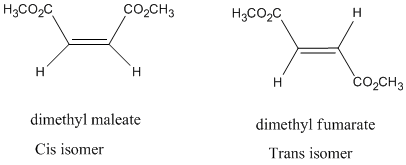
Dimethyl maleate is a cis isomer and dimethyl fumarate is a trans isomer.
Ans 2:
Because of their different spatial arrangements, dipole moment of these two molecules differ. As a result, they possess different boiling and melting point irrespective of the same connectivity.
In cis- trans geometrical isomers, usually cis will have larger dipole moment than trans isomer.
Dipole moment of dimethyl maleate > Dipole moment of dimethyl fumarate.
BP of dimethyl maleate (204 oC) > BP of dimethyl fumarate (193 oC)
Ans 3:
Since BP of dimethyl fumarate is 193 oC, distillation under reduced pressure (vacuum distillation) is one of the methods to purify.
Column chromatography is another method to purify dimethyl fumarate.
Add Answer to:
1. Are dimethyl maleate and dimethyl fumarate constitutional
isomers or geometric isomers? Explain.
2. Why are...
What two methods could be used to purify the dimethyl fumarate? Based on the 12 Principles...
What two methods could be used to purify the dimethyl fumarate? Based on the 12 Principles of Green Chemistry posted in the Green Chemistry Module, list 3 principles that are used in this experiment. The experiment: Isomers and Isomerization B: Isomerization of Dimethyl Maleate
Explain why dimethyl maleate is converted in high yield to dimethyl fumarate under the conditions you...
 Explain why dimethyl maleate is converted in high yield to
dimethyl fumarate under the conditions you used. Use thermodynamic
and kinetic arguments to justify your answer.
How does the reaction preformed relate to the isomerization of
retinal in the human eye (which enables vision).
Primer: A major topic covered in the second half of Organic I is the properties and reactivity of alkenes. This lab experiment will provide you with an opportunity to examine alkene reactivity by conducting an isomerization...
Explain why dimethyl maleate is converted in high yield to
dimethyl fumarate under the conditions you used. Use thermodynamic
and kinetic arguments to justify your answer.
How does the reaction preformed relate to the isomerization of
retinal in the human eye (which enables vision).
Primer: A major topic covered in the second half of Organic I is the properties and reactivity of alkenes. This lab experiment will provide you with an opportunity to examine alkene reactivity by conducting an isomerization...
The following two molecules are: different (not isomers) geometric isomers constitutional structural) isomers conformers Question 23...
 The following two molecules are: different (not isomers) geometric isomers constitutional structural) isomers conformers Question 23 Which statement is correct about the bonds in the following molecule? H-C-0-1 The oxygen carries a partial positive charge. none of the above The hydrogen bound to the oxygen carries a partial positive charge. The carbon carries a partial negative charge DELL
7. Diethyl ether and 1-butanol are isomers their boiling points are very different. Explain why these...
 7. Diethyl ether and 1-butanol are isomers their boiling points are very different. Explain why these two compounds have dramatically different boiling points. (2 pt.) CH3CH2OCH CH3 CH3CH2CH2CH OH Diethyl ether butanol
I. The constitutional isomers with molecular formula CaH 69°C have boiling points of 50°C, 58°C, 60°C,...
 I. The constitutional isomers with molecular formula CaH 69°C have boiling points of 50°C, 58°C, 60°C, 63°C, and 1. Calculate the unsaturation number for the molecular formula CeH4 2.Which molecular classes (alkane, alkene, alkyne, cycloalkane) unsaturationnumber and the molecular forrmula? 3. Draw the constitutional isomers of C H14. Identify the structural class and functional groups present. 4. Match the constitutional isomers you have drawn to the boiling points provided above. Explain your are consistent with both the rationale.
Answer the following questions: 1. In terms of structure, how are geometric isomers different from structural...
Answer the following questions: 1. In terms of structure, how are geometric isomers different from structural isomers? 2. In what kind of compounds can geometric isomers exist? 3. What is the property of sigma bonds that cause a molecule to have different conformations? 4. What three types of formulas are used to represent different conformation? 5. What is the characteristic of a chiral object? 6. What are enantiomers? 7. What kind of molecules have enantiomers, chiral or achiral? 8. Of...
And explain why? 3. Which pair of the following compounds are constitutional isomers? III IV I...
 And explain why?
3. Which pair of the following compounds are constitutional isomers? III IV I and II II and III III and IV I and IV
And explain why?
3. Which pair of the following compounds are constitutional isomers? III IV I and II II and III III and IV I and IV
Monochlorination of butane gives two constitutional isomers: 1-chlorobutane and 2-chlorobutane. Dichlorination of butane yields six constitutional...
 Monochlorination of butane gives two constitutional isomers:
1-chlorobutane and 2-chlorobutane. Dichlorination of butane yields
six constitutional isomers. Four of these six isomers are drawn
below. Draw the structures of the two missing isomers.
Monochlorination of butane gives two constitutional isomers:
1-chlorobutane and 2-chlorobutane. Dichlorination of butane yields
six constitutional isomers. Four of these six isomers are drawn
below. Draw the structures of the two missing isomers.
Which can have cis/trans isomers? and why? (1). 1,2,3-trimethylcyclopropane (2.) 1,2-dimethylbenzene (3.) 2,3-dimethyl-4-decene
Which can have cis/trans isomers? and why? (1). 1,2,3-trimethylcyclopropane (2.) 1,2-dimethylbenzene (3.) 2,3-dimethyl-4-decene
1. How many constitutional Date: utional isomers are possible for the formula CH? 2. The IUPAC...
 1. How many constitutional Date: utional isomers are possible for the formula CH? 2. The IUPAC name for A) 6-Ethyl-3,4-dimethylheptane B) 2-Ethyl-4,5-dimethylheptane (C) 3,4,6-Trimethyloctane D) 3,5,6-Trimethyloctane E) 2-(1-Methylpropyl)-4-methylhexane 3. Isopentyl is the common name for which alkyl group? CH3CH,CH,CH- A) CH3 B) CH3CH2CHCH2- CH CH,CHCH,CH- CH; CH3CH2CH- CH.CH CH CH3CCH,— D) E) CH Write structural formula for each of the following (b) 2,2-Dimethyl-3-ethylheptane (a) Neopentyl bromide (c) 4-Methyl-2-penten-2-ol (e) 1,4-Dicyclopropylcyclohexane (d) trans-4-7-Butylcyclohexanol (1) Bicylo[3,1,1 Jheptane Give IUPAC Name for each...
 Explain why dimethyl maleate is converted in high yield to
dimethyl fumarate under the conditions you used. Use thermodynamic
and kinetic arguments to justify your answer.
How does the reaction preformed relate to the isomerization of
retinal in the human eye (which enables vision).
Primer: A major topic covered in the second half of Organic I is the properties and reactivity of alkenes. This lab experiment will provide you with an opportunity to examine alkene reactivity by conducting an isomerization...
Explain why dimethyl maleate is converted in high yield to
dimethyl fumarate under the conditions you used. Use thermodynamic
and kinetic arguments to justify your answer.
How does the reaction preformed relate to the isomerization of
retinal in the human eye (which enables vision).
Primer: A major topic covered in the second half of Organic I is the properties and reactivity of alkenes. This lab experiment will provide you with an opportunity to examine alkene reactivity by conducting an isomerization...
 The following two molecules are: different (not isomers) geometric isomers constitutional structural) isomers conformers Question 23 Which statement is correct about the bonds in the following molecule? H-C-0-1 The oxygen carries a partial positive charge. none of the above The hydrogen bound to the oxygen carries a partial positive charge. The carbon carries a partial negative charge DELL
 7. Diethyl ether and 1-butanol are isomers their boiling points are very different. Explain why these two compounds have dramatically different boiling points. (2 pt.) CH3CH2OCH CH3 CH3CH2CH2CH OH Diethyl ether butanol
 I. The constitutional isomers with molecular formula CaH 69°C have boiling points of 50°C, 58°C, 60°C, 63°C, and 1. Calculate the unsaturation number for the molecular formula CeH4 2.Which molecular classes (alkane, alkene, alkyne, cycloalkane) unsaturationnumber and the molecular forrmula? 3. Draw the constitutional isomers of C H14. Identify the structural class and functional groups present. 4. Match the constitutional isomers you have drawn to the boiling points provided above. Explain your are consistent with both the rationale.
 And explain why?
3. Which pair of the following compounds are constitutional isomers? III IV I and II II and III III and IV I and IV
And explain why?
3. Which pair of the following compounds are constitutional isomers? III IV I and II II and III III and IV I and IV
 Monochlorination of butane gives two constitutional isomers:
1-chlorobutane and 2-chlorobutane. Dichlorination of butane yields
six constitutional isomers. Four of these six isomers are drawn
below. Draw the structures of the two missing isomers.
Monochlorination of butane gives two constitutional isomers:
1-chlorobutane and 2-chlorobutane. Dichlorination of butane yields
six constitutional isomers. Four of these six isomers are drawn
below. Draw the structures of the two missing isomers.
 1. How many constitutional Date: utional isomers are possible for the formula CH? 2. The IUPAC name for A) 6-Ethyl-3,4-dimethylheptane B) 2-Ethyl-4,5-dimethylheptane (C) 3,4,6-Trimethyloctane D) 3,5,6-Trimethyloctane E) 2-(1-Methylpropyl)-4-methylhexane 3. Isopentyl is the common name for which alkyl group? CH3CH,CH,CH- A) CH3 B) CH3CH2CHCH2- CH CH,CHCH,CH- CH; CH3CH2CH- CH.CH CH CH3CCH,— D) E) CH Write structural formula for each of the following (b) 2,2-Dimethyl-3-ethylheptane (a) Neopentyl bromide (c) 4-Methyl-2-penten-2-ol (e) 1,4-Dicyclopropylcyclohexane (d) trans-4-7-Butylcyclohexanol (1) Bicylo[3,1,1 Jheptane Give IUPAC Name for each...
Most questions answered within 3 hours.
-
Where is the error in this code sequence?
String s1 = "Hello";
String s2 = "ello";...
asked 11 months ago -
Financial data for Joel de Paris, Inc., for last year
follow:
Joel de Paris, Inc.
Balance...
asked 11 months ago -
Consider this reaction:
Al2(SO4)3 (aq)+ BaCl3
(aq) Al2Cl6 (aq)- +
3BaSO4(s) . What is the...
asked 11 months ago -
Suppose that Savneet is considering increasing her
recent random sample from 20 car rentals to 40...
asked 11 months ago -
Trucks arrive at an unloading terminal at an average rate of 120
per hour.
Trucks arrive...
asked 11 months ago -
Why are methanol and ethanol completely soluble in water while
octanol is not very little soluble....
asked 11 months ago -
A facilities manager at a university reads in a research report
that the mean amount of...
asked 11 months ago -
When the CuSO4 is rehydrated by adding water to the anhydrous
compound, is this an endothermic...
asked 11 months ago -
A ray of sunlight is passing from diamond into crown glass; the
angle of incidence is...
asked 11 months ago -
A block of mass 0.249 kg is placed on top of a light, vertical
spring of...
asked 11 months ago -
how do the kidneys compensate in the presences of acidosis
a) trigger hyperventilate
b) reserve acid...
asked 11 months ago -
Question 501 pts
The rental rate of capital to the firm increases. Which of the
following...
asked 11 months ago