3) Suppose that you know the top a fence is exactly 7 meters above the ground....
3) Suppose that you know the top a fence is exactly 7 meters above the ground. At some distance from the fence, you approximate the angle between the ground and the top of the fence is 25 degrees. Then you walk in the -x direction for 1.7 seconds closer to the fence, and the angle increases to 56 degrees. Then, immediately, you walk in the opposite direction for some time and the angle decreases to 49 degrees. If the average velocity is 1.6 m/s in the -x direction, how long did you walk, in seconds, in the last part of the "trip"?
Homework Answers
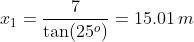
The initial point is
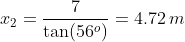
The second position is
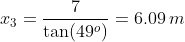
The third position is
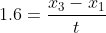
The average speed is
The total spend walking is

The time spent in the last part of the trip is

Answer is 3.88 s
Add Answer to:
3) Suppose that you know the top a fence is exactly 7 meters
above the ground....
A 29-kgkg child jumps to the ground from the top of a fence that is 1.6...
A 29-kgkg child jumps to the ground from the top of a fence that is 1.6 mm high. You analyze the problem using upward as the positive x direction. Taking xx = 0 to be at the bottom of the fence, what are the initial potential energy of the child-Earth system and the change in the system kinetic energy during the jump?Enter your answers numerically separated by a comma. Repeat the previous part for xx = 0 at the top...
Suppose you walk 13.5 m in a d rection exactly 24° south of west then you walk 195 m in a d rection exactly 42° west of north.
Suppose you walk 13.5 m in a d rection exactly 24° south of west then you walk 195 m in a d rection exactly 42° west of north.Part (a) How far are you from your starting point, in meters?Part (b) What is the angle of the compass direction of a line connecting your starting point to your final position measured North of West in degrees?
(18 %) Problem 3: west of north Suppose you walk 11 m in a direction exactly...
 (18 %) Problem 3: west of north Suppose you walk 11 m in a direction exactly 25° south of west then you walk 18 m in a direction exactly 44° 25% Part (a) How far are you from your starting point in m? R- 19.26 X Attempts Remain × 25% Part (b) What is the angle of the compass direction of a line connecting your starting point to your final position measured North of West in degrees? Grade Summary Deductions...
A batter hits a baseball 3 feet above the ground toward the center field fence, which...
 A batter hits a baseball 3 feet above the ground toward the center field fence, which is 10 1. feet high and 400 feet from home plate (where the batter stands when he hits the ball). The bal leaves the bat with a speed of 115 ft/s at an angle of 50° above the horizontal. Is it a home run? That is, does the ball clear the fence? You do not need to derive the formulas for projectile motion from...
At a height h = 44.0 m above the ground a rocket is fired at an...
At a height h = 44.0 m above the ground a rocket is fired at an initial speed v0 = 168.0 m/s at an angle θ = 27 degrees above the horizontal. Ignore air resistance. The magnitude of the gravitational acceleration is 9.8 m/s2. Choose the RIGHT as positive x-direction. Choose UPWARD as psotitive y-direction. Keep 2 decimal places in all answers (a) Find v0x, the x component of the initial velocity (in m/s) (b) Find v0y, the y component...
1. An airplane leaves airport A and travels in a straight line in a direction 30...
1. An airplane leaves airport A and travels in a straight line in a direction 30 degrees East of North at a constant speed of 300km/hr for 40 minutes, then it abruptly changes its direction to 25 degrees South of East and now travels at a constant velocity of 200km/hr for 30 minutes, and finally it abruptly heads directly South and travels at a velocity of 300km/hr for 60 minutes before landing at airport B. (a) calculate the distance, D,...
Solve exactly if possible. Express all decimals to 4 significant figures. 1) 2) 3) 4) 5)...
 Solve exactly if possible. Express all decimals to 4 significant figures. 1) 2) 3) 4) 5) 6) 7) What are Newton's Laws of motion? What is a "frame of reference"? What is a coordinate system? Express the point x-3, y-4 using polar coordinates. What is the SI unit for force? How is it defined using SI base units? What are the four fundamental forces in the universe? What is the approximate gravitational acceleration, g, near the Earth's surface? If this...
IlI. A SMOOTH ACCELERATING PLANE An smooth plane is inclined from the horizantal at angle of...
 IlI. A SMOOTH ACCELERATING PLANE An smooth plane is inclined from the horizantal at angle of 0 as shown. (Assume for now that 0- 70 degrees.) A mass m is placed at the top of the inclined plane and allowed to slide downwards (friction is negligible). At some point during the mass's trip. however, the plane begins to accelerate to the right at a rate of a, causing the mass to stop sliding on the plane. How/why does it stop...
1-1 Suppose you want to make a scale model of a hydrogen atom. You choose, for...
1-1 Suppose you want to make a scale model of a hydrogen atom. You choose, for the nucleus, a small ball bearing with a radius of 1.5 mm. The radius of the hydrogen atom is 0.529 × 10⁻¹⁰ m and the radius of the nucleus is 1.2 × 10⁻¹⁵ m. (a) What would be the radius of the model? (b) Suppose that now you want to make a scale model of the solar system using the same ball bearing as...
Please let me know questions 3 through 9. 1. Show all the atepa neceasary to convert...
 Please let me know questions 3
through 9.
1. Show all the atepa neceasary to convert 2.00 kilometera into milea atarting from 2.54 cm 1 inch. Explicitly ahow how the intermediate unita divide out in the converaion. 2. A poaition veotor ia alwaya drawn with ita tail at the origin. It haa unita of length and it locatea a point in a choaen coordinate ayatem. A diaplacement veotor ia drawn with ita tail anywhere in the coordinate apace. Diaplacement vectora...
Please let me know questions 3
through 9.
1. Show all the atepa neceasary to convert 2.00 kilometera into milea atarting from 2.54 cm 1 inch. Explicitly ahow how the intermediate unita divide out in the converaion. 2. A poaition veotor ia alwaya drawn with ita tail at the origin. It haa unita of length and it locatea a point in a choaen coordinate ayatem. A diaplacement veotor ia drawn with ita tail anywhere in the coordinate apace. Diaplacement vectora...
 (18 %) Problem 3: west of north Suppose you walk 11 m in a direction exactly 25° south of west then you walk 18 m in a direction exactly 44° 25% Part (a) How far are you from your starting point in m? R- 19.26 X Attempts Remain × 25% Part (b) What is the angle of the compass direction of a line connecting your starting point to your final position measured North of West in degrees? Grade Summary Deductions...
 A batter hits a baseball 3 feet above the ground toward the center field fence, which is 10 1. feet high and 400 feet from home plate (where the batter stands when he hits the ball). The bal leaves the bat with a speed of 115 ft/s at an angle of 50° above the horizontal. Is it a home run? That is, does the ball clear the fence? You do not need to derive the formulas for projectile motion from...
 Solve exactly if possible. Express all decimals to 4 significant figures. 1) 2) 3) 4) 5) 6) 7) What are Newton's Laws of motion? What is a "frame of reference"? What is a coordinate system? Express the point x-3, y-4 using polar coordinates. What is the SI unit for force? How is it defined using SI base units? What are the four fundamental forces in the universe? What is the approximate gravitational acceleration, g, near the Earth's surface? If this...
 IlI. A SMOOTH ACCELERATING PLANE An smooth plane is inclined from the horizantal at angle of 0 as shown. (Assume for now that 0- 70 degrees.) A mass m is placed at the top of the inclined plane and allowed to slide downwards (friction is negligible). At some point during the mass's trip. however, the plane begins to accelerate to the right at a rate of a, causing the mass to stop sliding on the plane. How/why does it stop...
 Please let me know questions 3
through 9.
1. Show all the atepa neceasary to convert 2.00 kilometera into milea atarting from 2.54 cm 1 inch. Explicitly ahow how the intermediate unita divide out in the converaion. 2. A poaition veotor ia alwaya drawn with ita tail at the origin. It haa unita of length and it locatea a point in a choaen coordinate ayatem. A diaplacement veotor ia drawn with ita tail anywhere in the coordinate apace. Diaplacement vectora...
Please let me know questions 3
through 9.
1. Show all the atepa neceasary to convert 2.00 kilometera into milea atarting from 2.54 cm 1 inch. Explicitly ahow how the intermediate unita divide out in the converaion. 2. A poaition veotor ia alwaya drawn with ita tail at the origin. It haa unita of length and it locatea a point in a choaen coordinate ayatem. A diaplacement veotor ia drawn with ita tail anywhere in the coordinate apace. Diaplacement vectora...
Most questions answered within 3 hours.
-
Where is the error in this code sequence?
String s1 = "Hello";
String s2 = "ello";...
asked 11 months ago -
Financial data for Joel de Paris, Inc., for last year
follow:
Joel de Paris, Inc.
Balance...
asked 11 months ago -
Consider this reaction:
Al2(SO4)3 (aq)+ BaCl3
(aq) Al2Cl6 (aq)- +
3BaSO4(s) . What is the...
asked 11 months ago -
Suppose that Savneet is considering increasing her
recent random sample from 20 car rentals to 40...
asked 11 months ago -
Trucks arrive at an unloading terminal at an average rate of 120
per hour.
Trucks arrive...
asked 11 months ago -
Why are methanol and ethanol completely soluble in water while
octanol is not very little soluble....
asked 11 months ago -
A facilities manager at a university reads in a research report
that the mean amount of...
asked 11 months ago -
When the CuSO4 is rehydrated by adding water to the anhydrous
compound, is this an endothermic...
asked 11 months ago -
A ray of sunlight is passing from diamond into crown glass; the
angle of incidence is...
asked 11 months ago -
A block of mass 0.249 kg is placed on top of a light, vertical
spring of...
asked 11 months ago -
how do the kidneys compensate in the presences of acidosis
a) trigger hyperventilate
b) reserve acid...
asked 11 months ago -
Question 501 pts
The rental rate of capital to the firm increases. Which of the
following...
asked 11 months ago