Calculate the maximum work that could be performed by 2 moles of an ideal gas undergoing...
Calculate the maximum work that could be performed by 2 moles of an ideal gas undergoing a reversible adiabatic expansion from 103 cm to 1003cm.
Must combine the 1st law of thermodynamics and the ideal gas equation .
Thanks
Homework Answers
Given data
Number of moles of gas (n) = 2 moles
initial volume V1= 103 cm3
final volume v2 = 1003
ideal gas equation is given as PV=nRT
As temprature is not given T= 298 k (standard)
Gas constant R = 8.314 J/K
According to firs law of thermodynamics
Internal enegy change U = heat supplied
to the system (q) + work done on the system (W)
U = heat supplied
to the system (q) + work done on the system (W)
in adiabatic process q = 0 =zero
Internal enegy change = 0 + w
now,
work done is given as W = P x (V2 - V1)
for adiabatic reversible condition It need to be integrated
taking PV= nRT
P=(n)RT/V
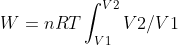
and it is Maximum Work given as
Wmax =- 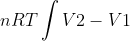
W max = -2.303 nRT logV2/V1
= -2.303*2*8.314*log 1003/103
= -2.303*2*8.314*log 9.738
= -2.303*2*8.314* 0.9885
W max = -37.854 J
If temprature is given put its value and calculate
Add Answer to:
Calculate the maximum work that could be performed by 2 moles of
an ideal gas undergoing...
Five moles of monatomic ideal gas have initial pressure 2.50 × 10³ Pa and initial volume...
Five moles of monatomic ideal gas have initial pressure 2.50 × 10³ Pa and initial volume 2.10 m3. While undergoing an adiabatic expansion, the gas does 1780 J of work. What is the final pressure of the gas after the expansion? (kPa)
Five moles of monatomic ideal gas have initial pressure 2.50 × 10³ Pa and initial volume...
Five moles of monatomic ideal gas have initial pressure 2.50 × 10³ Pa and initial volume 2.10 m3. While undergoing an adiabatic expansion, the gas does 1530 J of work. Part A What is the final pressure of the gas after the expansion? Units: kPa Units: kPa
Calculate the work necessary to isothermally perform steady compression of 2 moles of an ideal gas...
Calculate the work necessary to isothermally perform steady compression of 2 moles of an ideal gas from 1 bar to 10 bar and 311K in a piston. An isothermal process is one at constant Temperature. The steady compression of the gas should be performed such that the pressure of the system is always practically equal to the external pressure on the system. This is referred to as reversible compression.
Please give detailed explanation for final part. Thanks. Reversible adiabatic expansion of ideal gas (This question...
 Please give detailed explanation for final part. Thanks.
Reversible adiabatic expansion of ideal gas (This question involves working through the final section of lecture 3) Explain why the first Law for an reversible adiabatic process gives AU = -PdV, and why this equation doesn't hold for the Joule expansion. Assuming that for an ideal gas U = CVT, prove that the First Law leads to the statement that PVY is constant in a reversible adiabatic process. A container of Helium...
Please give detailed explanation for final part. Thanks.
Reversible adiabatic expansion of ideal gas (This question involves working through the final section of lecture 3) Explain why the first Law for an reversible adiabatic process gives AU = -PdV, and why this equation doesn't hold for the Joule expansion. Assuming that for an ideal gas U = CVT, prove that the First Law leads to the statement that PVY is constant in a reversible adiabatic process. A container of Helium...
Derive) A) the work done by n moles an ideal gas at temperature T in an...
Derive) A) the work done by n moles an ideal gas at temperature T in an isothermal expansion from V1 to V2 B) The entropy change of n moles of an ideal gas at Temperature T undergoing an isothermal expansion from V1 to V2
An ideal gas (1.82 moles) undergoes the following reversible Carnot cycle. (1) An isothermal expansion at...
An ideal gas (1.82 moles) undergoes the following reversible Carnot cycle. (1) An isothermal expansion at Thot=850K from 3.20L to 20.40L. (2) An adiabatic expansion until the temperature falls to 298K. The system then undergoes (3) an isothermal compression and a subsequent (4) adiabatic compression until the initial state is reached. a. Calculate work and ΔS for each step in the cycle and its overall efficiency. b. Determine ΔH and ΔU for steps (1) and (2). c. Explain why ΔUcycle=...
Ten. moles of ideal gas (monatomic), in the initial state P1=10atm, T1=300K are taken round the...
Ten. moles of ideal gas (monatomic), in the initial state P1=10atm, T1=300K are taken round the following cycle: a. A reversible isothermal expansion to V=246 liters, and b. A reversible adiabatic process to P=10 atm c. A reversible isobaric compression to V=24.6 liters Calculate the change of work (w), heat (q), internal energy (U), and entropy (S) of the system for each process?
Consider n moles of ideal gas kept in a heat-isolated cylinder (all processes are adiabatic) with...
Consider n moles of ideal gas kept in a heat-isolated cylinder (all processes are adiabatic) with a piston at external pressure p0, and at temperature T0. The external pressure is suddenly changed to p=2p0, and we wait for the system to equilibrate. The volume and the temperature of the ideal gas after equilibration is V and T, respectively. a) Calculate the amount w of work produced on the system in terms of p, p0, V, T0, and n. Using the...
Question 2: (a) Write down the equation for the work done by an expanding gas and...
 Question 2: (a) Write down the equation for the work done by an expanding gas and sketch this on a p-v diagram for a typical reversible process. [3 marks) (b) Starting from the first law of thermodynamics and the ideal gas law, show that for an isothermal expansion or compression of a gas, the process can be described by pv = constant. [5 marks] (c) Knowing that pv = constant for an isothermal process, derive the following equation for the...
1) Calculate q, w, Д ed--if 2.25 mol of an ideal gas with Cm 3R/2 undergoes...
 1) Calculate q, w, Д ed--if 2.25 mol of an ideal gas with Cm 3R/2 undergoes a reversible adiabatic expansion from an initial volume Vi - 5.50 m* to a final vol- ume Vf 25.0 m3. The initial temperature is 275 K.
 Please give detailed explanation for final part. Thanks.
Reversible adiabatic expansion of ideal gas (This question involves working through the final section of lecture 3) Explain why the first Law for an reversible adiabatic process gives AU = -PdV, and why this equation doesn't hold for the Joule expansion. Assuming that for an ideal gas U = CVT, prove that the First Law leads to the statement that PVY is constant in a reversible adiabatic process. A container of Helium...
Please give detailed explanation for final part. Thanks.
Reversible adiabatic expansion of ideal gas (This question involves working through the final section of lecture 3) Explain why the first Law for an reversible adiabatic process gives AU = -PdV, and why this equation doesn't hold for the Joule expansion. Assuming that for an ideal gas U = CVT, prove that the First Law leads to the statement that PVY is constant in a reversible adiabatic process. A container of Helium...
 Question 2: (a) Write down the equation for the work done by an expanding gas and sketch this on a p-v diagram for a typical reversible process. [3 marks) (b) Starting from the first law of thermodynamics and the ideal gas law, show that for an isothermal expansion or compression of a gas, the process can be described by pv = constant. [5 marks] (c) Knowing that pv = constant for an isothermal process, derive the following equation for the...
 1) Calculate q, w, Д ed--if 2.25 mol of an ideal gas with Cm 3R/2 undergoes a reversible adiabatic expansion from an initial volume Vi - 5.50 m* to a final vol- ume Vf 25.0 m3. The initial temperature is 275 K.
Most questions answered within 3 hours.
-
Where is the error in this code sequence?
String s1 = "Hello";
String s2 = "ello";...
asked 10 months ago -
Financial data for Joel de Paris, Inc., for last year
follow:
Joel de Paris, Inc.
Balance...
asked 10 months ago -
Consider this reaction:
Al2(SO4)3 (aq)+ BaCl3
(aq) Al2Cl6 (aq)- +
3BaSO4(s) . What is the...
asked 10 months ago -
Suppose that Savneet is considering increasing her
recent random sample from 20 car rentals to 40...
asked 10 months ago -
Trucks arrive at an unloading terminal at an average rate of 120
per hour.
Trucks arrive...
asked 10 months ago -
Why are methanol and ethanol completely soluble in water while
octanol is not very little soluble....
asked 10 months ago -
A facilities manager at a university reads in a research report
that the mean amount of...
asked 10 months ago -
When the CuSO4 is rehydrated by adding water to the anhydrous
compound, is this an endothermic...
asked 10 months ago -
A ray of sunlight is passing from diamond into crown glass; the
angle of incidence is...
asked 10 months ago -
A block of mass 0.249 kg is placed on top of a light, vertical
spring of...
asked 10 months ago -
how do the kidneys compensate in the presences of acidosis
a) trigger hyperventilate
b) reserve acid...
asked 10 months ago -
Question 501 pts
The rental rate of capital to the firm increases. Which of the
following...
asked 10 months ago