1. In the French town of Louisbourg, (now part of Nova Scotia), in 1757, the aggregate...
1. In the French town of Louisbourg, (now part of Nova Scotia),
in 1757, the aggregate production function per worker was y =
Ak^0.75. Louisbourg’s workers save a fraction, s, of their incomes,
so aggregate savings is given by S = sY.
1a. If the savings rate, population growth, depreciation rate and
productivity are: s = 0.25, n = 0.15, d = 0.10, A = 4, then what
was the steady-state capital-labour ratio k* and k^Golden. Given
k*, what are steady-state output per-worker, y*, steady-state
consumption perworker, c*, and steady-state investment per-worker,
i*? (No figure required) (9 Marks)
1b. The British captured Louisbourg and in 1760 destroyed part of
the buildings (capital) so k is now 100. Assuming this did not
impact A, n, s or d, how would your answer differ from 1a? Describe
and show calculations of what is occurring over time and link your
description to a figure. What would happen instead if the British
had built buildings and increased k to 400? (Figure does not have
to be to scale.) (10 Marks)
2. The production function for Canada in 2014 is Y= A(25N-2N^2) +
5N^2, where Y = Output, A = total factor productivity, N = labour
and K = capital.
i) Using calculus, derive an expression for aggregate labour demand (N^D). (3 points)
ii) If N^S = 50 + 0.125w, find the equilibrium wage, w* when A=2 and K=10. (3 points)
Homework Answers
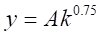
The equation for the production per worker is given as:
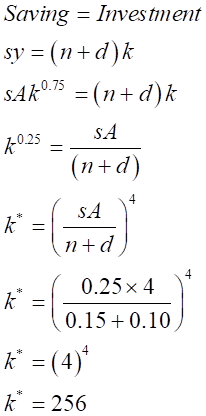
According to the Solow model, there is no change in the capital stock at the steady state equilibrium level.

At steady state equilibrium,
The condition for the golden rule level of the capital stock per worker is given as follows:
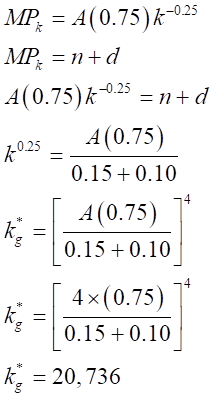
Thus, the value of the golden rule capital stock per worker is 20,736.
The steady state output per worker is determined by substituting the value of k in the production function equation. Thus, the value of steady state output per worker is determined as follows:

The consumption function equation is determined by taking the difference between income and the saving.

At steady state, the saving is equal to the investment.

Add Answer to:
1. In the French town of Louisbourg, (now part of Nova Scotia),
in 1757, the aggregate...
Questions: 1. In the French town of Louisbourg, (now part of Nova Scotia), in 1757, the...
 Questions: 1. In the French town of Louisbourg, (now part of Nova Scotia), in 1757, the aggregate production function per worker was y Ako 75 Louisbourg's workers save a fraction, s, of their incomes, so aggregate savings is given by S sY. 1a. If the savings rate, population growth, depreciation rate and productivity are: s 0.25 n 0.15, d 0.10, A 4, then what was the steady-state capital-labour ratio k* and kGolden Given k*, what are steady-state output per-worker, y*,...
Suppose that the aggregate production is given by , where Y is real GDP, K is...
 Suppose that the aggregate production is given by
, where Y is real GDP, K is the total capital stock and L is the
(constant) labour force. Assume that aggregate investment is equal
to aggregate savings and that the depreciation rate is 0.05, hence
the total capital stock evolves according to K=sY − 0.05K, where s
is the savings rate.
1) Under the stated assumptions for this question, what is the
steady-state level of capital per worker when the saving...
Suppose that the aggregate production is given by
, where Y is real GDP, K is the total capital stock and L is the
(constant) labour force. Assume that aggregate investment is equal
to aggregate savings and that the depreciation rate is 0.05, hence
the total capital stock evolves according to K=sY − 0.05K, where s
is the savings rate.
1) Under the stated assumptions for this question, what is the
steady-state level of capital per worker when the saving...
3 Growth Model Suppose that output (Y) in an economy is given by the following aggregate...
 3 Growth Model Suppose that output (Y) in an economy is given by the following aggregate production function: Y = K + NE where Kt is capital and Nt is the population. Furthermore, assume that capital depreciates at rate 8 and that savings is a constant proportion s of income. You may assume that 8 > S. 1. Suppose that the population remains constant. Solve for the steady-state level of capital per worker. 2. Now suppose that the population grows...
Section B (LONG QUESTIONS): Answer any THREE (3) of the following four ques tions. Each question...
 Section B (LONG QUESTIONS): Answer any THREE (3) of the following four ques tions. Each question is worth 25 marks for a total of 75 marks. B1. Solow (neoclassical) growth model: Consider the Solow (neoclassical) growth model seen in class where y denotes output per worker, k physical capital per worker, and A total factor productivity. Suppose that at any point in time the production function in per-worker terms is represented by where f(k) is increasing in k and there...
MALTHUS AND SOLOW GROWTH MODEL
Malthusian Model of Growth Notation: Yt Aggregate output; Nt Population size; L¯ Land (fixed); ct Per capita consumption Production: Aggregate production function is Yt = F(Nt , Lt) = zN2/3 t L 1/3 t Population Dynamics: Nt+1 = g(ct)Nt Population growth function: g(ct) = (3ct) 1/3 Parameter Values: Land: L¯ = 1000 for all t. Productivity parameter: z = 1 ...
Consider an economy described by the following Cobb-Douglas, constant-returns-to-scale, aggregate production function: Y (K, L)...
Consider an economy described by the following Cobb-Douglas, constant-returns-to-scale, aggregate production function: Y (K, L) = ?.??.? i.) Derive the per-capita/worker production function. ii.) Assume the depreciation rate (ɖ) is 1.5 percent, the population growth (n) is 4 percent, and the savings rate (s) is 8 percent; derive the discrete fundamental Solow Growth equation, and finally find the steady-state capital stock per-capita/worker (k*) and output per-capita/worker (y*). iii.) Assume the savings rate (s) rises to 16 percent, all else...
MALTHUSIAN MODEL
 Notation: Yt Aggregate output; Nt Population size; L¯ Land (fixed); ct Per capita consumptionAggregate production function is Yt = F(Nt
, Lt) = zN2/3
t L
1/3
t
Population Dynamics: Nt+1 = g(ct)Nt
Population growth function: g(ct) = (3ct)
1/3
Parameter Values: Land: L¯ = 1000 for all t. Productivity parameter: z = 1
(a) Solve for the steady state of this economy (Steady state: Nt+1 = Nt). Report steady
state values for c and N.
(b) Suppose the economy...
Notation: Yt Aggregate output; Nt Population size; L¯ Land (fixed); ct Per capita consumptionAggregate production function is Yt = F(Nt
, Lt) = zN2/3
t L
1/3
t
Population Dynamics: Nt+1 = g(ct)Nt
Population growth function: g(ct) = (3ct)
1/3
Parameter Values: Land: L¯ = 1000 for all t. Productivity parameter: z = 1
(a) Solve for the steady state of this economy (Steady state: Nt+1 = Nt). Report steady
state values for c and N.
(b) Suppose the economy...
d. Assume that the aggregate production function is given by: where Y is aggregate output, K is capital, L is the number of workers in the economy and E is the state of technology. Further assume...
 d. Assume that the aggregate production function is given by: where Y is aggregate output, K is capital, L is the number of workers in the economy and E is the state of technology. Further assume that capital depreciates at a rate of δ, the rate of technological progress is g, the population is growing at a rate of n and the saving rate is s. I5 marks] i. Determine the scale of production? Suppose capital is increased by a...
Q.2 Consider the Solow growth model. Suppose that F(K,N)=RºS No5 with d=0.1, s=0.2, n=0.01, and z=1...
 Q.2 Consider the Solow growth model. Suppose that F(K,N)=RºS No5 with d=0.1, s=0.2, n=0.01, and z=1 and take a period to be one year. (15 marks) a. Determine capital per worker, income per capita, and consumption per capita in the steady state. Show the theoretical derivation and numerical solution. (7 marks) b. Now suppose that the economy is initially in the steady state that you calculated in part a, and savings increases to s=0.4. Determine capital per worker, income per...
Consider the Solow growth model. Output at time t is given by the production function Y-AK3...
 Consider the Solow growth model. Output at time t is given by the production function Y-AK3 Lš where K, is total capital at time t, L is the labour force and A is total factor productivity. The labour force and total factor productivity are constant over time and capital evolves according the transition equation KH = (1-d) * Kit It: where d is the depreciation rate. Every person saves share s of his income and, therefore, aggregate saving is St-s...
 Questions: 1. In the French town of Louisbourg, (now part of Nova Scotia), in 1757, the aggregate production function per worker was y Ako 75 Louisbourg's workers save a fraction, s, of their incomes, so aggregate savings is given by S sY. 1a. If the savings rate, population growth, depreciation rate and productivity are: s 0.25 n 0.15, d 0.10, A 4, then what was the steady-state capital-labour ratio k* and kGolden Given k*, what are steady-state output per-worker, y*,...
 Suppose that the aggregate production is given by
, where Y is real GDP, K is the total capital stock and L is the
(constant) labour force. Assume that aggregate investment is equal
to aggregate savings and that the depreciation rate is 0.05, hence
the total capital stock evolves according to K=sY − 0.05K, where s
is the savings rate.
1) Under the stated assumptions for this question, what is the
steady-state level of capital per worker when the saving...
Suppose that the aggregate production is given by
, where Y is real GDP, K is the total capital stock and L is the
(constant) labour force. Assume that aggregate investment is equal
to aggregate savings and that the depreciation rate is 0.05, hence
the total capital stock evolves according to K=sY − 0.05K, where s
is the savings rate.
1) Under the stated assumptions for this question, what is the
steady-state level of capital per worker when the saving...
 3 Growth Model Suppose that output (Y) in an economy is given by the following aggregate production function: Y = K + NE where Kt is capital and Nt is the population. Furthermore, assume that capital depreciates at rate 8 and that savings is a constant proportion s of income. You may assume that 8 > S. 1. Suppose that the population remains constant. Solve for the steady-state level of capital per worker. 2. Now suppose that the population grows...
 Section B (LONG QUESTIONS): Answer any THREE (3) of the following four ques tions. Each question is worth 25 marks for a total of 75 marks. B1. Solow (neoclassical) growth model: Consider the Solow (neoclassical) growth model seen in class where y denotes output per worker, k physical capital per worker, and A total factor productivity. Suppose that at any point in time the production function in per-worker terms is represented by where f(k) is increasing in k and there...
 d. Assume that the aggregate production function is given by: where Y is aggregate output, K is capital, L is the number of workers in the economy and E is the state of technology. Further assume that capital depreciates at a rate of δ, the rate of technological progress is g, the population is growing at a rate of n and the saving rate is s. I5 marks] i. Determine the scale of production? Suppose capital is increased by a...
 Q.2 Consider the Solow growth model. Suppose that F(K,N)=RºS No5 with d=0.1, s=0.2, n=0.01, and z=1 and take a period to be one year. (15 marks) a. Determine capital per worker, income per capita, and consumption per capita in the steady state. Show the theoretical derivation and numerical solution. (7 marks) b. Now suppose that the economy is initially in the steady state that you calculated in part a, and savings increases to s=0.4. Determine capital per worker, income per...
 Consider the Solow growth model. Output at time t is given by the production function Y-AK3 Lš where K, is total capital at time t, L is the labour force and A is total factor productivity. The labour force and total factor productivity are constant over time and capital evolves according the transition equation KH = (1-d) * Kit It: where d is the depreciation rate. Every person saves share s of his income and, therefore, aggregate saving is St-s...
Most questions answered within 3 hours.
-
Where is the error in this code sequence?
String s1 = "Hello";
String s2 = "ello";...
asked 11 months ago -
Financial data for Joel de Paris, Inc., for last year
follow:
Joel de Paris, Inc.
Balance...
asked 11 months ago -
Consider this reaction:
Al2(SO4)3 (aq)+ BaCl3
(aq) Al2Cl6 (aq)- +
3BaSO4(s) . What is the...
asked 11 months ago -
Suppose that Savneet is considering increasing her
recent random sample from 20 car rentals to 40...
asked 11 months ago -
Trucks arrive at an unloading terminal at an average rate of 120
per hour.
Trucks arrive...
asked 11 months ago -
Why are methanol and ethanol completely soluble in water while
octanol is not very little soluble....
asked 11 months ago -
A facilities manager at a university reads in a research report
that the mean amount of...
asked 11 months ago -
When the CuSO4 is rehydrated by adding water to the anhydrous
compound, is this an endothermic...
asked 11 months ago -
A ray of sunlight is passing from diamond into crown glass; the
angle of incidence is...
asked 11 months ago -
A block of mass 0.249 kg is placed on top of a light, vertical
spring of...
asked 11 months ago -
how do the kidneys compensate in the presences of acidosis
a) trigger hyperventilate
b) reserve acid...
asked 11 months ago -
Question 501 pts
The rental rate of capital to the firm increases. Which of the
following...
asked 11 months ago