Why is the maximum data rate of a channel dependent on the channel's cutoff frequency?
Why is the maximum data rate of a channel dependent on the channel's cutoff frequency?
Homework Answers
- Data rate governs the speed of data transmission. A very important consideration in data communication is how fast we can send data, in bits per second, over a channel. Data rate depends upon 3 factors:
- The bandwidth available
- Number of levels in digital signal
- The quality of the channel – level of noise
- Two theoretical formulas were developed to calculate the data rate: one by Nyquist for a noiseless channel, another by Shannon for a noisy channel.
Noiseless Channel : Nyquist Bit Rate –
- For a noiseless channel, the Nyquist bit rate formula defines the theoretical maximum bit rate
BitRate = 2 * Bandwidth * log2(L)
- In the above equation, bandwidth is the bandwidth of the channel, L is the number of signal levels used to represent data, and BitRate is the bit rate in bits per second.
- Bandwidth is a fixed quantity, so it cannot be changed. Hence, the data rate is directly proportional to the number of signal levels.
Note –Increasing the levels of a signal may reduce the reliability of the system.
Noisy Channel : Shannon Capacity –
- In reality, we cannot have a noiseless channel; the channel is always noisy. Shannon capacity is used, to determine the theoretical highest data rate for a noisy channel:
-
Capacity = bandwidth * log2(1 + SNR)
- In the above equation, bandwidth is the bandwidth of the channel, SNR is the signal-to-noise ratio, and capacity is the capacity of the channel in bits per second.
- Bandwidth is a fixed quantity, so it cannot be changed. Hence, the channel capacity is directly proportional to the power of the signal, as SNR = (Power of signal) / (power of noise).
- The signal-to-noise ratio (S/N) is usually expressed in decibels (dB) given by the formula:
10 * log10(S/N)
so for example a signal-to-noise ratio of 1000 is commonly expressed as:
10 * log10(1000) = 30 dB.
Add Answer to:
Why is the maximum data rate of a channel dependent on the
channel's cutoff frequency?
Assume the channel bandwidth is 3100 Hz and the maximum data rate is 35 kb/s. To...
 Assume the channel bandwidth is 3100 Hz and the maximum data rate is 35 kb/s. To improve the maximum data rate by 60%, how many times should the signal-to-noise-rate (SNR) increase? Based on the improved maximum data rate and SNR, if the SNR further increases by 10 times, can the maximum data rate further increase by 20%?
If a binary signal is transmitted through a 4kHz noiseless channel, what is the maximum data...
If a binary signal is transmitted through a 4kHz noiseless channel, what is the maximum data rate? If the SNR of the channel is 20dB, what is the maximum data rate?
a) Is this a n-channel or p-channel? why? b) Does this appear to be a long...
 a) Is this a n-channel or p-channel? why?
b) Does this appear to be a long channel or a short channel
device? Why?
c) Based on the above IV curve you want to estimate Vt, explain
your approach to obtain it.
d) The high frequency limit of operation of a JFET is dependent
on the dimension and physical properties of the device. Describe
three different approaches to improve the high frequency response
in a JFET
Consider below I-V characteristics of...
a) Is this a n-channel or p-channel? why?
b) Does this appear to be a long channel or a short channel
device? Why?
c) Based on the above IV curve you want to estimate Vt, explain
your approach to obtain it.
d) The high frequency limit of operation of a JFET is dependent
on the dimension and physical properties of the device. Describe
three different approaches to improve the high frequency response
in a JFET
Consider below I-V characteristics of...
Consider a channel that can only send on bit at a time, with a bit rate...
Consider a channel that can only send on bit at a time, with a bit rate of 4 bits/sec and a cutoff frequency of 50000 Hz. Given a frame of 256 bits, what is the number of the highest harmonic passed through? See sec. 2.1.2.
The following is the channel frequency assignment for a 12-channel AM radio system: (c) Channel No Fcy 1240 kHz 1370 kHz 500 kHz 1630 kHz Channel No.Frequency 2280 kHz 2410 kHz 2540 kHz 2670 kHz Chan...
 The following is the channel frequency assignment for a 12-channel AM radio system: (c) Channel No Fcy 1240 kHz 1370 kHz 500 kHz 1630 kHz Channel No.Frequency 2280 kHz 2410 kHz 2540 kHz 2670 kHz Channel No. Freqency 1760 kHz 1890 kHz 2020 kHz 2150 kHz 10 2 12 When the AM superheterodyne radio receiver is tuned to Channel 10, in addition to the signal carried on Channel 10, you can also hear a weak signal carried on Channel3 (i)...
Question 1 Design a lowpass filter, with cutoff frequency wc. The maximum gain of the fitler should be A dB, and the filter gain at angular frequency ws should be no more than As dB. Use as few circui...
Question 1 Design a lowpass filter, with cutoff frequency wc. The maximum gain of the fitler should be A dB, and the filter gain at angular frequency ws should be no more than As dB. Use as few circuit elements as possible. wc 1552(rad/s) A 22,48 (dB) ws 3776 (rad/s) As -17,98 (dB)
Why does the fitness of a phenotype depend on frequency-dependent selection? A. Because selection favors the...
 Why does the fitness of a phenotype depend on frequency-dependent selection? A. Because selection favors the least common phenotype. B. Because the least number of alleles are at that locus. C. Because sexual selection produces dimorphism. OD. Because frequency-dependent selection acts against extreme phenotypes.
The frequency dependent conductivity of an electron gas in a metal is to a very good...
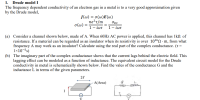 The frequency dependent conductivity of an electron gas in a
metal is to a very good approximation given by the Drude model
1. Drude model I The frequency dependent conductivity of an electron gas in a metal is to a very good approximation given by the Drude model, J(w) = σ(w)E(w) o(a) (a) Consider a channel shown below, made of A. When 60Hz AC power is applied, this channel has lk2 of resistance. If a material can be regarded as...
The frequency dependent conductivity of an electron gas in a
metal is to a very good approximation given by the Drude model
1. Drude model I The frequency dependent conductivity of an electron gas in a metal is to a very good approximation given by the Drude model, J(w) = σ(w)E(w) o(a) (a) Consider a channel shown below, made of A. When 60Hz AC power is applied, this channel has lk2 of resistance. If a material can be regarded as...
Determine the transfer function for a 5-tap FIR highpass filter with a lower cutoff frequency of...
Determine the transfer function for a 5-tap FIR highpass filter with a lower cutoff frequency of 3 kHz and a sampling rate of 8 kHz using the frequency sampling method.
Determine the lower and upper cutoff frequency for the network. Sketch the frequency response using bode plot 2. A self-biased n-channel JFET Amplifier with C1(input)-0.01uF C2(bypass)-2uF C3(...
 Determine the lower and upper cutoff frequency for the network.
Sketch the frequency response using bode plot
2. A self-biased n-channel JFET Amplifier with C1(input)-0.01uF C2(bypass)-2uF C3(output)-0.5uF VDD 20V Rsig- 10kQ RG-1M Ω RD-4.7k Q IDSS-8mA VGS(off-AV Cgd-2pF Cgs-4pF Cds-0.5pF Cwo-6pF RL-2.2k Ω Rc rQi=120 0.47uF R, 04uF 0.82Ω R: 2. A self-biased n-channel JFET Amplifier with C1 (input)=001uF C2bypass)-2uF C3(output):0.5UF VDD-20V Rsige 10kΩ RG-1M Ω RD-4.7k Ω IDSS-BmA VGS(off)-4V Cgd-2pF Cds-0.5pF Cwi-5pF RL-2.2k Ω
2. A self-biased n-channel JFET...
Determine the lower and upper cutoff frequency for the network.
Sketch the frequency response using bode plot
2. A self-biased n-channel JFET Amplifier with C1(input)-0.01uF C2(bypass)-2uF C3(output)-0.5uF VDD 20V Rsig- 10kQ RG-1M Ω RD-4.7k Q IDSS-8mA VGS(off-AV Cgd-2pF Cgs-4pF Cds-0.5pF Cwo-6pF RL-2.2k Ω Rc rQi=120 0.47uF R, 04uF 0.82Ω R: 2. A self-biased n-channel JFET Amplifier with C1 (input)=001uF C2bypass)-2uF C3(output):0.5UF VDD-20V Rsige 10kΩ RG-1M Ω RD-4.7k Ω IDSS-BmA VGS(off)-4V Cgd-2pF Cds-0.5pF Cwi-5pF RL-2.2k Ω
2. A self-biased n-channel JFET...
 Assume the channel bandwidth is 3100 Hz and the maximum data rate is 35 kb/s. To improve the maximum data rate by 60%, how many times should the signal-to-noise-rate (SNR) increase? Based on the improved maximum data rate and SNR, if the SNR further increases by 10 times, can the maximum data rate further increase by 20%?
 a) Is this a n-channel or p-channel? why?
b) Does this appear to be a long channel or a short channel
device? Why?
c) Based on the above IV curve you want to estimate Vt, explain
your approach to obtain it.
d) The high frequency limit of operation of a JFET is dependent
on the dimension and physical properties of the device. Describe
three different approaches to improve the high frequency response
in a JFET
Consider below I-V characteristics of...
a) Is this a n-channel or p-channel? why?
b) Does this appear to be a long channel or a short channel
device? Why?
c) Based on the above IV curve you want to estimate Vt, explain
your approach to obtain it.
d) The high frequency limit of operation of a JFET is dependent
on the dimension and physical properties of the device. Describe
three different approaches to improve the high frequency response
in a JFET
Consider below I-V characteristics of...
 The following is the channel frequency assignment for a 12-channel AM radio system: (c) Channel No Fcy 1240 kHz 1370 kHz 500 kHz 1630 kHz Channel No.Frequency 2280 kHz 2410 kHz 2540 kHz 2670 kHz Channel No. Freqency 1760 kHz 1890 kHz 2020 kHz 2150 kHz 10 2 12 When the AM superheterodyne radio receiver is tuned to Channel 10, in addition to the signal carried on Channel 10, you can also hear a weak signal carried on Channel3 (i)...
 Why does the fitness of a phenotype depend on frequency-dependent selection? A. Because selection favors the least common phenotype. B. Because the least number of alleles are at that locus. C. Because sexual selection produces dimorphism. OD. Because frequency-dependent selection acts against extreme phenotypes.
 The frequency dependent conductivity of an electron gas in a
metal is to a very good approximation given by the Drude model
1. Drude model I The frequency dependent conductivity of an electron gas in a metal is to a very good approximation given by the Drude model, J(w) = σ(w)E(w) o(a) (a) Consider a channel shown below, made of A. When 60Hz AC power is applied, this channel has lk2 of resistance. If a material can be regarded as...
The frequency dependent conductivity of an electron gas in a
metal is to a very good approximation given by the Drude model
1. Drude model I The frequency dependent conductivity of an electron gas in a metal is to a very good approximation given by the Drude model, J(w) = σ(w)E(w) o(a) (a) Consider a channel shown below, made of A. When 60Hz AC power is applied, this channel has lk2 of resistance. If a material can be regarded as...
 Determine the lower and upper cutoff frequency for the network.
Sketch the frequency response using bode plot
2. A self-biased n-channel JFET Amplifier with C1(input)-0.01uF C2(bypass)-2uF C3(output)-0.5uF VDD 20V Rsig- 10kQ RG-1M Ω RD-4.7k Q IDSS-8mA VGS(off-AV Cgd-2pF Cgs-4pF Cds-0.5pF Cwo-6pF RL-2.2k Ω Rc rQi=120 0.47uF R, 04uF 0.82Ω R: 2. A self-biased n-channel JFET Amplifier with C1 (input)=001uF C2bypass)-2uF C3(output):0.5UF VDD-20V Rsige 10kΩ RG-1M Ω RD-4.7k Ω IDSS-BmA VGS(off)-4V Cgd-2pF Cds-0.5pF Cwi-5pF RL-2.2k Ω
2. A self-biased n-channel JFET...
Determine the lower and upper cutoff frequency for the network.
Sketch the frequency response using bode plot
2. A self-biased n-channel JFET Amplifier with C1(input)-0.01uF C2(bypass)-2uF C3(output)-0.5uF VDD 20V Rsig- 10kQ RG-1M Ω RD-4.7k Q IDSS-8mA VGS(off-AV Cgd-2pF Cgs-4pF Cds-0.5pF Cwo-6pF RL-2.2k Ω Rc rQi=120 0.47uF R, 04uF 0.82Ω R: 2. A self-biased n-channel JFET Amplifier with C1 (input)=001uF C2bypass)-2uF C3(output):0.5UF VDD-20V Rsige 10kΩ RG-1M Ω RD-4.7k Ω IDSS-BmA VGS(off)-4V Cgd-2pF Cds-0.5pF Cwi-5pF RL-2.2k Ω
2. A self-biased n-channel JFET...
Most questions answered within 3 hours.
-
Where is the error in this code sequence?
String s1 = "Hello";
String s2 = "ello";...
asked 11 months ago -
Financial data for Joel de Paris, Inc., for last year
follow:
Joel de Paris, Inc.
Balance...
asked 11 months ago -
Consider this reaction:
Al2(SO4)3 (aq)+ BaCl3
(aq) Al2Cl6 (aq)- +
3BaSO4(s) . What is the...
asked 11 months ago -
Suppose that Savneet is considering increasing her
recent random sample from 20 car rentals to 40...
asked 11 months ago -
Trucks arrive at an unloading terminal at an average rate of 120
per hour.
Trucks arrive...
asked 11 months ago -
Why are methanol and ethanol completely soluble in water while
octanol is not very little soluble....
asked 11 months ago -
A facilities manager at a university reads in a research report
that the mean amount of...
asked 11 months ago -
When the CuSO4 is rehydrated by adding water to the anhydrous
compound, is this an endothermic...
asked 11 months ago -
A ray of sunlight is passing from diamond into crown glass; the
angle of incidence is...
asked 11 months ago -
A block of mass 0.249 kg is placed on top of a light, vertical
spring of...
asked 11 months ago -
how do the kidneys compensate in the presences of acidosis
a) trigger hyperventilate
b) reserve acid...
asked 11 months ago -
Question 501 pts
The rental rate of capital to the firm increases. Which of the
following...
asked 11 months ago