Subtract the binary number 01011101 from 11100011, show all borrows. Prove your answer using the decimal...
Subtract the binary number 01011101 from 11100011, show all borrows. Prove your answer using the decimal equivalent of each binary number.
Homework Answers
Request Answer!
We need at least 10 more requests to produce the answer.
0 / 10 have requested this problem solution
The more requests, the faster the answer.
Add Answer to:
Subtract the binary number 01011101 from 11100011, show all
borrows. Prove your answer using the decimal...
Help Convert the decimal number 348 to a. binary b. hexadecimal Show your work. Show the...
 Help
Convert the decimal number 348 to a. binary b. hexadecimal Show your work. Show the decimal equivalent of each of the numbers if they are interpreted as: 10111001 00101101 a. Unsigned binary b. Signed binary Subtract the two pairs of numbers. Show the operand and the results in decimal and binary. (Indicate if there is overflow) a. Assuming there arc unsigned b. Assuming they are signed 1101-0100 1011-1100
Help
Convert the decimal number 348 to a. binary b. hexadecimal Show your work. Show the decimal equivalent of each of the numbers if they are interpreted as: 10111001 00101101 a. Unsigned binary b. Signed binary Subtract the two pairs of numbers. Show the operand and the results in decimal and binary. (Indicate if there is overflow) a. Assuming there arc unsigned b. Assuming they are signed 1101-0100 1011-1100
1. Convert the binary number 10101102 to octal, decimal, and hexadecimal numbers. 2. Convert the decimal...
 1. Convert the binary number 10101102 to octal, decimal, and hexadecimal numbers. 2. Convert the decimal number 236.7510 to binary,octal, and hexadecimal numbers. 3. Add the following two binary numbers: 100111102 and 011110112. Remember to show any carries that are generated along the way. 4. Repeat the previous question, but this time subtract the second binary number from the first. Remember to show any borrows that are required along the way. 5. Determine the encoding of the decimal number 28610...
C++ Convert a Number from Binary to Decimal using a stack: The language of a computer...
 C++
Convert a Number from Binary to Decimal using a stack: The language of a computer is a sequence of Os and 1s. The numbering system we use is called the decimal system, or base 10 system. The numbering system that the computer uses is called the binary system, or base 2 system. The purpose of this exercise is to write a function to convert a string representing a binary number from base 2 to base 10. To convert a...
C++
Convert a Number from Binary to Decimal using a stack: The language of a computer is a sequence of Os and 1s. The numbering system we use is called the decimal system, or base 10 system. The numbering system that the computer uses is called the binary system, or base 2 system. The purpose of this exercise is to write a function to convert a string representing a binary number from base 2 to base 10. To convert a...
Question II (5 marks) 1. Suppose a computer wants to subtract decimal number 58 from decimal...
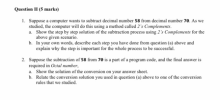 Question II (5 marks) 1. Suppose a computer wants to subtract decimal number 58 from decimal number 70. As we studied, the computer will do this using a method called 2's Complements. a. Show the step by step solution of the subtraction process using 2's Complements for the above given scenario. b. In your own words, describe each step you have done from question (a) above and explain why the step is important for the whole process to be successful....
Design a circuit that will subtract 1 from a 4-bit binary number (A3A2A1A0) if the number...
Design a circuit that will subtract 1 from a 4-bit binary number (A3A2A1A0) if the number is odd, and do no change if the number is even. Use half or full adders in your design. (Info: The number A3A2A1A0 is odd if the last binary digit A0 is 1.) (Info: subtracting 1 is the same as adding -1.)
(a) Subtract (78) in base 10 from (97) in base 10 using 2's complement arithmetic ,...
(a) Subtract (78) in base 10 from (97) in base 10 using 2's complement arithmetic , (b) Divide the number (221) in base 10 and (17) in base 10 by converting the original decimal number to its 8-bit equivalent using straight binary.
Translate the decimal number 167 into binary and hexadecimal. Show your work.
Translate the decimal number 167 into binary and hexadecimal. Show your work.
Convert the decimal numbers A and B to 5-bit binary numbers. Using two’s complement representation, show...
Convert the decimal numbers A and B to 5-bit binary numbers. Using two’s complement representation, show (i) how to subtract the two 5-bit binary numbers (A−B); (ii) how to translate the binary result back to decimal
3) Subtract the two pairs of numbers. Show the operand and the results in decimal and...
3) Subtract the two pairs of numbers. Show the operand and the results in decimal and binary. (PLEASE indicate if there is or isn't overflow for all 4 answers). 1101 - 1001 1011 - 0111 a.Assuming they are unsigned: b.Assuming they are signed:
1. a) Perform the following binary subtractions of unsigned binary numbers. Convert your answer to decimal....
 1. a) Perform the following binary subtractions of unsigned binary numbers. Convert your answer to decimal. i) 101001012 - 01001001, ii) 110110102 - 100100112 b) Repeat the calculations above but for when the binary numbers are in two's complement form. Comment on the results of the two methods used, noting and discrepancies. 2. Find the sums of the following unsigned hexadecimal numbers. Indicate whether or not the sum overflows an equivalent 8-bit binary result. a) 1116 +2216 b) 1716 +3516...
 Help
Convert the decimal number 348 to a. binary b. hexadecimal Show your work. Show the decimal equivalent of each of the numbers if they are interpreted as: 10111001 00101101 a. Unsigned binary b. Signed binary Subtract the two pairs of numbers. Show the operand and the results in decimal and binary. (Indicate if there is overflow) a. Assuming there arc unsigned b. Assuming they are signed 1101-0100 1011-1100
Help
Convert the decimal number 348 to a. binary b. hexadecimal Show your work. Show the decimal equivalent of each of the numbers if they are interpreted as: 10111001 00101101 a. Unsigned binary b. Signed binary Subtract the two pairs of numbers. Show the operand and the results in decimal and binary. (Indicate if there is overflow) a. Assuming there arc unsigned b. Assuming they are signed 1101-0100 1011-1100
 1. Convert the binary number 10101102 to octal, decimal, and hexadecimal numbers. 2. Convert the decimal number 236.7510 to binary,octal, and hexadecimal numbers. 3. Add the following two binary numbers: 100111102 and 011110112. Remember to show any carries that are generated along the way. 4. Repeat the previous question, but this time subtract the second binary number from the first. Remember to show any borrows that are required along the way. 5. Determine the encoding of the decimal number 28610...
 C++
Convert a Number from Binary to Decimal using a stack: The language of a computer is a sequence of Os and 1s. The numbering system we use is called the decimal system, or base 10 system. The numbering system that the computer uses is called the binary system, or base 2 system. The purpose of this exercise is to write a function to convert a string representing a binary number from base 2 to base 10. To convert a...
C++
Convert a Number from Binary to Decimal using a stack: The language of a computer is a sequence of Os and 1s. The numbering system we use is called the decimal system, or base 10 system. The numbering system that the computer uses is called the binary system, or base 2 system. The purpose of this exercise is to write a function to convert a string representing a binary number from base 2 to base 10. To convert a...
 Question II (5 marks) 1. Suppose a computer wants to subtract decimal number 58 from decimal number 70. As we studied, the computer will do this using a method called 2's Complements. a. Show the step by step solution of the subtraction process using 2's Complements for the above given scenario. b. In your own words, describe each step you have done from question (a) above and explain why the step is important for the whole process to be successful....
 1. a) Perform the following binary subtractions of unsigned binary numbers. Convert your answer to decimal. i) 101001012 - 01001001, ii) 110110102 - 100100112 b) Repeat the calculations above but for when the binary numbers are in two's complement form. Comment on the results of the two methods used, noting and discrepancies. 2. Find the sums of the following unsigned hexadecimal numbers. Indicate whether or not the sum overflows an equivalent 8-bit binary result. a) 1116 +2216 b) 1716 +3516...
Most questions answered within 3 hours.
-
Where is the error in this code sequence?
String s1 = "Hello";
String s2 = "ello";...
asked 10 months ago -
Financial data for Joel de Paris, Inc., for last year
follow:
Joel de Paris, Inc.
Balance...
asked 10 months ago -
Consider this reaction:
Al2(SO4)3 (aq)+ BaCl3
(aq) Al2Cl6 (aq)- +
3BaSO4(s) . What is the...
asked 10 months ago -
Suppose that Savneet is considering increasing her
recent random sample from 20 car rentals to 40...
asked 10 months ago -
Trucks arrive at an unloading terminal at an average rate of 120
per hour.
Trucks arrive...
asked 10 months ago -
Why are methanol and ethanol completely soluble in water while
octanol is not very little soluble....
asked 10 months ago -
A facilities manager at a university reads in a research report
that the mean amount of...
asked 10 months ago -
When the CuSO4 is rehydrated by adding water to the anhydrous
compound, is this an endothermic...
asked 10 months ago -
A ray of sunlight is passing from diamond into crown glass; the
angle of incidence is...
asked 10 months ago -
A block of mass 0.249 kg is placed on top of a light, vertical
spring of...
asked 10 months ago -
how do the kidneys compensate in the presences of acidosis
a) trigger hyperventilate
b) reserve acid...
asked 10 months ago -
Question 501 pts
The rental rate of capital to the firm increases. Which of the
following...
asked 10 months ago