Calculating net cash flows from investment
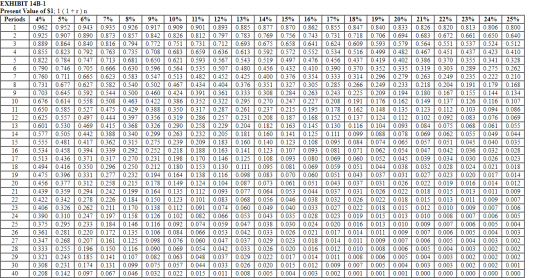
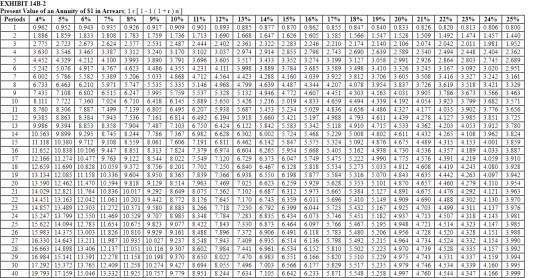
The question is below, and you can use the exhibits if necessary to calculate the discount rate.
Homework Answers
Request Answer!
We need at least 10 more requests to produce the answer.
0 / 10 have requested this problem solution
The more requests, the faster the answer.
You are given an investment to analyze. The cash flows from this investment are End of...
 You are given an investment to analyze. The cash flows from this investment are End of year 1. $26,010 2. $1,060 3. $14,060 4. $10,080 5. $3,280 What is the present value of this investment if 15 percent per year is the appropriate discount rate?
You are given an investment to analyze. The cash flows from this investment are End of...
You are given an investment to analyze. The cash flows from this investment are End of year 1. $12,550 2. $1,730 3. $12,240 4. $7,670 5. $5,570 What is the present value of this investment if 5 percent per year is the appropriate discount rate?
Your firm is considering two projects with the following cash flows: Cash flows from project B...
 Your firm is considering two projects with the following cash flows: Cash flows from project B (£000) (500) 200 250 170 25 30 Year Cash flows from project A (£000) 0(500) 167 180 160 100 100 4 1. Calculate the ARR and payback rule 2. If the appropriate discount rate is 12%, rank the two projects 3. Which project is preferred if you rank by IRR? 4. Calculate the discount rate (r) for which the NPVs of both projects are...
Calculating Value and Multiple Cash Flows: Investment X offers to pay you $4850 per year for...
Calculating Value and Multiple Cash Flows: Investment X offers to pay you $4850 per year for nine years, whereas Investment Y offers to pay you $6775 per year for five years. Which of these cash flow streams has the higher present value if the discount rate is 5%? If the discount rate is 21%? Calculating Annuity Present Value: An investment offers $5500 per year for 15 years, with the first payment occurring one year from now. If the required return...
You are given an investment to analyze. The cash flows from this investment are End of...
 You are given an investment to analyze. The cash flows from this investment are End of year 1. $1,204 2. $3.980 3. $993 4. $3,230 5. $817 What is the future value of this investment at the end of year five if 17.82 percent per year is the appropriate interest (discount) rate? Round the answer to two decimal places.
You are given three investment alternatives to analyze. The cash flows from these three investments are...
You are given three investment alternatives to analyze. The cash flows from these three investments are as follows: Investment End 0f Year A B C 1 $3,000 $1,000 $6,000 2 4,000 1,000 6,000 3 5,000 1,000 (6,000) 4 (6,000) 1,000 (6,000) 5 6,000 5,000 16,000 a. What is the present value of investment A at an annual discount rate of 15 percent? b. What is the present value of investment B at an annual discount rate of 15 percent? c. ...
5 Consider the investment project with the following net cash flows: Year Net Cash Flow 0...
 5 Consider the investment project with the following net cash flows: Year Net Cash Flow 0 $1,500 SX $650 SX What would be the value of X if the project's IRR is known to be 10%? The annual income from a rented house is $24,000. The annual expenses are $6000. If the house can be sold for $245,000 at the end of 10 years, how much could you afford to pay for it now, if you considered 900 to be...
Question 6.12 You are given three investment alternatives to analyze. The cash flows from these three...
Question 6.12 You are given three investment alternatives to analyze. The cash flows from these three investments are as follows: End of year A B C 1 2000 1000 4000 2 3000 1000 4000 3 4000 1000 (4000) 4 (5000) 1000 (4000) 5 5000 3000 14000 What is the present value of each of these three investments if the appropriate discount rate is 9 percent?
Annual cash inflows from two competing investment opportunities are given below. Each investment opportunity will require...
 Annual cash inflows from two competing investment opportunities are given below. Each investment opportunity will require the same initial investment. Year 1 Year 2 Year 3 Year 4 Investment X Investment y $ 3,000 $ 6,000 4,000 5,000 5,000 4.000 6,000 3,000 Total $ 18,000 $18,000 Click here to view Exhibit 11B-1, to determine the appropriate discount factor(s) using tables. Required: Compute the present value of the cash inflows for each investment using a 10% discount rate. (Round discount factor(s)...
13. A new hog investment requires an initial outlay of $120,000 and is expected to yield annual net cash flows of $ 21,500 over the investment's 10-year planning horizon. Assuming no salvage...
 13. A new hog investment requires an initial outlay of $120,000 and is expected to yield annual net cash flows of $ 21,500 over the investment's 10-year planning horizon. Assuming no salvage value, no taxes, and a 8 percent discount rate A. Should the investment be made if you use NPV analysis? Should the investment be made if you use IRR analysis? Use a required rate of return of 10.5% to determine if the investment is worthwhile. B.
13. A...
13. A new hog investment requires an initial outlay of $120,000 and is expected to yield annual net cash flows of $ 21,500 over the investment's 10-year planning horizon. Assuming no salvage value, no taxes, and a 8 percent discount rate A. Should the investment be made if you use NPV analysis? Should the investment be made if you use IRR analysis? Use a required rate of return of 10.5% to determine if the investment is worthwhile. B.
13. A...
 You are given an investment to analyze. The cash flows from this investment are End of year 1. $26,010 2. $1,060 3. $14,060 4. $10,080 5. $3,280 What is the present value of this investment if 15 percent per year is the appropriate discount rate?
 Your firm is considering two projects with the following cash flows: Cash flows from project B (£000) (500) 200 250 170 25 30 Year Cash flows from project A (£000) 0(500) 167 180 160 100 100 4 1. Calculate the ARR and payback rule 2. If the appropriate discount rate is 12%, rank the two projects 3. Which project is preferred if you rank by IRR? 4. Calculate the discount rate (r) for which the NPVs of both projects are...
 You are given an investment to analyze. The cash flows from this investment are End of year 1. $1,204 2. $3.980 3. $993 4. $3,230 5. $817 What is the future value of this investment at the end of year five if 17.82 percent per year is the appropriate interest (discount) rate? Round the answer to two decimal places.
 5 Consider the investment project with the following net cash flows: Year Net Cash Flow 0 $1,500 SX $650 SX What would be the value of X if the project's IRR is known to be 10%? The annual income from a rented house is $24,000. The annual expenses are $6000. If the house can be sold for $245,000 at the end of 10 years, how much could you afford to pay for it now, if you considered 900 to be...
 Annual cash inflows from two competing investment opportunities are given below. Each investment opportunity will require the same initial investment. Year 1 Year 2 Year 3 Year 4 Investment X Investment y $ 3,000 $ 6,000 4,000 5,000 5,000 4.000 6,000 3,000 Total $ 18,000 $18,000 Click here to view Exhibit 11B-1, to determine the appropriate discount factor(s) using tables. Required: Compute the present value of the cash inflows for each investment using a 10% discount rate. (Round discount factor(s)...
 13. A new hog investment requires an initial outlay of $120,000 and is expected to yield annual net cash flows of $ 21,500 over the investment's 10-year planning horizon. Assuming no salvage value, no taxes, and a 8 percent discount rate A. Should the investment be made if you use NPV analysis? Should the investment be made if you use IRR analysis? Use a required rate of return of 10.5% to determine if the investment is worthwhile. B.
13. A...
13. A new hog investment requires an initial outlay of $120,000 and is expected to yield annual net cash flows of $ 21,500 over the investment's 10-year planning horizon. Assuming no salvage value, no taxes, and a 8 percent discount rate A. Should the investment be made if you use NPV analysis? Should the investment be made if you use IRR analysis? Use a required rate of return of 10.5% to determine if the investment is worthwhile. B.
13. A...
Most questions answered within 3 hours.
-
Where is the error in this code sequence?
String s1 = "Hello";
String s2 = "ello";...
asked 10 months ago -
Financial data for Joel de Paris, Inc., for last year
follow:
Joel de Paris, Inc.
Balance...
asked 10 months ago -
Consider this reaction:
Al2(SO4)3 (aq)+ BaCl3
(aq) Al2Cl6 (aq)- +
3BaSO4(s) . What is the...
asked 10 months ago -
Suppose that Savneet is considering increasing her
recent random sample from 20 car rentals to 40...
asked 10 months ago -
Trucks arrive at an unloading terminal at an average rate of 120
per hour.
Trucks arrive...
asked 10 months ago -
Why are methanol and ethanol completely soluble in water while
octanol is not very little soluble....
asked 10 months ago -
A facilities manager at a university reads in a research report
that the mean amount of...
asked 10 months ago -
When the CuSO4 is rehydrated by adding water to the anhydrous
compound, is this an endothermic...
asked 10 months ago -
A ray of sunlight is passing from diamond into crown glass; the
angle of incidence is...
asked 10 months ago -
A block of mass 0.249 kg is placed on top of a light, vertical
spring of...
asked 10 months ago -
how do the kidneys compensate in the presences of acidosis
a) trigger hyperventilate
b) reserve acid...
asked 10 months ago -
Question 501 pts
The rental rate of capital to the firm increases. Which of the
following...
asked 10 months ago