An aluminium object with a mass of 5.77 kg and at a temperature of 23.3 °C...
An aluminium object with a mass of 5.77 kg and at a temperature of 23.3 °C comes to thermal contact with a 9.26 kg copper object which is initially at a temperature of 97.7 °C. What is going to be the equilibrum temperature of the two objects? Neglect heat transfer between the objects and the environment. The specific heats are: cAl = 900 J/kg°C and cCu = 387 J/kg°C.
Homework Answers
Dear student,
Find this solution.if any issue with that don't forget to write in comment section.I will rectify them as soon as possible.
If you find the solution helpful and kindly RATE THE ANSWER it would be appreciated.
Your rating is important to me.
Thanks for asking..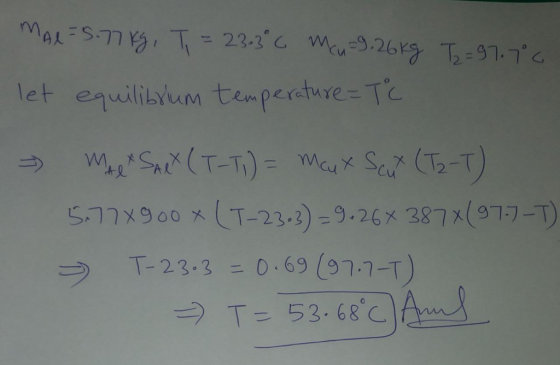
Add Answer to:
An aluminium object with a mass of 5.77 kg and at a temperature
of 23.3 °C...
1- An aluminium object with a mass of 3.10 kg and at a temperature of 21.3...
1- An aluminium object with a mass of 3.10 kg and at a temperature of 21.3 °C comes to thermal contact with a 7.21 kg copper object which is initially at a temperature of 86.5 °C. What is going to be the equilibrum temperature of the two objects? Neglect heat transfer between the objects and the environment. The specific heats are: cAl = 900 J/kg°C and cCu = 387 J/kg°C. 2- Three different liquids are mixed together in a calorimeter....
3. A 100 g block of copper initially at 60°C is placed in contact with a...
 3. A 100 g block of copper initially at 60°C is placed in contact with a 300 g block of aluminum initially at 30°C in an insulated container. A. Identify the block that loses thermal energy. (5 pts) B. Calculate the final equilibrium temperature of the two blocks. (15 pts) Copper a(Cu) = 17 x 10-61°C Ccu = 0.0923 cal/g.K = 386 J/kg-K LF (Cu) = 207 kJ/kg
To determine the specific heat of an object, a student heats it to 100 ∘C in...
To determine the specific heat of an object, a student heats it to 100 ∘C in boiling water. She then places the 87.2 g object in a 173 galuminum calorimeter containing 136 g of water. The aluminum and water are initially at a temperature of 19.8 ∘, and are thermally insulated from their surroundings. If the final temperature is 23.4 ∘, what is the specific heat of the object? Referring to the table, identify the material in the object. Substance...
A combination of 0.35 kg of water at 25.00 ° C, 0.53 kg of aluminum at...
A combination of 0.35 kg of water at 25.00 ° C, 0.53 kg of aluminum at 32.00 ° C and 0.45 kg of copper at 90.00 ° C are mixed in an insulated container and allowed to reach thermal equilibrium. Ignore any transfer of energy to or from the container. What is the final temperature of the mixture? Note: consider C water = 4186 J / K Kg, CAl = 900 J / K Kg, C cu = 387 J...
SETR To determine the specific heat of an object, a student heats it to 100 C...
 SETR To determine the specific heat of an object, a student heats it to 100 C in boiling water. She then places the 50.1 g object in a 187 g aluminum calorimeter containing 105 g of water. The aluminum and water are initially at a temperature of 19.9 °C, and are thermally insulated from their surroundings. Part A If the final temperature is 22.4 C, what is the specific heat of the objed? Express your answer using two significant figures....
Case 2: A 0.780-kg silver pellet with a temperature of 85 oC is added to 0.150...
 Case 2: A 0.780-kg silver pellet with a temperature of 85 oC is added to 0.150 kg of water in a copper cup of 0.66 kg. The initial temperature of the water and the copper cup is 14 oc. Assume no heat is exchanged with the surroundings. The specific heats of silver, water and copper are: 234 J/(kg oC), 4186 J/(kg oC) and 387 J/(kg oc), respectively. Find the final temprature of the system (silver+water+copper cup). Note: 1. Slver pellet...
The specific heat c is the amount of heat necessary to change the temperature of 1.00...
 The specific heat c is the amount of heat necessary to change the temperature of 1.00 kg of mass by 1.00°C. The specific heat c is a property of the substance; its Sl unit is J/(kg · K) or J/(kg.°C). Recall that the temperature change (AT) is the same in units of kelvin and degrees Celsius. water silver copper cup Case 1: A 0.780-kg silver pellet with a temperature of 85 °C is added to 0.150 kg of water in...
(a) Convert 15C to Fahrenheit. (b) The lineal coefficient of thermal expansion for aluminium is αAl...
(a) Convert 15C to Fahrenheit. (b) The lineal coefficient of thermal expansion for aluminium is αAl = 2.3 × 10⁻⁵ C−1. A sample of aluminium is measured to be 4.00000m long at 20C. What is its length at 15C? (c) The volume coefficient of thermal expansion for aluminium is βAl = 6.9 × 10⁻⁵ C−1. An aluminium vessel is shaped to accomodate 6000 microlitres of fluid at 20C. What is the capacity of the vessel at 15C? (d) The specific...
233 g of water at 16°C is contained in a copper container of mass 287 g....
 233 g of water at 16°C is contained in a copper container of
mass 287 g. An additional 134 g of water at 100°C is added. What is
the final equilibrium temperature if we treat thesystem's water and
container as isolated? Use the heat capacity values from the table
Specific heat capacity values at atmospheric pressure Material Water lce Steam Aluminium Iron Glass Copper Mercury Gold Specific heat capacity (J/kg K) 4186 2090 2010 900 448 837 387 138 129
233 g of water at 16°C is contained in a copper container of
mass 287 g. An additional 134 g of water at 100°C is added. What is
the final equilibrium temperature if we treat thesystem's water and
container as isolated? Use the heat capacity values from the table
Specific heat capacity values at atmospheric pressure Material Water lce Steam Aluminium Iron Glass Copper Mercury Gold Specific heat capacity (J/kg K) 4186 2090 2010 900 448 837 387 138 129
A cube of copper with a mass of 2.00 kg, initially at a temperature of 150.0°C,...
A cube of copper with a mass of 2.00 kg, initially at a temperature of 150.0°C, is in a well-insulated container. Water at a temperature of 22.0°C is added to the container, and the entire interior of the container is allowed to come to thermal equilibrium, where it reaches a final temperature of 67.0°C. What mass of water (in kg) was added? Assume any water turned to steam subsequently recondenses. kg
 3. A 100 g block of copper initially at 60°C is placed in contact with a 300 g block of aluminum initially at 30°C in an insulated container. A. Identify the block that loses thermal energy. (5 pts) B. Calculate the final equilibrium temperature of the two blocks. (15 pts) Copper a(Cu) = 17 x 10-61°C Ccu = 0.0923 cal/g.K = 386 J/kg-K LF (Cu) = 207 kJ/kg
 SETR To determine the specific heat of an object, a student heats it to 100 C in boiling water. She then places the 50.1 g object in a 187 g aluminum calorimeter containing 105 g of water. The aluminum and water are initially at a temperature of 19.9 °C, and are thermally insulated from their surroundings. Part A If the final temperature is 22.4 C, what is the specific heat of the objed? Express your answer using two significant figures....
 Case 2: A 0.780-kg silver pellet with a temperature of 85 oC is added to 0.150 kg of water in a copper cup of 0.66 kg. The initial temperature of the water and the copper cup is 14 oc. Assume no heat is exchanged with the surroundings. The specific heats of silver, water and copper are: 234 J/(kg oC), 4186 J/(kg oC) and 387 J/(kg oc), respectively. Find the final temprature of the system (silver+water+copper cup). Note: 1. Slver pellet...
 The specific heat c is the amount of heat necessary to change the temperature of 1.00 kg of mass by 1.00°C. The specific heat c is a property of the substance; its Sl unit is J/(kg · K) or J/(kg.°C). Recall that the temperature change (AT) is the same in units of kelvin and degrees Celsius. water silver copper cup Case 1: A 0.780-kg silver pellet with a temperature of 85 °C is added to 0.150 kg of water in...
 233 g of water at 16°C is contained in a copper container of
mass 287 g. An additional 134 g of water at 100°C is added. What is
the final equilibrium temperature if we treat thesystem's water and
container as isolated? Use the heat capacity values from the table
Specific heat capacity values at atmospheric pressure Material Water lce Steam Aluminium Iron Glass Copper Mercury Gold Specific heat capacity (J/kg K) 4186 2090 2010 900 448 837 387 138 129
233 g of water at 16°C is contained in a copper container of
mass 287 g. An additional 134 g of water at 100°C is added. What is
the final equilibrium temperature if we treat thesystem's water and
container as isolated? Use the heat capacity values from the table
Specific heat capacity values at atmospheric pressure Material Water lce Steam Aluminium Iron Glass Copper Mercury Gold Specific heat capacity (J/kg K) 4186 2090 2010 900 448 837 387 138 129
Most questions answered within 3 hours.
-
Where is the error in this code sequence?
String s1 = "Hello";
String s2 = "ello";...
asked 11 months ago -
Financial data for Joel de Paris, Inc., for last year
follow:
Joel de Paris, Inc.
Balance...
asked 11 months ago -
Consider this reaction:
Al2(SO4)3 (aq)+ BaCl3
(aq) Al2Cl6 (aq)- +
3BaSO4(s) . What is the...
asked 11 months ago -
Suppose that Savneet is considering increasing her
recent random sample from 20 car rentals to 40...
asked 11 months ago -
Trucks arrive at an unloading terminal at an average rate of 120
per hour.
Trucks arrive...
asked 11 months ago -
Why are methanol and ethanol completely soluble in water while
octanol is not very little soluble....
asked 11 months ago -
A facilities manager at a university reads in a research report
that the mean amount of...
asked 11 months ago -
When the CuSO4 is rehydrated by adding water to the anhydrous
compound, is this an endothermic...
asked 11 months ago -
A ray of sunlight is passing from diamond into crown glass; the
angle of incidence is...
asked 11 months ago -
A block of mass 0.249 kg is placed on top of a light, vertical
spring of...
asked 11 months ago -
how do the kidneys compensate in the presences of acidosis
a) trigger hyperventilate
b) reserve acid...
asked 11 months ago -
Question 501 pts
The rental rate of capital to the firm increases. Which of the
following...
asked 11 months ago