In step1, aqueous ammonia is added to a solution of the three ions. The equilibrium for...
- In step1, aqueous ammonia is added to a solution of the three ions. The equilibrium for the ammonia is
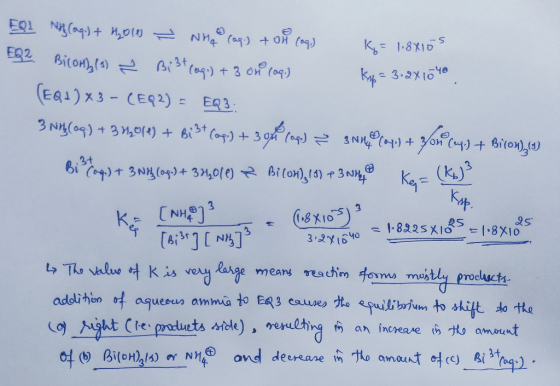
EQ1: NH3(aq + H2O(l) ßà NH4+(aq) Kb=1.8x10⁻⁵
The bismuth(III) ion is precipitated out of the solution as Bi(OH)3. The equilibrium involved is related to the one provided below:
EQ2: Bi(OH)3(s) ßà Bi3+(aq) +3OH(aq)- Ksp =3.2x10-40
Manipulate EQ 1 and 2 to solve for the net equation, EQ3:
EQ3 (net): 3H2O+ Bi3+(aq) +3NH3(aq) ßàBi(OH)-(s) +3NH4+(aq)
Write the mass law expression for the net reaction and calculate the K. Does the reaction form mostly products, or mostly reactants? EXPLAIN.
- Addition of excess aqueous ammonia to equilibrium 3(net) causes the equilibrium to shift to the (a)_______, resulting in an increase in the amount of (b)_______ and a decrease in the amount of (c)_______.
- In step 1, excess aqueous ammonia reacts with the Cu2+ ion to form a complex ion:
EQ4: Cu2+(aq)+ 4NH3(aq)ßà[Cu(NH3)4]2+(aq) Kf = 1.1x10¹³
A blue precipitate initially forms and then dissolves in the excess NH3. The precipitate that forms initially is Cu(OH)2.
EQ5: Cu2+(aq) + 2OH-(aq) ßà Cu(OH)2(s) K=2.08x10¹⁹
The needed OH-to dissolve the Cu(OH)2(s) comes from the ionization of ammonia in water:
EQ 6: NH3(aq) + H2O(l) ßà NH4+(aq)+ OH-(aq) Kb =1.8x10⁻⁵
Manipulate EQ 5 and 6 to find the net reaction (EQ 7) for the precipitation of the copper(II) hydroxide. Write the mass law expression and calculate the Knet.
EQ 7: Cu2+(aq) +2NH3(aq) + 2 H2O(l)ßàCu(OH)2(s) +2 NH4+(aq)
- The deep blue color of the solution of [Cu(NH3)4]2+(aq) comes from dissolving the Cu(OH)2(s) in excess NH3(aq). The net equation for the reaction is
EQ 8: Cu(OH)2(s) + 2OH-(aq) + 4 NH4+(aq) ßà [Cu(NH3)4]2+(aq) + 4 H2O(l)
Manipulate EQ 4, 5, and 6 to solve for the net reaction, EQ 8. Write the mass law expression and calculate Knet. Compare the K for equation 8 and equation 7. Which lies further to the right? How does excess ammonia helps dissolve the Cu(OH)2?
- Acetic acid is used to release the Cu2+ from the [Cu(NH3)4]2+(aq)
EQ 9: [Cu(NH3)4]2+(aq) + 4CH3CO2H(aq)ßà Cu2+ + 4 NH4+(aq) + 4CH3CO2-(aq)
Explain in terms of leChatelier’s principle and EQ9
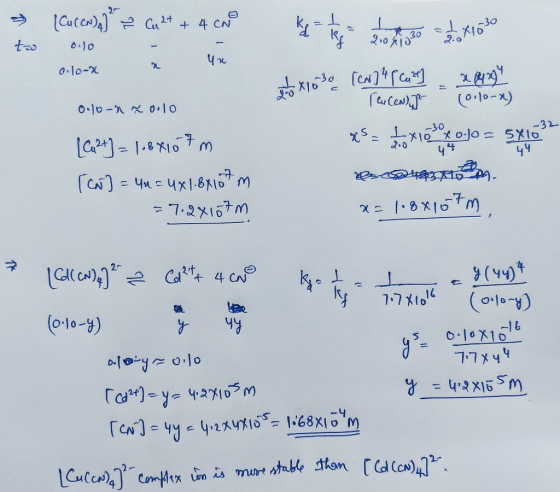
- Calculate the equilibrium [Cu2+] and the [CN-] if the initial concentration of [Cu(CN)4]2 =0.10M. Cu2+(aq) +4CN-(aq) ßà[Cu(CN)4]2Kf =2.0x1030
- Calculate the equilibrium [Cd2+] if the initial concentration of [Cd(CN)4]2- =0.10M
Cd2+(aq) + 4CN-(aq)ßà [Cd(CN)4]2 Kf =7.7x10¹⁶
Compare your answer to the answer from question 6. Which complex ion is more stable explain.
Please Show Work!
Homework Answers
According to LeChatelier principle, if an equilibrium is put under stress then equilibrium will shift in that direction such that the stress is minimised.

The value of equilibrium constant of EQ8 is greater than that of EQ7. Hence EQ8 will lies further to the right. The excess of ammonia can dissolve Cu(OH)2 , because Copper can form a stable complex with ligand(NH3).
Acetic acid is used to release Cu2+ from the complex because acetic acid neutralize the liquid ammonia. And concentration of ammonia decrease and equilibrium will shift backward i.e. dissociation of complex.
Add Answer to:
In step1, aqueous ammonia is added to a solution of the three
ions. The equilibrium for...
40. Concentrated aqueous ammonia is added to a solution of copper(II) sulfate. A white precipitate forms....
 40. Concentrated aqueous ammonia is added to a solution of copper(II) sulfate. A white precipitate forms. The precipitate dissolves as more ammonia is added, generating an intensely blue solution. Which combination of net ionic equations, in the appropriate order, describes this chemistry?! I Cu?* (aq) + 2OH(aq) Cu(OH)2 (19) II Cu?" (aq) + 2OH(aq) = Cu(OH)2 (8) III Cu(OH)(aq) + 4 NH, (aq) Cu(NH3),?* () + 2OH(aq) IV Cu(OH)2 (8) + 4NH, (aq) Cu(NH3)*(14) + 2OH(aq) V NH3(aq) + H20...
I am sort of confused on what these are asking? An explination of the concepts would really help, I will give thumbs up...
 I am sort of confused on what these are asking? An explination
of the concepts would really help, I will give thumbs up :)
3. Consider the following reactions: a) The formation of tetraaqua copper (Il) ion in solution Cu2+ + 4H2O(l) = [Cu(H2O)4](aq) b) The reaction of ammonia with water. NH3(aq) + H2O(l) = NH4+ (aq) + OH(aq) c) The self ionization of water 2H2O(0) — H3O*(aq) + OH(aq) d) The formation of copper (II) hydroxide [Cu(H20)4]2+ (aq) +...
I am sort of confused on what these are asking? An explination
of the concepts would really help, I will give thumbs up :)
3. Consider the following reactions: a) The formation of tetraaqua copper (Il) ion in solution Cu2+ + 4H2O(l) = [Cu(H2O)4](aq) b) The reaction of ammonia with water. NH3(aq) + H2O(l) = NH4+ (aq) + OH(aq) c) The self ionization of water 2H2O(0) — H3O*(aq) + OH(aq) d) The formation of copper (II) hydroxide [Cu(H20)4]2+ (aq) +...
When aqueous solutions of NH4OH(aq) and CuCl2(aq) are mixed, the products are NH4Cl(aq) and Cu(OH)2(s). What...
When aqueous solutions of NH4OH(aq) and CuCl2(aq) are mixed, the products are NH4Cl(aq) and Cu(OH)2(s). What is the net ionic equation for this reaction? Select the correct answer below: 2NH4OH(aq)+CuCl2(aq)⟶Cu(OH)2(s)+2NH4Cl(aq) 2NH+4(aq)+2OH−(aq)+Cu2+(aq)+2Cl−(aq)⟶Cu(OH)2(s)+2NH+4(aq)+2Cl−(aq) Cu2+(aq)+2OH−(aq)⟶Cu(OH)2(s) NH+4(aq)+Cl−(aq)⟶NH4Cl(s)
When aqueous solutions of NH4OH(aq) and CuCl2(aq) are mixed, the products are NH4Cl (aq) and Cu(OH)2(s)....
When aqueous solutions of NH4OH(aq) and CuCl2(aq) are mixed, the products are NH4Cl (aq) and Cu(OH)2(s). What is the net ionic equation for this reaction? Select the correct answer below: Question 12 options: 2 NH4OH(aq)+CuCl2(aq)⟶Cu(OH)2(s)+2NH4Cl(aq) 2NH+4(aq)+2OH−(aq)+Cu2+(aq)+2Cl−(aq)⟶Cu(OH)2(s)+2NH+4(aq)+2Cl−(aq) Cu2+(aq)+2OH−(aq)⟶Cu(OH)2(s) NH+4(aq)+Cl−(aq)⟶NH4Cl(s)
please help What is the approximate concentration of free Cu* ion at equilibrium when 1.57x10² mol...
 please help
What is the approximate concentration of free Cu* ion at equilibrium when 1.57x10² mol copperII) nitrate is added to 1.00 L of solution that is 1.380 M in NH3. For [Cu(NH3)4j2, Kf 2.1 1013 [Cu2 м What is the approximate concentration of free Fe2* ion at equilibrium when 1.42x10²mol iron(II) nitrate is added to 1.00 L of solution that is 1.38so M in CN. For [Fe(CN)6]4, Kf=1.0x1035 [Fe"]= In the presence of excess OH, the Al*(aq) ion forms...
please help
What is the approximate concentration of free Cu* ion at equilibrium when 1.57x10² mol copperII) nitrate is added to 1.00 L of solution that is 1.380 M in NH3. For [Cu(NH3)4j2, Kf 2.1 1013 [Cu2 м What is the approximate concentration of free Fe2* ion at equilibrium when 1.42x10²mol iron(II) nitrate is added to 1.00 L of solution that is 1.38so M in CN. For [Fe(CN)6]4, Kf=1.0x1035 [Fe"]= In the presence of excess OH, the Al*(aq) ion forms...
What are the equilibrium concentrations of NH3, NH4+, and OH- in a 0.95 M solution of ammonia?...
What are the equilibrium concentrations of NH3, NH4+, and OH- in a 0.95 M solution of ammonia? Kb = 1.8x10^-5 What is the pH of the solution? pH =
Which of the reactions involving metal ions (Equations 1A – 6B ) represent redox reaction(s)? Write...
Which of the reactions involving metal ions (Equations 1A – 6B ) represent redox reaction(s)? Write down the entire equation(s) AS WELL AS their corresponding balanced oxidation half-reaction(s) AND reduction half-reaction(s). Ag+(aq)+ HCl(aq)+ H2O(l) -> AgCl(s, white)+ H3O+(aq) Eq. 1A AgCl(s)+ 2NH3(aq) -> [Ag(NH3)2]+(aq)+ Cl–(aq) Eq. 2A Fe3+(aq)+ 3NH3(aq)+ 3H2O(l) -> Fe(OH)3(s)+ 3NH4(aq) Eq. 3A Fe3+(aq)+ 6SCN–(aq) -> Fe(SCN)63–(aq, blood-red) Eq. 4A Co2+(aq)+ 7NO2–(aq)+ 3K+(aq)+ 2H3O+(aq) -> NO(g)+ 3H2O(l)+ K3[Co(NO2)6](s, yellow) Eq. 6A 2 NO(g, colorless)+ O2(g) →2NO2(g, red-brown) Eq....
Balance the following redox reaction occurring in basic solution. Ag(s) + CN- (aq) + O2(g) →...
 Balance the following redox reaction occurring in basic
solution.
Ag(s) + CN- (aq) + O2(g) → Ag(CN), (aq) 2 Ag(s) + 4CN (aq) +202 + H2O(l)(9) + 2 Ag(CN)2 (aq) + 2OH(aq) • 2 Ag(s) + 8 CN (aq) + 402 + 2 H20(1)(g) + 4 Ag(CN)2 (aq) +8 OH(aq) 4 Ag(s) + 2 CN (aq) + O2 + 4H2O(1)(9) + 4 Ag(CN)2 (aq) + 8 OH (aq) 4 Ag(s) + 8 CN (aq) + O2 + 2 H20(1)(9) +...
Balance the following redox reaction occurring in basic
solution.
Ag(s) + CN- (aq) + O2(g) → Ag(CN), (aq) 2 Ag(s) + 4CN (aq) +202 + H2O(l)(9) + 2 Ag(CN)2 (aq) + 2OH(aq) • 2 Ag(s) + 8 CN (aq) + 402 + 2 H20(1)(g) + 4 Ag(CN)2 (aq) +8 OH(aq) 4 Ag(s) + 2 CN (aq) + O2 + 4H2O(1)(9) + 4 Ag(CN)2 (aq) + 8 OH (aq) 4 Ag(s) + 8 CN (aq) + O2 + 2 H20(1)(9) +...
Aqueous solutions of ammonia (NH3) and hydrogen cyanide (HCN) react to produce ammonium cyanide, (NH4CN) according...
 Aqueous solutions of ammonia (NH3) and hydrogen cyanide (HCN) react to produce ammonium cyanide, (NH4CN) according to the following equilibrium reaction. NH3(aq) + HCN(aq) = NH4+ (aq) + CN (aq) Given the following equilibrium constants, which statement best describes the reaction once equilibrium is established? (Kw - 1.01 x 10⁻¹⁴) NH4+ Ka = 5.6 x 10⁻¹⁰ HCN ka = 4.0 x 10⁻¹⁰ reaction is product favored, K<1 reaction is neither reactant nor product favored reaction is product favored, K>1 reaction...
Aqueous solutions of ammonia (NH3) and hydrogen cyanide (HCN) react to produce ammonium cyanide, (NH4CN) according...
 Aqueous solutions of ammonia (NH3) and hydrogen cyanide (HCN) react to produce ammonium cyanide, (NH4CN) according to the following equilibrium reaction. NH3(aq) + HCN(aq) = NH4+ (aq) + CN (aq) Given the following equilibrium constants, which statement best describes the reaction once equilibrium is established? (Kw = 1.01 x 10⁻¹⁴) NH4* Ka = 5.6 x 10⁻¹⁰ HCN Ka = 4.0 x 10⁻¹⁰ reaction is reactant favors, K> 1 O reaction is reactant favors, K <1 O reaction is product favored,...
 40. Concentrated aqueous ammonia is added to a solution of copper(II) sulfate. A white precipitate forms. The precipitate dissolves as more ammonia is added, generating an intensely blue solution. Which combination of net ionic equations, in the appropriate order, describes this chemistry?! I Cu?* (aq) + 2OH(aq) Cu(OH)2 (19) II Cu?" (aq) + 2OH(aq) = Cu(OH)2 (8) III Cu(OH)(aq) + 4 NH, (aq) Cu(NH3),?* () + 2OH(aq) IV Cu(OH)2 (8) + 4NH, (aq) Cu(NH3)*(14) + 2OH(aq) V NH3(aq) + H20...
 I am sort of confused on what these are asking? An explination
of the concepts would really help, I will give thumbs up :)
3. Consider the following reactions: a) The formation of tetraaqua copper (Il) ion in solution Cu2+ + 4H2O(l) = [Cu(H2O)4](aq) b) The reaction of ammonia with water. NH3(aq) + H2O(l) = NH4+ (aq) + OH(aq) c) The self ionization of water 2H2O(0) — H3O*(aq) + OH(aq) d) The formation of copper (II) hydroxide [Cu(H20)4]2+ (aq) +...
I am sort of confused on what these are asking? An explination
of the concepts would really help, I will give thumbs up :)
3. Consider the following reactions: a) The formation of tetraaqua copper (Il) ion in solution Cu2+ + 4H2O(l) = [Cu(H2O)4](aq) b) The reaction of ammonia with water. NH3(aq) + H2O(l) = NH4+ (aq) + OH(aq) c) The self ionization of water 2H2O(0) — H3O*(aq) + OH(aq) d) The formation of copper (II) hydroxide [Cu(H20)4]2+ (aq) +...
 please help
What is the approximate concentration of free Cu* ion at equilibrium when 1.57x10² mol copperII) nitrate is added to 1.00 L of solution that is 1.380 M in NH3. For [Cu(NH3)4j2, Kf 2.1 1013 [Cu2 м What is the approximate concentration of free Fe2* ion at equilibrium when 1.42x10²mol iron(II) nitrate is added to 1.00 L of solution that is 1.38so M in CN. For [Fe(CN)6]4, Kf=1.0x1035 [Fe"]= In the presence of excess OH, the Al*(aq) ion forms...
please help
What is the approximate concentration of free Cu* ion at equilibrium when 1.57x10² mol copperII) nitrate is added to 1.00 L of solution that is 1.380 M in NH3. For [Cu(NH3)4j2, Kf 2.1 1013 [Cu2 м What is the approximate concentration of free Fe2* ion at equilibrium when 1.42x10²mol iron(II) nitrate is added to 1.00 L of solution that is 1.38so M in CN. For [Fe(CN)6]4, Kf=1.0x1035 [Fe"]= In the presence of excess OH, the Al*(aq) ion forms...
 Balance the following redox reaction occurring in basic
solution.
Ag(s) + CN- (aq) + O2(g) → Ag(CN), (aq) 2 Ag(s) + 4CN (aq) +202 + H2O(l)(9) + 2 Ag(CN)2 (aq) + 2OH(aq) • 2 Ag(s) + 8 CN (aq) + 402 + 2 H20(1)(g) + 4 Ag(CN)2 (aq) +8 OH(aq) 4 Ag(s) + 2 CN (aq) + O2 + 4H2O(1)(9) + 4 Ag(CN)2 (aq) + 8 OH (aq) 4 Ag(s) + 8 CN (aq) + O2 + 2 H20(1)(9) +...
Balance the following redox reaction occurring in basic
solution.
Ag(s) + CN- (aq) + O2(g) → Ag(CN), (aq) 2 Ag(s) + 4CN (aq) +202 + H2O(l)(9) + 2 Ag(CN)2 (aq) + 2OH(aq) • 2 Ag(s) + 8 CN (aq) + 402 + 2 H20(1)(g) + 4 Ag(CN)2 (aq) +8 OH(aq) 4 Ag(s) + 2 CN (aq) + O2 + 4H2O(1)(9) + 4 Ag(CN)2 (aq) + 8 OH (aq) 4 Ag(s) + 8 CN (aq) + O2 + 2 H20(1)(9) +...
 Aqueous solutions of ammonia (NH3) and hydrogen cyanide (HCN) react to produce ammonium cyanide, (NH4CN) according to the following equilibrium reaction. NH3(aq) + HCN(aq) = NH4+ (aq) + CN (aq) Given the following equilibrium constants, which statement best describes the reaction once equilibrium is established? (Kw - 1.01 x 10⁻¹⁴) NH4+ Ka = 5.6 x 10⁻¹⁰ HCN ka = 4.0 x 10⁻¹⁰ reaction is product favored, K<1 reaction is neither reactant nor product favored reaction is product favored, K>1 reaction...
 Aqueous solutions of ammonia (NH3) and hydrogen cyanide (HCN) react to produce ammonium cyanide, (NH4CN) according to the following equilibrium reaction. NH3(aq) + HCN(aq) = NH4+ (aq) + CN (aq) Given the following equilibrium constants, which statement best describes the reaction once equilibrium is established? (Kw = 1.01 x 10⁻¹⁴) NH4* Ka = 5.6 x 10⁻¹⁰ HCN Ka = 4.0 x 10⁻¹⁰ reaction is reactant favors, K> 1 O reaction is reactant favors, K <1 O reaction is product favored,...
Most questions answered within 3 hours.
-
Where is the error in this code sequence?
String s1 = "Hello";
String s2 = "ello";...
asked 10 months ago -
Financial data for Joel de Paris, Inc., for last year
follow:
Joel de Paris, Inc.
Balance...
asked 10 months ago -
Consider this reaction:
Al2(SO4)3 (aq)+ BaCl3
(aq) Al2Cl6 (aq)- +
3BaSO4(s) . What is the...
asked 10 months ago -
Suppose that Savneet is considering increasing her
recent random sample from 20 car rentals to 40...
asked 10 months ago -
Trucks arrive at an unloading terminal at an average rate of 120
per hour.
Trucks arrive...
asked 10 months ago -
Why are methanol and ethanol completely soluble in water while
octanol is not very little soluble....
asked 10 months ago -
A facilities manager at a university reads in a research report
that the mean amount of...
asked 10 months ago -
When the CuSO4 is rehydrated by adding water to the anhydrous
compound, is this an endothermic...
asked 10 months ago -
A ray of sunlight is passing from diamond into crown glass; the
angle of incidence is...
asked 10 months ago -
A block of mass 0.249 kg is placed on top of a light, vertical
spring of...
asked 10 months ago -
how do the kidneys compensate in the presences of acidosis
a) trigger hyperventilate
b) reserve acid...
asked 10 months ago -
Question 501 pts
The rental rate of capital to the firm increases. Which of the
following...
asked 10 months ago