*Question 6 GOES WITH QUESTION 5 it’s not a different question * 5. An economy’s AD...
Homework Answers
Y= 1000-2P..............Equation 1.
P=20+0.1Y................Equation 2,
P-20
Y=P-20/0.1
1000-2P=P-20/0.1
Solving this equation we get, P= 100
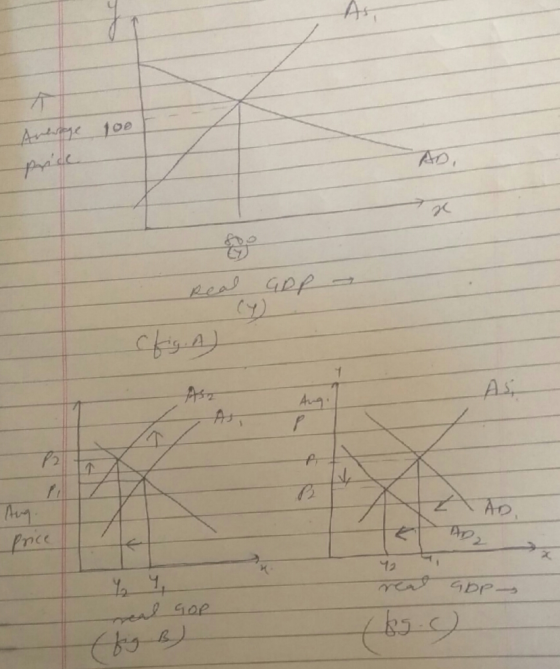
Putting P in any of the equations 1 or 2, we get Equilibrium quantity as 800 units. Refer fig.A. below
6.
Initial equilibrium is at P= 100 and quantity = 800 units (It is Y1 and p1 in diagrams B and C)
a. Increasing minimum wage will cost of production to rise and hence aggregate supply will shift to left. Average price will go up from p1 to p2. and economy will produce less than its potential. This is stagflation as prices are rising and GDP is shifting to left(less than potential). Refer fig. B below.
b. If consumer confidence drops then Aggregate demand will shift to left. Average price levels will come down from P1 to P2 and real GDP will shift to left. This is deflationary pressure in an economy. Refer fig. C below.
Add Answer to:
*Question 6 GOES WITH QUESTION 5 it’s not a different question
*
5. An economy’s AD...
Check And < Question 11 of 13 > The graphs below illustrate an initial equilibrium for...
 Check And < Question 11 of 13 > The graphs below illustrate an initial equilibrium for the economy. Suppose that investment spending falls. Use the graphs to show the new positions of aggregate demand (AD), short-run aggregate supply (SRAS), and long-run aggregate supply (LRAS) in both the short-run and the long-run, as well as the short-run and long-run equilibria resulting from this change. Then answer what happens to the price level and GDP. Short-run graph SRAS Short-run equilibrium Aggregate price...
The graphs illustrate an initial equilibrium for the economy. Suppose that oil prices temporarily decrease Use...
 The graphs illustrate an initial equilibrium for the economy. Suppose that oil prices temporarily decrease Use the graphs to show the new positions of aggregate demand (AD), short-run aggregate supply (SRAS), and long-run aggregate supply (LRAS) in both the short run and the long run, as well as the short-run and long-run equilibriums resulting from this change. Then, indicate what happens to the price level and GDP in the short run and in the long run. Short-run graph Long-run graph...
graph requires adjustment Question 8 of 16 > The accompanying graphs illustrate an initial equilibrium for...
 graph requires adjustment
Question 8 of 16 > The accompanying graphs illustrate an initial equilibrium for the economy. Suppose that a snowstorm destroys a large number of corn crops. Use the graphs to show the new positions of aggregate demand (AD), short-run aggregate supply (SRAS), and long-run aggregate supply (LRAS) in both the short-run and the long-run, as well as the short-run (Esr) and long-run (Eur) equilibria resulting from this change. Then answer what happens to the price level and...
graph requires adjustment
Question 8 of 16 > The accompanying graphs illustrate an initial equilibrium for the economy. Suppose that a snowstorm destroys a large number of corn crops. Use the graphs to show the new positions of aggregate demand (AD), short-run aggregate supply (SRAS), and long-run aggregate supply (LRAS) in both the short-run and the long-run, as well as the short-run (Esr) and long-run (Eur) equilibria resulting from this change. Then answer what happens to the price level and...
The graphs illustrate an initial equilibrium for the economy. Suppose that the stock market broadly decreases....
 The graphs illustrate an initial equilibrium for the economy. Suppose that the stock market broadly decreases. Use the graphs to show the new positions of aggregate demand (AD), short-run aggregate supply (SRAS), and long-run aggregate supply (LRAS) in both the short run and the long run, as well as the short-run and long-run equilibriums resulting from this change. Then, indicate what happens to the price level and GDP in the short run and in the long run. Short-run graph Long-run...
AD-AS and Phillip Curve Model, Money Market and Banking System Graphically illustrate an economy in the...
AD-AS and Phillip Curve Model, Money Market and Banking System Graphically illustrate an economy in the long run equilibrium, producing at the full employment level of production. Indicate the equilibrium Price level (P*) and the level of real GDP (Y*) Graphically illustrate an economy in the short run equilibrium producing at a below full employment level of production. Indicate the equilibrium Price level (P*) and the level of real GDP (Y*) and show the amount of the recessionary gap. Graphically...
The graph below depicts the aggregate demand, Irrun aggregate supply, and short-run aggregate supply curves for...
 The graph below depicts the aggregate demand, Irrun aggregate supply, and short-run aggregate supply curves for the United States at an initial long-run macroeconomic equilibrium Price level] (P) LRAS SRAS Real GDP Consider a situation in which two things happen simultaneously: there is a deterioration of institutions, and the federal government massively increases spending. Which of the graphs below illustrates the shifts in this model given this situation? Price level Price level (P) (P) URAS LRAS, LRAS SRAS SRAS SRAS...
Suppose the economy starts out in a long-run equilibrium at potential GDP.. Draw the economy’s short-run...
Suppose the economy starts out in a long-run equilibrium at potential GDP.. Draw the economy’s short-run and long-run Phillips curves in one graph an AS/AD diagram with potential GDP shown in a second graph. Suppose a wave of business pessimism reduces aggregate demand. Show the effect of this shock on your diagrams from part a). Can the government return the economy to its original inflation rate and original unemployment rate using fiscal policy? Now start over with the economy back...
1. Suppose a boom in stock market prices helps make people feel wealthier. Using the model...
1. Suppose a boom in stock market prices helps make people feel wealthier. Using the model of aggregate demand and aggregate supply, identify and illustrate the curves that are affected, and which direction these curves would shift. In your own words, explain what happens to price level and real GDP and equilibrium? (Hint: Graph your own AD/AS model to answer part of the question) Aggregate demand and aggregate supply macroeconomics
Assignment Score: NaN% Resources Hint Check Answer Question 4 of 13 > The graph shows the...
 Assignment Score: NaN% Resources Hint Check Answer Question 4 of 13 > The graph shows the aggregate demand (AD) curve and the long-run aggregate supply (LRAS) curve for a hypothetical economy. Suppose that the economy experiences an increase in the human capital of workers, causing productivity to rise Show the effect of this change by shifting one of the curves in the graph. How will this change affect the price level? The price level will rise. The price level will...
Using aggregate demand (AD), short-run aggregate supply (SRAS) and long-run aggregate supply (LRAS) curves
Question 1: AD-SRAS-LRAS Model Using aggregate demand (AD), short-run aggregate supply (SRAS) and long-run aggregate supply (LRAS) curves, graphically illustrate the effect of an increase in the money supply on output and prices in the short and long run. Assume that the economy is initially in long run equilibrium at the potential output level and prices are fixed in the short-run. In your graph, label "A" for the initial equilibrium, "B' for the short-run equilibrium, and "C" for the long-run equilibrium.
 Check And < Question 11 of 13 > The graphs below illustrate an initial equilibrium for the economy. Suppose that investment spending falls. Use the graphs to show the new positions of aggregate demand (AD), short-run aggregate supply (SRAS), and long-run aggregate supply (LRAS) in both the short-run and the long-run, as well as the short-run and long-run equilibria resulting from this change. Then answer what happens to the price level and GDP. Short-run graph SRAS Short-run equilibrium Aggregate price...
 The graphs illustrate an initial equilibrium for the economy. Suppose that oil prices temporarily decrease Use the graphs to show the new positions of aggregate demand (AD), short-run aggregate supply (SRAS), and long-run aggregate supply (LRAS) in both the short run and the long run, as well as the short-run and long-run equilibriums resulting from this change. Then, indicate what happens to the price level and GDP in the short run and in the long run. Short-run graph Long-run graph...
 graph requires adjustment
Question 8 of 16 > The accompanying graphs illustrate an initial equilibrium for the economy. Suppose that a snowstorm destroys a large number of corn crops. Use the graphs to show the new positions of aggregate demand (AD), short-run aggregate supply (SRAS), and long-run aggregate supply (LRAS) in both the short-run and the long-run, as well as the short-run (Esr) and long-run (Eur) equilibria resulting from this change. Then answer what happens to the price level and...
graph requires adjustment
Question 8 of 16 > The accompanying graphs illustrate an initial equilibrium for the economy. Suppose that a snowstorm destroys a large number of corn crops. Use the graphs to show the new positions of aggregate demand (AD), short-run aggregate supply (SRAS), and long-run aggregate supply (LRAS) in both the short-run and the long-run, as well as the short-run (Esr) and long-run (Eur) equilibria resulting from this change. Then answer what happens to the price level and...
 The graphs illustrate an initial equilibrium for the economy. Suppose that the stock market broadly decreases. Use the graphs to show the new positions of aggregate demand (AD), short-run aggregate supply (SRAS), and long-run aggregate supply (LRAS) in both the short run and the long run, as well as the short-run and long-run equilibriums resulting from this change. Then, indicate what happens to the price level and GDP in the short run and in the long run. Short-run graph Long-run...
 The graph below depicts the aggregate demand, Irrun aggregate supply, and short-run aggregate supply curves for the United States at an initial long-run macroeconomic equilibrium Price level] (P) LRAS SRAS Real GDP Consider a situation in which two things happen simultaneously: there is a deterioration of institutions, and the federal government massively increases spending. Which of the graphs below illustrates the shifts in this model given this situation? Price level Price level (P) (P) URAS LRAS, LRAS SRAS SRAS SRAS...
 Assignment Score: NaN% Resources Hint Check Answer Question 4 of 13 > The graph shows the aggregate demand (AD) curve and the long-run aggregate supply (LRAS) curve for a hypothetical economy. Suppose that the economy experiences an increase in the human capital of workers, causing productivity to rise Show the effect of this change by shifting one of the curves in the graph. How will this change affect the price level? The price level will rise. The price level will...
Most questions answered within 3 hours.
-
Where is the error in this code sequence?
String s1 = "Hello";
String s2 = "ello";...
asked 10 months ago -
Financial data for Joel de Paris, Inc., for last year
follow:
Joel de Paris, Inc.
Balance...
asked 10 months ago -
Consider this reaction:
Al2(SO4)3 (aq)+ BaCl3
(aq) Al2Cl6 (aq)- +
3BaSO4(s) . What is the...
asked 10 months ago -
Suppose that Savneet is considering increasing her
recent random sample from 20 car rentals to 40...
asked 10 months ago -
Trucks arrive at an unloading terminal at an average rate of 120
per hour.
Trucks arrive...
asked 10 months ago -
Why are methanol and ethanol completely soluble in water while
octanol is not very little soluble....
asked 10 months ago -
A facilities manager at a university reads in a research report
that the mean amount of...
asked 10 months ago -
When the CuSO4 is rehydrated by adding water to the anhydrous
compound, is this an endothermic...
asked 10 months ago -
A ray of sunlight is passing from diamond into crown glass; the
angle of incidence is...
asked 10 months ago -
A block of mass 0.249 kg is placed on top of a light, vertical
spring of...
asked 10 months ago -
how do the kidneys compensate in the presences of acidosis
a) trigger hyperventilate
b) reserve acid...
asked 10 months ago -
Question 501 pts
The rental rate of capital to the firm increases. Which of the
following...
asked 10 months ago