Q) What is the kinetic energy, in joules, of a molecule of oxygen moving at a...
Q) What is the kinetic energy, in joules, of a molecule of oxygen moving at a speed of 255 m/s(use the appropriate prefix to avoid exponential notation)
a) The equation for kinetic energy is ½mv2, and is in units of joules. What are the component units for joules in terms of mass and velocity?
kg m^2/s^2
b) From the previous part, we know that the mass needs to be in units of kg. What is the mass of an oxygen molecule in kg?
mass= 5.31E-26 kg
c) Finally, using the mass you calculated in the previous part and the velocity given in the problem, calculate the kinetic energy of one oxygen molecule moving at 255 m/s. Note the units given: 1 aJ = 10-18 J.
Homework Answers
K.E = 1/2 mv^2
S.I unit of energy is Joules
So unit of mass and velocity should be S.I
unit of mass = kg
unit of velocity = m/s
************
b)
molar mass of O2 = 32 g/mol
1 mol has 6.022 x10^23 molecules
so mass of 1 molecule O2 = [ 1 mol/6.022 x10^23 ]* 32 g/mol
= 5.31 x10^-23 g
=5.31 x10^-26 kg
***********************
c)
K.E = 1/2 [5.31 x10^-26 kg]*[255 m/s]^2 = 172641. x10^-26 J
Answer
K.E = 1.73E-21 J
= 1.73E-3 aJ
******************************
Add Answer to:
Q) What is the kinetic energy, in joules, of a molecule of
oxygen moving at a...
i) Mass 1 is initially moving in the +x direction and has 20 Joules of kinetic...
i) Mass 1 is initially moving in the +x direction and has 20 Joules of kinetic energy. It collides perfectly elastically with mass 2 moving at in the -x direction with 14 Joules of kinetic energy. After the collision, mass 2 has 20 Joules of kinetic energy. How much kinetic energy does mass 1 have after the collision in Joules? (Note: the masses are not needed to answer this question.) ii) Mass 1 of 10 kg is initially moving at...
We learned in class that the kinetic energy (KE) of an object with mass m moving...
We learned in class that the kinetic energy (KE) of an object with mass m moving at velocity v is KE =½ m v^2. Accordingly, the kinetic energy (KE) per unit mass (m) of a body moving at velocity v is KE/m=v^2 /2. What is the asteroid’s kinetic energy per unit mass (J/kg) for an impact at this velocity? State your answer in units of J/kg. velocity is 29.8 km/s
FIGURE 6-39 Problem 14. (b) 3 Kinetic Energy; Work-Energy Principle At room temperature, an oxygen molecule,...
 FIGURE 6-39 Problem 14. (b) 3 Kinetic Energy; Work-Energy Principle At room temperature, an oxygen molecule, with mass 531 10-20 kg, typically has a kinetic energy of about 621 X 10-21 J. How fast is it moving? 17. (I) How much work is required to stop an electron (m = 9.11 X 10+ kg) which is moving with a speed of 1.10 x 10 m/s? 15 wange? 33
9.8 What is the kinetic energy of a single molecule of oxygen if it is travelling...
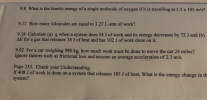 9.8 What is the kinetic energy of a single molecule of oxygen if it is travelling at 1.5 x 10³ m/s? 9.12 How many kilojoules are equal to 3.27 L-atm of work? 9.18 Calculate (a) q when a system does 54 J of work and its energy decreases by 72 J and (b) AE for a gas that releases 38 J of heat and has 102 J of work done on it. 9.02 For a car weighing 980 kg, how...
What is the kinetic energy in Joules of a 8,699.2 kg truck moving at 63.9 km/hr?
What is the kinetic energy in Joules of a 8,699.2 kg truck moving at 63.9 km/hr?
What is the kinetic energy in Joules of a 7,320.4 kg truck moving at 81.1 km/hr?
What is the kinetic energy in Joules of a 7,320.4 kg truck moving at 81.1 km/hr?
1.) Kinetic Energy Part A) What is the kinetic energy of a proton moving at 1.40x10⁶...
1.) Kinetic Energy Part A) What is the kinetic energy of a proton moving at 1.40x10⁶ m/s? Part B)How about a 1300 kg car moving at 60 mph?
a In mechanics, the energy of a moving body is called kinetic energy. If an object...
 a In mechanics, the energy of a moving body is called kinetic energy. If an object of mass (kilograms) is moving with a velocity v (meters per second), then the kinetic energy k( joules) is given by the equation ke we model the mass and inputs to a system (moving body) and the energy as output, then obnerve the system for while and deduce the following two rules of inference based on our observations Rule 1: IF x is small...
Find the uncertainty in kinetic energy. Kinetic energy depends on mass and velocity according to this...
Find the uncertainty in kinetic energy. Kinetic energy depends on mass and velocity according to this function E(m,v) = 1/2 m v2. Your measured mass and velocity have the following uncertainties Sm= 1.49 kg and Sv= 2.31 m/s. What is is the uncertainty in energy, SE , if the measured mass, m = 2.3 kg and the measured velocity, v = 13.42 m/s? Units are not needed in your answer. Find the uncertainty in kinetic energy. Kinetic energy depends on...
6. (10 pts) What is the kinetic energy in joules) of a 4000 lb car moving...
 6. (10 pts) What is the kinetic energy in joules) of a 4000 lb car moving at 60 mph? S hox 30m across a level floor
 FIGURE 6-39 Problem 14. (b) 3 Kinetic Energy; Work-Energy Principle At room temperature, an oxygen molecule, with mass 531 10-20 kg, typically has a kinetic energy of about 621 X 10-21 J. How fast is it moving? 17. (I) How much work is required to stop an electron (m = 9.11 X 10+ kg) which is moving with a speed of 1.10 x 10 m/s? 15 wange? 33
 9.8 What is the kinetic energy of a single molecule of oxygen if it is travelling at 1.5 x 10³ m/s? 9.12 How many kilojoules are equal to 3.27 L-atm of work? 9.18 Calculate (a) q when a system does 54 J of work and its energy decreases by 72 J and (b) AE for a gas that releases 38 J of heat and has 102 J of work done on it. 9.02 For a car weighing 980 kg, how...
 a In mechanics, the energy of a moving body is called kinetic energy. If an object of mass (kilograms) is moving with a velocity v (meters per second), then the kinetic energy k( joules) is given by the equation ke we model the mass and inputs to a system (moving body) and the energy as output, then obnerve the system for while and deduce the following two rules of inference based on our observations Rule 1: IF x is small...
 6. (10 pts) What is the kinetic energy in joules) of a 4000 lb car moving at 60 mph? S hox 30m across a level floor
Most questions answered within 3 hours.
-
Where is the error in this code sequence?
String s1 = "Hello";
String s2 = "ello";...
asked 11 months ago -
Financial data for Joel de Paris, Inc., for last year
follow:
Joel de Paris, Inc.
Balance...
asked 11 months ago -
Consider this reaction:
Al2(SO4)3 (aq)+ BaCl3
(aq) Al2Cl6 (aq)- +
3BaSO4(s) . What is the...
asked 11 months ago -
Suppose that Savneet is considering increasing her
recent random sample from 20 car rentals to 40...
asked 11 months ago -
Trucks arrive at an unloading terminal at an average rate of 120
per hour.
Trucks arrive...
asked 11 months ago -
Why are methanol and ethanol completely soluble in water while
octanol is not very little soluble....
asked 11 months ago -
A facilities manager at a university reads in a research report
that the mean amount of...
asked 11 months ago -
When the CuSO4 is rehydrated by adding water to the anhydrous
compound, is this an endothermic...
asked 11 months ago -
A ray of sunlight is passing from diamond into crown glass; the
angle of incidence is...
asked 11 months ago -
A block of mass 0.249 kg is placed on top of a light, vertical
spring of...
asked 11 months ago -
how do the kidneys compensate in the presences of acidosis
a) trigger hyperventilate
b) reserve acid...
asked 11 months ago -
Question 501 pts
The rental rate of capital to the firm increases. Which of the
following...
asked 11 months ago