A construction firm is deciding on whether to bid on a government project. The preparation of...
A construction firm is deciding on whether to bid on a government
project. The preparation of the bid costs $100,000 and has a 25%
chance of success. If the bid is successful, then the firm has an
80% chance of making $500,000 and a 20% chance of losing $200,000,
minus the cost of the bid preparation. If the bid fails, the cost
of bid preparation is lost. If the firm decides not to bid, the
money it would have spent on bid preparation accrues 10%
interest.
(a) Construct a decision tree to account for all decision
alternatives, states of nature, and associated payoffs.
(b) Calculate the expected payoff if the firm decides to bid.
(c) According to your analysis, recommend whether the firm should
bid or not bid based on the expected value approach.
Homework Answers
(a)
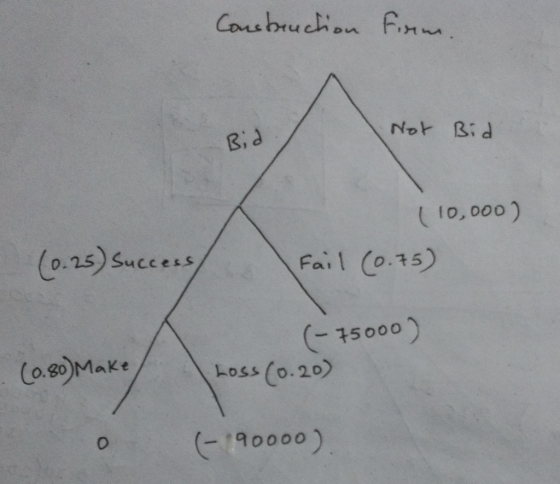
(b) If the firm decides to bid, then there will be 2 outcomes: Sucess and Fail with a probability of 0.25 and 0.75 respectively.
Expected pay-off if the firm bids and it fails = p(loss)* total cost = 0.75* 100000 = -75000 [negative sign denotes loss]
there are 2 outcomes if the firm's bid is successful: Make Profit OR Loss with a probability of 0.80 and 0.20 respectively.
Expected pay-off if the firm's bid is successful and makes profit = [p(success)* p(making profit) * 500,000] - [cost of bid]
= (0.25*0.80*500,000) - 100,000
=100000 - 100000 = 0
Expected pay-off if the firm's bid is successful and inccur a loss = [p(success)*p(loss)*200,000] - [cost of bid]
=(0.25*0.20*200000)- 100000
=10000 - 100000 = - 90000 [negative sign denotes loss]
(c) From the above analysis we can say that the firm should not bid as he is worse off even when the bidding is successful and he makes a profit.
Expected pay-off if the firm does not bid = (10/100)*100000 = 10000
The Firm should not bid.
Add Answer to:
A construction firm is deciding on whether to bid on a government
project. The preparation of...
A contractor is deciding between submitting a bid for either a highway or a dam project (he cannot submit bids for both...
 A contractor is deciding between submitting a bid for either a highway or a dam project (he cannot submit bids for both). The estimated bid price for the highway job is $1.5M (million), that for the dam is S3M. Cost for preparing a bid is 2% of the bid price, and estimated net profit is 10% of the bid price. The contractor estimates there is 70% chance to win the highway job, but only a 50-50 chance for getting the...
5. An investor is deciding whether to build a retail store. If she invests in the store and it is successful, she e...
 5. An investor is deciding whether to build a retail store. If she invests in the store and it is successful, she expects a return of $100,000 in the first year. If the store is not successful, she will suffer a loss of $80,000. She guesses that the probability that the store will be a success is 0.6. To remove some of the uncertainty from this decision, the investor tries to establish more information, but this market research will cost...
Decision Tree A company is trying to decide whether to bid for a certain contract or...
Decision Tree A company is trying to decide whether to bid for a certain contract or not. They estimate that merely preparing the bid will cost $10,000. If their company bids, then they estimate that there is a 50% chance that their bid will be put on the “short-list”, otherwise their bid will be rejected. Once “short-listed”, the company will have to supply further detailed information (entailing costs estimated at $5,000). After this stage, their bid will either be accepted...
Q6. Kay Medical Supplies (KMS Ltd) is a small company that manufactures nitrile and synthetic gloves....
 Q6. Kay Medical Supplies (KMS Ltd) is a small company that manufactures nitrile and synthetic gloves. In the light of the ongoing pandemic, the company has expanded its production line by manufacturing a new type of latex gloves. The company is deciding whether or not to submit an Expression of Interest (Eol) for a governmental contract for hospital supplies. KMC Ltd has estimated that the preparation of the Eol has an associated cost of £35,000. If the company decides to...
Q6. Kay Medical Supplies (KMS Ltd) is a small company that manufactures nitrile and synthetic gloves....
 Q6. Kay Medical Supplies (KMS Ltd) is a small company that manufactures nitrile and synthetic gloves. In the light of the ongoing pandemic, the company has expanded its production line by manufacturing a new type of latex gloves. The company is deciding whether or not to submit an Expression of Interest (Eol) for a governmental contract for hospital supplies. KMC Ltd has estimated that the preparation of the Eol has an associated cost of £35,000. If the company decides to...
3. For this decision tree question all the information is about costs, so when comparing the...
 3. For this decision tree question all the information is about costs, so when comparing the expected net present value, you are looking for the decisions with the lowest cost. Also assume all values are already in present value terms. (no discounting required) A forest company is deciding on whether or not to comply with government regulations regarding harvesting practices. The cost of compliance is $100,000. The cost of non compliance involves uncertainty. There is a 70% chance of not...
Need help solving these questions Your company is deciding whether to invest in a new machine....
 Need help solving these questions
Your company is deciding whether to invest in a new machine. The new machine will increase cash flow by $328,420 per year. You believe the technology used in the machine has a 10-year life; in other words, no matter when you purchase the machine, it will be obsolete 10 years from today. The machine is currently priced at $1,760,000. The cost of the machine will decline by $110,000 per year until it reaches $1,320,000, where...
Need help solving these questions
Your company is deciding whether to invest in a new machine. The new machine will increase cash flow by $328,420 per year. You believe the technology used in the machine has a 10-year life; in other words, no matter when you purchase the machine, it will be obsolete 10 years from today. The machine is currently priced at $1,760,000. The cost of the machine will decline by $110,000 per year until it reaches $1,320,000, where...
Newfoundland Energy System In the early 2000s, Newfoundland Energy System (NES) was deciding how much to...
Newfoundland Energy System In the early 2000s, Newfoundland Energy System (NES) was deciding how much to bid for the salvage rights to a grounded ship, the SS Klondike. If the bid were successful, the ship could be repaired and outfitted to haul coal for the company’s power-generation stations. But the value of doing so depended on the outcome of a U.S. Coast Guard judgment about the salvage value of the ship. The Coast Guard’s judgment involved an obscure law regarding...
The Newox Company is considering whether or not to drill for natural gas on its own...
The Newox Company is considering whether or not to drill for natural gas on its own land. If they drill, their initial expenditure will be $44,000 for drilling costs. If they strike gas, they must spend an additional $33,000 to cap the well and provide the necessary hardware and control equipment. (This $33,000 cost is not a decision; it is associated with the event "strike gas.") If they decide to drill but no gas is found, there are no other...
work 3.pdf X + ork 3.pdf?target=4df5354f-43de-4868-bae8-6d46f03c0f7d 1. Stephen Owsu is deciding whether he should get into...
 work 3.pdf X + ork 3.pdf?target=4df5354f-43de-4868-bae8-6d46f03c0f7d 1. Stephen Owsu is deciding whether he should get into the MBA program at a state university or not. The tuition and books for this program will cost him $60,000. If he starts the MBA program, he has to give up his current position as a financial advisor at Edward Jones which pays him $42,000 a year (after tax). On average, an MBA graduates will make an extra $25.000 per year over a business...
 A contractor is deciding between submitting a bid for either a highway or a dam project (he cannot submit bids for both). The estimated bid price for the highway job is $1.5M (million), that for the dam is S3M. Cost for preparing a bid is 2% of the bid price, and estimated net profit is 10% of the bid price. The contractor estimates there is 70% chance to win the highway job, but only a 50-50 chance for getting the...
 5. An investor is deciding whether to build a retail store. If she invests in the store and it is successful, she expects a return of $100,000 in the first year. If the store is not successful, she will suffer a loss of $80,000. She guesses that the probability that the store will be a success is 0.6. To remove some of the uncertainty from this decision, the investor tries to establish more information, but this market research will cost...
 Q6. Kay Medical Supplies (KMS Ltd) is a small company that manufactures nitrile and synthetic gloves. In the light of the ongoing pandemic, the company has expanded its production line by manufacturing a new type of latex gloves. The company is deciding whether or not to submit an Expression of Interest (Eol) for a governmental contract for hospital supplies. KMC Ltd has estimated that the preparation of the Eol has an associated cost of £35,000. If the company decides to...
 Q6. Kay Medical Supplies (KMS Ltd) is a small company that manufactures nitrile and synthetic gloves. In the light of the ongoing pandemic, the company has expanded its production line by manufacturing a new type of latex gloves. The company is deciding whether or not to submit an Expression of Interest (Eol) for a governmental contract for hospital supplies. KMC Ltd has estimated that the preparation of the Eol has an associated cost of £35,000. If the company decides to...
 3. For this decision tree question all the information is about costs, so when comparing the expected net present value, you are looking for the decisions with the lowest cost. Also assume all values are already in present value terms. (no discounting required) A forest company is deciding on whether or not to comply with government regulations regarding harvesting practices. The cost of compliance is $100,000. The cost of non compliance involves uncertainty. There is a 70% chance of not...
 Need help solving these questions
Your company is deciding whether to invest in a new machine. The new machine will increase cash flow by $328,420 per year. You believe the technology used in the machine has a 10-year life; in other words, no matter when you purchase the machine, it will be obsolete 10 years from today. The machine is currently priced at $1,760,000. The cost of the machine will decline by $110,000 per year until it reaches $1,320,000, where...
Need help solving these questions
Your company is deciding whether to invest in a new machine. The new machine will increase cash flow by $328,420 per year. You believe the technology used in the machine has a 10-year life; in other words, no matter when you purchase the machine, it will be obsolete 10 years from today. The machine is currently priced at $1,760,000. The cost of the machine will decline by $110,000 per year until it reaches $1,320,000, where...
 work 3.pdf X + ork 3.pdf?target=4df5354f-43de-4868-bae8-6d46f03c0f7d 1. Stephen Owsu is deciding whether he should get into the MBA program at a state university or not. The tuition and books for this program will cost him $60,000. If he starts the MBA program, he has to give up his current position as a financial advisor at Edward Jones which pays him $42,000 a year (after tax). On average, an MBA graduates will make an extra $25.000 per year over a business...
Most questions answered within 3 hours.
-
Where is the error in this code sequence?
String s1 = "Hello";
String s2 = "ello";...
asked 10 months ago -
Financial data for Joel de Paris, Inc., for last year
follow:
Joel de Paris, Inc.
Balance...
asked 10 months ago -
Consider this reaction:
Al2(SO4)3 (aq)+ BaCl3
(aq) Al2Cl6 (aq)- +
3BaSO4(s) . What is the...
asked 10 months ago -
Suppose that Savneet is considering increasing her
recent random sample from 20 car rentals to 40...
asked 10 months ago -
Trucks arrive at an unloading terminal at an average rate of 120
per hour.
Trucks arrive...
asked 10 months ago -
Why are methanol and ethanol completely soluble in water while
octanol is not very little soluble....
asked 10 months ago -
A facilities manager at a university reads in a research report
that the mean amount of...
asked 10 months ago -
When the CuSO4 is rehydrated by adding water to the anhydrous
compound, is this an endothermic...
asked 10 months ago -
A ray of sunlight is passing from diamond into crown glass; the
angle of incidence is...
asked 10 months ago -
A block of mass 0.249 kg is placed on top of a light, vertical
spring of...
asked 10 months ago -
how do the kidneys compensate in the presences of acidosis
a) trigger hyperventilate
b) reserve acid...
asked 10 months ago -
Question 501 pts
The rental rate of capital to the firm increases. Which of the
following...
asked 10 months ago