# This program calculates the ending principal in a bank # account after compounding the interest....
# This program calculates the ending principal in a bank
# account after compounding the interest.
def calculate_principal_post_interest(principal, annual_interest_rate, compounds_per_year, years):
"""
:param principal: Positive float
:param annual_interest_rate: A positive integer (e.g. 6 for 6%)
:param compounds_per_year: A positive integer
:param years: A positive integer
:return:
"""
#raise NotImplementedError
P = principal
r = annual_interest_rate
n = compounds_per_year
t = years
return round(P * ((1 + (r / n)) ** (n * t)), 2)
Homework Answers
CODE
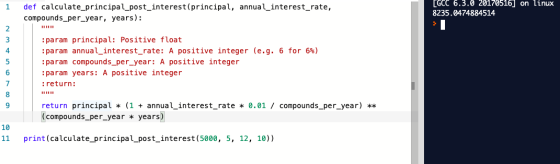
def calculate_principal_post_interest(principal, annual_interest_rate, compounds_per_year, years):
"""
:param principal: Positive float
:param annual_interest_rate: A positive integer (e.g. 6 for 6%)
:param compounds_per_year: A positive integer
:param years: A positive integer
:return:
"""
return principal * (1 + annual_interest_rate * 0.01 / compounds_per_year) ** (compounds_per_year * years)
print(calculate_principal_post_interest(5000, 5, 12, 10))
Add Answer to:
# This program calculates the ending principal in a bank
# account after compounding the interest....
Write a program in Python that computes the interest accrued on an account. You can modify...
Write a program in Python that computes the interest accrued on an account. You can modify the “futval.py” program given in Chapter 2 to accomplish it. Your program should use a counted loop rather than a formula. It should prompt the user to enter the principal amount, the yearly interest rate as a decimal number, the number of compounding periods in a year, and the duration. It should display the principal value at the end of the duration. To compute...
14.Compound Interest hank account pays compound interest, it pays interest not only on the principal amount...
 14.Compound Interest hank account pays compound interest, it pays interest not only on the principal amount that was deposited into the account, but also on the interest that has accumulated over time. Suppose you want to deposit some money into a savings account, and let the account earn compound interest for a certain number of years. The formula for calculating the balance of the account afer a specified namber of years is The terms in the formula are A is...
in python language. 3. Calculates the final amount (A). The program uses four inputs: P, n,r,...
 in python language.
3. Calculates the final amount (A). The program uses four inputs: P, n,r, and t. Hint: nt 1 = P(1+3) Where • P = principal amount (initial investment) . r= annual nominal interest rate (as a decimal) • n = number of times the interest is compounded per year . t = number of years
in python language.
3. Calculates the final amount (A). The program uses four inputs: P, n,r, and t. Hint: nt 1 = P(1+3) Where • P = principal amount (initial investment) . r= annual nominal interest rate (as a decimal) • n = number of times the interest is compounded per year . t = number of years
. (Financial application: compound value) If you start a bank account with $10,000 and your bank...
. (Financial application: compound value) If you start a bank account with $10,000 and your bank compounds the interest quarterly (4 times per year) at an interest rate of 8%, how much money do you have at the year's end? (assume that you do not add or withdraw any money from the account). A=P(1+r/n)n * t A: Final amount, r: interest rate, P: principal amount, n: number of times per year interest is compounded, t: number of years must be...
%%Python Question%% get_min_payment() • Parameters ◦ the total amount of the mortgage (called the principal; should...
%%Python Question%% get_min_payment() • Parameters ◦ the total amount of the mortgage (called the principal; should be a positive number) ◦ the annual interest rate (should be a float between 0 and 1) ◦ the term of the mortgage, in years (should be a positive integer; default value: 30) ◦ the number of payments per year (should be a positive integer; default value: 12) • Functionality ◦ Compute the minimum mortgage payment. Should use the formula A= Pr(1+r) n (1+r)...
A person puts $400.00 into a savings account with 2.4% annual interest rate (computed continuously). The...
 A person puts $400.00 into a savings account with 2.4% annual
interest rate (computed continuously). The value of such an
investment is given by:
V=Pe(rt), where P is principal invested, r is the annual interest
rate, and t is the number of years receiving interest. How many
years are required before the total interest is
increased by > $1.00 due to compounding interest? Round up to
the nearest whole year. Without compounding, the total interest
amount would have been P...
A person puts $400.00 into a savings account with 2.4% annual
interest rate (computed continuously). The value of such an
investment is given by:
V=Pe(rt), where P is principal invested, r is the annual interest
rate, and t is the number of years receiving interest. How many
years are required before the total interest is
increased by > $1.00 due to compounding interest? Round up to
the nearest whole year. Without compounding, the total interest
amount would have been P...
Future Value of Account A Note: Account A pays simple interest. Future ValueA = Principal +...
 Future Value of Account A Note: Account A pays simple interest. Future ValueA = Principal + Interest Principal + [(Principal x Interest Rate) x Investment Period] $2,000 + [($2,000 x 996) x 3 years] = Round your answer to two decimal places. Future Value of Account X Note: Account X pays compound interest. Future Valuex = Present Value x Interest Rate Factor Present Valuex(1 +Interest Rate)n years $2,000 x (1 + 0.09)3 = - Round your answer to two decimal...
In lecture, Professor Gruber explained discrete compounding interest. Interest can also be compounded continuously. Here we...
 In lecture, Professor Gruber explained discrete compounding interest. Interest can also be compounded continuously. Here we explain the difference. Professor Gruber calculated future value as FV = P(1+r)", where P is the principal, r is the interest rate, and t is the term of the contract (often in years). This formula can be generalized to FV = P(1+r/m)mt, where m is the number of compounding periods per year (in lecture, this was 1). That is, after every compounding period, more...
Future Value of Account A Note: Account A pays simple interest. Future Value Principal + Interest...
 Future Value of Account A Note: Account A pays simple interest. Future Value Principal + Interest Principal + [(Principal x Interest Rate) x Investment Period] $2,000 + [($2,000 x 6%) x 3 years] Future Value of Account X Note: Account X pays compound interest. Future Valuex = Present Value x Interest Rate Factor Present Value x (1 + Interest Rate)N $2,000 (1 + 0.06)3 $ To find the interest rate factor, you can use four different ways, including multiplying it...
Write a program that calculates the amount of money that you must invest In a savings...
 Write a program that calculates the amount of money that you must invest In a savings account at a given interest rate for a given number of years to have a certain dollar amount at me end of the period Y our program will ask the user for the amount the user wants to have at the end of the term (future value). the number of years the user plans to let the money stay in the account, and the...
 14.Compound Interest hank account pays compound interest, it pays interest not only on the principal amount that was deposited into the account, but also on the interest that has accumulated over time. Suppose you want to deposit some money into a savings account, and let the account earn compound interest for a certain number of years. The formula for calculating the balance of the account afer a specified namber of years is The terms in the formula are A is...
 in python language.
3. Calculates the final amount (A). The program uses four inputs: P, n,r, and t. Hint: nt 1 = P(1+3) Where • P = principal amount (initial investment) . r= annual nominal interest rate (as a decimal) • n = number of times the interest is compounded per year . t = number of years
in python language.
3. Calculates the final amount (A). The program uses four inputs: P, n,r, and t. Hint: nt 1 = P(1+3) Where • P = principal amount (initial investment) . r= annual nominal interest rate (as a decimal) • n = number of times the interest is compounded per year . t = number of years
 A person puts $400.00 into a savings account with 2.4% annual
interest rate (computed continuously). The value of such an
investment is given by:
V=Pe(rt), where P is principal invested, r is the annual interest
rate, and t is the number of years receiving interest. How many
years are required before the total interest is
increased by > $1.00 due to compounding interest? Round up to
the nearest whole year. Without compounding, the total interest
amount would have been P...
A person puts $400.00 into a savings account with 2.4% annual
interest rate (computed continuously). The value of such an
investment is given by:
V=Pe(rt), where P is principal invested, r is the annual interest
rate, and t is the number of years receiving interest. How many
years are required before the total interest is
increased by > $1.00 due to compounding interest? Round up to
the nearest whole year. Without compounding, the total interest
amount would have been P...
 Future Value of Account A Note: Account A pays simple interest. Future ValueA = Principal + Interest Principal + [(Principal x Interest Rate) x Investment Period] $2,000 + [($2,000 x 996) x 3 years] = Round your answer to two decimal places. Future Value of Account X Note: Account X pays compound interest. Future Valuex = Present Value x Interest Rate Factor Present Valuex(1 +Interest Rate)n years $2,000 x (1 + 0.09)3 = - Round your answer to two decimal...
 In lecture, Professor Gruber explained discrete compounding interest. Interest can also be compounded continuously. Here we explain the difference. Professor Gruber calculated future value as FV = P(1+r)", where P is the principal, r is the interest rate, and t is the term of the contract (often in years). This formula can be generalized to FV = P(1+r/m)mt, where m is the number of compounding periods per year (in lecture, this was 1). That is, after every compounding period, more...
 Future Value of Account A Note: Account A pays simple interest. Future Value Principal + Interest Principal + [(Principal x Interest Rate) x Investment Period] $2,000 + [($2,000 x 6%) x 3 years] Future Value of Account X Note: Account X pays compound interest. Future Valuex = Present Value x Interest Rate Factor Present Value x (1 + Interest Rate)N $2,000 (1 + 0.06)3 $ To find the interest rate factor, you can use four different ways, including multiplying it...
 Write a program that calculates the amount of money that you must invest In a savings account at a given interest rate for a given number of years to have a certain dollar amount at me end of the period Y our program will ask the user for the amount the user wants to have at the end of the term (future value). the number of years the user plans to let the money stay in the account, and the...
Most questions answered within 3 hours.
-
Where is the error in this code sequence?
String s1 = "Hello";
String s2 = "ello";...
asked 10 months ago -
Financial data for Joel de Paris, Inc., for last year
follow:
Joel de Paris, Inc.
Balance...
asked 10 months ago -
Consider this reaction:
Al2(SO4)3 (aq)+ BaCl3
(aq) Al2Cl6 (aq)- +
3BaSO4(s) . What is the...
asked 10 months ago -
Suppose that Savneet is considering increasing her
recent random sample from 20 car rentals to 40...
asked 10 months ago -
Trucks arrive at an unloading terminal at an average rate of 120
per hour.
Trucks arrive...
asked 10 months ago -
Why are methanol and ethanol completely soluble in water while
octanol is not very little soluble....
asked 10 months ago -
A facilities manager at a university reads in a research report
that the mean amount of...
asked 10 months ago -
When the CuSO4 is rehydrated by adding water to the anhydrous
compound, is this an endothermic...
asked 10 months ago -
A ray of sunlight is passing from diamond into crown glass; the
angle of incidence is...
asked 10 months ago -
A block of mass 0.249 kg is placed on top of a light, vertical
spring of...
asked 10 months ago -
how do the kidneys compensate in the presences of acidosis
a) trigger hyperventilate
b) reserve acid...
asked 10 months ago -
Question 501 pts
The rental rate of capital to the firm increases. Which of the
following...
asked 10 months ago