what is the difference in the 50% and 25% duty cycle forward average current pulse width...
what is the difference in the 50% and 25% duty cycle forward average current pulse width modualation
Homework Answers

Add Answer to:
what is the difference in the 50% and 25% duty cycle
forward average current pulse width...
Problem 4: The Pulse Width Modulator module The signal that is shown below has a 50 % duty Cycle Provide a sketch o...
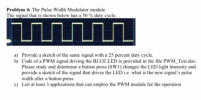 Problem 4: The Pulse Width Modulator module The signal that is shown below has a 50 % duty Cycle Provide a sketch of the same signal with a 25 percent duty cycle. b) a) Code of a PWM signal driving the BLUE LED is provided in the file PWM_Test.doc Please study and determine a button press (SW1) changes the LED light intensity and provide a sketch of the signal that drives the LED i.e. what is the new signal's pulse...
Use below drawings to describe how to measure a). period b). pulse width c). duty cycle using input capture feature of a timer. No need to write code or set up register, just plain English describ...
 Use below drawings to describe how to measure a). period b). pulse width c). duty cycle using input capture feature of a timer. No need to write code or set up register, just plain English describing how to do the measurement. Hint, you are using the input capture of a timer. 2. K-Pulse Width- Duty cycle = th/h
Use below drawings to describe how to measure a). period b). pulse width c). duty cycle using input capture feature of a...
Use below drawings to describe how to measure a). period b). pulse width c). duty cycle using input capture feature of a timer. No need to write code or set up register, just plain English describing how to do the measurement. Hint, you are using the input capture of a timer. 2. K-Pulse Width- Duty cycle = th/h
Use below drawings to describe how to measure a). period b). pulse width c). duty cycle using input capture feature of a...
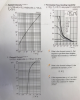
Please use the graphs to answer the following questions. Question 1.1) The forward current/voltage curve of the LED is shown on the figures. What is the forward current IF when the forward voltage VF...
 Please use the graphs to answer the following questions.
Question 1.1) The forward current/voltage curve of the LED is
shown on the figures. What is the forward current IF
when the forward voltage VF is 1.5V? (Hint-See Figure 1.
(a) 4points
Question 1.2) How much forward current you need to double the
radiant intensity from the radiant intensity at 100 mA forward
current. (choose the closest number) (Hint - See Figure 1 (b)
4points)
Question 1.3) What is the forward...
Please use the graphs to answer the following questions.
Question 1.1) The forward current/voltage curve of the LED is
shown on the figures. What is the forward current IF
when the forward voltage VF is 1.5V? (Hint-See Figure 1.
(a) 4points
Question 1.2) How much forward current you need to double the
radiant intensity from the radiant intensity at 100 mA forward
current. (choose the closest number) (Hint - See Figure 1 (b)
4points)
Question 1.3) What is the forward...
Problem 2: Pulse width modulation (PWM) is a method of reducing the average power delivered by...
 Problem 2: Pulse width modulation (PWM) is a method of reducing the average power delivered by an electrical signal, by effectively chopping it up into discrete parts. The average value of voltage fed to the load is controlled by turning the switch between supply and load on and off at a fast rate. The longer the switch is on compared to the off periods, the higher the total power supplied to the load. PWM is particularly suited for running DC...
(Show all Work) ) Radiant Intensitypge 2 3 Permissible Pulse Handling Capability mA)=t(t), single pulse,い25㎍ ,12m25...
 (Show all Work)
) Radiant Intensitypge 2 3 Permissible Pulse Handling Capability mA)=t(t), single pulse,い25㎍ ,12m25 ℃duitycycle D- T 25°C 10 ○L01715 1.0 Te (100 mA) 100 0.8 0.005 0.01 0.02 0.05 0.1 0.2 0.5 PVE 0.6 10 0.4 0.2 102 10 103 102 10 10 10's 10 10-3 10 5 10 5 10 mA 10 What is the forward current Ie that requires to get three times brighter intensity than normal (Uy-100 mA)? 0.9 2 Forward Current 3page 12...
(Show all Work)
) Radiant Intensitypge 2 3 Permissible Pulse Handling Capability mA)=t(t), single pulse,い25㎍ ,12m25 ℃duitycycle D- T 25°C 10 ○L01715 1.0 Te (100 mA) 100 0.8 0.005 0.01 0.02 0.05 0.1 0.2 0.5 PVE 0.6 10 0.4 0.2 102 10 103 102 10 10 10's 10 10-3 10 5 10 5 10 mA 10 What is the forward current Ie that requires to get three times brighter intensity than normal (Uy-100 mA)? 0.9 2 Forward Current 3page 12...
AVT245 Radar Systems Name- Date: If the pulse repetition frequency (PRF) is 2000 Hz, what is...
 AVT245 Radar Systems Name- Date: If the pulse repetition frequency (PRF) is 2000 Hz, what is the pulse repetition interval (PRI)? pts) 1) 2) If the RADAR unit has a pulse repetition frequency (PRF) of 2000 Hz and a pulse width of 0.05 microseconds, what is the duty cycle? 3pts) A pulse RADAR has a pulse repetition frequency (PRF) of 400 Hz, a pulse width of 1 microsecond, and a peak power of 100 kilowatts. What is the average power...
What is the difference between cycle +/- and the relationship with forward bias and reverse bias...
What is the difference between cycle +/- and the relationship with forward bias and reverse bias of a diode! please state it clearly and completely. thanks!
What is the minimum bandwidth needed to pass a periodic pulse train whose frequency is 28.8...
What is the minimum bandwidth needed to pass a periodic pulse train whose frequency is 28.8 kHz and duty cycle is 20 percent? 50 percent?
Find the average voltage of a square wave with VL=0V Vh=5V and a duty cycle of...
Find the average voltage of a square wave with VL=0V Vh=5V and a duty cycle of 45%.
Problem 31: (34 points) 1. (10 points) A pulse width modulated (PWM) signal fPwM(t) in Figure...
 Problem 31: (34 points) 1. (10 points) A pulse width modulated (PWM) signal fPwM(t) in Figure 2. The symbol D represents a duty cycle, a number between zero and one. Determine the compact trigonometric Fourier series coefficients (Co Cn, θ.) of the signal f(t) 2. (10 points) One use of PWM is to generate variable DC voltages. While the PWM signal is not DC, you should be able to see from your results in part 1 that it has a...
 Problem 4: The Pulse Width Modulator module The signal that is shown below has a 50 % duty Cycle Provide a sketch of the same signal with a 25 percent duty cycle. b) a) Code of a PWM signal driving the BLUE LED is provided in the file PWM_Test.doc Please study and determine a button press (SW1) changes the LED light intensity and provide a sketch of the signal that drives the LED i.e. what is the new signal's pulse...
 Use below drawings to describe how to measure a). period b). pulse width c). duty cycle using input capture feature of a timer. No need to write code or set up register, just plain English describing how to do the measurement. Hint, you are using the input capture of a timer. 2. K-Pulse Width- Duty cycle = th/h
Use below drawings to describe how to measure a). period b). pulse width c). duty cycle using input capture feature of a...
Use below drawings to describe how to measure a). period b). pulse width c). duty cycle using input capture feature of a timer. No need to write code or set up register, just plain English describing how to do the measurement. Hint, you are using the input capture of a timer. 2. K-Pulse Width- Duty cycle = th/h
Use below drawings to describe how to measure a). period b). pulse width c). duty cycle using input capture feature of a...
 Please use the graphs to answer the following questions.
Question 1.1) The forward current/voltage curve of the LED is
shown on the figures. What is the forward current IF
when the forward voltage VF is 1.5V? (Hint-See Figure 1.
(a) 4points
Question 1.2) How much forward current you need to double the
radiant intensity from the radiant intensity at 100 mA forward
current. (choose the closest number) (Hint - See Figure 1 (b)
4points)
Question 1.3) What is the forward...
Please use the graphs to answer the following questions.
Question 1.1) The forward current/voltage curve of the LED is
shown on the figures. What is the forward current IF
when the forward voltage VF is 1.5V? (Hint-See Figure 1.
(a) 4points
Question 1.2) How much forward current you need to double the
radiant intensity from the radiant intensity at 100 mA forward
current. (choose the closest number) (Hint - See Figure 1 (b)
4points)
Question 1.3) What is the forward...
 Problem 2: Pulse width modulation (PWM) is a method of reducing the average power delivered by an electrical signal, by effectively chopping it up into discrete parts. The average value of voltage fed to the load is controlled by turning the switch between supply and load on and off at a fast rate. The longer the switch is on compared to the off periods, the higher the total power supplied to the load. PWM is particularly suited for running DC...
 (Show all Work)
) Radiant Intensitypge 2 3 Permissible Pulse Handling Capability mA)=t(t), single pulse,い25㎍ ,12m25 ℃duitycycle D- T 25°C 10 ○L01715 1.0 Te (100 mA) 100 0.8 0.005 0.01 0.02 0.05 0.1 0.2 0.5 PVE 0.6 10 0.4 0.2 102 10 103 102 10 10 10's 10 10-3 10 5 10 5 10 mA 10 What is the forward current Ie that requires to get three times brighter intensity than normal (Uy-100 mA)? 0.9 2 Forward Current 3page 12...
(Show all Work)
) Radiant Intensitypge 2 3 Permissible Pulse Handling Capability mA)=t(t), single pulse,い25㎍ ,12m25 ℃duitycycle D- T 25°C 10 ○L01715 1.0 Te (100 mA) 100 0.8 0.005 0.01 0.02 0.05 0.1 0.2 0.5 PVE 0.6 10 0.4 0.2 102 10 103 102 10 10 10's 10 10-3 10 5 10 5 10 mA 10 What is the forward current Ie that requires to get three times brighter intensity than normal (Uy-100 mA)? 0.9 2 Forward Current 3page 12...
 AVT245 Radar Systems Name- Date: If the pulse repetition frequency (PRF) is 2000 Hz, what is the pulse repetition interval (PRI)? pts) 1) 2) If the RADAR unit has a pulse repetition frequency (PRF) of 2000 Hz and a pulse width of 0.05 microseconds, what is the duty cycle? 3pts) A pulse RADAR has a pulse repetition frequency (PRF) of 400 Hz, a pulse width of 1 microsecond, and a peak power of 100 kilowatts. What is the average power...
 Problem 31: (34 points) 1. (10 points) A pulse width modulated (PWM) signal fPwM(t) in Figure 2. The symbol D represents a duty cycle, a number between zero and one. Determine the compact trigonometric Fourier series coefficients (Co Cn, θ.) of the signal f(t) 2. (10 points) One use of PWM is to generate variable DC voltages. While the PWM signal is not DC, you should be able to see from your results in part 1 that it has a...
Most questions answered within 3 hours.
-
Where is the error in this code sequence?
String s1 = "Hello";
String s2 = "ello";...
asked 10 months ago -
Financial data for Joel de Paris, Inc., for last year
follow:
Joel de Paris, Inc.
Balance...
asked 10 months ago -
Consider this reaction:
Al2(SO4)3 (aq)+ BaCl3
(aq) Al2Cl6 (aq)- +
3BaSO4(s) . What is the...
asked 10 months ago -
Suppose that Savneet is considering increasing her
recent random sample from 20 car rentals to 40...
asked 10 months ago -
Trucks arrive at an unloading terminal at an average rate of 120
per hour.
Trucks arrive...
asked 10 months ago -
Why are methanol and ethanol completely soluble in water while
octanol is not very little soluble....
asked 10 months ago -
A facilities manager at a university reads in a research report
that the mean amount of...
asked 10 months ago -
When the CuSO4 is rehydrated by adding water to the anhydrous
compound, is this an endothermic...
asked 10 months ago -
A ray of sunlight is passing from diamond into crown glass; the
angle of incidence is...
asked 10 months ago -
A block of mass 0.249 kg is placed on top of a light, vertical
spring of...
asked 10 months ago -
how do the kidneys compensate in the presences of acidosis
a) trigger hyperventilate
b) reserve acid...
asked 10 months ago -
Question 501 pts
The rental rate of capital to the firm increases. Which of the
following...
asked 10 months ago