Q1. Hierarchical IP Address 1.1 Give a non-network example of hierarchical addressing, and discuss how it...
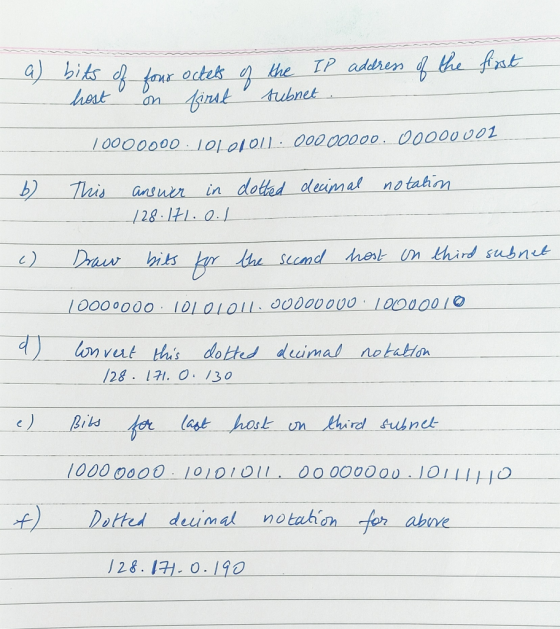
Q1. Hierarchical IP Address 1.1 Give a non-network example of hierarchical addressing, and discuss how it reduces the amount of work needed in physical delivery. Do not use any example in the book, the postal service, or the telephone network.1.2 A firm is assigned the network part 128.171. It selects a 10-bit subnet part. a) Draw the bits for the four octets of the IP address of the first host on the first subnet. (Hint: as we don’t use all 1 or all 0, the 1st subnet/host is 00...01, while the last subnet/host is 11...10. The number of 1&0 in the expression depends on the length of subnet/host part)b) Convert this answer into dotted decimal notation.c) Draw the bits for the second host on the third subnet. (In binary, 2 is 10, while 3 is 11.)d) Convert this into dotted decimal notation.e) Draw the bits for the last host on the (last # of your ID, if zero, use the one before the last number)th subnet.f) Convert this answer into dotted decimal notation.Q2. Wireshark for Packet Information2. Visit calstate.edu, login the system with your id/password. Use Wireshark to
capture this process.Find the packets with following protocols, 1) TCP: 2) UDP: 3) HTTP;and answer the following questions: a) What's the source/destination IP address? b) What type of protoc ol is it? c) what are the source and destination port numbers?
Homework Answers
The question 1 discusses hierarchical addressing as well as a numerical on computer networks. Please refer to the attached images below for detailed solutions to both these questions. the second subpart of Q1 i.e. 1.2 has six further sub-sub parts, all of them have been answered.

Add Answer to:
Q1. Hierarchical IP Address 1.1 Give a non-network example of
hierarchical addressing, and discuss how it...
A firm is assigned the network part 128.171
A firm is assigned the network part 128.171. It selects a 8-bit subnet part. a) Draw the bits for the four octets of the IP address of the first host on the first subnet. (Hint: Use Windows Calculator.)b) Convert this answer into dotted decimal notation.c) Draw the bits for the second host on the third subnet. (In binary, 2 is 10, while 3 is 11.)d) Convert this into dotted decimal notation.e) Draw the bits for the last host on the...
Given an IP address and mask of 192.168.0.0 /24 (address / mask), design an IP addressing...
Given an IP address and mask of 192.168.0.0 /24 (address / mask), design an IP addressing scheme that satisfies the following requirements. Network address/mask and the number of hosts for Subnets A and B will be provided by your instructor. Subnet Number of Hosts Subnet A 25 Subnet B 75 The 0th subnet is used. No subnet calculators may be used. All work must be shown on the other side of this page. Subnet A Specification Student Input Points Number...
In a class B subnet, we know the IP address of one of the hosts and...
 In a class B subnet, we know the IP address of one of the hosts and the subnet mask as given below: IP Address: 188.48.82.176 Subnet mask: 255.255.255.248 1) What is the first valid host address in the subnet? (in dotted decimal) 2) What is the last valid address in the subnet? (in dotted decimal) 3) What is the subnet network address? (in dotted decimal) 4) What is the subnet broadcast address? (in dotted decimal) 5) What is the number...
Network IP Addressing Network Layout of 2 networks Given an IP address and mask of 172.23.29.0/24,...
Network IP Addressing Network Layout of 2 networks Given an IP address and mask of 172.23.29.0/24, design an IP addressing scheme that satisfies the following requirements. Subnet B Specification This network requires space for 62 machines plus the router Number of bits in the subnet Blank 1 IP mask (binary) Blank 2 New IP mask (decimal) Blank 3 Maximum number of usable subnets of this size when using this mask (including the 0th subnet) Blank 4 Number of usable hosts...
Step 2. Basic IP addressing. Task: Use the IP address chart and your knowledge of IP...
 Step 2. Basic IP addressing. Task: Use the IP address chart and your knowledge of IP address classes to answer the following questions l. What is the decimal and binary range of the first octet of all possible Class B IP addresses? Decimal: From: To: Binary: 2. Which octet(s) represent the network portion of a Class C IP address? 3. Which octet(s) represent the host portion of a Class A IP address? Io: Step 3. Determine the host and network...
Given an IP address and mask of 192.168.1.0 255.255.255.0 (address / mask) subnet A has 55 hosts subnet b has 112 hosts The 0th subnet is not used. (Do not use 192.168.1.0) (Subnetting Help) Subne...
Given an IP address and mask of 192.168.1.0 255.255.255.0 (address / mask) subnet A has 55 hosts subnet b has 112 hosts The 0th subnet is not used. (Do not use 192.168.1.0) (Subnetting Help) Subnet A Specification Student Input Number of Network bits in the subnet mask New Subnet mask (decimal) Number of usable hosts IP Subnet (Network ID) First IP Host address Last IP Host address (Subnetting Help) Subnet B Specification Student Input Number of Network bits in the...
Task 1: Design a Logical LAN Topology Step 1: Design an IP addressing scheme Given the IP address block of 192.168.7.0...
 Task 1: Design a Logical LAN Topology Step 1: Design an IP addressing scheme Given the IP address block of 192.168.7.0 /24, design an IP addressing scheme that satisfies the following requirements Subnet Subnet A Subnet B Number of Hosts 110 54 The 0 subnet is used. No subnet calculators may be used. Create the smallest possible subnets that satisfy the requirements for hosts. Assign the first usable subnet to Subnet A. Subnet A Specification Student Input Number of bits...
Part 1: Develop the IPV4 Addressing Scheme Given an IP address and mask of 192.168.1.0 /24...
 Part 1: Develop the IPV4 Addressing Scheme Given an IP address and mask of 192.168.1.0 /24 (address / mask), design an IP addressing scheme that satisfies the following requirements Subnet Number of Hosts Subnet A 20 Subnet B 60 Use subnet zero for the first subnet. No subnet calculators are allowed Host computers will use the last IP address in the subnet. The network router will use the first usable host address. The switch will use the second usable host...
Assume that we have a machine with IP address 15.107.33.204 with netmask 255.255.255.240. Assume that you...
Assume that we have a machine with IP address 15.107.33.204 with netmask 255.255.255.240. Assume that you manage a /11 address space, and that we have fully divided it up into into Child networks the size of the one on which this machine resides. Answer the following questions: a. (1 pt) What is the netmask of the parent network in dotted decimal and “slash” notations? b. (1 pt) What “class” is the parent network? c. (1 pt) How many bits do...
8. Consider the class-less IP network 130.45.130.0/21 a. How many bits are in the net id?...
8. Consider the class-less IP network 130.45.130.0/21 a. How many bits are in the net id? ________________ b. How many bits are in the host id? _________________ c. How many possible hosts are there? __________________ d. What is the mask in binary and dotted decimal? __________________________ and _______________________________ e. What is the broadcast IP address for this network? ____________________________
 In a class B subnet, we know the IP address of one of the hosts and the subnet mask as given below: IP Address: 188.48.82.176 Subnet mask: 255.255.255.248 1) What is the first valid host address in the subnet? (in dotted decimal) 2) What is the last valid address in the subnet? (in dotted decimal) 3) What is the subnet network address? (in dotted decimal) 4) What is the subnet broadcast address? (in dotted decimal) 5) What is the number...
 Step 2. Basic IP addressing. Task: Use the IP address chart and your knowledge of IP address classes to answer the following questions l. What is the decimal and binary range of the first octet of all possible Class B IP addresses? Decimal: From: To: Binary: 2. Which octet(s) represent the network portion of a Class C IP address? 3. Which octet(s) represent the host portion of a Class A IP address? Io: Step 3. Determine the host and network...
 Task 1: Design a Logical LAN Topology Step 1: Design an IP addressing scheme Given the IP address block of 192.168.7.0 /24, design an IP addressing scheme that satisfies the following requirements Subnet Subnet A Subnet B Number of Hosts 110 54 The 0 subnet is used. No subnet calculators may be used. Create the smallest possible subnets that satisfy the requirements for hosts. Assign the first usable subnet to Subnet A. Subnet A Specification Student Input Number of bits...
 Part 1: Develop the IPV4 Addressing Scheme Given an IP address and mask of 192.168.1.0 /24 (address / mask), design an IP addressing scheme that satisfies the following requirements Subnet Number of Hosts Subnet A 20 Subnet B 60 Use subnet zero for the first subnet. No subnet calculators are allowed Host computers will use the last IP address in the subnet. The network router will use the first usable host address. The switch will use the second usable host...
Most questions answered within 3 hours.
-
Where is the error in this code sequence?
String s1 = "Hello";
String s2 = "ello";...
asked 10 months ago -
Financial data for Joel de Paris, Inc., for last year
follow:
Joel de Paris, Inc.
Balance...
asked 10 months ago -
Consider this reaction:
Al2(SO4)3 (aq)+ BaCl3
(aq) Al2Cl6 (aq)- +
3BaSO4(s) . What is the...
asked 10 months ago -
Suppose that Savneet is considering increasing her
recent random sample from 20 car rentals to 40...
asked 10 months ago -
Trucks arrive at an unloading terminal at an average rate of 120
per hour.
Trucks arrive...
asked 10 months ago -
Why are methanol and ethanol completely soluble in water while
octanol is not very little soluble....
asked 10 months ago -
A facilities manager at a university reads in a research report
that the mean amount of...
asked 10 months ago -
When the CuSO4 is rehydrated by adding water to the anhydrous
compound, is this an endothermic...
asked 10 months ago -
A ray of sunlight is passing from diamond into crown glass; the
angle of incidence is...
asked 10 months ago -
A block of mass 0.249 kg is placed on top of a light, vertical
spring of...
asked 10 months ago -
how do the kidneys compensate in the presences of acidosis
a) trigger hyperventilate
b) reserve acid...
asked 10 months ago -
Question 501 pts
The rental rate of capital to the firm increases. Which of the
following...
asked 10 months ago