According to Reader's Digest, 46% of primary care doctors think their patients receive unnecessary medical care....
According to Reader's Digest, 46% of primary care doctors think their patients receive unnecessary medical care.
a. Suppose a sample of 260 primary care doctors was taken. Show the sampling distribution of the proportion of the doctors who think their patients receive unnecessary medical care. Use z-table. (to 4 decimals)
b. What is the probability that the sample proportion will be within +/- 0.03 of the population proportion. Round your answer to four decimals.
c. What is the probability that the sample proportion will be within +/- 0.05 of the population proportion. Round your answer to four decimals.
d. What would be the effect of taking a larger sample on the probabilities in parts (b) and (c)? Why? The probabilities would "increase" This is because the increase in the sample size makes the standard error "smaller"
Homework Answers
a)
since np and n(1-p) both are greater than or eqaul to 4, sampling distribution of the proportion of the doctors who think their patients receive unnecessary medical care is approximately normal
with
| estimate proportion= μp= | 0.4600 |
and
| std error of proportion=σp=√(p*(1-p)/n)= | 0.0309 |
b)
probability that the sample proportion will be within +/- 0.03 of the population proportion:
| probability =P(0.43<X<0.49)=P((0.43-0.46)/0.031)<Z<(0.49-0.46)/0.031)=P(-0.97<Z<0.97)=0.834-0.166=0.6680 | |||||
c)
| probability =P(0.41<X<0.51)=P((0.41-0.46)/0.031)<Z<(0.51-0.46)/0.031)=P(-1.62<Z<1.62)=0.9474-0.0526=0.8948 |
d)
The probabilities would "increase" This is because the increase in the sample size makes the standard error "smaller
Add Answer to:
According to Reader's Digest, 46% of primary care doctors think
their patients receive unnecessary medical care....
According to Reader's Digest, 41% of primary care doctors think their patients receive unnecessary medical care....
 According to Reader's Digest, 41% of primary care doctors think their patients receive unnecessary medical care. Use z-table. a. Suppose a sample of 370 primary care doctors was taken. Show the sampling distribution of the proportion of the doctors who think their patients receive unnecessary medical care. EP) .41 ор .0262 (to 4 decimals) b. What is the probability that the sample proportion will be within +0.03 of the population proportion. Round your answer to four decimals. .7498 c. What...
According to Reader's Digest, 33% of primary care doctors think their patients receive unnecessary medical care....
 According to Reader's Digest, 33% of primary care doctors think their patients receive unnecessary medical care. Use z-table. a. Suppose a sample of 300 primary care doctors was taken. Show the sampling distribution of the proportion of the doctors who think their patients receive unnecessary medical care. E() - j (to 4 decimals) b. What is the probability that the sample proportion will be within 3:0.03 of the population proportion. Round your answer to four decimals. c. What is the...
According to Reader's Digest, 36% of primary care doctors think their patients receive unnecessary medical care....
According to Reader's Digest, 36% of primary care doctors think their patients receive unnecessary medical care. A.) Suppose a sample of 250 primary care doctors was taken. Show the sampling distribution of the proportion of the doctors who think their patients receive unnecessary medical care. Use z-table. E(p-bar) = σ p-bar = (to 4 decimals) B.) What is the probability that the sample proportion will be within ±0.03 of the population proportion. Round your answer to four decimals. C.) What...
According to Reader's Digest, 36% of primary care doctors think their patients receive unnecessar...
 According to Reader's Digest, 36% of primary care doctors think their patients receive unnecessary medical care. Use z table. a. Suppose a sample of 370 primary care doctors was taken. Show the sampling distribution of the proportion of the doctors who think their patients receive unnecessary medical care. E(P)- (to 4 decimals) b. what is the probability that the sample proportion will be within ±0.03 of the population proportion. Round your answer to four decimals c. what is the probability...
According to Reader's Digest, 41% of primary care doctors think their patients receive unnecessary medical care....
According to Reader's Digest, 41% of primary care doctors think their patients receive unnecessary medical care. a. Suppose a sample of 330 primary care doctors was taken. Show the sampling distribution of the proportion of the doctors who think their patients receive unnecessary medical care. Use z-table. (to 4 decimals) E(p)= σ(p)= b. What is the probability that the sample proportion will be within +/- .03 of the population proportion. Round your answer to four decimals. c. What is the...
According to Reader's Digest, 38% of primary care doctors think their patients receive unnecessary medical care....
According to Reader's Digest, 38% of primary care doctors think their patients receive unnecessary medical care. a. Suppose a sample of 330 primary care doctors was taken. Show the sampling distribution of the proportion of the doctors who think their patients receive unnecessary medical care. Use z-table. E(p bar)= Sigma subscript p bar= (to 4 decimals) b. What is the probability that the sample proportion will be within plus/minus0.03 of the population proportion. Round your answer to four decimals.
the first drop down menu is increase/decrease and the second is larger/smaller. eBook According to Reader's...
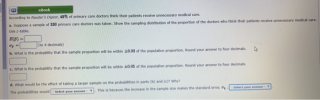 the first drop down menu is increase/decrease and the second
is larger/smaller.
eBook According to Reader's Digest, 49% of primary care doctors think their patients receive unnecessary medical care. a. Suppose a sample of 330 primary care doctors was taken. Use z-table. Show the sampling distribution of the proportion of the doctors who think their patients receive unnecessary medical care. ơi-| J(to 4 decimals) t is the probability that the sample proportion will be within t0.08 of the population proportion....
the first drop down menu is increase/decrease and the second
is larger/smaller.
eBook According to Reader's Digest, 49% of primary care doctors think their patients receive unnecessary medical care. a. Suppose a sample of 330 primary care doctors was taken. Use z-table. Show the sampling distribution of the proportion of the doctors who think their patients receive unnecessary medical care. ơi-| J(to 4 decimals) t is the probability that the sample proportion will be within t0.08 of the population proportion....
Thirty-six percent of primary care doctors think their patients receive unnecessary medical care. If required, round...
Thirty-six percent of primary care doctors think their patients receive unnecessary medical care. If required, round your answer to four decimal places. (a) Suppose a sample of 300 primary care doctors was taken. Show the distribution of the sample proportion of doctors who think their patients receive unnecessary medical care. np = n(1-p) = E(p) = σ(p) = (b) Suppose a sample of 500 primary care doctors was taken. Show the distribution of the sample proportion of doctors who think...
In the EAl sampling problem, the population mean is $51,900 and the population standard deviation is $4,000
In the EAl sampling problem, the population mean is $51,900 and the population standard deviation is $4,000. When the sample size is n 30, there is a 0.5878 probability of obtaining a sample mean within+$600 of the population mean. Use z-table. a. What is the probability that the sample mean is within $600 of the population mean if a sample of size 60 is used (to 4 decimals)? b. What is the probability that the sample mean is within $600 of the...
4. 42% of all primary care doctors in USA think that their patients receive unnecessary care....
4. 42% of all primary care doctors in USA think that their patients receive unnecessary care. Suppose that we took a random sample of 300 primary doctors and find that 46% of the doctors in our sample think that their patients receive unnecessary care. In this problem, what is p and p ̂? What is the sampling distribution of P ̂? Are you (statistically speaking) surprised at the results that we got?
 According to Reader's Digest, 41% of primary care doctors think their patients receive unnecessary medical care. Use z-table. a. Suppose a sample of 370 primary care doctors was taken. Show the sampling distribution of the proportion of the doctors who think their patients receive unnecessary medical care. EP) .41 ор .0262 (to 4 decimals) b. What is the probability that the sample proportion will be within +0.03 of the population proportion. Round your answer to four decimals. .7498 c. What...
 According to Reader's Digest, 33% of primary care doctors think their patients receive unnecessary medical care. Use z-table. a. Suppose a sample of 300 primary care doctors was taken. Show the sampling distribution of the proportion of the doctors who think their patients receive unnecessary medical care. E() - j (to 4 decimals) b. What is the probability that the sample proportion will be within 3:0.03 of the population proportion. Round your answer to four decimals. c. What is the...
 According to Reader's Digest, 36% of primary care doctors think their patients receive unnecessary medical care. Use z table. a. Suppose a sample of 370 primary care doctors was taken. Show the sampling distribution of the proportion of the doctors who think their patients receive unnecessary medical care. E(P)- (to 4 decimals) b. what is the probability that the sample proportion will be within ±0.03 of the population proportion. Round your answer to four decimals c. what is the probability...
 the first drop down menu is increase/decrease and the second
is larger/smaller.
eBook According to Reader's Digest, 49% of primary care doctors think their patients receive unnecessary medical care. a. Suppose a sample of 330 primary care doctors was taken. Use z-table. Show the sampling distribution of the proportion of the doctors who think their patients receive unnecessary medical care. ơi-| J(to 4 decimals) t is the probability that the sample proportion will be within t0.08 of the population proportion....
the first drop down menu is increase/decrease and the second
is larger/smaller.
eBook According to Reader's Digest, 49% of primary care doctors think their patients receive unnecessary medical care. a. Suppose a sample of 330 primary care doctors was taken. Use z-table. Show the sampling distribution of the proportion of the doctors who think their patients receive unnecessary medical care. ơi-| J(to 4 decimals) t is the probability that the sample proportion will be within t0.08 of the population proportion....
Most questions answered within 3 hours.
-
Where is the error in this code sequence?
String s1 = "Hello";
String s2 = "ello";...
asked 11 months ago -
Financial data for Joel de Paris, Inc., for last year
follow:
Joel de Paris, Inc.
Balance...
asked 11 months ago -
Consider this reaction:
Al2(SO4)3 (aq)+ BaCl3
(aq) Al2Cl6 (aq)- +
3BaSO4(s) . What is the...
asked 11 months ago -
Suppose that Savneet is considering increasing her
recent random sample from 20 car rentals to 40...
asked 11 months ago -
Trucks arrive at an unloading terminal at an average rate of 120
per hour.
Trucks arrive...
asked 11 months ago -
Why are methanol and ethanol completely soluble in water while
octanol is not very little soluble....
asked 11 months ago -
A facilities manager at a university reads in a research report
that the mean amount of...
asked 11 months ago -
When the CuSO4 is rehydrated by adding water to the anhydrous
compound, is this an endothermic...
asked 11 months ago -
A ray of sunlight is passing from diamond into crown glass; the
angle of incidence is...
asked 11 months ago -
A block of mass 0.249 kg is placed on top of a light, vertical
spring of...
asked 11 months ago -
how do the kidneys compensate in the presences of acidosis
a) trigger hyperventilate
b) reserve acid...
asked 11 months ago -
Question 501 pts
The rental rate of capital to the firm increases. Which of the
following...
asked 11 months ago