Remember that the current coming into a junction equals the current coming out of the junction....
Remember that the current coming into a junction equals the current coming out of the junction.
Also bear in mind that voltage is basically a height difference between two points.
1) If you measure the potential across two batteries and find that V1 = 1.3V and V2 = 1.4V,
then you measure the potential between the negative ends of battery 1 and positive end of
battery 2 and get V12-+ = -0.1 and the potential between the positive ends of battery 1
and negative ends of battery 2 gives V12+- = 0.1, what is the potential between the
negative end of battery 1 and the positive end of battery 2? What about the potential
difference between the negative end of battery 2 and the positive end of battery 1?
2) Draw a circuit diagram of all the voltage measurements from question 1. (These should
still all be closed circuits)
3) So, since the two answers in question 1 are different, what is a practical application of
this knowledge (that battery order changes effective voltage)? For the one I’m thinking
of, consider that you have a remote control with two AA batteries and it dies while you
have no replacement batteries on hand. If you have other practical applications, I’d also
love to read them.
4) Suppose you have two light bulbs with a resistance of 100 ohms and a 1.5 V battery set
up like the series and parallel circuits in the first circuit lab. Using Ohm’s law and the law
that current into a junction equals current out of the junction, determine the current in the
light bulbs and battery for both circuits. Do these numbers agree with your observations
in that lab? (They may not) If not, why not? (You might have to make a reasonable
educated guess for the parallel circuit)
Homework Answers


Add Answer to:
Remember that the current coming into a junction equals the
current coming out of the junction....
7. Circuits for 15 points: Five 20k12 resistors are placed in the following circuit with two...
 7. Circuits for 15 points: Five 20k12 resistors are placed in the following circuit with two 100V DC power supplies. (a) Identify all series and parallel circuit equivalents that you can find. Calculate these equivalent resistance values. (b) Now you assemble a different circuit. You connect a 2022 resistor to the positive lead of a 20 V battery, and a 30 resistor to the positive lead of a 10 V battery. The other ends of both the 2012 and 30...
1)If one measures the current in series resistors, is the current measured before the resistors different...
1)If one measures the current in series resistors, is the current measured before the resistors different than what measured between the two resistors? a) no difference, current is the same b) the difference depends on the direction of the current c)the current after the first resistor will decrease d) yes, they are different If one measures the current in parallel resistors, are the currents in parallel resistors always the same? a) no, only currents in series resistors are the same...
Example 1 . A micrometer indicates a current flow of 16 μΑ in a circuit. How...
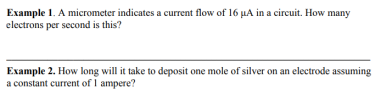 Example 1 . A micrometer indicates a current flow of 16 μΑ in a circuit. How many electrons per second is this? E cample 2.low long wllir wake to depoesit one mole of silver on an electrode assuming Example 3. Two batteries each have potential differences of 1.5 V between their positive and negative terminals. (a) If the positive terminal of one battery is connected to the negative terminal of the 1.5 V 1.5 V Point 1 Point 2 Point...
1. Shown above are two different circuits. Each circuit is made out a battery, a capacitor,...
 1. Shown above are two different circuits. Each circuit is made
out a battery, a capacitor, a switch, and two resistors. All the
components (batteries, switches, capacitors, and resistors) are
identical in the above circuits. For both circuits, when the switch
is closed, the capacitors will get charged. Which of the following
is correct about the peak current in the circuit?
- Circuit B has 4 times larger peak current than circuit A.
- Circuit B has 2 times larger...
1. Shown above are two different circuits. Each circuit is made
out a battery, a capacitor, a switch, and two resistors. All the
components (batteries, switches, capacitors, and resistors) are
identical in the above circuits. For both circuits, when the switch
is closed, the capacitors will get charged. Which of the following
is correct about the peak current in the circuit?
- Circuit B has 4 times larger peak current than circuit A.
- Circuit B has 2 times larger...
Parallel Circuit Please answer the following Questions. heres the circuit .What can you infer about the...
 Parallel Circuit
Please answer the following Questions.
heres the circuit
.What can you infer about the current through each of the bulbs as each additional bulb is added in parallel? Explain. What can you infer about the current through the battery as each additional bulb is added in parallel? Explain. . What can you infer about the current through the whole circuit as each additional bulb is added in parallel? Explain. Refer back to your rule developed in section 2...
Parallel Circuit
Please answer the following Questions.
heres the circuit
.What can you infer about the current through each of the bulbs as each additional bulb is added in parallel? Explain. What can you infer about the current through the battery as each additional bulb is added in parallel? Explain. . What can you infer about the current through the whole circuit as each additional bulb is added in parallel? Explain. Refer back to your rule developed in section 2...
A.) Shown above are two different circuits. Each circuit is made out a battery, a capacitor,...
 A.) Shown above are two different circuits. Each circuit is made
out a battery, a capacitor, a switch, and two resistors. All the
components (batteries, switches, capacitors, and resistors) are
identical in the above circuits. For both circuits, when the switch
is closed, the capacitors will get charged. Which of the following
is correct about the peak current in the circuit? Explain your
choice.
a) Circuit B has 4 times larger peak current than circuit A.
b) Circuit B has...
A.) Shown above are two different circuits. Each circuit is made
out a battery, a capacitor, a switch, and two resistors. All the
components (batteries, switches, capacitors, and resistors) are
identical in the above circuits. For both circuits, when the switch
is closed, the capacitors will get charged. Which of the following
is correct about the peak current in the circuit? Explain your
choice.
a) Circuit B has 4 times larger peak current than circuit A.
b) Circuit B has...
4. Consider the identical light bulbs (e) in the circuit to the right. Circuits 1, 2,...
 4. Consider the identical light bulbs (e) in the circuit to the right. Circuits 1, 2, 3, 4 are series circuits". I? 2 Circuits 5, 6, and 8 are "parallel circuits". 4 Some circuits have one battery, others have two batteries. 6 Now close the switch. Using the "brightness" of the bulb in the simple circuit 1 as the standard for normal" brightness, answer the following questions by specifying the circuit(s) number(s) 5 7 (a) Which circuits had bulbs that...
!? Verify Kirchhoff’s Current law (I) in = (I) out for junction point “X” in the...
 !? Verify Kirchhoff’s Current law (I) in = (I) out for
junction point “X” in the circuit
point 560 Ω resistor 1000 Ω resistor 4.5 . 1 |ー オー1 ered battery box1 -T 10000 Ω resistor 17 black 1 Is switch (closed for measurements only) +1 To measure each current, the wire it is flowing through must be "cut" (disconnected) and the ammeter inserted in series. COM Do not place the ammeter across a component, as this may damage the...
!? Verify Kirchhoff’s Current law (I) in = (I) out for
junction point “X” in the circuit
point 560 Ω resistor 1000 Ω resistor 4.5 . 1 |ー オー1 ered battery box1 -T 10000 Ω resistor 17 black 1 Is switch (closed for measurements only) +1 To measure each current, the wire it is flowing through must be "cut" (disconnected) and the ammeter inserted in series. COM Do not place the ammeter across a component, as this may damage the...
1. An atom with more electrons than protons is a (positive ion) (Negative ion) (Cation) (Anion)...
 1. An atom with more electrons than protons is a (positive ion) (Negative ion) (Cation) (Anion) 2. An atom with fewer electrons than protons is a (positive ion) (Negative ion) (Cation) (Anion) 3. An electric current is a flow of (uncharged Particles) (charged particles) 4. A battery supplies what type of current 5. The current flow in a wire moves from the_ terminal to the termina.l 6. The SI unit of electric charge is the (resistance) (ampere) (ohm) (volt) 7....
corresponding choices I. Select each true statement concerning electric circuits a. Conventional current is the flow...
 corresponding choices I. Select each true statement concerning electric circuits a. Conventional current is the flow of electrons. b. Voltage is constant for series circuits. c. Current is constant for parallel circuits. d. A circuit can be both series and parallel. e. A circuit can be neither series nor parallel Select each true statement concerning electric potential a. When moving a pos itive charge toward a negative charge, electric potential increases. b. Electric equipotential lines and Electric field lines are...
 7. Circuits for 15 points: Five 20k12 resistors are placed in the following circuit with two 100V DC power supplies. (a) Identify all series and parallel circuit equivalents that you can find. Calculate these equivalent resistance values. (b) Now you assemble a different circuit. You connect a 2022 resistor to the positive lead of a 20 V battery, and a 30 resistor to the positive lead of a 10 V battery. The other ends of both the 2012 and 30...
 Example 1 . A micrometer indicates a current flow of 16 μΑ in a circuit. How many electrons per second is this? E cample 2.low long wllir wake to depoesit one mole of silver on an electrode assuming Example 3. Two batteries each have potential differences of 1.5 V between their positive and negative terminals. (a) If the positive terminal of one battery is connected to the negative terminal of the 1.5 V 1.5 V Point 1 Point 2 Point...
 1. Shown above are two different circuits. Each circuit is made
out a battery, a capacitor, a switch, and two resistors. All the
components (batteries, switches, capacitors, and resistors) are
identical in the above circuits. For both circuits, when the switch
is closed, the capacitors will get charged. Which of the following
is correct about the peak current in the circuit?
- Circuit B has 4 times larger peak current than circuit A.
- Circuit B has 2 times larger...
1. Shown above are two different circuits. Each circuit is made
out a battery, a capacitor, a switch, and two resistors. All the
components (batteries, switches, capacitors, and resistors) are
identical in the above circuits. For both circuits, when the switch
is closed, the capacitors will get charged. Which of the following
is correct about the peak current in the circuit?
- Circuit B has 4 times larger peak current than circuit A.
- Circuit B has 2 times larger...
 Parallel Circuit
Please answer the following Questions.
heres the circuit
.What can you infer about the current through each of the bulbs as each additional bulb is added in parallel? Explain. What can you infer about the current through the battery as each additional bulb is added in parallel? Explain. . What can you infer about the current through the whole circuit as each additional bulb is added in parallel? Explain. Refer back to your rule developed in section 2...
Parallel Circuit
Please answer the following Questions.
heres the circuit
.What can you infer about the current through each of the bulbs as each additional bulb is added in parallel? Explain. What can you infer about the current through the battery as each additional bulb is added in parallel? Explain. . What can you infer about the current through the whole circuit as each additional bulb is added in parallel? Explain. Refer back to your rule developed in section 2...
 A.) Shown above are two different circuits. Each circuit is made
out a battery, a capacitor, a switch, and two resistors. All the
components (batteries, switches, capacitors, and resistors) are
identical in the above circuits. For both circuits, when the switch
is closed, the capacitors will get charged. Which of the following
is correct about the peak current in the circuit? Explain your
choice.
a) Circuit B has 4 times larger peak current than circuit A.
b) Circuit B has...
A.) Shown above are two different circuits. Each circuit is made
out a battery, a capacitor, a switch, and two resistors. All the
components (batteries, switches, capacitors, and resistors) are
identical in the above circuits. For both circuits, when the switch
is closed, the capacitors will get charged. Which of the following
is correct about the peak current in the circuit? Explain your
choice.
a) Circuit B has 4 times larger peak current than circuit A.
b) Circuit B has...
 4. Consider the identical light bulbs (e) in the circuit to the right. Circuits 1, 2, 3, 4 are series circuits". I? 2 Circuits 5, 6, and 8 are "parallel circuits". 4 Some circuits have one battery, others have two batteries. 6 Now close the switch. Using the "brightness" of the bulb in the simple circuit 1 as the standard for normal" brightness, answer the following questions by specifying the circuit(s) number(s) 5 7 (a) Which circuits had bulbs that...
 !? Verify Kirchhoff’s Current law (I) in = (I) out for
junction point “X” in the circuit
point 560 Ω resistor 1000 Ω resistor 4.5 . 1 |ー オー1 ered battery box1 -T 10000 Ω resistor 17 black 1 Is switch (closed for measurements only) +1 To measure each current, the wire it is flowing through must be "cut" (disconnected) and the ammeter inserted in series. COM Do not place the ammeter across a component, as this may damage the...
!? Verify Kirchhoff’s Current law (I) in = (I) out for
junction point “X” in the circuit
point 560 Ω resistor 1000 Ω resistor 4.5 . 1 |ー オー1 ered battery box1 -T 10000 Ω resistor 17 black 1 Is switch (closed for measurements only) +1 To measure each current, the wire it is flowing through must be "cut" (disconnected) and the ammeter inserted in series. COM Do not place the ammeter across a component, as this may damage the...
 1. An atom with more electrons than protons is a (positive ion) (Negative ion) (Cation) (Anion) 2. An atom with fewer electrons than protons is a (positive ion) (Negative ion) (Cation) (Anion) 3. An electric current is a flow of (uncharged Particles) (charged particles) 4. A battery supplies what type of current 5. The current flow in a wire moves from the_ terminal to the termina.l 6. The SI unit of electric charge is the (resistance) (ampere) (ohm) (volt) 7....
 corresponding choices I. Select each true statement concerning electric circuits a. Conventional current is the flow of electrons. b. Voltage is constant for series circuits. c. Current is constant for parallel circuits. d. A circuit can be both series and parallel. e. A circuit can be neither series nor parallel Select each true statement concerning electric potential a. When moving a pos itive charge toward a negative charge, electric potential increases. b. Electric equipotential lines and Electric field lines are...
Most questions answered within 3 hours.
-
Where is the error in this code sequence?
String s1 = "Hello";
String s2 = "ello";...
asked 10 months ago -
Financial data for Joel de Paris, Inc., for last year
follow:
Joel de Paris, Inc.
Balance...
asked 10 months ago -
Consider this reaction:
Al2(SO4)3 (aq)+ BaCl3
(aq) Al2Cl6 (aq)- +
3BaSO4(s) . What is the...
asked 10 months ago -
Suppose that Savneet is considering increasing her
recent random sample from 20 car rentals to 40...
asked 10 months ago -
Trucks arrive at an unloading terminal at an average rate of 120
per hour.
Trucks arrive...
asked 10 months ago -
Why are methanol and ethanol completely soluble in water while
octanol is not very little soluble....
asked 10 months ago -
A facilities manager at a university reads in a research report
that the mean amount of...
asked 10 months ago -
When the CuSO4 is rehydrated by adding water to the anhydrous
compound, is this an endothermic...
asked 10 months ago -
A ray of sunlight is passing from diamond into crown glass; the
angle of incidence is...
asked 10 months ago -
A block of mass 0.249 kg is placed on top of a light, vertical
spring of...
asked 10 months ago -
how do the kidneys compensate in the presences of acidosis
a) trigger hyperventilate
b) reserve acid...
asked 10 months ago -
Question 501 pts
The rental rate of capital to the firm increases. Which of the
following...
asked 10 months ago