when oceanic crust and continental crust converge at a subduction zone, which plate is most likely...
Homework Answers
In a subduction zone, when an oceanic lithospheric plate converges with a continental lithospheric plate, the oceanic plate gets subducted under the continental plate. This is because the oceanic plate has a higher density than the continental plate. Lithologically, The continental crust consists of various layers, with a bulk composition that is intermediate (SiO2 wt% = 60.6). The average density of continental crust is about 2.83 g/cm3. The oceanic crust has an average density of 3.3 g/cm3 and is mainly made up of mafic and ultramafic composition i.e. the upper oceanic crust usually consists of pillow lavas and discordant intrusive igneous complexes, and the lower oceanic crust is composed of troctolite, gabbro and ultramafic cumulates. Due to this higher density, the oceanic crust subducts under the continental crust.
Add Answer to:
when oceanic crust and continental crust converge at a subduction
zone, which plate is most likely...
A subduction zone is often created when: Pangaea broke apart continental crust collides with continental crust oceanic crust pulls apart from oceanic crust continental crust pulls apart from continent...
A subduction zone is often created when: Pangaea broke apart continental crust collides with continental crust oceanic crust pulls apart from oceanic crust continental crust pulls apart from continental crust oceanic crust collides with continental crust
which type of crust, oceanic or continental is most likely to preserve evidence of very early...
which type of crust, oceanic or continental is most likely to preserve evidence of very early earth and why? explain in detail
Suggest how specific characteristics of convergent plate boundaries and/or oceanic crust may influence the angle of...
Suggest how specific characteristics of convergent plate boundaries and/or oceanic crust may influence the angle of subduction, in particular specific aspects of crustal properties that may lead to a steep or shallow angle of subduction. (A strong answer will discuss how specific characteristics of oceanic crust may influence the angle at which oceanic crust subducts, preferably by citing examples of the behavior of crust at ocean-ocean or other convergent plate boundaries.)
12:24 1 LTE Twitter Close What causes and controls subduction zone earthquakes? extra credit slid...
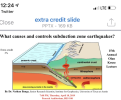 12:24 1 LTE Twitter Close What causes and controls subduction zone earthquakes? extra credit slide PPTX - 169 KB Extra credit 3% 15th Annual Olan Kruse Lecture oceanic crust continental crust lithosphere earthquakes asthenosphere slow-moving currents in the mantle By Dr. Nathan Bangs, Senior Research Scientist, Institute for Geophysics, University of Texas at Austin 7:00 PM, Thursday, April 18, 2019 Peacock Auditorium, BES 100
12:24 1 LTE Twitter Close What causes and controls subduction zone earthquakes? extra credit slide PPTX...
12:24 1 LTE Twitter Close What causes and controls subduction zone earthquakes? extra credit slide PPTX - 169 KB Extra credit 3% 15th Annual Olan Kruse Lecture oceanic crust continental crust lithosphere earthquakes asthenosphere slow-moving currents in the mantle By Dr. Nathan Bangs, Senior Research Scientist, Institute for Geophysics, University of Texas at Austin 7:00 PM, Thursday, April 18, 2019 Peacock Auditorium, BES 100
12:24 1 LTE Twitter Close What causes and controls subduction zone earthquakes? extra credit slide PPTX...
14. Why are most subduction zones located near the edge of continents? a. This is commonly...
 14. Why are most subduction zones located near the edge of continents? a. This is commonly the location where continental crust and oceanic crust meet. b. A density difference between subducting plates create a significant void at the point of subduction. c. Ocean water causes the colliding plates to cool and contract. d. All of the above. 15. (1) What is an island arc? a. A large wooden boat that ferries animals from one island chain to another. b. A...
Describe the arrangement and location of earthquakes, volcanoes, and bathymetric features for the following two plate...
Describe the arrangement and location of earthquakes, volcanoes, and bathymetric features for the following two plate boundaries: 1) near a convergent boundary (oceanic to continental subduction zone) and 2) near a divergent boundary at the mid-oceanic ridge.
1. Which feature below is a subduction zone associated with? a. Flat topography b. Mantle upwelling...
1. Which feature below is a subduction zone associated with? a. Flat topography b. Mantle upwelling c. Deep trench d. Mid-ocean ridge 2. Since oceanic crust is constantly being produced, the size of the Earth is increasing in size over time. a. True b. False 3. The volcanoes that make up volcanic arcs always sit directly on top of the plate boundary of a subduction zone. a. True b. False 4. What is frequently a warning sign of an impending...
what happens to the old ocean lithosphere at the convergent plate boundary THE AGE OF THE CRUST The cross section b...
 what happens to the old ocean lithosphere at the convergent
plate boundary
THE AGE OF THE CRUST The cross section below shows the oceanic lithosphere (thinner, more dense) ond continental lithosphere (thicker, less dense). The ocean surfoce is indicated by o dashed line. 1. Label the divergent plate boundary and the convergent plate boundary. 2. What type of lithosphere is created new at the divergent plate boundary? oceanic lithosphere continental lithosphere 3. What happens to the old ocean lithosphere at...
what happens to the old ocean lithosphere at the convergent
plate boundary
THE AGE OF THE CRUST The cross section below shows the oceanic lithosphere (thinner, more dense) ond continental lithosphere (thicker, less dense). The ocean surfoce is indicated by o dashed line. 1. Label the divergent plate boundary and the convergent plate boundary. 2. What type of lithosphere is created new at the divergent plate boundary? oceanic lithosphere continental lithosphere 3. What happens to the old ocean lithosphere at...
4. On the following pages are three maps showing bathymetry and earthquakes from 1965-2005 (green <...
 4. On the following pages are three maps showing bathymetry and earthquakes from 1965-2005 (green < 50 km, yellow 50-250 km, red > 250 km deep). For each, [1] describe kind of plate tectonic setting it is and give 2-3 lines of evidence for how you know, (2) Give the geographic names of two places/features that exemplify that type of plate boundary, [3] produce a cartoon cross-section sketch showing the topography, sub-surface geology showing the main layers of the oceanic...
The sliding of seafloor beneath a continent or island arc is known as Question 1 options:...
The sliding of seafloor beneath a continent or island arc is known as Question 1 options: obliteration. subduction. obduction obfuscation Question 2 (1 point) Which of the following is a characteristic or feature of a convergent plate boundary? Question 2 options: plates pushing together subduction volcanic arc trench all of the above Question 3 (1 point) ocean-ocean convergent boundaries are also sites of subduction Question 3 options: True False Question 4 (1 point) The subducting plate at a convergent boundary:...
 12:24 1 LTE Twitter Close What causes and controls subduction zone earthquakes? extra credit slide PPTX - 169 KB Extra credit 3% 15th Annual Olan Kruse Lecture oceanic crust continental crust lithosphere earthquakes asthenosphere slow-moving currents in the mantle By Dr. Nathan Bangs, Senior Research Scientist, Institute for Geophysics, University of Texas at Austin 7:00 PM, Thursday, April 18, 2019 Peacock Auditorium, BES 100
12:24 1 LTE Twitter Close What causes and controls subduction zone earthquakes? extra credit slide PPTX...
12:24 1 LTE Twitter Close What causes and controls subduction zone earthquakes? extra credit slide PPTX - 169 KB Extra credit 3% 15th Annual Olan Kruse Lecture oceanic crust continental crust lithosphere earthquakes asthenosphere slow-moving currents in the mantle By Dr. Nathan Bangs, Senior Research Scientist, Institute for Geophysics, University of Texas at Austin 7:00 PM, Thursday, April 18, 2019 Peacock Auditorium, BES 100
12:24 1 LTE Twitter Close What causes and controls subduction zone earthquakes? extra credit slide PPTX...
 14. Why are most subduction zones located near the edge of continents? a. This is commonly the location where continental crust and oceanic crust meet. b. A density difference between subducting plates create a significant void at the point of subduction. c. Ocean water causes the colliding plates to cool and contract. d. All of the above. 15. (1) What is an island arc? a. A large wooden boat that ferries animals from one island chain to another. b. A...
 what happens to the old ocean lithosphere at the convergent
plate boundary
THE AGE OF THE CRUST The cross section below shows the oceanic lithosphere (thinner, more dense) ond continental lithosphere (thicker, less dense). The ocean surfoce is indicated by o dashed line. 1. Label the divergent plate boundary and the convergent plate boundary. 2. What type of lithosphere is created new at the divergent plate boundary? oceanic lithosphere continental lithosphere 3. What happens to the old ocean lithosphere at...
what happens to the old ocean lithosphere at the convergent
plate boundary
THE AGE OF THE CRUST The cross section below shows the oceanic lithosphere (thinner, more dense) ond continental lithosphere (thicker, less dense). The ocean surfoce is indicated by o dashed line. 1. Label the divergent plate boundary and the convergent plate boundary. 2. What type of lithosphere is created new at the divergent plate boundary? oceanic lithosphere continental lithosphere 3. What happens to the old ocean lithosphere at...
 4. On the following pages are three maps showing bathymetry and earthquakes from 1965-2005 (green < 50 km, yellow 50-250 km, red > 250 km deep). For each, [1] describe kind of plate tectonic setting it is and give 2-3 lines of evidence for how you know, (2) Give the geographic names of two places/features that exemplify that type of plate boundary, [3] produce a cartoon cross-section sketch showing the topography, sub-surface geology showing the main layers of the oceanic...
Most questions answered within 3 hours.
-
Where is the error in this code sequence?
String s1 = "Hello";
String s2 = "ello";...
asked 10 months ago -
Financial data for Joel de Paris, Inc., for last year
follow:
Joel de Paris, Inc.
Balance...
asked 10 months ago -
Consider this reaction:
Al2(SO4)3 (aq)+ BaCl3
(aq) Al2Cl6 (aq)- +
3BaSO4(s) . What is the...
asked 10 months ago -
Suppose that Savneet is considering increasing her
recent random sample from 20 car rentals to 40...
asked 10 months ago -
Trucks arrive at an unloading terminal at an average rate of 120
per hour.
Trucks arrive...
asked 10 months ago -
Why are methanol and ethanol completely soluble in water while
octanol is not very little soluble....
asked 10 months ago -
A facilities manager at a university reads in a research report
that the mean amount of...
asked 10 months ago -
When the CuSO4 is rehydrated by adding water to the anhydrous
compound, is this an endothermic...
asked 10 months ago -
A ray of sunlight is passing from diamond into crown glass; the
angle of incidence is...
asked 10 months ago -
A block of mass 0.249 kg is placed on top of a light, vertical
spring of...
asked 10 months ago -
how do the kidneys compensate in the presences of acidosis
a) trigger hyperventilate
b) reserve acid...
asked 10 months ago -
Question 501 pts
The rental rate of capital to the firm increases. Which of the
following...
asked 10 months ago